Applied Behavior Analysis
A scientific approach for discovering environmental variables that reliably influcence socially significant behaviors & for developing a technology of behavior change that is practical and applicaple.
- ABA is an evidence bassed APPLIED science
Science
A systematic approach for seeking and organizing knowledge about the natural world.
- Science is based on determinism.
Purpose of Science
To acheive a thorough understanding of the phenomena under study.
- In ABA, the phenomena under study are socially important behaviors
3 Levels of Scientific Understanding
DPC
Dana Priya Can
- Description
- Prediction (Correlation; Covariation)
- Control (Causation)
Description
(one of the 3 Levels of Scientific Understanding)
Systematic observations that can be quanified and classfield. Not causal explanations.
Prediction
(Correlation; Covariation)
(one of the 3 Levels of Scientific Understanding)
Two events may regularly occur at the same time. This does not necessarily mean one causes the other.
Control
- (Causation)*
- (one of 3 Levels of Scientific Understanding)*
- Functional relation
- The highest level of scientific understanding
- Experimental demonstration that manipulating the independent variable results in a change in the dependent variable.
6 Attitudes of Science/Philosophical Assumptions of Behavior
DEER PP
- Determinism
- Empiricism
- Experimentation (Experimental Analysis)
- Replication
- Parsimony
- Philosophical Doubt
Determinism
(one of 6 Attitudes of Science)
- The universe is a lawful and orderly place in which all phenomena occur as the result of other events–not at random.
- Cause and effect
- Lawfulness: If/Then Statements
- The world is orderly and predictable
Empiricism
(one of 6 Attitudes of Science)
- The practice of objective observation of the phenomena of interest
- FACTS
- Experimental, data-based scientific approach, drawing upon observation and experience
- Requires objective quantification and detailed description of events
Experimentation
(Experimental Analysis)
(one of 6 Attitudes of Science)
- Requires manipulating variables to see the effects on the dependent variable
- An assesment for causation
- Requires all variables to be controlled except for the dependent variable
Replication
(one of 6 Attitudes of Science)
- Used to determine the RELIABILITY and usefulness of findings
- How scientists discover their mistakes, making science a self-correcting enterprise
Parsimony
(one of 6 Attitudes of Science)
- The simplest theory
- All simple and logical explanations must be ruled out before considering more complex explanations
- Helps scientists fit findings within the field’s existing knowledge base
Philosophical Doubt
(one of 6 Attitudes of Science)
- Having healthy skepticism and a critical eye about the results of studies and your work with clients
7 Dimensions of ABA
Defined by Baer, Wolf, and Risley in 1st Edition of JABA in 1968
BATCAGE
- Behavioral
- Observable events
- Must be measurable and in need of improvement
- Applied
- ABA improves socially signficant behaviors, the overall life of the client, and signficant others
- Technological
- defines procedures clearly and in detail so that they are REPLICABLE
- Conceptually Systematic
- All procedures used should be tied to the basic principles of behavior analysis from which they were derived
- Analytical (Functional Relation; Experimentation; Control; Causation)
- A FUNCTIONAL RELATIONSHIP IS DEMONSTRATED between the manipulated events and a reliable change in some measurable dimension of the targeted behavior
- Believability
- Generality (Generalization)
- Extends behavior change across, time, settings, or other behaviors
- Effective
- Improves behavior in a practical manner, not simply making a change that is statistically significant
Mentalism
(Spiritual; Psychic; Subjective; Feelings; Attitudes; Processing)
- an approach to explaining behavior that assumes an inner dimension exists and causes behavior
- traditional psychology
Dominated by:
- Hypothetical Constructs (Imaginary Constructs)
- Explanatory Fictions
- Circular Reasoning
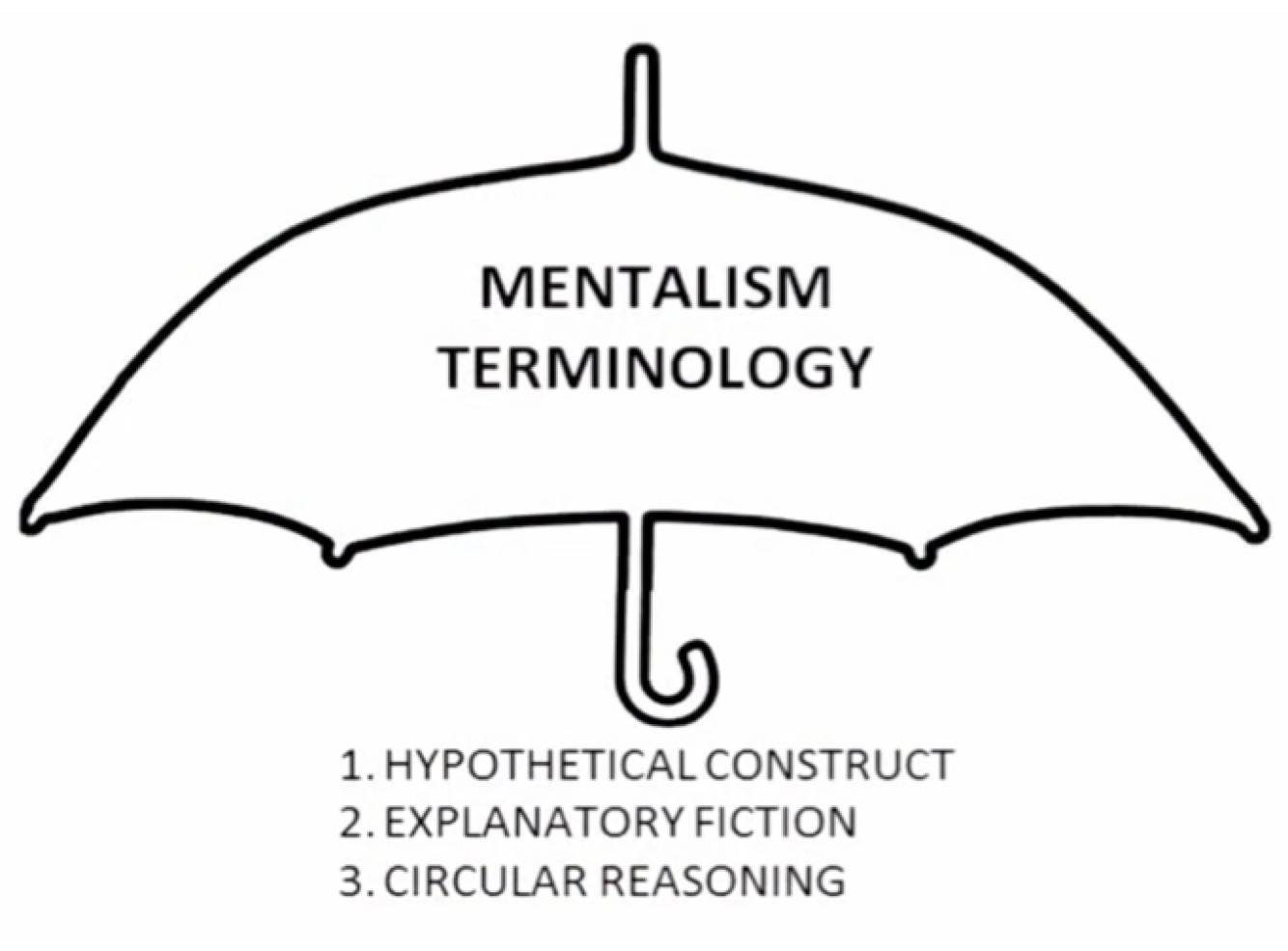
Hypothetical Constructs
- (Imaginary Constructs)*
- Presumed but unobserved entities such as free will, readiness, unobservable storage and retrieval mechanisms for memory, information processing
Explanatory Fictions
- Ficticious variables that are another name for the observed behavior and contribute nothing to the understanding the variables that maintain the behavior
- Associated words: knows, wants, figures out
Circular Reasoning
The cause and effect are both inferred from the same information (ex: he cried because he felt sad)
Behaviorism
- The philosphy of the science of behavior
- emerged in the early 1900s
- Enviornmental (not mentalistic) explanation of behavior
4 Branches of Behavior Analysis
CASE
- Conceptual Analysis of Behavior (Behaviorism)
- ABA
- Behavior Service Delivery- refers to people in various fields implementing ABA
- Experimental Analysis of Behavior (EAB)
History of Behaviorism
- 1850’s - early 1900s: Pavlov and Classical Conditioning
- 1900’s: Mentalism
- 1913: Watson and Methodological Behaviorism (Stimulus-Response Behaviorism; S-R Psychology; Watsonian Behaviorism)
- 1938 - 1990’s: Skinner and Radical Behaviorism
Methodological Behaviorism
(Stimulus-Response Behaviorism; S-R Psychology; Watsonian Behaviorism)
- John Watson
- only looks at publicly observable events and is NOT concerned with private events
- The study of behavior through direct observation of the relationship between enviornmental stimuli (S) and the responses (R) they bring about
- 1920 Watson conducted the Little Albert Experiment pairing a white rat with a loud noise
Radical Behaviorism
- B.F. Skinner in 1938
- It’s called RADICAL because it included private events into the understanding of behavior
- Influenced by:
- Darwinian Selectionism (Selection by Consequences)
- Pragmatism



-
Section 1: Foundational Knowledge: Easy42
-
Section 2: Foundational Knowledge: Hard97
-
Section 3: Foundational Knowledge: Super Hard81
-
Section 4: Assessment61
-
Section 6: Measurement52
-
Section 5: Experimental Design61
-
Section 7: Displaying and Interpreting Behavioral Data23
-
Section 8: Behavior Change Procedures77
-
Section 9: Ensuring Staff Competence25
-
Section 10: Ethics110



