Normal vital signs in the newborn
- Respiratory rate (RR)
- Heart rate (HR)
- RR: 40 to 60 breaths per minute
- HR: 120 to 160 beats per minute
A 28-year-old G1 P0 woman delivers a 3.9 kg male infant whose Apgar scores are 9 and 10 at 1 and 5 minutes respectively. The delivery was uncomplicated and both mother and child are in no acute distress. What is the most appropriate next step in management of this patient?
a. Intubate the child
b. Send cord blood for arterial blood gas (ABG)
c. Suction the mouth and nose
d. Nasogastric tube (NGT) placement
e. Give prophylactic antibiotics
Fischer, Conrad (2012-11-01). Master the Boards USMLE Step 2 CK (Page 403). Kaplan Medical Test Prep. Kindle Edition.
C. Once the child is delivered, the mouth and nose are suctioned, followed by clamping and cutting of the umbilical cord. The newborn is then dried, wrapped
in clean towels, and placed under a warmer as he has just descended from an environment of 98.6° F to approximately 65° F. Gentle rubbing or stimulating the heels of the newborn helps to stimulate crying and breathing. Intubation and ABG analysis of the
child are indicated only if the newborn is not breathing or is in respiratory distress. Nasogastric tube placement is indicated when GI decompression is needed. Antibiotics are indicated for sepsis.
Fischer, Conrad (2012-11-01). Master the Boards USMLE Step 2 CK (Page 403). Kaplan Medical Test Prep. Kindle Edition.
Outline the Rx given at delivery of the newborn
- 1% silver nitrate eye drops or 0.5% erythromycin ophthalmic ointment
- 1mg of vitamin K IM to prevent vitamin K deficient bleeding (VKDB). VKDB used to be known as hemorrhagic disease of the newborn
List screening tests to do before discharge
- Hearing test to rule out sensorineural hearing loss
- Phenylketonuria
- Galactosemia
- Hypothyroidism
Apgar Score
The Apgar score delineates a quantifiable measurement for the need and effectiveness of resuscitation. The Apgar score does not predict mortality.
- What does the one-minute Apgar score evaluate?
- What does the five-minute Apgar score evaluate?
Fischer, Conrad (2012-11-01). Master the Boards USMLE Step 2 CK (Page 404). Kaplan Medical Test Prep. Kindle Edition.
- One-minute score evaluates conditions during labor and delivery
- Five-minute score evaluates the response to resuscitative efforts.
Fischer, Conrad (2012-11-01). Master the Boards USMLE Step 2 CK (Page 404). Kaplan Medical Test Prep. Kindle Edition.
True or False:
A low score on the Apgar is associated with future cerebral palsy.
False
Fischer, Conrad (2012-11-01). Master the Boards USMLE Step 2 CK (Page 404). Kaplan Medical Test Prep. Kindle Edition.
A 3.9 kg male infant whose Apgar scores were 9 and 10 at 1 and 5 minutes, respectively, after delivery is brought in by his parents because his eyes are red.
The delivery was without any complications and both mother and child are in no acute distress. What is the most likely diagnosis at 1 day, at 2 to 7 days, and at >7 days?
a. Chemical irritation
b. Neisseria gonorrhoeae
c. Chlamydia trachomatis
d. Herpes simplex
e. All of the above
Fischer, Conrad (2012-11-01). Master the Boards USMLE Step 2 CK (Page 404). Kaplan Medical Test Prep. Kindle Edition.
E. To diagnose the cause of conjunctivitis in the newborn, you must consider when the redness and irritation begins.
- At 1 day, the most likely cause of the conjunctivitis is chemical irritation
- From days 2 to 7, the most likely cause is Neisseria gonorrhoeae
- Conjunctivitis after more than 7 days post delivery is most likely due to Chlamydia trachomatis
- Conjunctivitis after 3 weeks or more is most likely due to herpes infection.
Fischer, Conrad (2012-11-01). Master the Boards USMLE Step 2 CK (Page 404). Kaplan Medical Test Prep. Kindle Edition.
List the criteria of the Apgar Score
Acronym used is APGAR
- Appearance = Skin color/complexion
- Blue all over = 0
- Normal except extremities = 1
- Normal all over = 2
- Pulse = Pulse rate
- < 60 bpm or asystole = 0
- > 60 bpm but < 100 bpm = 1
- > 100 bpm = 2
- Grimace = Reflex irritability
- No response = 0
- Grimace/feeble cry = 1
- Sneeze/cough = 2
- Activity = Muscle tone
- None = 0
- Some flexion = 1
- Active movement = 2
- Respiration = Breathing
- Absent = 0
- Weak or irregular = 1
- Strong = 2
Fischer, Conrad (2012-11-01). Master the Boards USMLE Step 2 CK (Page 404). Kaplan Medical Test Prep. Kindle Edition.
List the lab abnormalities of infant of a diabetic mother (IODM)
- Hypoglycemia
- Hypocalcemia
- Hypomagnesemia
- Hyperbilirubinemia
- Polycythemia
List the congenital abnormalities associated with IODM
- Cardiac abnormalities (ASD, VSD, truncus arteriosus)
- Small left colon syndrome
True or False:
IODM is associated with an increased risk of developing diabetes and childhood obesity
True
A 1-week-old newborn is brought to the ED after a home delivery. His parents state they do not believe in vaccinations nor did they seek any medical attention
after delivery. They state they have noticed bright red blood per rectum from the infant and he is very lethargic. On examination the infant has unequal pupils and his diaper has gross red blood. What is the most likely diagnosis?
a. Cerebrovascular accident
b. Meckel’s diverticulum
c. Vitamin K deficient bleeding
d. Crohn disease
Fischer, Conrad (2012-11-01). Master the Boards USMLE Step 2 CK (Page 405). Kaplan Medical Test Prep. Kindle Edition.
C. As this child received no routine newborn care, it is very likely he is suffering from a vitamin K deficiency. Newborns are at most risk as their immature livers do not utilize vitamin K to develop the appropriate clotting factors. Breast milk typically has very low levels of vitamin K. The child’s lethargy is likely from intracranial bleeding, and the bright red blood per rectum is mucosal bleeding. The child’s age precludes a diagnosis of CVA, Crohn disease, or a Meckel’s diverticulum.
Fischer, Conrad (2012-11-01). Master the Boards USMLE Step 2 CK (Page 405). Kaplan Medical Test Prep. Kindle Edition.
Respiratory distress in the newborn
- Best initial test
- List the other diagnostic studies
- Best initial Rx
- Chest X-ray
- Other tests:
- ABG
- Blood cultures (R/O sepsis)
- Blood glucose (R/O hypoglycemia)
- CBC (R/O anemia or polycythemia)
- Cranial ultrasound (R/O intracranial hemorrhage)
- Best initial Rx:
- Oxygen: keep SaO2 > 95%
- Give nasal CPAP if high O2 requirements to prevent barotrauma and bronchopulmonary dysplasia
- Consider empiric antibiotics for suspected sepsis
Meconium aspiration 1:
List the diagnostic test and the findings
CXR. Findings are;
- Patchy infiltrates
- Increased AP diameter (barrel chest)
- Flattening of the diaphragm
Rx of meconium aspiration
- positive pressure ventillation
- High-frequency ventillation
- Nitric oxide therapy
- Extracorporeal membrane oxygenation
How to prevent meconium aspiration?
endotracheal intubation and airway suction of depressed infants
Possible complications of meconium aspiration
- Pulmonary artery HTN
- Air leak (pneumothorax, pneumomediastinum)
- Aspiration pneumonitis
Meconium plugs are seen in the lower colon. List the conditions associated with meconium plugs
- Small left colon in IODM
- Hirschsprung disease
- Cystic fibrosis
- Maternal drug abuse
Meconium ileus is seen in the lower ileum. List the condition in which it is associated with.
Cystic fibrosis
Best initial diagnostic test and Rx of meconium plug and ileus
Best initial test: Abdominal X-ray
Rx: Gastrografin enema
List the components of the VACTERL syndrome
- Vertebral defects
- Anal atresia
- Cardiac abnormalities
- Tracheoesophageal fistula with esophageal atresia
- Radial and Renal anomalies
- Limb syndrome
A premature infant is born by normal vaginal delivery without complication. There is no respiratory distress. Upon the first feed, she begins vomiting gastric and bilious material. CXR is shown. What is the most likely diagnosis?
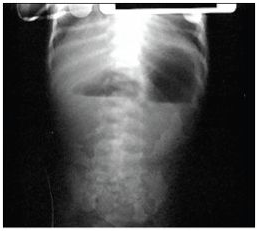
Duodenal atresia. Half of infants with this condition are born prematurely, and the condition is associated with Down syndrome. Look for polyhydramnios in the prenatal exam. Treatment involves NG decompression and surgical correction. You must search for other abnormalities (VACTERL association) with X-ray of the spine, abdominal ultrasound, and echocardiogram
List the differential diagnosis of double-bubble seen on abdominal X-ray of newborn infants
- Duodenal atresia
- Annular pancreas
- Malroration
- Volvulus
When is hyperbilirubinemia considered pathological?
- It appears on the first day of life
- Bilirubin rises > 5mg/dL/day
- Bilirubin > 12mg/dL in term infant
- Direct bilirubin > 2mg/dL at any time
- Hyperbilirubinemia is present after the 2nd week of life

-
Section 1: Allergy and Immunology14
-
Section 2: Pharmacology4
-
Section 3: Herbal Remedies and Supplements3
-
Section 4: Preoperative and Postoperative Care27
-
Section 5: Pediatrics49
-
Section 6: Pediatrics 248
-
Section 7: Toxicology50
-
Section 8: CCS1
-
Section 9: Pediatrics 325
-
Section 10: Surgery10
-
Section 11: Ethics and Behavioral Issues3



