Which of the following is a component of a quality management system?
- A. Customer needs.
- B. Organizational structure.
- C. Staff selection.
- D. Prevention of unauthorized access.
- E. Calibration.
Organizational structure.
- Components of a quality management system are: organizational structure, responsibilities, policies, processes, procedures, and resources needed. It is the responsibility of executive management to address these elements for QA.
- The other answers are not quality system components, but rather, a quality function or responsibility.
For sentinel events, which of the following is true?
- A. A sentinel event is any unexpected occurrence that results in death.
- B. Hospitals are required to report a sentinel event to The Joint Commission.
- C. Failure to submit a root cause analysis for a reported sentinel event may result in denial of accreditation by The Joint Commission.
- D. Only deaths resulting from medical errors qualify as reviewable sentinel events by The Joint Commission.
- E. A root cause analysis is not necessary if the event can be clearly attributed to an error by an individual or group of individuals.
Failure to submit a root cause analysis for a reported sentinel event may result in denial of accreditation by The Joint Commission.
- A sentinel event is an unexpected occurrence involving death or serious physical or psychological injury, or risk thereof.
- Serious injury includes loss of limb or function.
- “Risk thereof” includes any situation for which recurrence would carry a significant chance of a serious adverse outcome.
- These events signal the need for immediate investigation and response.
- Hemolytic transfusion reactions caused by the administration of ABO-incompatible blood or components are sentinel events.
- The Joint Commission does not require sentinel event reporting but it does encourage reporting for purposes of:
- Sharing “lessons learned” with other institutions.
- Consultation with The Joint Commission staff during root cause analysis and development of corrective action.
- Demonstrating due diligence in addressing patient safety issues.
- Once The Joint Commission is aware of a sentinel event, either through voluntary reporting or other methods, the organization must submit a thorough and credible root cause analysis and action plan within 45 days of discovering the event.
- If more than 45 days have elapsed at the time of discovery, the
organization has 15 days to submit a root cause analysis and
action plan.
- If more than 45 days have elapsed at the time of discovery, the
- Beyond the due date, there are still opportunities for an organization to comply with the requirement to submit a root cause analysis and action plan. If the root cause analysis is not submitted within 90 days of the due date, a recommendation for denial of accreditation status is submitted to the Accreditation Committee. Even then, the organization is given the opportunity to respond.
- Root cause analysis should identify the risk factors that contribute to the probability of an event occurring. An error by an individual or group of individuals may be indicative of an ineffective process. Additionally, not all sentinel events are the result of errors.
A laboratory purchases a new plasma freezer and is in the process of equipment qualification. The lab checks that the freezer control alarms are triggered when the temperature goes beyond the established range. This testing is an example of which aspect of equipment qualification?
- A. Installation qualification (IQ).
- B. Calibration of equipment.
- C. Operational qualification (OQ).
- D. Emergency preparedness.
- E. Performance qualification (PQ).
Operational qualification (OQ).
- IQ, OQ, and PQ are the components of equipment qualification. IQ is focused on environmental needs for the equipment (eg, space needed, table-top versus floor instrument, appropriate ventilation). OQ is focused on the equipment working properly (ie, holds appropriate temperature, control alarms). PQ is focused on verifying the capabilities of the equipment (ie, it maintains blood products at a set temperature, control alarms interface with institutional security). See also Explanation for Question 25.
- Testing that control alarms function properly is an example of OQ because it is verification that freezer alarms are working properly.
At the blood collection center, a potential blood donor is deferred because he had sex with a man last week. Unfortunately, the costs associated with recruitment and initial screening of this donor cannot be recovered via collection of a transfusable product. How may a donor center best minimize these costs of quality?
- A. Donor education with initial recruitment materials.
- B. Donor education with required reading during assessment.
- C. Donor education during limited physical exam.
- D. Postdonation look-back procedures when new information is provided.
- E. Postdonation audits of donor history.
Donor education with initial recruitment materials.
- When taking a process approach to blood donation, efforts to educate potential donors of reasons for deferral prior to the donor assessment is the optimal way to minimize the costs of quality. Once the potential donor begins the assessment process, more is invested (ie, phlebotomist, nursing, and potentially physician time) to ensure quality, which does not result in a transfusable product. If a donor who should have been deferred is collected, then even more resources are consumed. Not only does the collection facility need to gain control over the collected products, but it also must invest in review and actions to prevent similar errors in the future.
The individual designated to oversee a facility’s quality functions must have authority to:
- A. Take disciplinary action against individuals who repeatedly disregard institutional policies, processes, and procedures.
- B. Initiate corrective action for processes that do not comply with requirements.
- C. Approve and implement new or changed medical policies, processes, and procedures.
- D. Approve deviations from established policies, processes, and procedures.
- E. Approve and implement new or changed technical policies, processes, and procedures.
Initiate corrective action for processes that do not comply with requirements.
- The person with responsibility for oversight of the quality system should have the authority to recommend and initiate corrective action when appropriate.
- Other quality oversight functions include the following:
- Review and approval of: SOPs, training plans, validation and qualification plans, document control and recordkeeping systems, suppliers, and product specification.
- Review of nonconformances.
- Analysis of operational data.
- The medical director must approve all medical and technical policies and procedures. The quality oversight officer may not implement new or changed policies or procedures without the medical director’s approval.
- Exceptions to policies, processes, and procedures must be warranted by clinical situations, require justification, and must be preapproved by the medical director on a case-by-case basis.
For competency assessment (CA), which is true?
- A. CAs must be performed for each procedure or test that an employee performs.
- B. CAs must be performed at 3 months and 6 months during the first year of employment.
- C. Each CA must include both a written evaluation and direct performance observation.
- D. CAs must be performed at least annually after the employee’s first year.
- E. CAs must be performed by the laboratory supervisor, per Clinical Laboratory Improvement Amendments (CLIA) regulations.
CAs must be performed at least annually after the employee’s first year.
- CAs are required for any staff members whose functions may affect the quality of testing, the provision of services, or the manufacture of products.
- CA methods may include the following: Written tests, direct observation (eg, maintenance, performance), review of completed work, and testing of unknown samples.
- It is up to the employer to determine which methods will be used to perform CAs.
- Assessments may be targeted at techniques or methods that are applicable to several procedures. CAs for each procedure or test that an employee performs are not required.
- CMS requires that CAs be performed a minimum of twice in the first year of employment and at least yearly thereafter. The assessment completed at the end of training may serve as one of the first year’s assessments.
- CLIA regulations specify that the laboratory supervisor is responsible for ensuring that staff maintain competency, but they do not specify that only the supervisor may perform CAs. Each establishment may determine who is eligible to perform CAs. Criteria for eligibility should be described in the establishment’s quality system.
If a laboratory technologist has been working in a given laboratory for just over 3 years, what is the minimum number of CAs that should be in his or her file?
- A. One.
- B. Two.
- C. Three.
- D. Four.
- E. Five.
Five
- A laboratory technologist who has worked in a laboratory for just over 3 years should have at least five competency evaluations on file: at initial hire, at 6 months, at 1 year, at 2 years, and at 3 years. If competency issues have arisen during employment, then additional assessments should be on file.
Which of the following is true about critical supplies or services?
- A. Critical supplies are those needed the most for daily operations.
- B. The quality system should include processes to ensure that incoming supplies are acceptable.
- C. If supplies and reagents are FDA-approved, the vendors of those supplies are assumed to be qualified.
- D. The supplier must define acceptance criteria for the product or service.
- E. None of the above.
The quality system should include processes to ensure that incoming supplies are acceptable.
- Critical supplies are those materials, supplies, or services that affect the quality of products produced or services provided.
- A list must be maintained of critical materials, supplies, and services and approved suppliers.
- The quality system should include policies and processes that address the following: Supplier qualification, agreements, and how incoming supplies are received and qualified for use.
- Vendors of FDA-approved products must be qualified to serve as suppliers of critical supplies. The criteria used to qualify the vendor are determined by the establishment.
What should be done first when equipment is malfunctioning?
- A. It depends on whether any CLIA-regulated analytes are affected.
- B. Evaluate the potential clinical impact.
- C. Verify that preventive maintenance is up to date.
- D. Develop a Pareto chart with a quality review board.
- E. Develop a fishbone diagram with a quality review board.
Evaluate the potential clinical impact.
- Regardless of whether the analyte is CLIA-regulated, the clinical impact should be evaluated and documented. Of the options, this should be done first to minimize negative impact.
- The remaining answers may be needed at some point. One should verify that preventative maintenance had been done.A fishbone diagram helps assess potential causes of error. A Pareto chart helps assess which causes occur more commonly and where resources should be used.
For equipment used in the collection, processing, testing, or storage of blood components and human cells, tissues, and cellular and tissue-based products, which of the following is required?
- A. Biannual preventive maintenance.
- B. FDA inspection and approval before implementation.
- C. Biannual recalibration.
- D. Documentation of OQ.
- E. A list of employees currently approved to use the equipment.
Documentation of OQ.
- All equipment used in the collection, processing, testing, or stor- age of blood components or HCT/Ps must be qualified for use before implementation and after modifications or repairs that may affect its function.
- Qualification is demonstrating the equipment is capable of fulfilling specified requirements.
- There should be written procedures for installation, operational, and PQ.
- IQ verifies that the equipment and all components have been installed and activated in accordance with the manufacturer’s specification and any cGMP requirements that may be applicable. IQ includes ensuring the equipment is assigned a unique identification number and entered into a preventive maintenance program.
- OQ verifies that the functionality of the equipment conforms with the manufacturer’s specifications.
- PQ verifies that the equipment meets the user’s specifications. PQ tests should be designed to verify the satisfactory performance of the equipment or system in the organization’s processes. PQ is performed under the user’s operating conditions,
by user personnel, and with real process materials. PQ is performed after IQ and OQ.
- Employees must be trained on equipment use before being allowed to operate a piece of equipment. Employee training records should provide evidence of this training and document satisfactory results on a CA. A specific list of employees authorized to use the equipment is not required but may be desirable for complex pieces of equipment.
For documents and records, which of the following is true?
- A. The terms documents and records are used interchangeably.
- B. Documents and records must be retained indefinitely.
- C. Documents provide information on what should happen.
- D. Accrediting agencies may review documents, but records are legally protected from outside review.
- E. Records provide information on what should happen.
Documents provide information on what should happen.
- Documents are written policies, procedures, process descriptions, labels, work instructions, and forms. They describe the activities of the establishment and the expectations for how things should happen. Documents may be in paper or electronic format.
- Records provide evidence that what should have happened has happened. Forms become records when data are added to them. Records may be in paper or electronic format.
- The quality system should include a document management system that ensures documents are current and comprehensive and both current and obsolete documents are available. The system should also ensure records are accurate and complete.
- There should be defined processes for developing, approving, distributing, and maintaining documents.
- Distribution of documents should be controlled so copies of obsolete documents may be reliably retrieved and replaced with current documents.
- Documents must be reviewed, modified, and reapproved periodically. Review should be performed annually.
- Documents must be protected from unintended alterations or destruction.
- The required retention period for documents and records is determined by the purpose of the documents and records and is established by regulatory and accrediting organizations.
Which of the following events is a biological product deviation (BPD) that must be reported to the FDA?
- A. An Rh-positive Red Blood Cell (RBC) unit is incorrectly labeled as Rh negative and issued to an Rh-positive patient. The unit is returned to the blood bank.
- B. An Rh-positive unit is labeled as Rh negative and is crossmatched for an Rh-negative individual with anti-D. The unit is crossmatch incompatible. There is a delay in providing blood for the patient while the explanation for the positive crossmatch is pursued.
- C. While reviewing the blood donor questionnaires from the day’s collections, a supervisor notices that follow-up questions were missing for 15 donors who had responded that they had traveled to a malarial risk area. Eventually all 15 collections must be discarded because of incomplete donor histories.
- D. Blood bank policy requires that all neonates receive cytomegalovirus (CMV)-seronegative cellular blood products. AB CMV-seronegative platelets are not available for a group AB 3-month-old infant. Leukocyte-reduced AB platelets are issued with approval of the blood bank medical director.
- E. None of the above.
An Rh-positive Red Blood Cell (RBC) unit is incorrectly labeled as Rh negative and issued to an Rh-positive patient. The unit is returned to the blood bank.
- Manufacturing events that affect the safety, purity, or potency of blood components that have been distributed must be reported to the FDA. These events constitute biologic product deviations (BPDs).
- Manufacturing encompasses testing, processes, packing, labeling, storage, and distribution steps.
- Distribution of a product that does not meet known patient specifications also constitutes a BPD when this is a result of an error and not a therapeutic decision.
- Reporting is required only when the manufacturer has lost control of the product; ie, it has distributed the product. BPDs discovered before the establishment loses control of the product need not be reported, but should be thoroughly investigated and addressed by the quality unit.
- Reporting is required regardless of whether the product was administered or whether it resulted in an adverse event.
- A BPD report (BPDR):
- Must be submitted within 45 days of discovering information that would reasonably suggest a BPD has occurred.
- May be submitted on paper or electronically using a standardized form available from the CBER website.
- Deviation codes are used to classify events according to the type of error that occurred.
- The requirement to report BPDs also applies to HCT/Ps.
- HCT/P deviations are defined as events that are in violation of regulatory and established specifications for the prevention of communicable disease transmission or contamination, or unexpected or unforeseeable events that may result in disease transmission or contamination.
Which of the following statements is true about PT?
- A. PT may not be performed in duplicate.
- B. A flow cytometry laboratory may not perform PT that is reported by an HPC laboratory.
- C. PT is required only for CLIA-regulated tests.
- D. A laboratory may compare its results with results of other laboratories before reporting the results.
- E. If a laboratory fails a PT survey, it must discontinue performing that test until corrective action is implemented.
PT is required only for CLIA-regulated tests.
- As a condition of certification, laboratories must participate in an approved PT program for any CLIA-regulated testing that they perform. Notably, if your laboratory is certified by CAP, PT is required for all tests performed.
- In the absence of an approved program, laboratories must have a system for determining the accuracy and reliability of test results. For example, they may test reference samples or samples from a regional pool.
- PT samples must be handled and tested in the same manner as regular patient samples. Repeat testing is permitted providing that is also the manner in which patient specimens are tested.
- Laboratories operating under the same CLIA certificate may perform testing for each other. However, a laboratory may not send PT samples to a laboratory that operates under a different CLIA number, even if that laboratory is within the same facility and handles patient samples the same way.
- Laboratories may not discuss a proficiency survey with other laboratories during the active period of a survey.
- For CAP surveys, unsatisfactory performance on a single testing event requires investigation and corrective action by the laboratory but does not require suspension of testing or reporting to the laboratory accrediting program.
- Failure to attain a satisfactory score on two of three events requires immediate corrective action or suspension of testing. The corrective action must be approved by the accrediting program.
- Failure to attain a satisfactory score on three of four events is considered critical PT performance and requires immediate suspension of testing.
Which of the following donors is eligible to donate whole blood?
A. A 40-year-old female, blood pressure 175/101 mmHg, pulse 86 bpm, hemoglobin 13 g/dL, temperature 36 C.
B. A 25-year-old male, blood pressure 190/99 mmHg, pulse 100 bpm, hematocrit 45%, temperature 36.7 C.
C. An 82-year-old female, blood pressure 120/40 mmHg, pulse 72 bpm, hemoglobin 12.5 g/dL, temperature 37.2 C.
D. An 18-year-old female, blood pressure 150/80 mmHg, pulse 80 bpm, hemoglobin 11 g/dL, temperature 37 C.
E. A 16-year-old male, blood pressure 130/70 mmHg, pulse 90 bpm, hematocrit 42%, temperature 37.7 C.
Question 1: C
Which of the following donors is acceptable for whole blood donation?
A. A female with a hemoglobin of 11.0 g/dL by venipuncture.
B. A male with a hemoglobin of 13.0 g/dL by earlobe puncture.
C. A male with a hemoglobin of 12.5 g/dL by venipuncture.
D. A male with a hemoglobin of 13.0 g/dL by venipuncture.
E. A female with a hemoglobin of 10.0 g/dL by venipuncture.
Question 3: D
- The FDA has stated that earlobe hemoglobin measurements are unacceptable because of substantial variation in hemoglobin values compared with concurrent values from venipuncture samples.
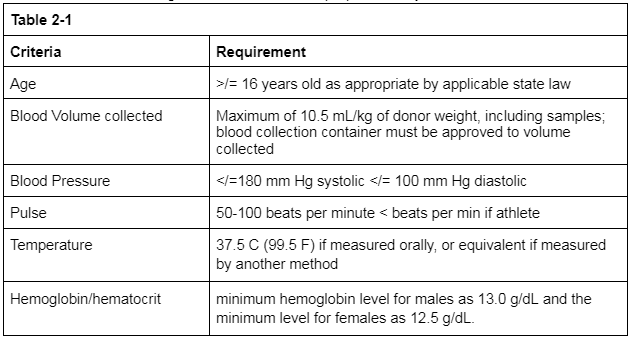
- The FDA’s May 2015 final rule [21 CFR 630.10(f)(3)(i)(B)] defines the minimum hemoglobin level for males as 13.0 g/dL and the minimum level for females as 12.5 g/dL.
- The May 2015 final rule also includes new regulations to permit female donors with a hemoglobin level of 12.0-12.5 g/dL to donate provided the donor center uses standard operating procedures approved by the FDA for this purpose and as being adequate to ensure that the donor’s health will not be adversely affected.
If a donor receives the hepatitis B vaccine, how long could the vaccine cause a positive test result for hepatitis B surface antigen?
A. Never causes a positive test result.
B. 3 days.
C. 18 days.
D. 3 months.
E. 18 months.
Question 4: C
• The hepatitis B vaccine may cause a positive hepatitis B surface antigen (HBsAg) test result in blood donors up to 18 days after vaccination. When a donor tests repeatedly positive for HBsAg, which confirms positive by neutralization, he or she may be able to donate again if confirmed that the donor received the vaccine for routine reasons and within 28 days of donation. If the vaccination was given in response to an exposure incident, then the donor must wait 12 months from the date of exposure before being tested for donor reentry.
Which of the following donors is not eligible for donation?
A. A woman who donated whole blood 8 weeks ago and now presents for a 2-unit red cell donation by apheresis.
B. A jogger with a pulse of 48 bpm.
C. A 20-year-old woman who gave birth to a healthy infant 8 weeks ago.
D. A 30-year-old perfusionist who received hepatitis B immunoglobulin 18 months ago.
E. A 17-year-old soccer player with an oral temperature of 37.8 C.
Question 5: E
Requirements for donor eligibility to donate whole blood are set forth in AABB Standards for Blood Banks and Transfusion Services (Standards). See Table 2-1.
Age: Lower limit: 16 years. 16- and 17-year-old donors are acceptable as permitted by state law. Upper limit: None.
The donor should be in good health and must be free of major organ disease (heart, liver, and lungs), cancer, or abnormal bleeding tendency.
Maximum allowable collection volume is 10.5 mL of whole blood collected per kg body weight (450 ± 45 mL for a 110-lb adult, including samples).
Persons weighing <110 lb (50 kg) may have as little as 300 mL drawn without reducing the amount of anticoagulant in the primary bag. If it is necessary to draw <300 mL, the amount of anticoagulant must be reduced proportionately.
Donors are deferred for 6 weeks after the delivery of a healthy infant.
After hepatitis B immunoglobulin administration, donors are deferred for 12 months.
A new blood donor recently had a positive test for anticardiolipin antibodies. Which routine screening test will most likely be positive in this donor?
A. Babesia immunofluorescence.
B. Anti-HTLV-I/II.
C. Anti-HBVc.
D. HIV nucleic acid test.
E. Syphilis nontreponemal.
Question 6: E
The nontreponemal VDRL test uses an antigen mixture that contains cardiolipin; hence, this donor with a recent anti-cardiolipin antibody may test positive. In the event of a positive nontreponemal donor test result, the donor center may use a treponemal donor test to identify a biological false-positive result and conduct donor counseling and reentry. The treponemal tests detect antibodies that are specific for treponemal antigens (not cardiolipin).
A donor would be eligible to donate whole blood if he or she reported which of the following health history items?
A. Aspirin ingestion in the last 24 hours.
B. Ears pierced 6 months ago.
C. Delivery of an infant 4 weeks ago.
D. Treatment for gonorrhea 9 months ago.
E. None of the above.
Question 7: A
- AABB DHQ v2.0 flowcharts (reviewed and formally recognized by the FDA in guidance) address deferral of whole blood donors. See “Guidance for industry: Implementation of acceptable full length and abbreviated donor history questionnaires and accompanying materials for use in screening donors of blood and blood components (May 2016).”
- Also refer to the AABB website for v2.0 flowcharts for each question (including additional references) at http://www.aabb.org/tm/ questionnaires/documents/dhq/v2.pdf.
- Donors are deferred during pregnancy and for 6 weeks after childbirth.
- Completion of treatment for syphilis or gonorrhea, a history of syphilis or gonorrhea—12-month deferral.
- Sexual contact with an individual with hepatitis B, symptomatic hepatitis C, or unknown hepatitis—12-month deferral. Residing with or sexual contact with a person with asymptomatic hepatitis C is not cause for deferral. See “Guidance for industry: Revised recommendations for reducing the risk of human immunodeficiency virus transmission by blood and blood products (December 2015).”
- Sexual contact with an individual with HIV infection or a positive test for the HIV/AIDS virus—12-month deferral.
- Males who have had sexual contact with another male—12-month deferral after the last sexual contact with a male. Note: not all donors define “sex” or “sexual contact” in the same way. The donor must have read the Blood Donor Educational Material provided.
- Allogeneic blood component transfusion—12-month deferral.
- Organ, tissue, bone marrow transplant—12-month deferral.
- Bone or skin graft—12-month deferral.
- Sexual contact with a prostitute or anyone else who takes money, drugs, or other payment for sex—12-month deferral.
- Sexual contact with anyone who has ever used needles to take drugs or steroids or anything not prescribed by their doctor—12-month deferral.
- Female donors: Sexual contact with a male who has had sexual contact with another male—12-month deferral.
- Had a tattoo—12-month deferral. (In states where tattoo parlors are licensed and inspected by the state and also use sterile needles and non-reused ink, deferral is not necessary.)
- Had an ear or body piercing—12-month deferral.
- Came in contact with someone else’s blood (mucous membrane contact or needlestick)—12-month deferral.
- Incarceration in jail, juvenile detention, lockup, or prison for more than 72 consecutive hours—12-month deferral.
- Traveled to a malaria-endemic area—12-month deferral.
- Emigrated from a malaria-endemic area—3-year deferral.
- Had a history of malaria—3-year deferral.
- In addition to donor eligibility requirements at 21 CFR 640.3 and recommendations applicable to donors of whole blood, FDA’s December 2007 “Guidance for Industry and FDA Review Staff, Collection of Platelets by Automated Methods” recommends:
- Deferral of donors taking aspirin within 48 hours before collection because aspirin blocks the generation of thromboxane A2, which inhibits the platelet release reaction and renders the platelets inactive. The guidance recommends donor deferral of 14 days for Plavix (clopidogrel) or Ticlid (ticlopidine).
- Ingestion of aspirin or aspirin-containing medications within “2 full days” preceding donation or ingestion of medications that irreversibly inhibit platelet function is cause for deferral of a plateletpheresis donor because a plateletpheresis donor serves as the sole source of platelets for a patient. However, under the same circumstances, a donor is eligible to donate when taking aspirin within 48 hours of collection if the donor is not the sole source of platelets because the collection is pooled with collections from other donors.
- Other drugs should be considered, such as those listed on the AABB’s Medication Deferral List, which is reviewed by the FDA.
How long does the blood donor center have to make reasonable attempts to notify a donor if he or she has a positive test result that would disqualify the individual as a donor?
A. 48 hours.
B. 72 hours.
C. 8 weeks.
D. 12 weeks.
E. 16 weeks.
Question 8: C
Blood donor centers have 8 weeks to make reasonable attempts to notify donors of positive infectious disease results that disqualify the donor from future donation.
The donor history questionnaire that is used by most blood centers in the United States was ________ by the AABB and is ________ by the Food and Drug Administration (FDA).
A. Endorsed; mandated.
B. Developed; recognized.
C. Mandated; developed.
D. Mandated; endorsed.
E. Endorsed; developed.
Question 10: B
The DHQ v2.0 was developed by the AABB and is formally recognized by the FDA guidance. The AABB DHQ is not mandated. A blood donor center can develop a questionnaire and submit it to the FDA in a prior approval supplement under 21 CFR 601.12(b).
Which of the following donors is eligible to donate?
A. Wife of a hemophilia patient; last sexual contact 2 days ago.
B. Former prostitute; married with no high-risk behavior for 10 years.
C. Male who had sex with a prostitute 9 months ago; a condom was used.
D. Male who had sex with another male 6 months ago.
E. None of the above.
Question 11: A
- Given the enhanced safety measures now used in the manufacture of clotting factor concentrates, FDA does not recommend deferral for receipt of FDA-licensed clotting factor concentrates or for sex with a person who has received clotting factor concentrates. Furthermore, the FDA does not recommend deferral for receipt of other FDA-licensed plasma derivatives because of HIV or hepatitis risks.
- 12-month deferral for some high-risk behavior: see Explanation for Question 7.
- Permanent deferral for other high-risk behavior or situations:
- Positive test for HIV.
- Using needles to take drugs, steroids, or anything not prescribed by a doctor.
- Receiving a dura mater (or brain covering) graft or xenotransplantation product.
- Receiving money, drugs, or other payments for sex.
- For males having sex with males, sexual contact with prostitutes, or sexual contact with other high-risk groups, it is irrelevant whether or not the individual involved used a barrier method or practiced “safe sex.” Similarly, if the individual was a prostitute in a country or area where prostitution is legal and regulated [ie, serologic screening for sexually transmitted disease (STDs) is used], the individual is still deferred.
- AABB DHQ Flowcharts (reviewed and recognized by the FDA) address these issues.
Which of the following donors is eligible to donate?
A. Donor immunized against German measles (rubella) 2 weeks ago.
B. Donor received varicella zoster immunization 3 weeks ago.
C. Donor immunized against rubeola 4 weeks ago.
D. Donor received an experimental, unlicensed vaccine as part of a research project 12 weeks ago.
Question 15: C
- Toxoid, synthetic, or killed vaccines: no deferral; accept if donor is free of symptoms [anthrax, cholera, diphtheria, hepatitis A, hepatitis B, influenza, Lyme disease, paratyphoid, pertussis, plague, pneumococcal polysaccharide, polio (Salk, injectable), rabies, Rocky Mountain spotted fever, tetanus, typhoid injectable)].
- Recombinant vaccines: no deferral.
- Live attenuated viral and bacterial vaccines: 2-week deferral [measles (rubella), mumps, polio (Sabin, oral), typhoid (oral), yellow fever].
- Live attenuated viral vaccines: 4-week deferral [rubella (German measles), varicella zoster (chicken pox)].
- Smallpox vaccination: 21 days from the date of vaccination or until the vaccination site scab falls off, whichever is later (if no complications have occurred), 2 months from the date of vaccination if the scab was removed (did not fall off), 14 days after resolution of complications in those with vaccine-related complications.
- Exposure to a smallpox vaccination site: no deferral if simple exposure; until the scab falls off if they have developed a skin lesion following exposure; 3 months from the time of vaccination of the person they came in contact with if they developed a skin lesion and removed the scab (did not fall off); 14 days after resolution of any complications.
- Other vaccines: 12-month deferral (hepatitis B immunoglobulin, unlicensed vaccines).
- Hepatitis B vaccine contains HBsAg, synthesized using recombinant DNA technology or from noninfectious virions obtained from infected individuals. A series consisting of three intramuscular injections is required, with the second and the third injections given 1 month and 6 months after the first injection, respectively. In the United States, universal childhood vaccination has been implemented. All laboratory workers with possible exposure to blood and tissues should receive this vaccine.
- Hepatitis B vaccination is not required for individuals who have adequate titers of antibodies to HBsAg. Hepatitis B vaccine contains only HBsAg. Recent or remote immunization with hepatitis B vaccine does not explain the presence of antibody to hepatitis B core antigen (HBc) in a donor. Studies have shown that some sensitive HBsAg assays can detect the injected HBsAg for up to 18 days following immunization. The potential for a positive HBsAg result does exist.
How long after receiving hepatitis B immunoglobulin must donors wait before donating?
A. 3 months.
B. 6 months.
C. 12 months.
D. 3 years.
E. Indefinitely.
Question 17: C
- Toxoid, synthetic, or killed vaccines: no deferral; accept if donor is free of symptoms [anthrax, cholera, diphtheria, hepatitis A, hepatitis B, influenza, Lyme disease, paratyphoid, pertussis, plague, pneumococcal polysaccharide, polio (Salk, injectable), rabies, Rocky Mountain spotted fever, tetanus, typhoid injectable)].
- Recombinant vaccines: no deferral.
- Live attenuated viral and bacterial vaccines: 2-week deferral [measles (rubella), mumps, polio (Sabin, oral), typhoid (oral), yellow fever].
- Live attenuated viral vaccines: 4-week deferral [rubella (German measles), varicella zoster (chicken pox)].
- Smallpox vaccination: 21 days from the date of vaccination or until the vaccination site scab falls off, whichever is later (if no complications have occurred), 2 months from the date of vaccination if the scab was removed (did not fall off), 14 days after resolution of complications in those with vaccine-related complications.
- Exposure to a smallpox vaccination site: no deferral if simple exposure; until the scab falls off if they have developed a skin lesion following exposure; 3 months from the time of vaccination of the person they came in contact with if they developed a skin lesion and removed the scab (did not fall off); 14 days after resolution of any complications.
- Other vaccines: 12-month deferral (hepatitis B immunoglobulin, unlicensed vaccines).
- Hepatitis B vaccine contains HBsAg, synthesized using recombinant DNA technology or from noninfectious virions obtained from infected individuals. A series consisting of three intramuscular injections is required, with the second and the third injections given 1 month and 6 months after the first injection, respectively. In the United States, universal childhood vaccination has been implemented. All laboratory workers with possible exposure to blood and tissues should receive this vaccine.
- Hepatitis B vaccination is not required for individuals who have adequate titers of antibodies to HBsAg. Hepatitis B vaccine contains only HBsAg. Recent or remote immunization with hepatitis B vaccine does not explain the presence of antibody to hepatitis B core antigen (HBc) in a donor. Studies have shown that some sensitive HBsAg assays can detect the injected HBsAg for up to 18 days following immunization. The potential for a positive HBsAg result does exist.






