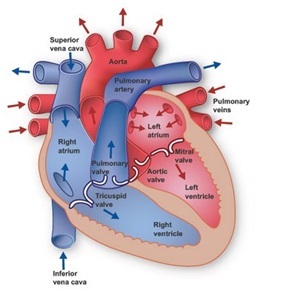
Describe the Basic Structure of the Heart
- Thin-walled atria act as reservoirs to supply the muscular pumping chambers, the thick-walled ventricles
- Right side of the heart pumps blood to the lungs (pulmonary circulation)
- Left side of the heart pumps blood to the body (systemic circulation)
Describe the features of the myocardium
- Centrally positioned nuclei (1 or 2 per cell)
- Intercalated discs (for electrical & mechanical coupling with adjacent cells)
- Adherens-type junctions (to anchor cells and provide anchorage for actin)
- Gap junctions (for electrical coupling)
- In contrast with skeletal muscle, the T tubules of cardiac muscle are inline with the Z bands and not with the A-I band junction.
How does the myocardium work as a pump?
The MYOCARDIUM consists of individual (discrete) cells joined by low electrical resistance connections.
- The action potential causes rise in intracellular calcium.
- The cardiac action potential is very long, so over most of the heart, a single action potential will produce a sustained contraction of the cell lasting about (~280ms)
- Action potentials spread from cell to cell so at each heart beat all the cells in the heart normally contract.
- Action potentials are triggered by spread of excitation from cell to cell.
How are APs generated and explain the spread of excitation
APs are generated spontaneously at regular intervals.
Normally the pacemaker is the Sino-Atrial Node (a small group of specialised cells) in the right atrium. 1 AP = 1 beat
Excitation spreads over the atria to the AV node and hence down the muscular septum between the ventricles to excite the ventricular muscle from the endocardial side to the epicardial surface. Ventricles contract from the apex up, forces blood towards he outflow valves. Contraction is co-ordinated.
The AV node delays (~120ms) impulses to prevent rapid conduction (atrial fibrillation) and allow the atria to contract and empty blood into the ventricles first.
What is Systole?
- The period when the myocardium is contracting
- 1/3 second long (~300ms)
What is Diastole?
- The period of relaxation between contractions
- 2/3 second long (700ms)
- The interval between beats
- At rest th SA node geerates an AP once a second.
Why does the apex of the heart contract first and relaxes last?
To prevent backflow
Contaction of the atria is not forceful but the ventricular muscle is organised into figure of eight band which squeeze the ventricular chambers forcefully in a way most effective for ejection throughout the outflow valve.
Explain the main differencs between the right and left sides of the heart
- The left side of the heart has a thicker myocardium, as it must generate the force to get blood around the entire body compared to the right side that must only get it around the lungs.
- The right side of the heart has the pacemaker, the SA node.
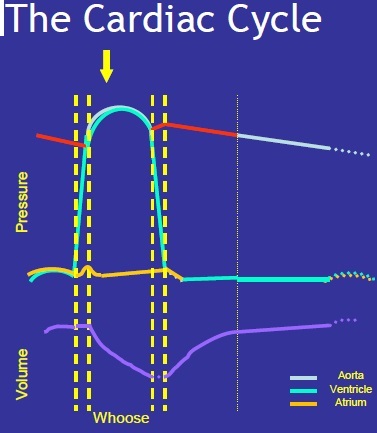
Describe the sequence of pressure and volume changes in the atria and ventricles over a complete cardiac cycle in the normal individual
- In early diastole, as the ventricular muscle relaxes, the intra-ventricular pressure falls and the atrio-ventricular valves (tricuspid and mitral) open as atrial pressure exceeds ventricular.
- The atria have been distended by continuing venous return during the preceding systole so initially blood is forced rapidly from the atria into the ventricles the ‘rapid filling’ phase. Filling of the ventricles continue throughout diastole at a steadily decreasing rate until the intraventricular pressure rises to match atrial pressure.
- At low heart rates the ventricles are more or less full before the next systole begins.
- Atrial systole is the contraction of the atria which forces a small extra amount of blood into the ventricles.
- After a delay of about 100-150 milliseconds the ventricles begin to contract (systole).
- As intra-ventricular pressure rises, so blood tends to flow the ‘wrong way’ (backwards) through the atrioventricular valves, producing TURBULENCE which closes the valves forcibly.
- The ventricles then contract ‘isovolumetrically’ and intra-ventricular pressure rises rapidly until it exceeds the diastolic pressure in the arteries when the outflow (aortic and pulmonary) valves open.
- There is then a period of rapid ejection of blood and both intra ventricular and arterial pressure rise to a maximum.
- Towards the end of systole intra ventricular pressure falls and once it is below the arterial pressure, the outflow valves close and when the atrial pressure is reached the A/V valves open and the whole process starts again
Explain what is happening at Stage 1
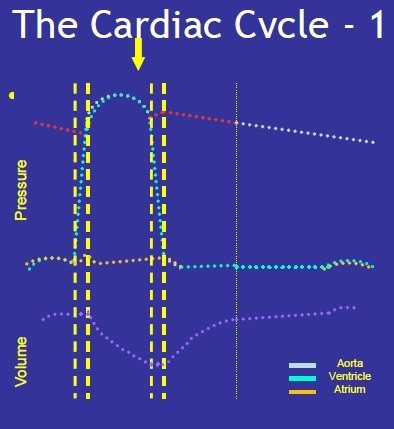
- start toward the end of ventricular systole
- Ventricles contracted
- Intra-ventricular pressure high
- Outflow valves open
- Blood flowing into the arteries
- Ventricular pressure > atrial pressure so a/v valves closed
Explain what is happening at Stage 2
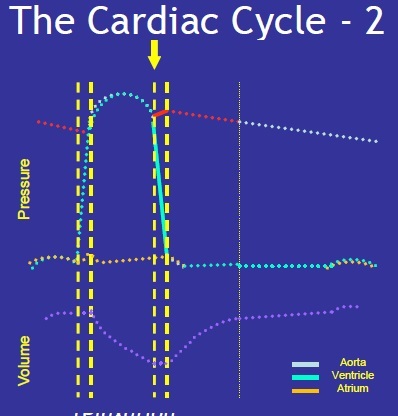
- Ventricles bein to relax
- Intraventricular pressure falls
- Intraventricular pressure becomes < arterial
- Brief backflow closes outflow valves
- All valves now closed
- Isovlmetric relaxation
What is Isovolumetric Relaxation?
- the pressure in the artery which now hs all the ejeced blood is now greater than that in the venticle.
- The blood now closes the semilunar valves as it tries to go from the artery into the ventricle preventing back flow.
- Although the pressure in the ventricle is declining, it is still greater than that in the atria so that AV valves are still closed. Thus as the ventricle is relaxing, the volume of blood in the ventricle is not changing.
- Stage 2 will continue until the ventrcular pressure becomes lower than the atria pressure and the filling stage starts again
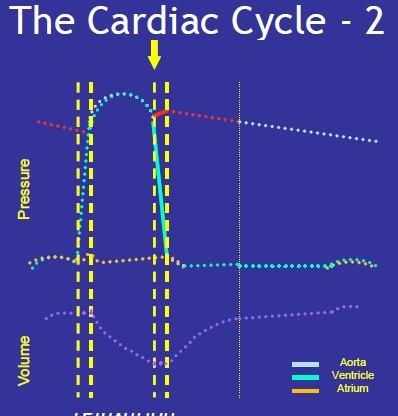
Explain what is happening at Stage 3
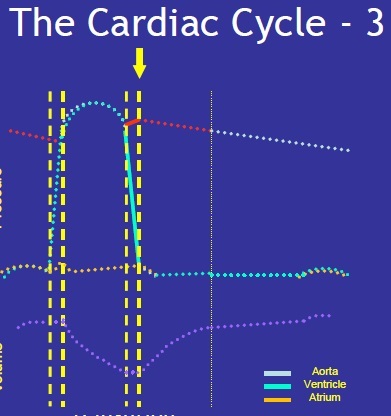
- During systole, blood has continued to return to the atria
- Atrial pressure is relatively high
- As intra-ventricular pressue falls, eventually, atrial pressure > intra-ventricular pressure
- So a/v valves open
Explain what is happening at Stage 4
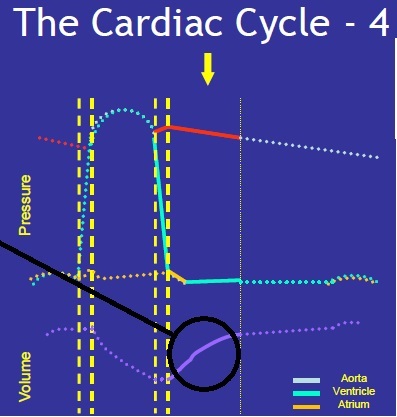
- A/V valves are open
- Ventrcles fill rapidly - ‘rapid filling phase’
- Lasts about 200-300ms
- Most filling of ventricles occurs in this phase
Explain what is happening at Stage 5
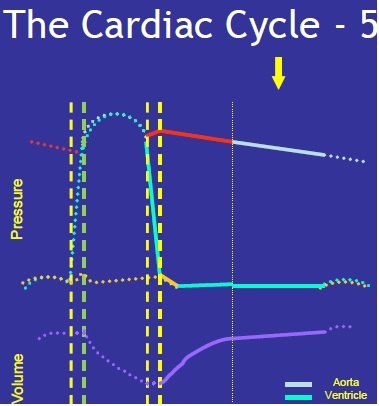
As diastole continues, the vetricles fill more slowly
Intraventricular pressurerises as the ventricular walls stretch until intra-ventricular pressure matches atrial pressure and filling stops
Explain what is happening at Stage 6
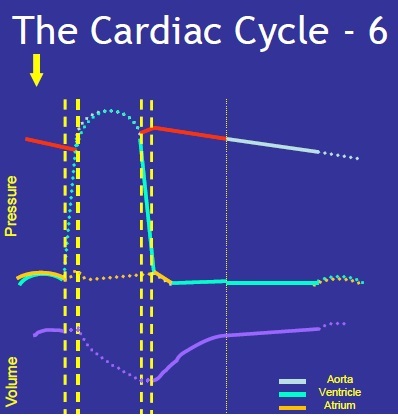
atrial systole - forces a small extra amount of blood into the ventricles but the heart pumps perfectly well without atrial systole
Explain what is happening at Stage 7
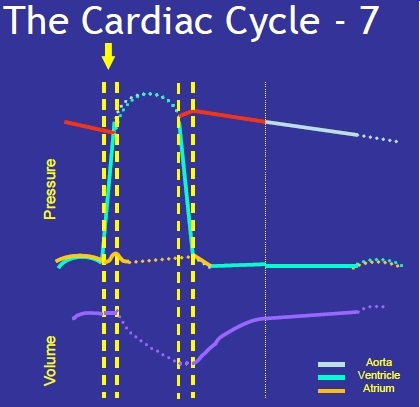
- Ventricular systole
- intraventricular pressure rises very rapidly. Quickly exceeds atrial pressure.
- So after brief back flow a/v valves close
- All valves are closed at this point
- Isovolumetric contraction occurs.
What is Isovolumetric Contration?
In the early phase of systole when the myocardial muscle fibres have begun to shorten but have not developed enough pressure in the ventricles to overcome the aortic and pulmonary end-diastolic pressures and open the aortic and pulmonary valves, the ventricular volume does not change (during this period of muscle fibre contraction)
Explain what is happening at Stage 8
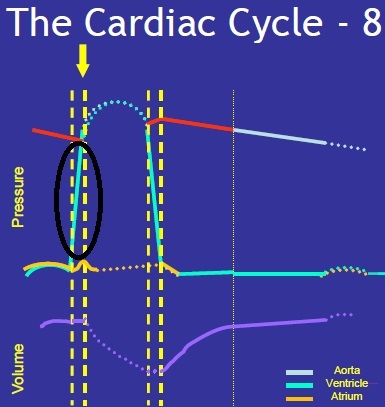
- Intraventricular pressure rises very rapidly
- Until intra-ventricular pressure > arterial prssure (which has been falling in diastole)
- So ouflow valves open
Explain what is happening at Stage 9
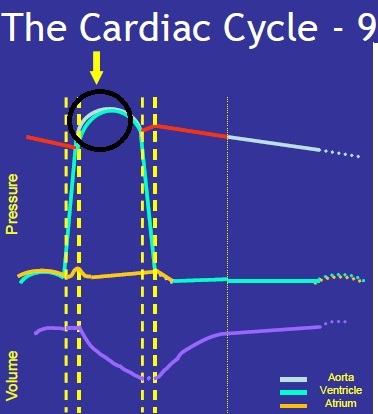
- As outflow valves open, blood is ejected rapidly into the arteries.
- Rapid ejection phase
- Arterial pressure rises rapidly.
Explain what is happening at Stage 10
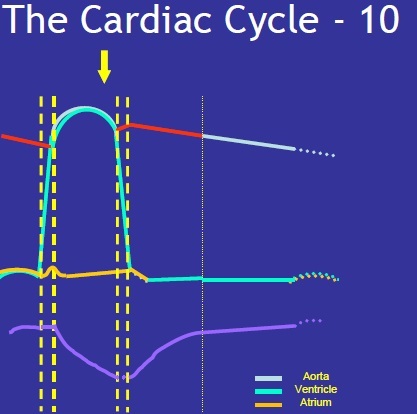
- As arterial presure rises, the rate of ejection of blood falls.
- Both arterial and intraventricular prssures peak towards the end of syste
- Outflow eventually ceases with blood still in ventricle
- Eventualy systole ends - and cardiac cycle begins again
Explain the origin of the 1st and 2nd heart sounds
- Sound is produced by sudden acceleration and deceleration of structures by turbulent flow.
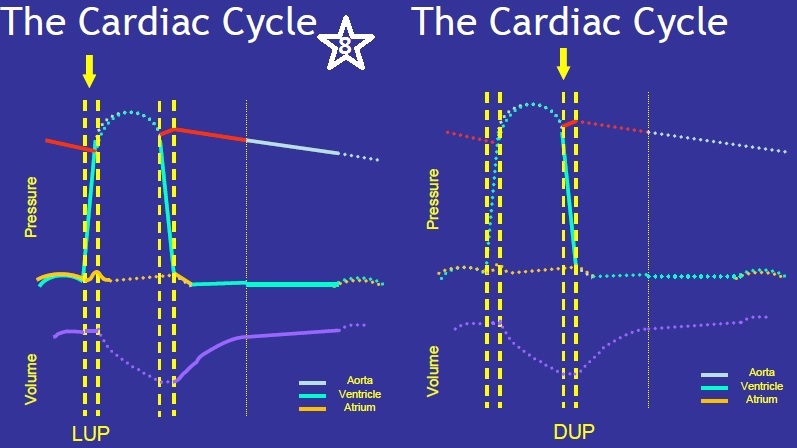
- First heart sound: as the A/V valves close, oscillations are induced in a variety of structures producing a mixed sound with crescendo-decrescendo quality ‘lup’ (at onset of ventricuar systole)
- Second heart sound: as the semi-lunar valves close oscillations are induced in other structures including the column of blood in the arteries. This produces a sound of shorte duration, higher frequency and lower intensity ‘dup’ (at end of ventricular systole)
What happens at rest? What happens if someone’s heart is beating slowly? Why may sounds be split?
At rest, interval from 1st to 2nd heart sound is about 280 milliseconds.
Interval from 2nd to next 1st heart sound is about 700 milliseconds (length of diastole).
If someone’s heart is beating slowly, diastole lengthens (not systole – not interval between 1st and 2nd heart sounds).
Sounds may split if valves of right and left heart do not close at same time.
What may cause a murmur?
- in exercise, turbulent flow generates murmurs in normal individuals
At rest:
- Narrowed valve: stnosis
- Valve not closing properly: incompetence
- So murmurs occur when blood flow is highest.*
e. g. aortic stenosis produces a murmur in the raid ejection phase (early systole). A defect in the mitral valve can also cause a murmur but this is less common than narowing of an artery.