Name the 5 quantum numbers
- n, principal quantum number
- l, angular momentum quantum number
- ml, magnetic quantum number
- s
- ms
What does each quantum number represent?
- n
- l
- ml
- s
- ms
n = shell/energy
l = type of orbital (magnitude of angular momentum), s = 0 for s-orbitals
ml = number of degenerate orbitals (component of the orbital angular momentum on a particular axis / orientation of angular momentum). For a d-orbital, l = 2 → ml = 2, 1, 0 -1, -2 → 5 degenerate orbitals
s = magnitude of spin (intrinsic angular momentum), always = 1/2
ms = orientation of spin (intrinsic angular momentum), = -1/2 or 1/2
orbital energy equation
En = -RHZ2/n2
Give formulae for:
- Total #nodes
- # angular
- # radial
- Total #nodes = n - 1 = #angular + #radial
- # angular = l (so all s = 0, all p = 1, all d = 2)
- # radial = n - l - 1
Radial nodes: first appearance of each orbital type has none, then go up by 1 with each shell.
When is it correct that energy of 4s energy of 3d?
Up to Ni
Name the symmetry labels and what each represents
- σ: rotational symmetry about the internuclear axis, without a change in phase
- π: nodal plane (change in phase) in internuclear axis
If there is a centre of inversion (2 points equidistant but opposite directions from centre are equivalent):
- g: no change in sign on passing through centre of inversion
- u: change in sign on passing through centre of inversion
Draw the MO diagram for O2, and sketch each MO and assign its symmetry.
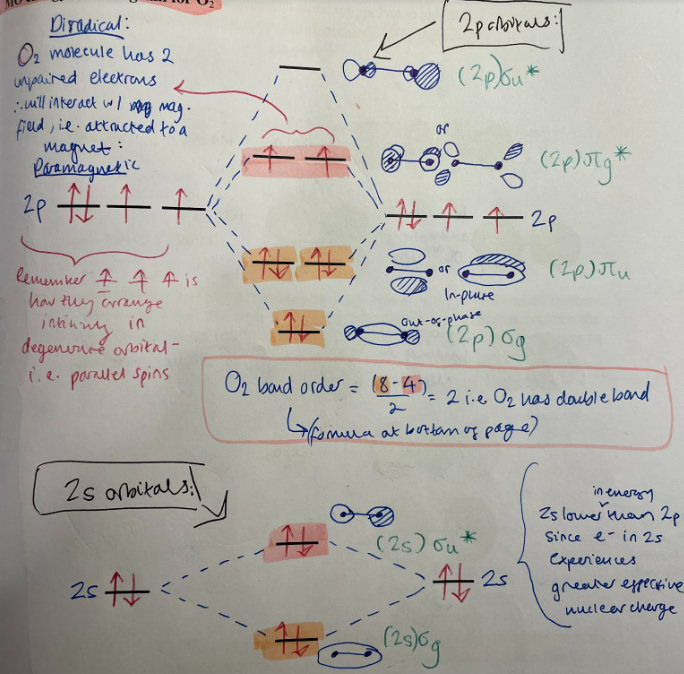
For the first-period homonuclear diatomics up to & including __, sp mixing is strong enough to make the sigma-g orbital higher-energy than the pi-u orbital.
N
describe the effect of sp mixing on the following MOs
- (2s)σg
- (2p)σg
- (2s)σu*
- (2p)σu*
- (2s)σg becomes more bonding (lowered)
- (2s)σg becomes less bonding (raised)
- (2p)σu* becomes less antibonding
- (2s)σu* becomes more antibonding
To obtain linear geometry, which AOs contribute to the HAOs?
sp
s, pz (IN axis)
To obtain trig planar geometry, which AOs contribute to the HAOs?
sp2
s, pz, py
To obtain tetrahedral geometry, which AOs contribute to the HAOs?
s, pz, py, px
To obtain bent geometry, which AOs contribute to the HAOs?
sp3 but not equal
s, pz, py, px with greater p-character
To obtain octahedral geometry, which AOs contribute to the HAOs?
sp3d2
s, px, py, pz, dz^2, dx^2-y^2
To obtain square planar geometry, which AOs contribute to the HAOs?
sp2d: s, px, py, dx^2-y^2
or p2d2: px, py, dx^2-y^2, dz^2
To obtain trig bipyramidal geometry, which AOs contribute to the HAOs?
sp3d: d, px, py, pz, d??
spd3: s, p??,
Why is BH3 sp2 hybridised rather than sp3?
- Want to minimise energy of HOMO
- Sp2 arrangement has:
- 3 x occupied sigma
- A vacant boron p-orbital (non-bonding)
- 3 x vacant sigma*
- So HOMO = sigma, made from sp2 HAOs
- Sp3 arrangement has:
- 3 x occupied sigma
- a vacant sp3 HAO (non-bonding)
- 3 x vacant sigma*.
- So HOMO = sigma, made from sp3 HAOs
- HOMO of sp3 arrangement has more p-character than that of sp2 arrangement, so is higher in energy, so is less favourable
Another way of thinking about it: don’t want to waste s-character on an unoccupied orbital. Highest preference for using lowest-energy (s) orbitals when building HAOs
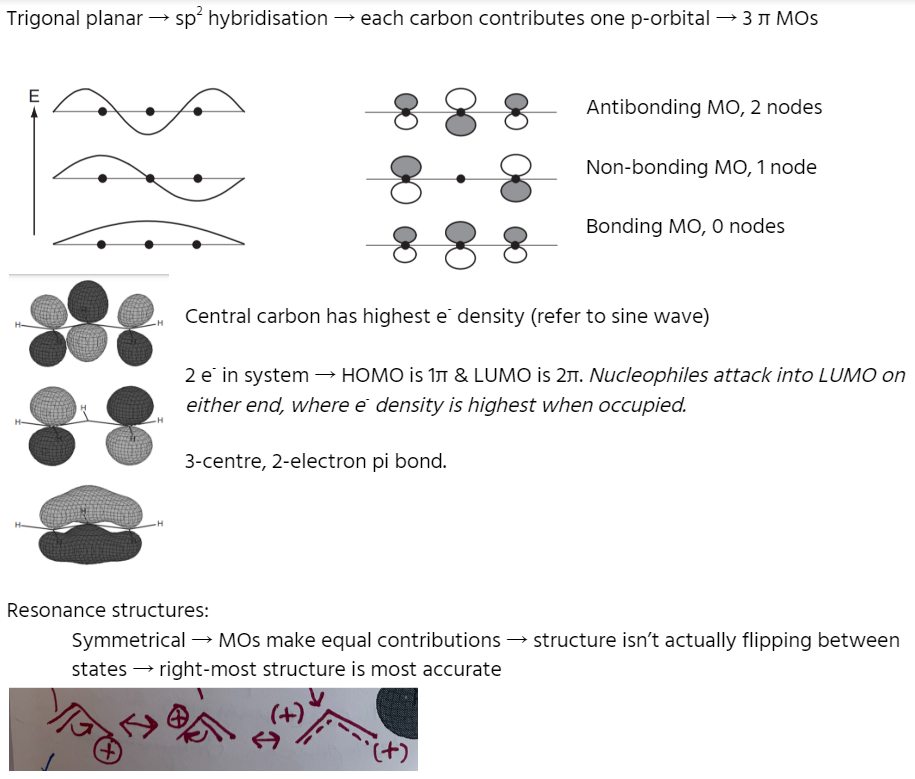
Using diagrams, describe the conjugated system and bonding in the allyl cation, H2C=CH-C+H2, and draw the resonance structures.
Higher-energy MOs have more nodes, so shape of π MOs can be predicted with sine waves:
- Begin sine wave one bond-length away from end of molecule
- n AOs → n MOs, and first MO has no nodes, so highest-energy MO has (n - 1) nodes
- MOs are labelled in order of energy: 1π, 2π, etc
- Atoms drawn in a straight line for simplicity, but might be a simplification
- Nodes are where wave changes sign / crosses axis
- Height of wave predicts shape of MO (contribution each AO makes to it)
- NB: when combining p-orbitals of different elements, AOs are different energies → MOs aren’t symmetrical → e- density isn’t even (highest where AO energy was lowest)
How would you compare the energies of orbitals of the same type?
Poorer size/energy match between constituent AOs → worse interaction → lower energy
HOMO-LUMO interactions cause net reduction in energy of the highest-energy electrons. The best interaction is between the orbitals closest in energy, which are?
Whichever HOMO is highest-energy, & the LUMO of the other reactant.
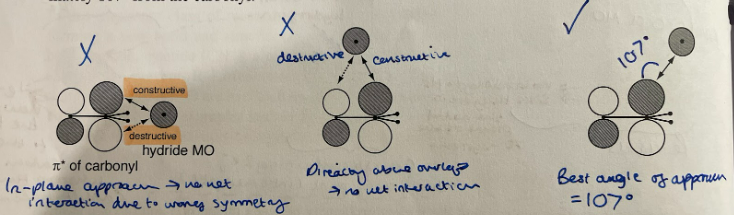
State the most favourable angle of approach for nucleophiles,
1070
use diagrams to show that 107o is the best angle of nucleophilic approach

-
Shapes & Structures 177
-
Organic 1: Nucleophilic addition to the carbonyl group9
-
pKa values20
-
pKaH values18
-
Shapes & Structures 222
-
Kinetics 1: Rate laws, theories concerning rates21
-
Kinetics 2: Experimental derivation of rate laws & constants20
-
Kinetics 3: Obtaining kinetic data2
-
Kinetics 4: Complex reactions: pre-equilibrium, steady state, MM27
-
Kinetics 5: Complex reactions: composite Arrhenius parameters; chain reactions10
-
Kinetics 6: Main recall23
-
Energetics & Equilibria 1: first law, second law, gas expansions, internal energy, enthalpy, heat capacity, absolute entropy50
-
Energetics & Equilibria 2: Gibbs energy25
-
Energetics & Equilibria 3: Chemical changes11
-
Energetics & Equilibria 4: Equilibrium15
-
Energetics & Equilibria 5: Electrochemistry31
-
Energetics & Equilibria 6: Main recall39



