List types of shock
circulatory shock:
- hypovolemia
- maldistributive
- cardiogenic
- obstructive
anemia
hypoxemia
impaired cellular oxygen utilization and energy production
What is the broad definition of shock?
the VO2 exceeds DO2 and utilization –> leading to a cellular energy debt and measurable organ dysfunction
other more common now: impaired cellular energy production
DO2 is a function of ____ and ____
DO2 is a function of CO and CaO2
CaO2 = ___ x ___ x ___ + ___
CaO2 = 1.34 x Hb x SO2 + 0.003 PaO2
Fill in the blanks
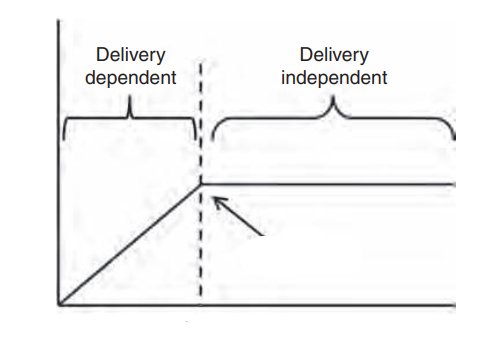
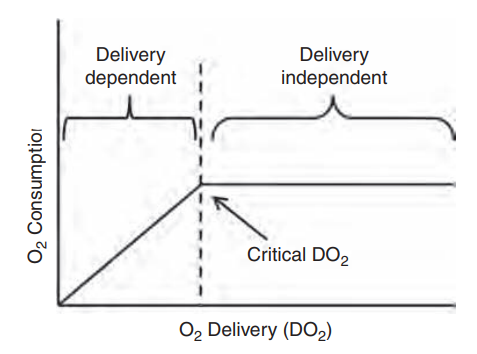
Explain how the delivery-independent Oxygen cosumption can be maintaned
- DO2 in excess of VO2
- Oxygen extraction only 25% under normal circumstances. Can be increased to 70-80% if DO2 is decreased
When does oxygen consumption become delivery dependent?
When the DO2 drops to a point when oxygen extraction cannot be increased enough to compensate and VO2 will drop with further decline in DO2
what are the intracellular consequences of decreased O2 delivery and consumption?
decreased DO2 and VO2 –> decreased oxidative phosphorylation/electron transport chain in the mitochondria to produce ATP
–> cells respond by reducing metabolic activity
eventually switch to anaerobic metabolism –> lactate production
–> intracellular acidosis: denaturation of proteins, decreased enzyme function, disruption of transport mechanisms
inadequate cellular energy –> intracellular systems fail (ion pumps fail, oxygen free radical formation, loss of adenine nucleotides) –> tissue injury
ion pumps fail –> membrane integrity of cells fail –> fluid shifts into cells –> cellular edema
–> cellular necrosis or triggering of apoptosis
What are the 3 stages of shock?
- compensated shock
- decompensated shock
- terminal/irreversible shock
Explain the pathophysiology of compensated shock
the body is attempting to maintain core tissue/organ perfusion
- baroreceptors sense decreased vessel wall tension
- chemoreceptors sense hypoxia/hypercapnia/acidemia
► cathecholamine release
► tachycardia, increased cardiac contracility, peripheral vasoconstriction
► restores mean arterial perfusion pressure ► preserves perfusion of core organs
also: activation of RAAS system and increased release of vasopressin ► additional vasoconstriction + decreased urinary water loss
also: decrease in hydrostatic pressure (if applicable) ► water movement from itnerstitial into intravascular compartment
May happen at the expense of peripheral and splanchnic circulation ► hypoxic damage happens here already in compensated phase of shock
Explain the pathophysiology of decompensated shock
compensatory mechanisms are overwhelmed/exhausted
► impaired core perfusion
- hypotension ► hypoperfusion ► hyperlactatemia ► metabolic (lactic) acidosis ► progressive catecholamine insensitivty
► vasodilation/ loss of vasomotor tone ► impaired venous return ► decrease in CO
► bradycardia ► decrease in CO
► irreversible/terminal shock
List 5 groups of complications arising from shock
- Systemic inflammatory response
- Coagulopathy
- Mitochondrial dysfunction
- Microcirculatory dysfunction
- Multiple organ dysfunction syndrome
What are the causes for systemic inflammation in shock?
- upregulation and release of inflammatory cytokines, e.g., IL-6, G-CSF
- IL-6 and G-CSF serve as chemotactic factors ► neutrophil infiltration into affected tissues ► diapedesis
- ► neutrophils release reactive oxygen and nitrogen species and proteolytic enzymes
- ► vasodilation, increased capillary permeability, dectruction of extracellular matrix
- ► tissue edema ► decreased O2 and metabolite exchange ► cellular dysfunction
- neutrophil plugging on endothelium ► vessel obstruction ► disruption of microcirculatory blood flow
- activation of the complement system
- tissue injury ► release of split products, e.g., C3a, C5a (i.e., anaphylactoxins)
- lead to
- ► increased vascular permeability
- ► histamine and arachidonic acid product release
- ► cytokine production and release,
- ► promote aggregation and adherence of granulocytes to endothelium
increased activity of phospholipases A2 and C
- stimulates production of prostaglandins and leukotrienes
- ► further recruitment of inflamamtory cells
- ► alterations in vascular permeability
- ► impaired vasomotor tone
- ► enhanced platelet activity and aggregation
“shock gut”
- decreased intestinal perfusion ► increased intestinal permeability ► bacterial translocation
after reperfusion ► release of toxic metabolites and reactive oxygen species
- hypoxanthines accumulate during ischemia
- reperfusion ► O2 reintroduced ► formation of ROS
- lipid peroxidation, membrane disruption, DNA damage
- ► further cell damage ► necrosis and apoptosis
Explain how shock leads to coagulopathy
shock ► systemic inflammation
- inflammatory cytokines (IL-1, IL-6, TNF-alpha, arachidonic acid metabolites) ► procoagulant
- increased expression of tissue factor on endothelium and monocytes
- consumption and downregulation of natural anticoagulants (protein C, antithrombin
- increased activity of Plasminogen-activator-inhibitor (PAI-1) and thrombin-activatable fibrinolysis inhibitor (TAFI)
► hypercoagulable state ► microthrombi
- arterial clots ► impairs tissue perfusion
- venous clots ► impairs venous return and oxygenation (if PTE)
►consumption of clotting factors + platelets ► hypocoagulable state
Explain how shock causes mitochondrial damage
- inflammatory cytokines (e.g., TNF-alpha) ► uncoupling of oxidative phosphorylation, increased mitochondrial permeability and apoptosis
- increased production of reactive oxygen and nitrogen species and decreased ability to scavange free radicals
- reperfusion injury (increased free radicals)
During shock, what leads to microvascular derangements, other than decreased perfusion?
- endothelial edema from ischemic injury ► increaed wall thickness decreases diameter
- increased permeability
- damage from inflammatory mediators ► inflammation ► endothelial activation ► leukocyte adhesion and capillary plugging
- arterial microthrombi ► impaired blood flow
Explain how the gastrointestinal tract is compromised during shock
►splanchnic and peripheral circulation is first to be compromised during compensatory vasoconstriction to preserve perfusion of vital organs ► ischemic injury
►epithelial injury and loss of mucosal barrier ► bacterial translocation
► reperfusion injury ► shown to cause dysmotility
Briefly describe the pathophysiology of ARDS
- ARDS involves inflammation-induced diffuse alveolar-capillary injury and subsequent severe accumulation of proteinaceous edema in the pulmonary interstitium and alveoli
List 3 examples of DAMPs released during cell death from shock
mitochondrial DNA
histones
heat shock proteins
List 8 compensatory mechanisms being initiated during shock
- baroreceptors (sense decreased stretch) - decreased inhibition of sympathetic tone - increases vasoconstriction, HR and contractility
- peripheral chemoreceptors (sense increased CO2, decreased pH and O2) - vasoconstriction and increasing HR
- central chemoreceptors (medulla oblongate, senses pH/CO2) - increased RR and TV
- decreased capillary hydrostatic pressure causes reabsorption of volume from interstitium
- increased circulating catecholamines and endorphine - vasoconstriction and decreases pain perception
- hyperglycemia - from upregulated hepatic gluconeogenesis
- RAAS upregulation
- ADH synthesis and release - secondary to hypothalamus sensing decreased ECV
What causes neurogenic shock?
abnormally low sympathetic tone and unopposed parasympathetic stimulation of vascular smooth muscles
typically TBI or spinal cord injuries
causes distributive shock
What is a normal CVP in a well-perfused patient?
0-6 cm H2O
What can cause decreased SvO2
- decreased DO2 (
- increased VO2 (e.g., hyperthermia, fever, seizures)
What can cause an increased SvO2?
hyperdynamic stage of sepsis
cytotoxic tissue hypoxia (e.g., cyanide toxicity)

-
Shock68
-
Venous O2 Saturation. Walton & Hansen. 2018. JVECC30
-
Venous return in CC and shock. Pathophys. Funk et al. 2013. CC med29
-
Venous return in CC and shock. shock and vent. Funk et al. 20131
-
Ischemia-Reperfusion Injury - SACCM 8, SAER 15832
-
HUNG Fluid/Shock/Trauma133
-
HUNG CPR39
-
CPR, PCA32
-
Lactate39
-
RECOVER15
-
Vasopressors29
-
Monitoring things10
-
Consensus circulatory shock and hemodynamic monitoring10
-
AMP 18: Defibrillation16
-
CCM 205: Defibrillation6



