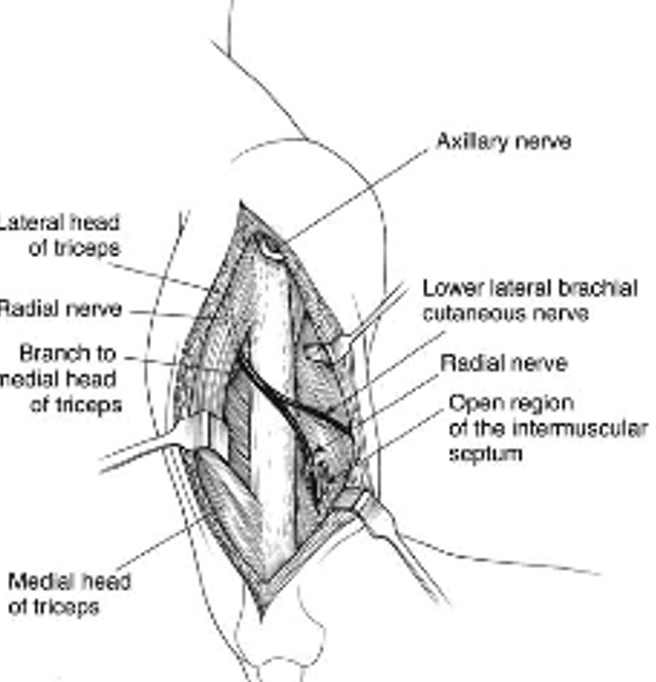
Deltopectoral Approach
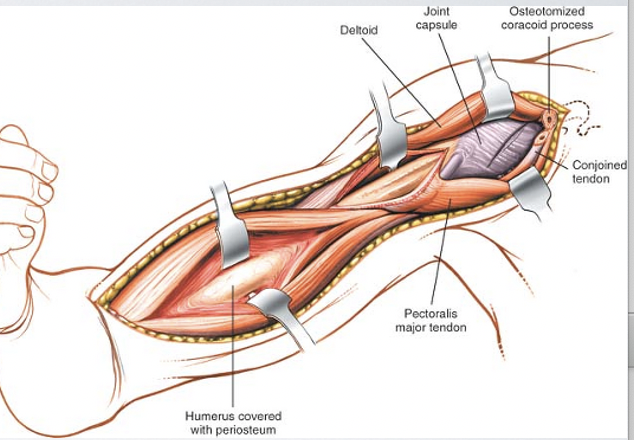
Incision: Coracoid process to deltoid insertion.
Interval: Deltoid and pec Deep dissection: Incise fascia over short head of biceps and coracobrachialis, retract biceps and coracobrachialis medially; may release a portion of conjoint tendon from ~1cm distal to coracoid to increase exposure; may also release superior ~1cm of pec major insertion of humerus distally
Keep arm adducted while working around coracoid to relax plexus and maximize it’s distance from the coracoid
Retract coracobrachialis carefully to avoid injury to musculocutaneous nerve
Externally rotate arm to protect axillary nerve (running below inferior border of subscapularis); Identify the “3 sisters” (artery and two veins running along inferior border of subscapularis) and ligate or cauterize
May split or detach subscapularis (either separately from or with capsule as a single layer) depending on case being done
Dangers: musculocutaneous nerve under coracobrachialis, axillary nerve below subscapularis, brachial plexus and vessels medial to coracoid in the event of a major bleed - take down conjoint tendon completely to gain proximal control
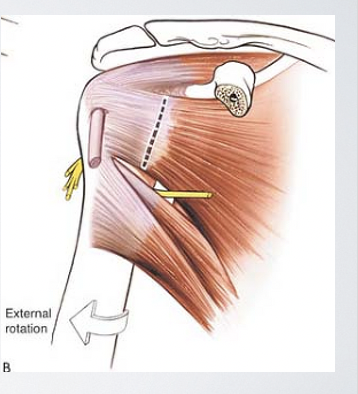
Deltoid-Splitting Approach
Incision: 5 cm incision from lateral edge of acromion down lateral aspect of arm Interval: no true interval - deltoid split Superficial dissection: Split deltoid, stopping ~5cm from edge of acromion to avoid axillary nerve (may put stay suture to avoid inadvertent extension) Deep dissection: Debride any inflammatory tissue within subacromial bursa and expose rotator cuff tendons Can extend distally through second incision after raising plane under deltoid and palpating axillary nerve through proximal incision; start second incision distal to this point and can slide beneath deltoid and nerve (running on undersurface of deltoid)
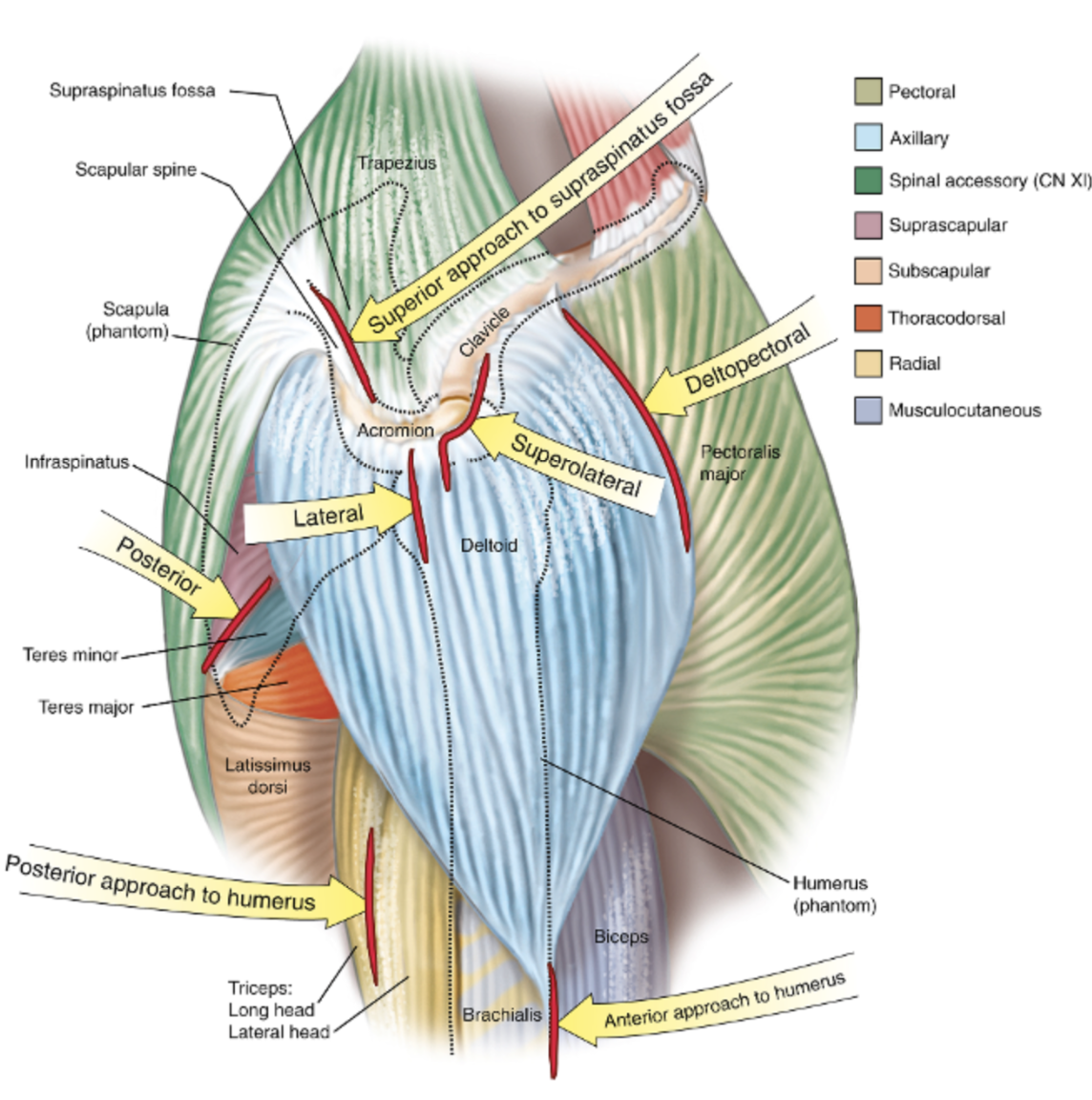
Posterior Approach to shoulder (Judet)
Look this up
- Incision: Along spine of scapula, extending to lateral edge of acromion (alternate incision angled 45 degrees - in red)
- Interval: teres minor and infraspinatous
- Superficial dissection: Detach deltoid from spine of scapula; ID plane betwen deltoid and infraspinatus in lateral aspect of incision and work back to ensure infraspinatus not stripped along with deltoid
- Deep dissection: Bluntly dissect between infraspinatus and teres minor, exposing posterior joint capsule; make longitudinal capsulotomy close to edge of scapula
Dangers: axillary nerve and posterior circumflex artery in quadrangular space (teres minor/major), suprascapular nerve (around base of spine of scapula under infraspinatus
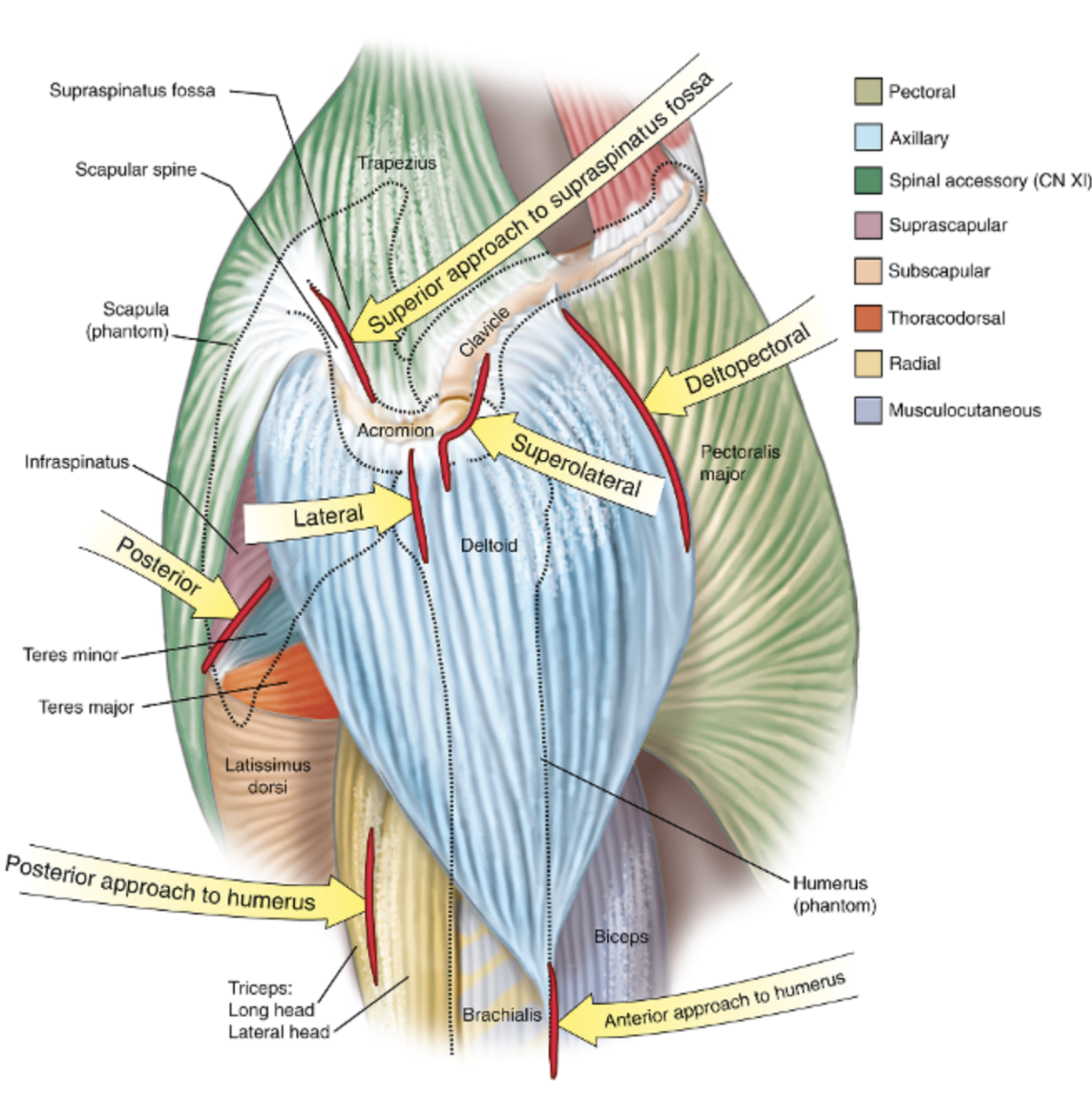
Anterior approach to humerus
Incision: Extension of deltopectoral along lateral edge of biceps (stop ~5cm from elbow flexor crease) Interval: deltopectoral proximally, then biceps and brachialis (brachialis-splitting) Superficial dissection: deltopectoral approach proximally, then find plane between biceps and brachialis and retract biceps medially Deep dissection: proximally stay lateral to pec insertion, dissect subperiosteally to expose humerus; watch for anterior circumflex at proximal extent of pec insertion (ligate); may need to subperiosteally elevate pec insertion to fully expose Distally split brachialis (midline) to expose humerus Dangers: radial nerve in spiral groove (middle third) and between BR and brachialis distally; axillary nerve proximally; anterior humeral circumflex artery (as above)
Anterolateral Approach to humerus
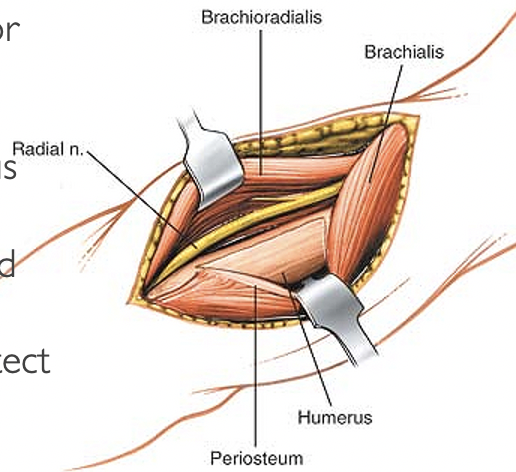
Incision: Over lateral border of biceps from ~10 cm proximal to flexor crease to just above crease Interval: BR and brachialis (elevates brachialis - cf anterior approach SPLITs brachialis) Superficial dissection: ID and protect lateral cutaneous nerve of forearm (between biceps and brachialis distally); develop plane between BR and brachialis and find radial nerve (at level of elbow); trace nerve proximally until it pierces intermuscular septum (protect nerve) Deep dissection: Subperiosteally elevate brachialis from lateral to medial (starting medial to radial nerve) Dangers: radial nerve, lateral antebrachial cutaneous nerve
Anterolateral approach to humerus
- Incision: Over lateral border of biceps from ~10 cm proximal to flexor crease to just above crease
- Interval: BR and brachialis (elevates brachialis - cfanterior approach SPLITs brachialis)
- Superficial dissection: ID and protect lateral cutaneous nerve of forearm (between biceps and brachialis distally); develop plane between BR and brachialis and find radial nerve (at level of elbow); trace nerve proximally until it pierces intermuscular septum (protect nerve)
- Deep dissection: Subperiosteally elevate brachialis from lateral to medial (starting medial to radial nerve)
- Dangers: radial nerve, lateral antebrachial cutaneous nerve
Extensile Posterior Approach to Humerus
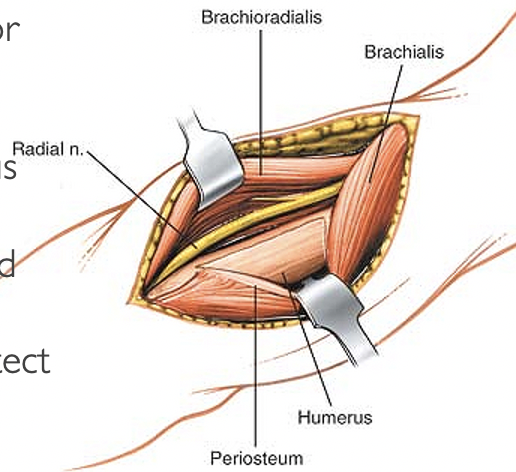
- Incision: Posterolateral incision along humerus
- Interval: Lateral triceps and intermuscular septum
- Superficial dissection: ID radial nerve (exiting spiral groove ~14 cm from lateral epicondyle and piercing intermuscular septum ~10 cm from epicondyle) by finding lower lateral brachial cutaneous nerve along posterior aspect of intermuscular septum and tracing it back to radial nerve
- Deep dissection: Divide intermuscular septum for ~3cm over radial nerve to allow mobilization; subperiosteally elevate medial and lateral heads of triceps from lateral to medial
- Dangers: lower lateral brachial cutaneous nerve, radial nerve