If a system of equations has no solutions, what is it called?
Inconsistent
When at least one solution exists for a given system of linear equations, we call that system ________.
When at least one solution exists for a given system of linear equations, we call that system consistent .
A consistent system of linear equations has XXXXXX solutions.
A consistent system of linear equations has One or An Infinite solutions.
If a consistent system has an infinite number of solutions, if we can define a solution in terms of some extra parameter t , we call this a XXXXXXXXX solution .
If a consistent system has an infinite number of solutions, if we can define a solution in terms of some extra parameter t , we call this a parametric solution .
What are three definitions for the Rank of a matrix?
The rank of a matrix is any of:
- the number of pivots when the matrix is in ref
- the number of independent rows
- the number of independent columns
All three are equivalent.
What is the definition of the Row Canonical Form of a matrix?
A matrix is in row canonical form if when:
- the pivot in each row is a 1
- the pivot is the only non-zero entry in its column.
How do you solve a system of simultaneous equations using matrices?
- Write the equations in matrix form Ax=b
- Create an augmented matrix from A and b
- Reduce the matrix to ref or rref form
- Use back substiution to solve for each variable
(if the matrix is not full rank you will have to create a parametric solution using the free variables)
What are Elementary Matrices?
They are square matrices that represent the elementary row operations.
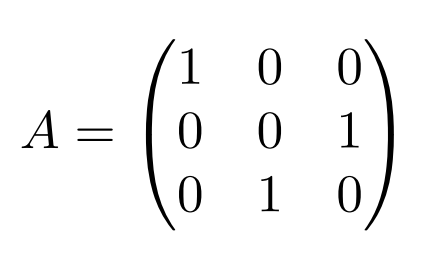
What does an Elementary Matrix that represents swapping two rows look like?
Start with an apppropriately sized Identity matrix and then swap the same two rows that you want swapped in the target matrix.
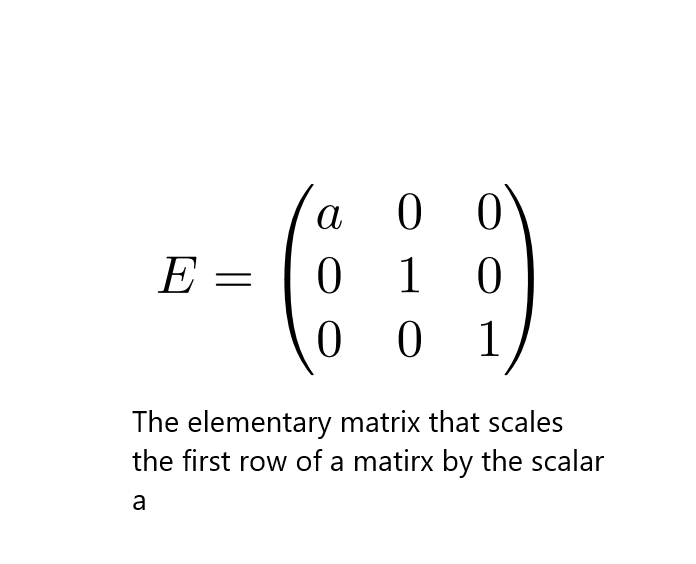
What does an Elementary Matrix that represents scaling a row by a constant look like?
Start with an apppropriately sized Identity matrix and then replace the 1 in the row you want scaled with the value you want it scaled by.
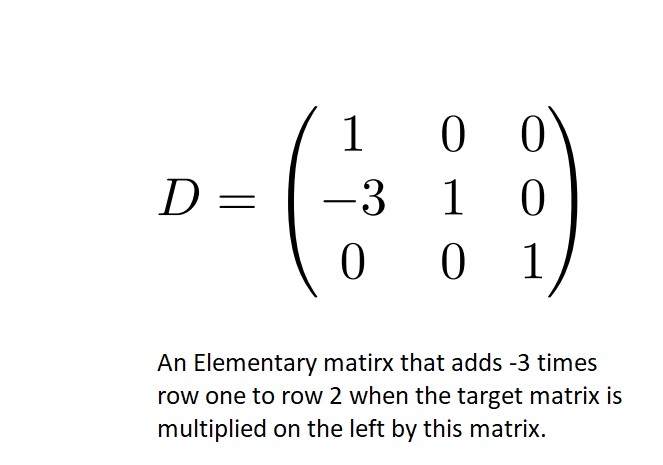
What does an elementary matrix look like that adds some multiple of one row to another row?
- Start with an identity matrix I of the appropriate size.
- Change the rows of ‘I’ to relflect the changes you want in the target matrix. Call this matrix D.
- Mulitply the target matrix by the left by D (DA)
What does it mean if a matrix is singular?
A Singular matrix in non-invertible
Is an invertible matrix singular or non-singular?
Invertible = non-singular
When solving Ax=b using an augmented matrix {Ab] (where A is a square matrix),
what does it mean when the last row of the ref form takes the form of
[0 0 0…0 | n] where n is non-zero?
It means the equation Ax=b has no solutions.
When solving Ax=b using an augmented matrix {Ab],
what does it mean when the last row of the ref form takes the form of
[0 0 0…0 | 0] ?
The Ax=b will have an infinite number of solutions
For a Homogeneous Set of Equations,
if in the rref form
the # of equations = # of unknowns
How many solutions are there to the system?
Only one solution:
The zero solution [0 0 0 … 0]
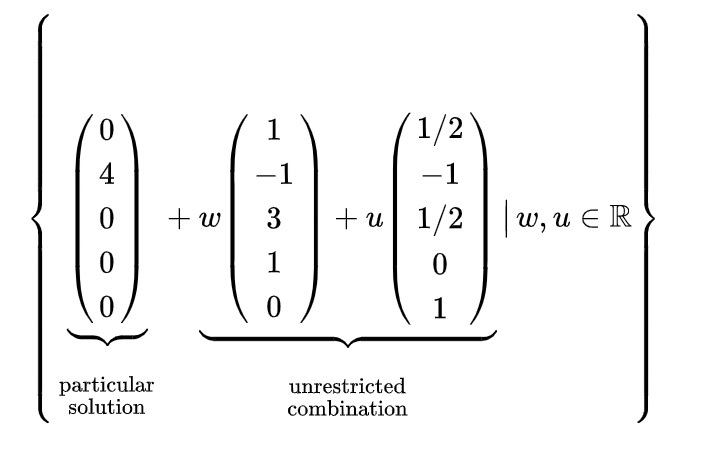
What is the general form of solutions for a system of simultaneous equations?
in general, a solution has the form of
- a vector that is a particular solution of the system
- added to an unrestricted combination of some other vectors.
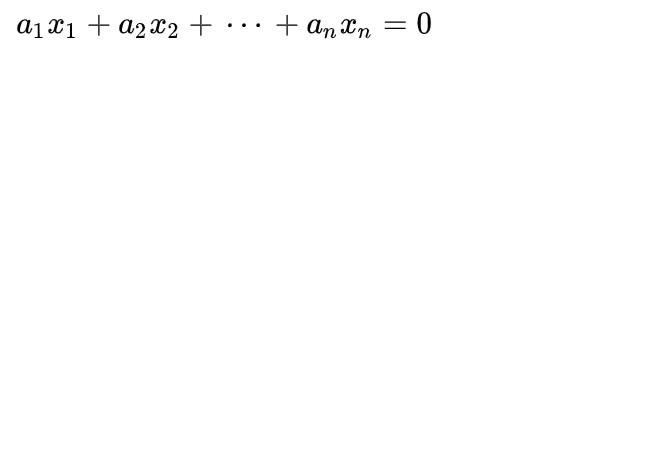
What makes an equation homogeneous?
A linear equation is homogeneous if it has a constant of zero, that is, if it can be put in the form show below.
Why is it advantageous to study a homogeneous system of eqations that are associated with a non-homogeneous system of equations?
Homogeneous equations always have at least one solution - the zero vector.
Studying the associated homogeneous system has a great advantage over studying the original system. Nonhomogeneous systems can be inconsistent. But a homogeneous system must be consistent since there is always at least one solution, the vector of zeros.
What is the formal theorem of the
General Solution = Particular + Homogeneous solutions
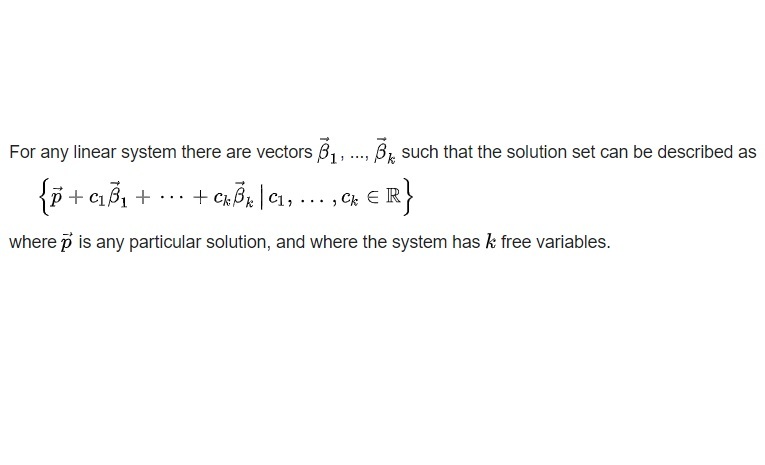
What are the names of the two parts of the solution of a system of simultaneous equations?
The General Solution = the Particular solution + the Homogeneous solution
If a set of homogeneous equations has only one solution, what will that solution be?
The 0 vector.
How many solutions can a set of homogeneous equations have?
Either
- one solution (the 0 vector) or
- many solutions (including the 0 vector)
How many solution vectors will there be to a homogeneous set of equations?
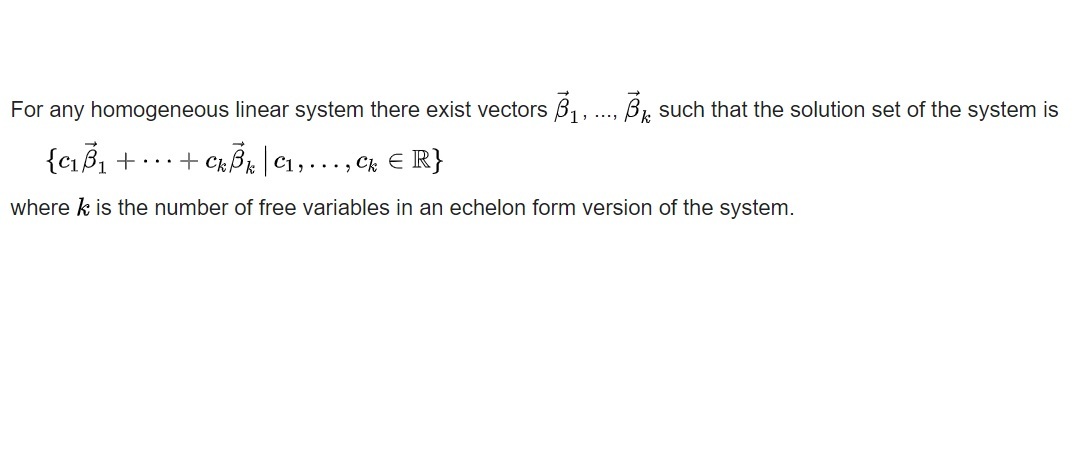
There will be as many solution vectors as there is free variables in the RREF of the equations.