deciduous trees
trees which shed leaves annually, as opposed to evergreens
evergreen trees
trees having green leaves throughout the year, as opposed to deciduous
datum
a horizontal plan elevation used as reference for other elevations in surveying and mapping
utility
a public service, such as telephone, was, gas, or electricity
flood plain
the land surrounding a flowing stream over which water spreads when a flood occurs
How is a parcel of land described?
- described according to the property lines and boundaries. A metes and bounds survey identifies the length and compass orientation of each property line.
- It can also be described by its location within a township or subdivision.
frost line
A max depth at which soil will freeze, below this depth soils will remain above freezing.
Cut and Fill
a method of grading used to create a level area on a sloped site. to cut is to remove soil, to fill is to add soil. ideally, this type of grading should be limited in order to minimize the impact on a naturally occurring site.
What are the 4 main site factors that affect the physical form of a building?
1. Site to Structure - flat or passive site
2. Site to Form Relationships - the line of the site should be considered in relation to the buildings form
3. Vegetation - plants, bushes, and trees on a site create shapes, textures, and mass which have a visual impact on a buildings form
4. Climate - cold climates require compact building forms. Hot climates require open, airy plans that allow for good air circulation. Also, climates with substation snow and rain are likely to incorporate sloped roof surfaces.
Macroclimate
- based on latitude, elevation and proximity to water
- prevailing weather conditions of a region through th eyear and average over a number of years
characterized by
- Islands/Costal Region=constant & moderate temperature
- Arid/Desert Region=low humidity & greater temperature variation
- Mountainous Region=winds are forced to rise
Microclimate
- The modification of prevailing weather conditions by site specific features such as bodies of water, hills, trees, paved areas, and buildings.
- based on solar radiation, the angle between the ground and altitude
- Greatest sun rays= perpendicular to ground
- Winter Solstice = least hours of sun and low sun angle
- Summer Solstice =most hours of sun and high sun angle
- Vernal/Autumnal Equinox= equal hours of sun and dark
Climate is described quantitatively by:
- temperature range and distribution
- hours of daylight
- wind direction and velocity
- amount of relative humidity and precipitation
Degree day (dd)
the amount by which the average outdoor temperature at a paticular location is below 65 degrees F for one day
chill factor
fictitious temp assigned to a combination of actual temp and wind velocity which = the same effect as still air
Equinox
- vernal - approx March 21st
- autumn - approx Sept 22nd
- when the sun crosses the plane of the equater and the day and night are equal length
- northern hemispher, the summer solstice is Jume 21st
- winter solstice approx Dec 22nd
cluster
type of residential siting, where a series of housing units are grouped closely together and surrounded by open space
Albedo
Reflectivity measured as the relative permeability of a surface of radient energy flowing in either direction
runoff coefficient
the percentage of total rainfall which is not absorbed in the ground and runs off.
invert
the lowest point of the inside of a drain, pipe, channel or other liquid carrying conduit
coniferous
describing cone-bearing evergreen trees and shrubs, such as pines, spruce, fir, and cedar
drain tile
Clay pipe, usually with open joints, used to convey water away from a footing or to disperse liquid in a septic tank
backfill
earth that is replaced around a foundation or retaining wall after the concrete forms have been removed
transpiration
the process by which water vapor escapes into the atmosphere from plants
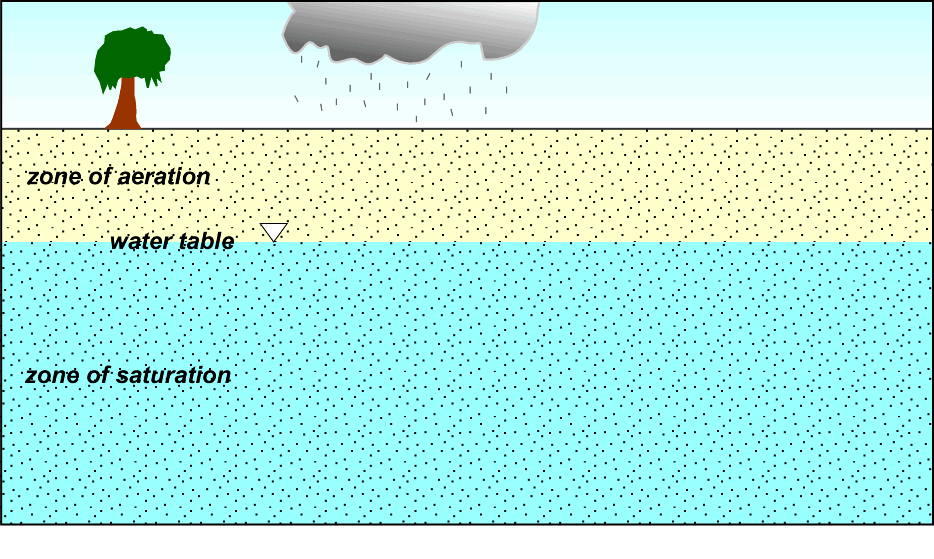
water table
- the level below which the subsoil is completely saturated with water aka groundwater level