Reverse
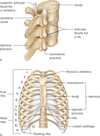
The various vertebrae are named according to their location in the vertebral column. The cervical vertebrae are located in the neck. The first cervical vertebra, called the atlas, holds up the head and allows it to tilt side to side. It is so named because Atlas, of Greek mythology, held up the world. The second cervical vertebra is called the axis, because it allows a degree of rotation. The thoracic vertebrae have long, thin spinous processes (Fig. 12.7a). The thoracic vertebrae articulate with one another and with the ribs at articular facets. Lumbar vertebrae have large bodies and thick processes. The five sacral vertebrae are fused together in the sacrum. The coccyx, or tailbone, is usually composed of four fused vertebrae.
Types of Vertebrae
Reverse
need atp to attach myasin heads to actin
need in form of Adp and phosphate form
triggers
What role does atp in muscle contraction
Reverse
Extra
BIOLOGY TODAY Science
Osteoarthritis and Joint Replacement Surgery
Osteoarthritis is a condition that afflicts nearly everyone, to a greater or lesser degree, as each person ages. The bones that unite to form joints, or articulations, are covered with a slippery cartilage. This articular cartilage wears down over time, as friction in the joint wears it away (Fig. 12B). By age 80, people typically have osteoarthritis in one or more joints. By contrast, rheumatoid arthritis is an autoimmune disorder (see Section 7.5) that causes inflammation within the joint. Unlike osteoarthritis, which typically affects older people, rheumatoid arthritis can afflict a person of any age, even young children. Both forms of arthritis cause a loss of the joint’s natural smoothness. This is what causes the pain and stiffness associated with arthritis. Arthritis is first treated with medications for joint inflammation and pain and with physical therapy to maintain and strengthen the joint. If these treatments fail, a total joint replacement is often performed. Successful replacement surgeries are now routine, thanks to the hard work and dedication of the British orthopedic surgeon Dr. John Charnley.
Figure 12B Osteoarthritis. A comparison of a normal knee (a) and a knee with osteoarthritis (b).
(both): ©Puwadol Jaturawutthichai/Alamy
Early experimental surgeries by Charnley and others had been very disappointing. Fused joints were immobile, and fusion didn’t always relieve the patient’s pain. Postsurgical infection was common. The bones attached to the artificial joint eroded, and the supporting muscles wasted away because the joint wasn’t useful. Charnley wanted to design a successful prosthetic hip, with the goal of replacing both parts of the diseased hip joint: the acetabulum, or “socket,” as well as the ball-shaped head of the femur. Charnley soon determined that surgical experimentation alone wasn’t enough. He studied bone repair, persuading a colleague to operate on Charnley’s tibia, or shinbone, to see how repair occurred. He studied the mechanics of the hip joint, testing different types of synthetic materials. He achieved his first success using a hip socket lined with Teflon but soon discovered that the surrounding tissues became inflamed. After multiple attempts, his perfected hip consisted of a socket of durable polyethylene. Polyethylene is still used today as the joint’s plastic component. The head of his prosthetic femur was a small, highly polished metal ball. Stainless steel, cobalt, and titanium, as well as chrome alloys, form the metal component today. Various techniques for cementing the polyethylene socket onto the pelvic bone had failed when bone pulled away from the cemented surface and refused to grow. Charnley’s surgery used dental cement, slathered onto the bone surfaces. When the plastic components were attached, cement was squeezed into every pore of the bone, allowing the bone to regenerate and grow around the plastic. Finally, Charnley devised a specialized surgical tent and instrument tray to minimize infection.
Charnley’s ideas were innovative and unorthodox, and he was reassigned to a former tuberculosis hospital, which he converted into a center for innovation in orthopedic surgery. His colleagues developed a prosthetic knee joint similar to the Charnley hip. In knee replacement surgery (see the chapter opener), the damaged ends of bones are removed and replaced with artificial components that resemble the original bone ends. Hip and knee replacements remain the most common joint replacement surgeries, but ankles, feet, shoulders, elbows, and fingers can also be replaced. Though many improvements on the procedure continue, the Charnley hip replacement remains the technique after which all others are modeled.
When a joint replacement is complete, the patient’s hard work is vital to ensure the success of the procedure. Exercise and activity are critical to the recovery process. After surgery, the patient is encouraged to use the new joint as soon as possible. The extent of improvement and range of motion of the joint depend on its stiffness before the surgery, as well as the amount of patient effort during therapy following surgery. A complete recovery varies in time from patient to patient but typically takes several months. Older patients can expect their replacements to last about 10 years. However, younger patients may need a second replacement if they wear out their first prosthesis. Still, individuals who have joint replacement surgery can expect an improved quality of life and a bright future with greater independence and healthier, pain-free activity.
Questions to Consider
Compare each component of Charnley’s artificial joint with that of a real synovial joint.
Explain why rheumatoid arthritis is actually a disorder of the immune system.
Movements Permitted by Synovial Joints
Intact skeletal muscles are attached to bones by tendons that span joints. When a muscle contracts, one bone moves in relation to another bone. The more common types of movements are described in Figure 12.11.
Figure 12.11 Synovial joints allow for a variety of movement. a. Flexion and extension. b. Adduction and abduction. c. Rotation and circumduction. d. Inversion and eversion. Red dots indicate pivot points.
CHECK YOUR PROGRESS 12.4
List the three major types of joints.
Answer
Fibrous, cartilaginous, synovial.
Describe the basic movements of cartilaginous and fibrous joints, and give an example of each in the body.
Answer
Cartilaginous joints are slightly movable and found in the rib cage and intervertebral discs; fibrous joints are not movable and are found in the sutures of the skull.
Describe the different movements of synovial joints, and give an example of each in the body.
Answer
Flexion and extension—knee; adduction and abduction—hip and shoulder; rotation—arm; circumduction—hip and shoulder; inversion and eversion—foot and ankle.
CONNECTING THE CONCEPTS
For more information on ligaments and tendons, refer to the following discussion:
Section 4.2 describes the connective tissue found in the tendons and ligaments.
Reverse
tendon
endomesium - delicate connective tissue sheet- particular fibers- individual cell
perimecium- fascilcle- bundling together
endomesium- outside
tendon- connective tissue- forms - fusion- of all connective tissue sheets conencting muscle to bone
origin and insertion- attachment of muscle on stationary bone- insertion- attachment on bone that moves
How are skeletal muscles attached ; hierarchy of organization
Reverse
12.3 Bones of the Appendicular Skeleton
LEARNING OUTCOMES
Upon completion of this section, you should be able to
Identify the bones of the pelvic and pectoral girdles.
Identify the bones of the upper and lower limbs.
Bones of the Appendicular Skeleton
Reverse
Dense, smooth, homogeneous Composed of osteons with a central canal containing blood vessels Contains living bone cells called osteocytes in chambers called lacunae
Compact bone
Reverse
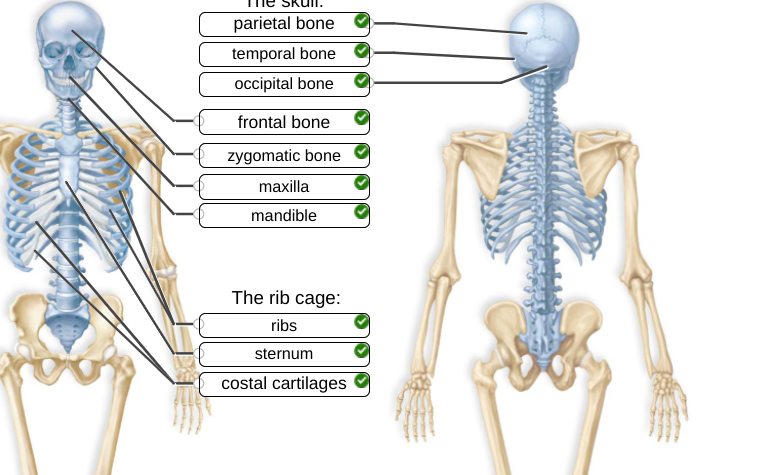
The skeletal system
Reverse
Metathesis- where epiphiyses and diaphyses meet
growth plate
spongey bone- red bone marrow
Epiphyses
How do bones grow, remodel, and repair?
Reverse
posture- stay upright
attach to skeleton- muscles contract
constant body temperature
movement of cardiovascular vessels
protects internal organs
stabilizes joints- tendons- joints tighter
Skeletal muscle
Reverse
shoulder girdle, pectoral girdle, arms, hands, pelvic girdle or hip girdle and lower limbs
Appendicular skeleton
Reverse
Look at slide 12. 14
The coxal bones support the abdominal cavity.
Reverse
Identify the regions of the vertebral column.
Reverse
designed for strength
unorganized appearance
cells receive nutrients through canaliculi
contains trabeculae
These are characteristics of spongy bone marrow
Reverse
- not as strong as bone, but it more flexible
- matrix is gel-like and contains many collagenous and elastic fibers.
- The cells, called chondrocytes, lie within lacunae that are irregularly grouped.
- Cartilage has no nerves, making it well suited for padding joints where the stresses of movement are intense.
- Cartilage also has no blood vessels and relies on neighboring tissues for nutrient and waste exchange. This makes it slow to heal.
The three types of cartilage differ according to the type and arrangement of fibers in the matrix.
- Hyaline cartilage is firm and somewhat flexible. The matrix appears uniform and glassy, but actually it contains a generous supply of collagen fibers. Hyaline cartilage is found at the ends of long bones, in the nose, at the ends of the ribs, and in the larynx and trachea.
- Fibrocartilage is stronger than hyaline cartilage, because the matrix contains wide rows of thick, collagenous fibers. Fibrocartilage is able to withstand both tension and pressure and is found where support is of prime importance—in the disks between the vertebrae and in the cartilage of the knee.
- Elastic cartilage is more flexible than hyaline cartilage, because the matrix contains mostly elastin fibers. This type of cartilage is found in the ear flaps and the epiglottis.
Cartilage characteristics and three types
Reverse
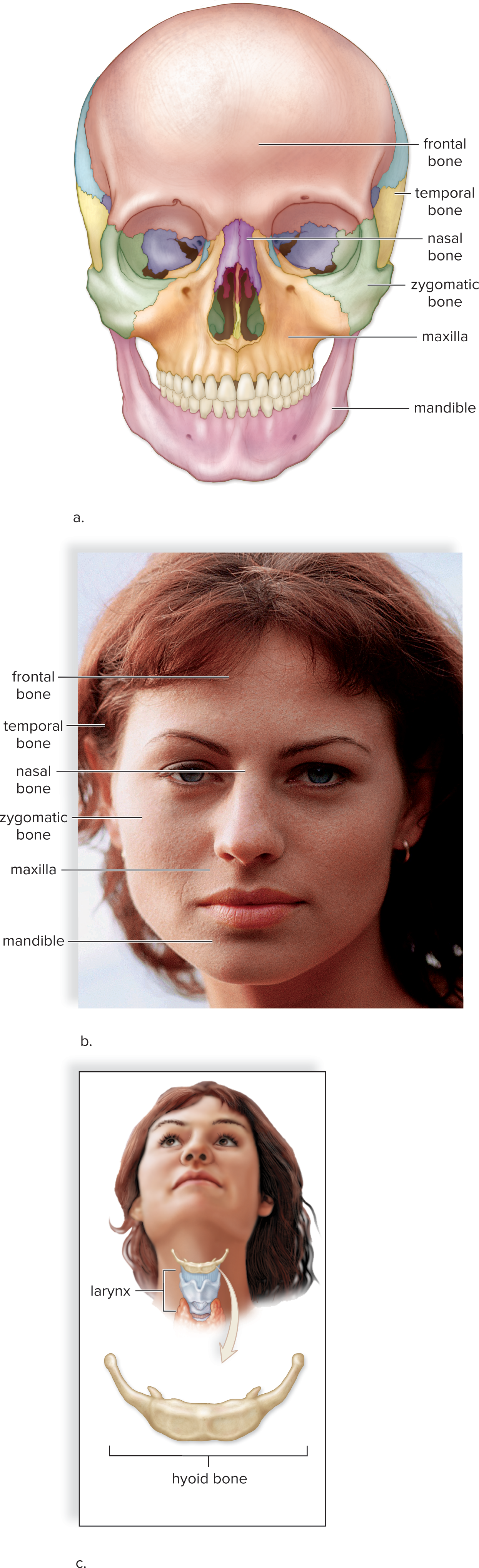
The most prominent of the facial bones are the mandible, the maxillae (sing., maxilla), the zygomatic bones, and the nasal bones.
The mandible, or lower jaw, is the only movable portion of the skull, and it forms the chin (Fig. 12.4 and Fig. 12.5). The maxillae form the upper jaw and a portion of the eye socket. Further, the hard palate and the floor of the nose are formed by the maxillae (anterior) joined to the palatine bones (posterior). Tooth sockets are located on the mandible and on the maxillae. The grinding action of the mandible and maxillae allows us to chew our food.
The Facial Bones
Reverse
contraction cycle
if calcium present- repeats
each time- actin moves closer
Actin filament- thin - filament - two other proteins associated triponin tropomyasin
- calcium - released sarcoplasmic reticulum- shifts position- threads- tropomyasin- myasin binding sites exposed along
heads- golf club- atp binding sites- atp binds- adp and phosphate-
breakdown of atp- myosin heads crossbridge to actin filament-
atp - and phosphate released- changes position- powerstroke- actin filament- pulls towards sarcomere
atp - heads detach actin filament
Reverse
knees elbows, movable, ?
synovial
Reverse
intramembraneous ossificaiton
connective tissues becomes osteoblasts- mesochuymal
secreting ossification center- matrix
bony matrix- collagen fibers and muco polysaccharides
will lay calcium there- by osteoblasts
calcification- part of the process -
Reverse
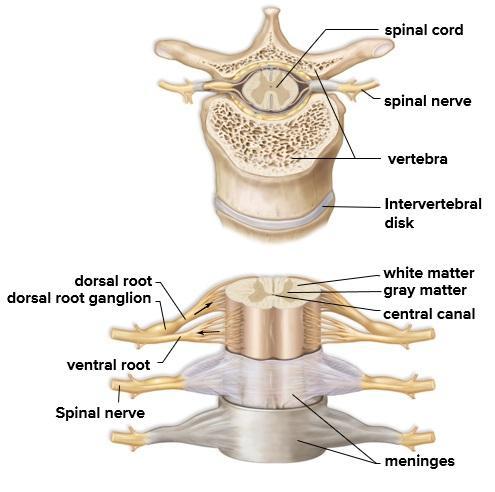
The spinal cord extends from the base of the brain and down through the vertebral column.
- Passes through the foramen magnum into the vertebral canal, which is created by openings in vertebrae
- Spinal nerves project from the spinal cord between vertebrae.
- Protection of the spinal cord
- Bony vertebrae surround spinal cord
- Fluid-filled intervertebral disks cushion and separate vertebrae
- Protective membranes called meninges wrap around the spinal cord
Spinal cord and surrounding structures
- long, thin spinous processes (Fig. 12.7a)
- articulate with one another and with the ribs at articular facets
- between cervicle and lumbar vertebrae
What characterizes the thoracic vertebrae? What do they articulate with? What 2 types of vertebrae is the thoracic vertebrae located between?
Reverse
What are some bone- and joint-associated injuries or conditions?
Reverse
Vertebral column
concave, convex,
structure- helps - stability carry body weight
curvature






-
Urinary System144
-
Digestive System310
-
Skeletal system398
-
Muscular system127
-
Nervous System560
-
Senses535
-
Endochrine System183
-
To go on study Sheet/Exam Q's Testing/PLQ's, thematic connecting dots, processes, lectures, out of view, Learning Smart Hints, Exam 3 100% A+++50
-
Exam 3 Final Study Guide1
-
Reproductive System54



