MSW
Municipal solid waste
Amounts generated in a region depends on:
- rates of urbanisation
- types and patterns of consumption
- household revenue and lifestyles.
-Often more than 30% of public sector budget to prevent/mitigate pollution (main concerns are impact on human and enviro health).. We’re bad at it as Canadians.
Global MSW Outputs
1 - US, #2 - China, #3 - Canada
OECD - Organization for economic cooperation and development - wealthier 34 nations - have global lead on MSW output at 1.6 million tonnes/day
Global output - 1.2 billion tonnes/year, expected to double by 2025
Composition of MSW
- Organics - biodegradable waste…
- Recyclables - paper, glass etc.. & Electronic waste (e-waste, WEEE waste electrical and electronic equipment)
- Inert Waste - construction & demolition waste, dirt etc (no toxicity concerns)
- Composite Waste - hetergeneous mixtures of waste clothing, paper, glass etc (not easily separated)
- Hazardous Waste - paints, chemicals, light bulbs etc
- Toxic Waste - pesticides, herbicides, fungicides etc
- Medical Waste
*CROMITH*
Solid waste legislation (national)
Part 3 of EMA - Municipal waste mgmt
Ministry of Environment required all regions and districts hand in solid waste mgmt plan - goal was 50% reduction by 2000, and 75% by 2015.
Solid waste legislation (reg/municip) - bylaws
- CRD solid waste bylaws
- solid waste disposal
- recycling
- Metro Vancouver bylaws
Five Rs
- Reduce
- Reuse
- Recycle
- Recovery
- Residuals
Reduction Methods
- Reduce amount of waste transported and deposited into landfill
Reduction methods:
- Mechanical reduction processes - compaction, shredding
- Source separation programs - blue bins, collections/drop off
- Organics recycling - composting
Compaction
- mechanical compaction occurs under your sink, in the collection vehicle, at transfer stations or during baling.. Can reduce volumes by 80%
Transfer stations: facilities used to consolidate wastes into larger transport vehicles (semi-trailers) when the disposal site is not in the vicinity of where the waste was collected. Allows for fewer waste vehicles on road.
Shredding/Pulverizing
- Reduces MSW volumes by up to 40%
- Homogeneously sized material facilitates mechanical separation machinery (metals, plastics..)
- Vector (organism) reduction due to difficulty finding food scraps and habitat voids
- Enhances biodegradation in organic wastes
- Homogeneous reduced sizes required for incineration and waste to fuel processes
Baling
- compacting solid waste into rectangular blocks or bales. Typically 1.5m3/1ton
- volume reductions up to 80%
Sanitary Landfill Operation (once reduced MSW is dumped)
- spread out and compacted with special heavy equipment.
- Waste is covered typically each day with a layer of compacted soil, rock, biosolids…. Plastic sheeting cover prevents rain infiltration contributing to leachate.
- Modern sites include the presence a both a bottom liner coupled to leachate control system.
Organic waste: Composting
The biological decomposition of the organic portion of MSW, typically under carefully controlled conditions. Occurs naturally, but we can speed it up.
- Diverts 20-60% of MSW from landfills.(Co-composting of biosolid/organics mixtures)
- Composting can result in organics volume reductions of 30-60%
- Produces rich soil amendment/fertilizer: improved moisture retention, decreased erosion
- Stabilizes organics-reduces leaching of nutrients
- Kills pathogens
Composting: Biology
Primary Consumers:
- Composters - eat organics- bacteria, (actinomycetes), fungi, nematodes, mites…
- earthworms ,millipedes, sow bugs, snails, slugs….shred plant materials to increase surface area for microbes.
Secondary consumers:
- eat primary consumers - beetles, nematodes, mites
Tertiarty consumers:
- eat secondary consumers - larger beetles, ants
- Resulting compost is composed of organic matter including plant, microbial*
- and invertebrate residues*
Compost: Chemistry
- C/N Carbon to Nitrogen ratios
- Moisture
- O2
- Temperature
- pH
•Nutrient balance:
-Adequate P, K and trace minerals
Carbon:Nitrogen Ratio
- C/N is a serious limiting factor in composting efficiency.
- “IDEAL” C/N = 30:1 (finished compost @10:1)
- range of 25:1 to 40:1 supports rapid microbial decomposition.
Brown - C/N too high, too little N= limited cell growth - slow decay
Green - : C/N too low, too much N
Composting Chemistry: Moisture
Optimum moisture content 40-60% (“squeeze test”)
Composting Chemistry: O2
C6H12O6 + **6O2** -\> 6CO2 +6H2O
Rapid aerobic (low odor) decomposition requires sufficient oxygen.
Concentrations > 15% optimal *
Concentrations < 5% : composting slows
Composting Chemistry: Temp requirements
- Psychrophilic (<5o C)
- Mesophilic (10 - 45o C)
- Thermophilic (>50oC)
Decomposition occurs most rapidly in thermophilic stage (40 – 60oC)
Composting Chemistry: Temperature Regulations
O.M.R.R. (under the Waste Management Act)
Organic Matter Recycling Regulations
Pathogen reduction requirements:
a.) Windrows: *(controlled compost rows. Piles are mechanically mixed/aerated.) *
** ≥ 55o C** for at least 15 days with no fewer than 5 turnings during high temp period….
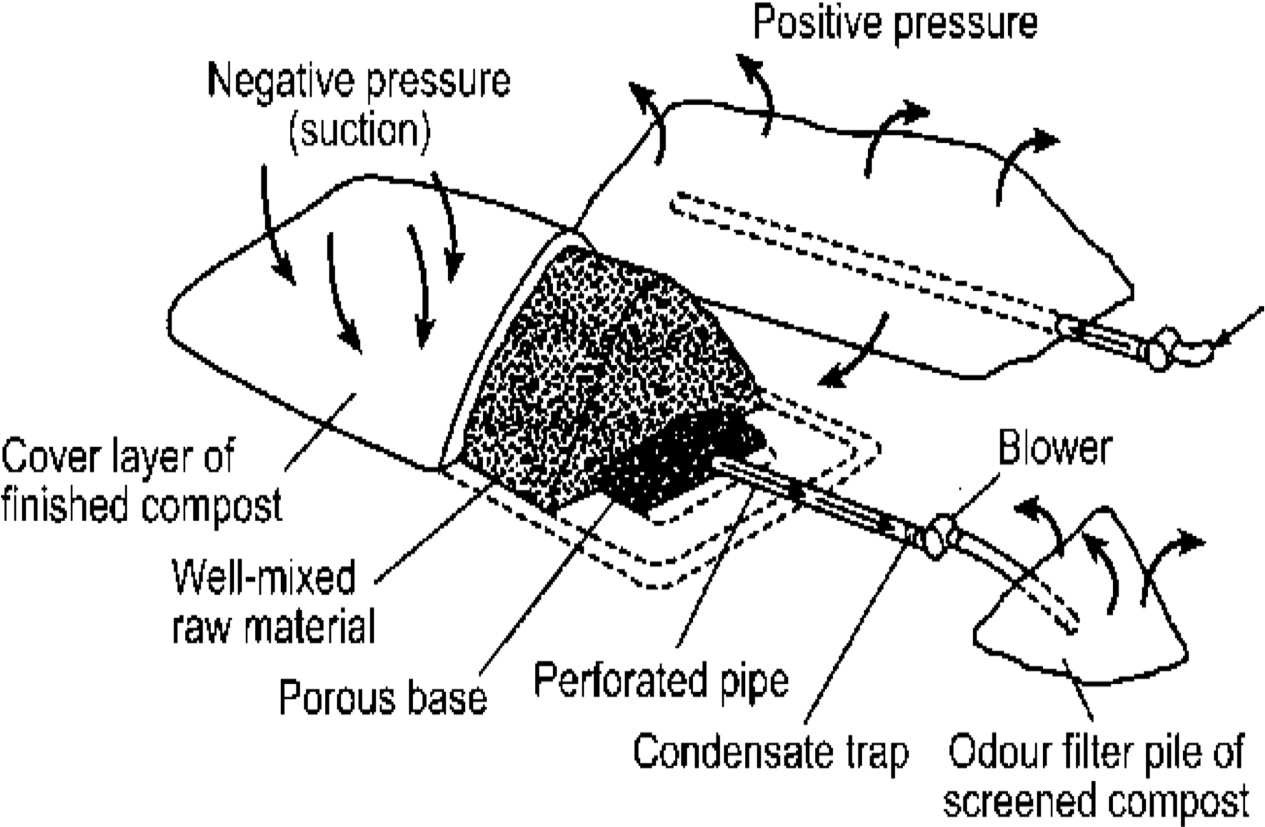
b.) Static aerated piles: (mixed piles remain stationary; aerated through pipes/floor vents ( +/-). )
insulated piles **≥ 55o C** for at least 3 days
c.) In Vessel ‘bioreactors’: (compost medium enclosed, carefully controlled aeration/odor control.)
** ≥ 55o C** for at least 3 days
**All methods involve regular monitoring of O2/Temp/moisture within the piles
Composting Chemistry: pH
- efficient between pH 5.5 and 8.5, with absolute optimums of pH 6.5 to 7.5
- Bacteria and fungi release organic acids during early stages of composting.
-drop in pH encourages fungi and the breakdown of lignin and cellulose.
Biofilters
Odor control is primary concern for compost facilities, especially those near residential areas. Use biofilters because…
least expensive, most effective and most widely used. Composed of moist organic materials and microbes to adsorb, then biologically degrade odorous compounds.
Composting: Physics
- Microbial activity generally occurs on the surface of the organic particles.
- Particle size can increase surface areas, increasing rates of decomposition.
- if particle size is *too small*, the *porosity* and the amounts of *O2 **available decreases*. Bulking agents used (wood chips)
•Shape and Size of compost pile: must be sufficient to retain heat and moisture, yet small enough to maintain aeration. Ambient temperatures a factor (arctic vs tropics)
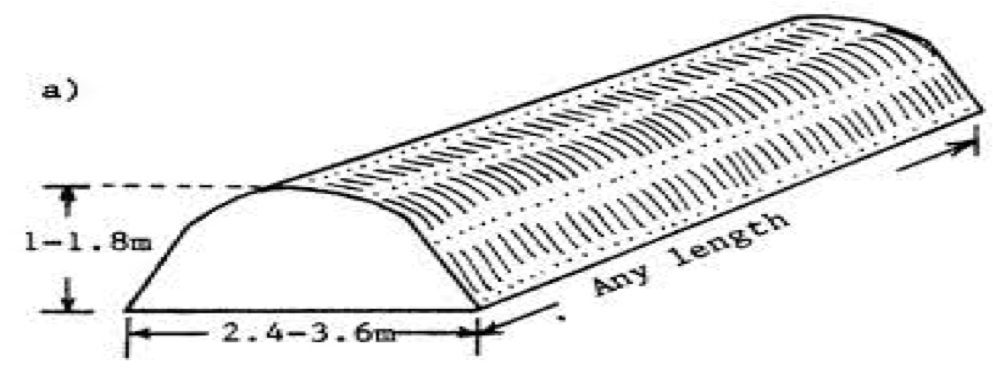
Windrows
- Commercial, large scale operations
- Rows typically sized for optimum SA/volume balance for O2/heat control.
- Outside or covered
- Rows are mechanically turned for aeration and mixing as required
Aerated Static Piles
Variety of commercial systems that biodegrade organics without physical manipulation during 1o composting phase.
- Can be in windrows, open/covered or closed systems.
- Good for high moisture feed stocks
- Reduced handling time/costs..
- Some disposable residuals….