cc: narrowing of the neural foramina
spurling test (compression)
(1) extend and sidebend C-spine to the side being tested
(2) push downward on top of patient’s head
If pain radiates to ipsilateral arm: Test (+)
(pain distribution can localize nerve)
cc: shoulder pain (tests ROM of shoulder)
Apley Scratch Test
(1) Reach behind head and touch opposite shoulder (tests abduction and external rotation)
(2) reach in front of the head and touch opposite shoulder (internal rotation and adduction)
(3) reach behind back and touch inferior angle of opposite scapula with back of hand (internal rotation and adducion)
cc: rotator cuff tear
Drop Arm Test
(1) abduct shoulder to 90 degrees
(2) tell patient to slowly lower arm
(+) if patient cannot lower arm smoothly or if drops to side from 90 degrees
cc: Biceps tendon pain
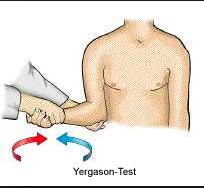
Yergason’s Test
(tests stability of biceps tendon in bicipital groove)
(1) flex elbow to 90 degrees
(2) physician grasps elbow with one hand and wrist with the other hand
(3) pull downward on patient’s elbow and externally rotate forearm with patient resisting motion
(+) biceps tendon pops out of the bicipital groove
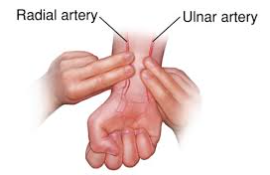
cc: blood supply to the hand
Allen’s Test
(assesses blood supply to the hand by the radial and ulnar arteries)
(1) have patient make fist
(2) occlude radial and ulnar arteries
(3) open hand –> should be pale
(4) release one of the arteries… if flushes slowly or not at all, artery is not adequately supplying hand
(5) repeat on other side
cc: tenosynovitis of abductor pollicus longus and extensor pollicus brevis tendons (aka DeQuervain)
Finkelstein Test
(1) make fist with the thumb tucked inside the fingers
(2) stabilize pt’s foremarm and deviate wrist ulnarly
(+) pain over the tendon at the wrist
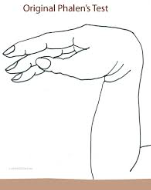
cc: Carpel Tunnel
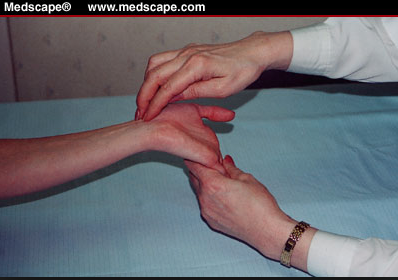
Phalen’s Test
(1) physician maximally flexes the patient’s wrist and holds in position for one minute (inverted prayer sign)
(+) if tingling sensation in thumb, index finger, middle and lateral poriton of ring finger
Reverse Phalen’s Test
(1) put hands in prayer position (wrists are extended)
cc: carpel tunnel (Tinel’s sign)
peformed on the transverse carpel ligament
cc: lower back pain with lateral flexion
Hip-drop test
(1) hold superior and lateral aspects of iliac crest
(2) have patient bend one knee withou lifting the heel from the floor
normal: sidebend towards the contralateral side of the bending knee smoothly with ipsilateral iliac crest dropping more than 20-25 degrees
(+) if not smooth or if drop is less than 20-25 degrees
cc: low back pain
assess hamstring vs sciatic nerve
Straight Leg Raise Test
- patient supine with knees extended.
- place one hand under heel and other hand on anterior aspect of knee
- lift leg upward keeping knee extended and flexing the hip
- lift leg until patient feels discomfort (should go to 70-80 degree flexion)
(+) for pain means either hamsring tightness or sciatic nerve compression
Braggard’s Test
- lower leg just beyond point where pain was felt
- dorsiflex foot (stretches the sciatic nerve)
(+) pain –> sciactic nerve and straight leg raise is considered (+)
(-) pain –> hamstring origin…. then straight leg raise is considered (-)
cc: pelvic pain
(most likely won’t do since would take up too much time, but just a recap)
Standing flexion test
(1) assess **iliosacral **motion
Seated Flexion Test
(1) assess sacroiliac motion
ASIS Compression Test
(1) determines the side of the sacroiliac dysfunction
- side resistant to compression –> (+) on that side
Lumbosacral Spring test
tests whether or not sacral base is tilted posterior
(1) heel of hand over lumbosacral junction… rapid spring applied townward
(+) if no spring
Sphinx Test
(1) patient prone.. thumbs in superior sulci
(2) go into sphinx position (lumbar extension and sacral flexion)
cc: gluteus medius muscle strength
Trendelenberg Test
(1) stand behind patient
(2) patient picks one leg off floor
normal: gluteus medius muscle should pull up unsupported pelvis to keep it level
(+) test: pelvis falls… weakness is in the gluteus medius of the leg that is standing (not leg lifted)
cc: Lateral Hip Pain
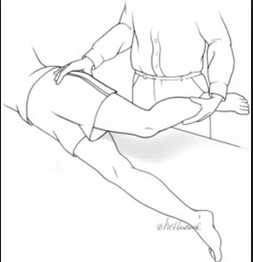
Ober Test (tight tensor fascia lata and iliotibial band)
(1) lie on side opposite the IT band being tested
(2) physician flexes knee, abducts hip to 90 degrees and slightly extends hip while keeping pelvis stabilized
(3) slowly allow thigh to fall to table
(+) if thigh remains in abducted position indicating a tight IT band
cc: OA of the hip
or sacroiliac and hip joint pathology
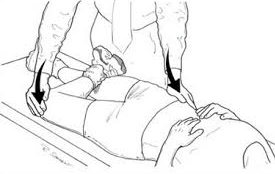
Patrick’s test (FABERE test)
(1) Flexion
(2) ABduction
(3) External Rotation
(4) Extend
(+) pain around hip joint means general hip joint pathology
(5) then place one hand on contralateral ASIS and pressure downward with other hand on pt’s ipsilateral knee
(+) pain accentuated by arthritic changes in hip or SI joint
cc: flexion contracture of the hip / iliopsoas pain
Thomas Test (tests the psoas)
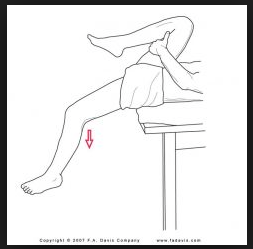
- Patient supine with knees at the end of the table, physician stands at side of table
- Ask patient to bring both legs up to chest and secure with arms, then to drop one leg
- Make sure there is no gap in their lumbar region and assess the space beneath straightened leg
Compare both sides
Normal: Leg should be flat to the table,
(+) test if any space underneath…. means flexion contracture of the hip flexors (e.g. Flexion 35° from table)
cc: anterior hip pain
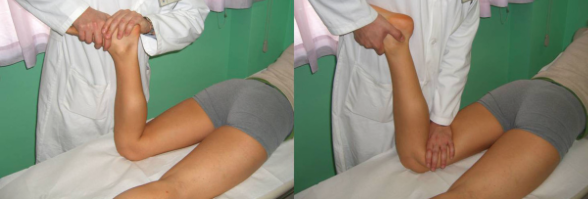
Rectus Femoris Test
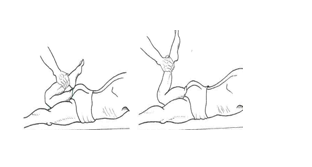
- With pt. prone, stabilize pelvis with cephalad hand.
- Flex knee and assess ROM and restriction.
- Compare bilaterally.
Flexion – 0 – 135o passive ROM.
cc: knee pain
Anterior and Posterior Drawer Test
(1) patient supine with hip flexed to 45 and knee flexed to 90
(2) sit on pt’s foot, wrap both hands behind the tibia, place on thumb on medial joint line and one on the lateral joint line
(3) tibia pulled anterior (tests Anterior cruciate ligament)
(4) push posterior on tibia (tests Posterior cruciate ligament)
Varus and Valgus Stress Test (stability of collateral ligaments)
- lie supine with knee flexed jsut enough to unlock it from full extension. stabilize ankle with one hand and other hand on knee
- valgus test: push lateral –> medial… tests MCL
- Varus test… push medial –> lateral… tests LCL
Apley’s Compression and distraction test
(1) patient prone with knee flexed to 90
(2) compression: press straight down on heel; internally and externally rotate tibia in position.
(+) pain –> meniscal tear
(3) distraction: pull upward on foot; internally and externally rotate tibia
(+) pain –> ligamentous injury
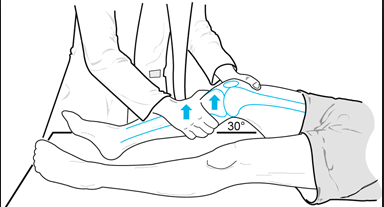
cc: knee pain Lachman Test
Lachman’s Test
(assesses stability of ACL)
- patient supine. grasp proximal tibia with one hand and distal femur with other hand
- flex knee to 30 degrees.
- tibia pulled forward by hands
- both sides compared
(+) if tibia excessively moves out from under the femur
cc: knee pain: McMurray test
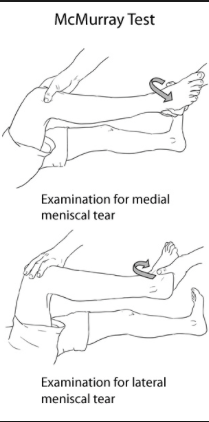
McMurray Test
(detects tear in posterior aspect of menisci)
- fully flex knee.
- physician’s finger palpate medial knee joint line.
- externally rotate tibia and place valgus stress on knee
- maintain position, then slowly extend knee… if palpable or audible “click” noted, test (+) for posterior tear of medial meniscus
- to test lateral meniscus… do same procedure but with internal rotation and varus stress
cc: patello-femoral syndrome
Patellar grind test
- patinet lies supine with knee fully extended and relaxed
- physician pushes the patella distally, then instructs patient to contract quads
(+ ) test: any roughness of the articular surfaces will grind and be painful when muscle contracts and moves patella
cc: ankle pain
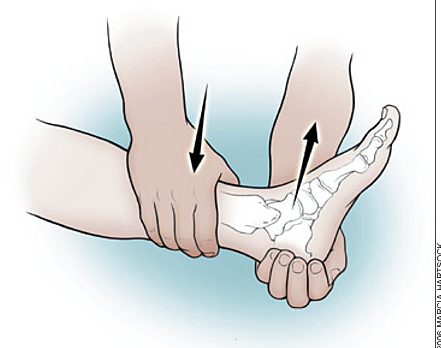
Anterior Drawer Test of Ankle
(tests medial and lateral ligaments of the ankle… mostly anterior talofibular but also superficial and deep deltoid ligaments)
- patient supine. physician grasps the distal tibia/ fibula with one hand and pulls the foot forward with the other hand grasping posterior aspect of the calcaneus
- foot should be held in 20 degrees of dorsiflexion the entire time
- check both sides
if after comparing both sides, excessive movement of the talus under the tibia/ fibula occurs, then a bilateral injury has occured to the mentioned ligaments
if there is deviation to one side, then only the ligaments to the opposite side of the foot are damaged
cc: abdominal pain possible appendicitis
Rebound
- Ask patient which hurts more
- pushing in slowly but deeply or suddenly lift hand from point of depression
Rovsing’s Sign
- pain in RLQ with LLQ pressure
Psoas sign
- Place your hand just above the patient’s right knee
- Ask patient to raise that thigh against your hand
pain –> (+) test
cc: abdominal pain acute appendictis continued
one other sign
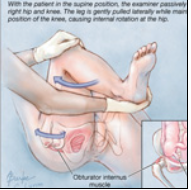
Obturator sign
- Patient lies supine with right thigh flexed 90 degrees
- Examiner immobilizes right ankle with right hand
- Left hand rotates right hip by:
- Pull right knee laterally (hip external rotation)
- Pull right knee medially (hip internal rotation)
- Left obturator/Pelvis examined in similar fashion
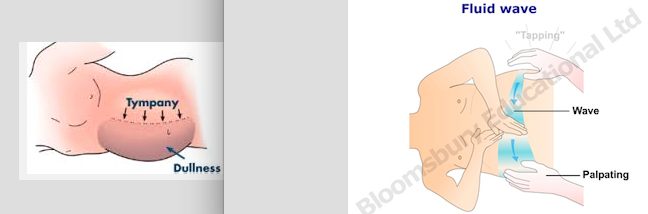
cc: Ascites
Shifting dullness
- place patient in supine position
- percuss from umbilicus laterally to dullness
- roll patient to decubitus position
- perscuss from highest elevation to dullness
- note shifting of dullness –> ascites
Fluid Wave
- place patient’s hand vertically on abdomen’s umbilical line
- tap side with finger pads while feeling for transmitted pulse on other side