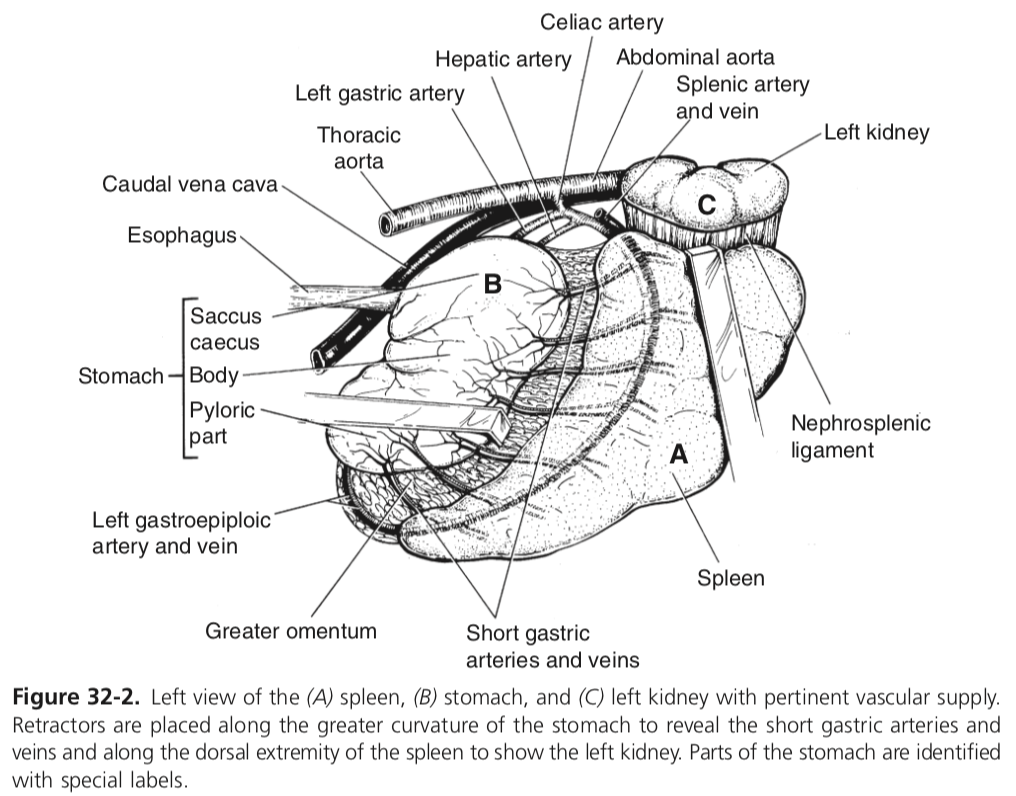
Parts of the stomach
Cardia
Fundus (saccus caecus - blind ending & most caudally located)
Body
Pylorus
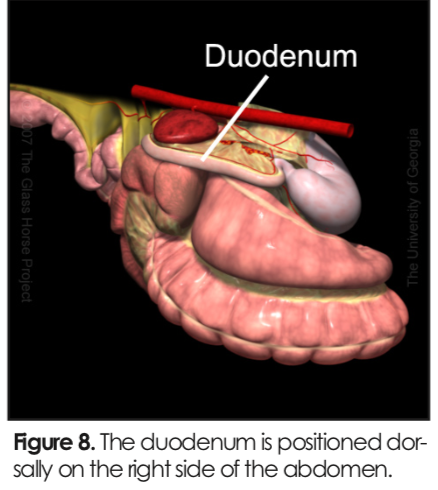
Parts of the duodenum
- Dilated ampulla immediately after pylorus
- Curves sharply dorsally, creating the cranial duodenal flexure - pancreas lies within this
- From cranial flexure, runs caudally, dorsally on the right as the descending duodenum (has v short mesoduodenum)
- Then runs across base of caecum, curving caudally around ROM to the left side of abdo = the caudal duodenal flexure
- Ascending duodenum then runs cranially for a short time & is attached to transverse/ descending colon at duodenocolic fold, continuing as jejunum from there
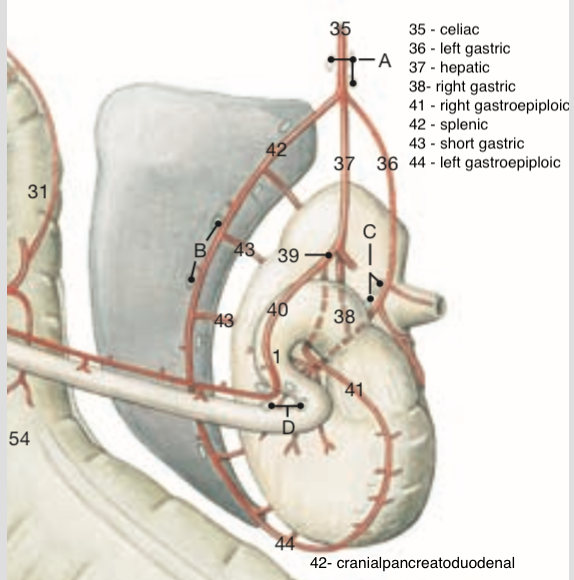
Blood supply to the stomach & duodenum
Stomach - celiac aa (supplies liver, spleen, stomach, pancreas & proximal duodenum) via branches of the splenic aa (short gastric aa), gastric & gastroepiploic aas (see image)
Duodenum - from celiac (cranial pancreatoduodenal aa) and cranial mesenteric (caudal pancreatoduodenal) aa - so good collateral supply
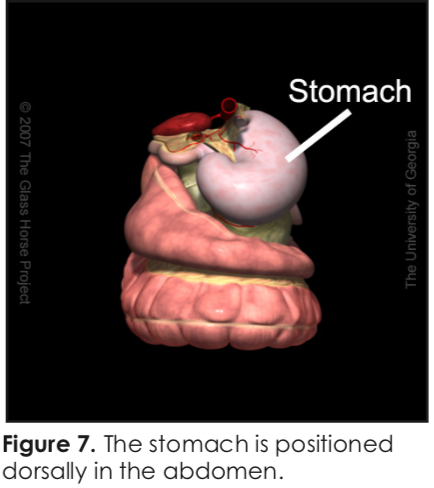
Attachments/ligaments of the stomach
Greater curvature (left)- greater omentum. Closely assoc w gastrosplenic (greater curvature - hilus of spleen), gastrophrenic (cardia - diaphragm) & phrenicosplenic (spleen - diaphragm) -all 3 continuous.
Greater omentum blends w gastrophrenic ligaments - forms a potential cavity, the omental bursa, entered by the epiploic foramen
Lesser curvature (right)- lesser omentum consisting of hepatogastric and hepatoduodenal ligaments (lesser curvature on the right so remember as liver/duodenum on the right)
Boundaries of the epiploic foramen (and direction of entrapment)
Caudate process of liver, caudal vena cava (craniodorsally), right lobe of the pancreas, & hepatic portal vein (ventrally).
Almost all entrapments occur from LEFT to RIGHT
(right to left is reported)
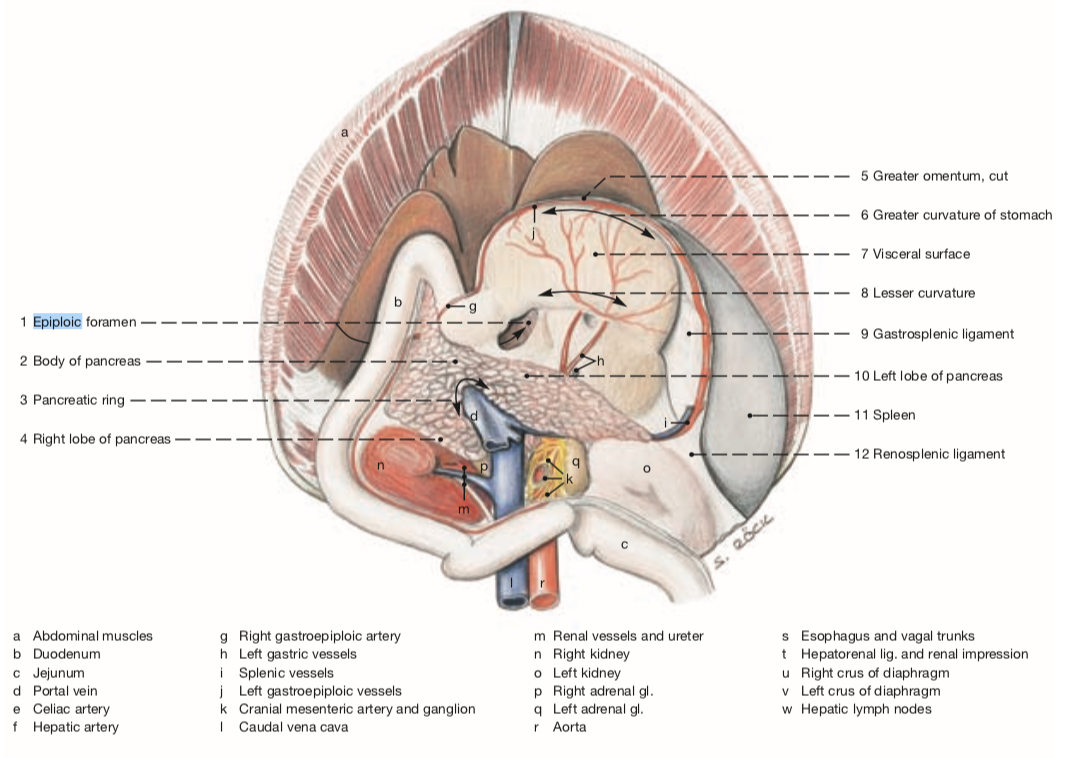
4 distinct areas of gastric mucosa
- Nonglandular stratified squamous - extensive (50% surface) - no secretory capacity
- Cardiac epithelium - glandular belt of tissue adjacent to margo w unknown function, bicarb?, -ve fb for acid secretion?
- Proper glandular gastric mucosa; parietal cells (HCl) zymogen cells (pepsinogen), enterochromaffin cells (histamine), G cells (gastrin - enhance acid secretion), D cells (somatostatin - inhibits acid secretion)
- Pyloric mucosa.
Where do the bile and pancreatic ducts empty?
And the accessory duts?
Bile & pancreatic ducts open within cranial flexure & empty via major duodenal papilla
Accessory pancreatic duct empties approx opposite major, at minor duodenal papilla
What is the migrating myoelectric complex & its 3 phases
Cyclic, recurring motility pattern that occurs in the stomach and small bowel during fasting
Phase I – A prolonged period of quiescence (40–60% of total time);
Phase II – Increased frequency of action potentials and smooth muscle contractility (20–30% of total time);
Phase III – A few minutes of peak electrical and mechanical activity (5–10 minutes);
Phase IV – Declining activity which merges with the next Phase I
4 layers of the stratified squamous gastric mucosa
From deep to superficial -
- Stratum germinavatum
- Stratum spinosum
- Stratum transitionale
- Stratum corneum
GSTC -
Similar to skin BSGLC
Methods of acid protection for the gastric mucosa
exceptionally impermeable (transepithelial resistance of 2-3000Ω/cm2) conferred mainly by interepithelial tight junctions in the stratum corneum and secretions from the stratum spinosum.
gastric mucosa is protected from ‘back diffusion’ of H+ by high transepithelial electrical resistance, as well as mucus and bicarbonate secretion and Na+ H+ exchangers
Protection superior in glandular vs squamous region
Repair mechanisms for the gastroduodenal muosa
- Superficial wounds - epithelial restitution - migration of epithelium adjacent to area of injury
- Deep wounds - req repair of submucosal vasculature, occurring through granulation tissue formation, fibroplasia & epithelial migration, likely facilitated by epidermal growth factor
Methods to measure gastric emptying
Scintigraphy. Eg 370MBq T99 w egg albumin (for solid phase) & in water (for liquid phase) by NGT after 12hr fast. Liquid & solid phase 50% gastric emptying times are 30 & 90 minutes, respectively, in normal horses
Acetaminophen (paracetamol) - 20mg/kg PO; clearance correlates w scintigraphic emptying
C-octanoic acid - breath samples correlate well w scintigraphic gastric emptying
Dx & Tx of gastric impaction
Dx - solid feed filled to or above margo after >16hr fast
Tx - medical; PO fluids, starvation, carbonated no caffeine drinks (coke zero)
Sx - infusion of fluid via 14g needle through greater curvature
Gastrotomy difficult/impossible but reported
Partial gastrectomy & total splenectomy has been used to tx gastric mass (Voss 2020)
Risk factors for gastric impactions
Fresian breed
Poor dentition
Link w liver dz
Ingestion of persimmon seeds
Sx tx options for pyloric outflow tract obstruction
- Hieneke Mikulikze pyloroplasty - Kent 2020 EVR CR; full thickness 4 cm longitudinal incision was made through ventral pylorus & proximal duodenum, between stay sutures. Closure transversely - single layer full thickness SI 0 PDS sutures between the oral & aboral side of the now transverse orientated incision, starting at the centre (the initial commissures of the incision).
- Bypass procedures depending on the location of the obstruction. Incl gastroduodenostomy, duodenojejunostomy or gastrojejunostomy. Any anatamosis w jejunum involved needs to be combined w jejunojejunostomy to prevent filling of the proximal segment of jejunum (see diagrams). Can use stapled or hand-sewn techniques. 2 layers (mucosal and seromuscular) sufficient
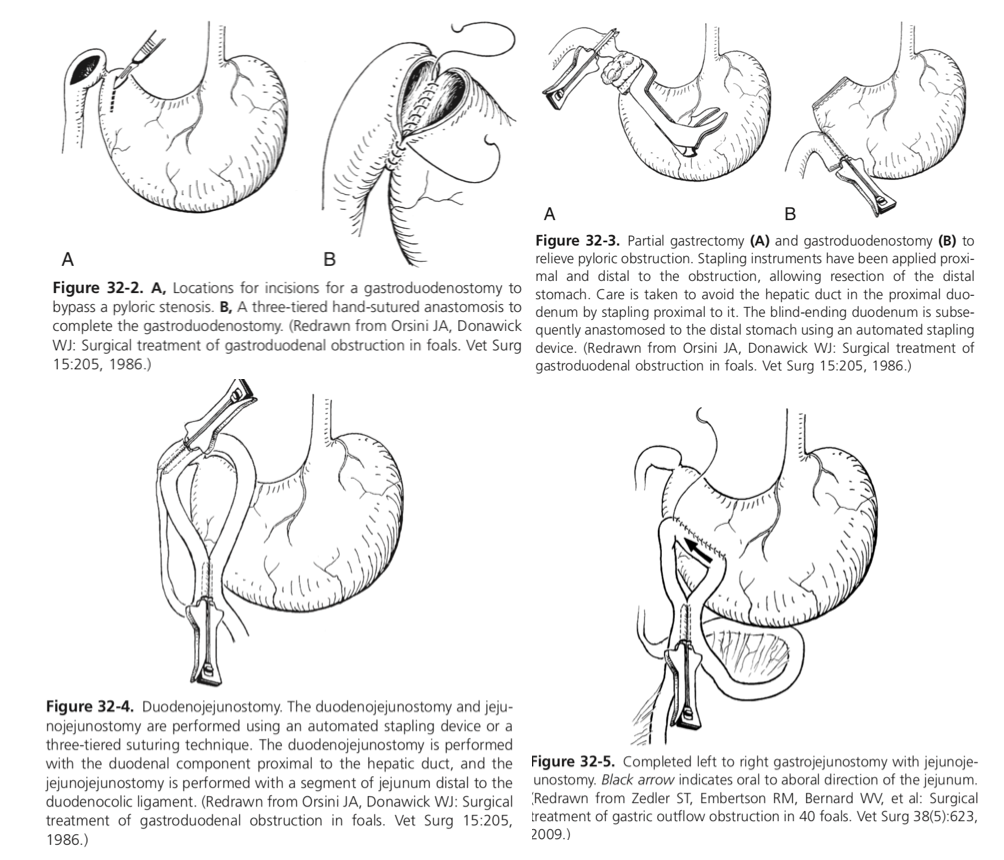
Indications, procedure & outcomes for gastroduodenostomy (GD) (Zedler 2009 VS)
- GDO performed when there was pyloric obstruction &/or obstruction of the proximal 1–2 cm of duodenum, provided duodenum distal to obstruction could be aligned w stomach without excessive tension
- 4–5 cm segment of duodenum sutured to stomach w 2-0 PG 910 continuous Lembert
- Full thickness 3-4cm incisions, made into stomach & duodenum parallel & close to 1st suture line. (If ventilated, gastric incision made between breaths to avoid rapid expulsion of content.
- Cut edges of the stomach and the duodenum adjacent to original suture line (far side) were then apposed w 2-0 pg 910 in a full thickness simple continuous pattern.
- The near side-incised edges were apposed with a full thickness, simple continuous pattern, oversewn w a continuous Lembert, w 2-0 or 3-0 pg910.
- This side to side anastomosis produced an average stoma length of 2.5–3 cm between the stomach and the duodenum
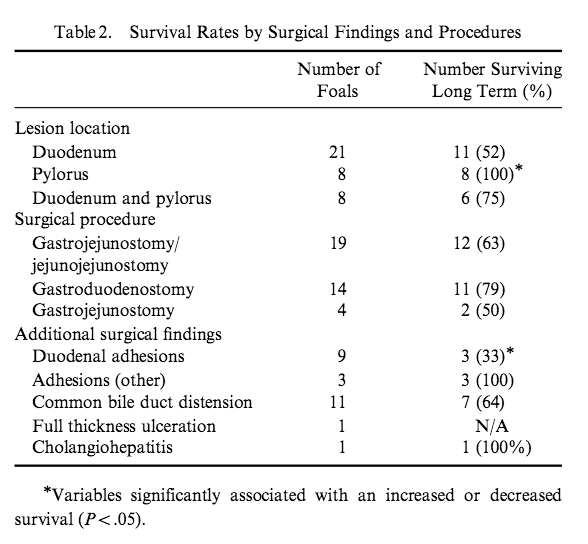
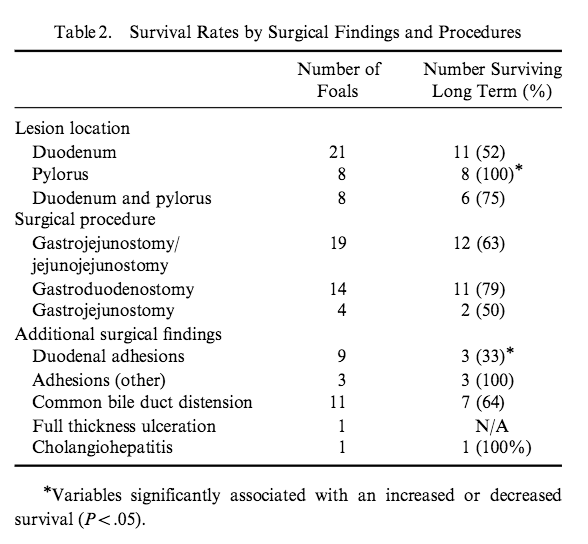
- 79% long term survival
Indications, procedure & outcome for gastrojejunostomy (+/- jejunojejunostomy) (Zedler 2009 VS)
- Used w duodenal obstruction or pyloric obstruction w significant duodenal involvement
- In most foals, GJO combined w JJO to avoid potential complications assoc w blind loop
- A 7–8 cm segment of proximal jejunum (20cm aboral to duodenocolic fold) aligned w a relatively avascular region of caudal ventral aspect of stomach, secured w 2-0 pg 910 stay sutures.
- Jejunum aligned w oral segment to the left side of the foal’s abdomen & aboral segment to the right & distal to the planned anastomosis.
- Side-side GJO; first suturing the jejunum, slightly off the anti-mesenteric site, to stomach w 2-0 pg910. Far side sutured 1st, then incisions made. Near side closed in 2 layers w 2-0/3-0 pg 910 = 6–7 cm stoma
- JJO performed by aligning 10–15 cm oral & aboral to GJO site.
- The JJO was either hand sewn or stapled; stapled anastomoses: autosuture stapling instrument inserted & fired
- Far edges of stab incisions apposed w single layer simple continuous pattern. Near sides apposed w a simple continuous pattern oversewn w continuous Lembert. Ends reinforced w single cruciate
- Hand-sewn - 2 layer side-to-side as per GDO/GJO
- 12/19 & 2/4 GJ+JJ & GJ only respectively LTS (overall - 14/23 = 61%)
- ie better LTS w GJ + JJ combined
Differentiating features of DPJ vs SSI lesions
DPJ usually respond well to analgesia/gastric decompression
Often leucocytosis & pyrexia
Surgery generally worsens px for DPJ
Main branches of the celiac artery
- Left gastric artery
- Hepatic artery
- Splenic artery (gives off short gastric aa to lesser curvature)