Define a stroke
A stroke involves, usually permanent, neurological deficit lasting >24 hours
Define a TIA
A TIA involves a brief episode of neurological dysfunction without permanent effects lasting <24 hours
What is the proportion of stroke that is ischaemic? And what proportion is haemorrhagic?
15% are haemorrhagic
85% are ischaemic
Within ischaemic stroke, what are the different types?
Atherosclerosis
Cardioembolic
Other
Within haemorrhagic stroke, what are the different types?
Intracerebral
and subarachnoid
What do A and B represent?
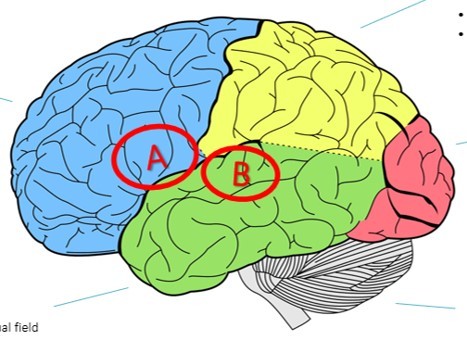
A: Broca’s area
B: Wernicke’s area
Which lobes do each of the coloured areas represent?
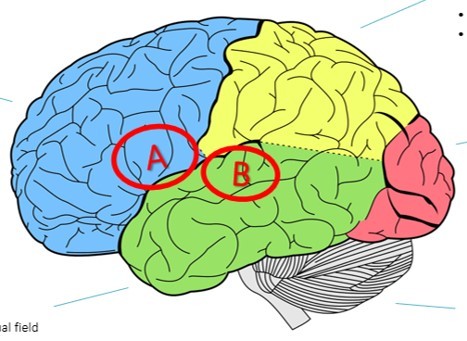
Blue: frontal lobe
Yellow: parietal lobe
Green: temporal lobe
Red: occipital lobe
What functions is the frontal lobe responsible for?
- Motor function
- Higher cognition
- thought processing
- reasoning
- intelligence
What functions is the parietal lobe responsible for?
- Sensory function
- Sensory association
- Vision
- fibres for lower quadrant visual field
What functions is the temporal lobe responsible for?
Temporal lobe
- language
- hearing
- vision
- fibres for upper quadrant visual field
- memory and emotion
- association
What functions is the occipital lobe responsible for?
vision
What functions is the cerebellum responsible for?
Cerebellum
- Balance
- Movement
- Coordination
The following areas are (generally) supplied by which arteries?
- Red
- Yellow
- Blue
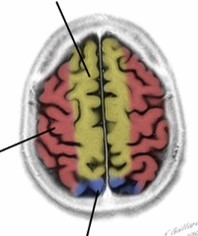
- Middle cerebral artery
- Anterior cerebral artery
- Posterior cerebral artery
The following areas are supplied (generally) by which arteries?
- Blue
- Red
- Yellow
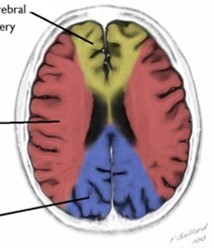
- Posterior cerebral artery
- Middle cerebral artery
- Anterior cerebral artery
Why do motor and sensory deficits often occur together?
Because the brain regions responsible for them are beside each other
Label the main arteries that supply the brain in this diagram of *what*?
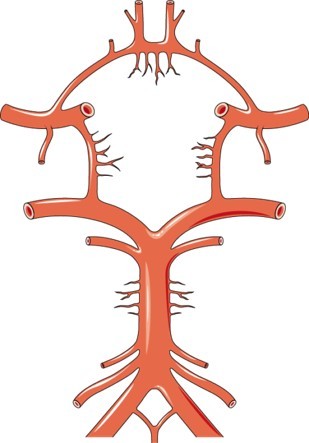
The Circle of Willis
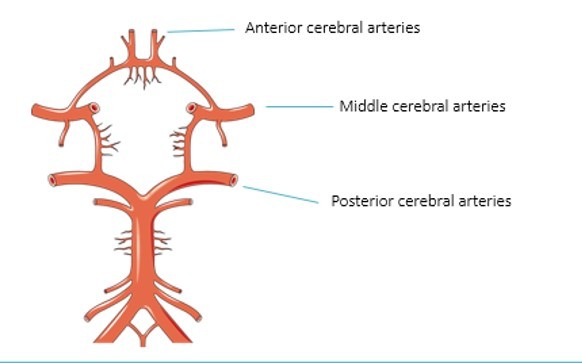
Which lobe/lobes do the anterior cerebral arteries supply?
Frontal
Parietal
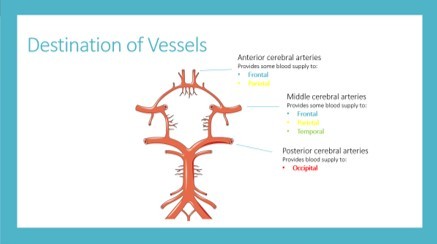
Which lobe/lobes do the middle cerebral arteries supply?
Frontal
Parietal
Temporal
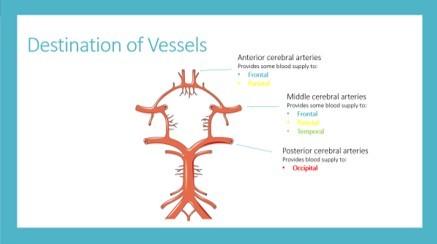
Which lobe/lobes do the posterior cerebral arteries supply?
Occipital
What is the Oxford Classification of Stroke?
It categorises stroke based on the inital presenting symptoms and clinical signs
Does the Oxford Classification of Stroke provide a diagnosis?
No, it’s essentially a working diagnosis before imaging which can give an idea of where to look for the causative issue
What are the four different categories a stroke could fit under in the Oxford Classification of Stroke?
TACS (total anterior circulation stroke)
PACS (partial anterior circulation stroke)
LACS (lacunar syndrome)
POCS (posterior circulation syndrome)
What is a TAC?
A Total Anterior Circulation Stroke
a large stroke affecting a large vessel
of the anterior circulation and :.
many smaller downstream vessels
supplying various brain regions
In a TAC
A) Which part of the brain circulation is disrupted?
B) Which arteries are disrupted?
C) Which brain lobes are affected?
A) Anterior circulation
B) Anterior and middle cerebral arteries
C) Frontal, parietal and temporal






