Gives the audience hints or signs about the future. It suggests what is to come through imagery, language, and/or symbolism. It does not directly give away the outcome, but rather, suggests it.
Foreshadowing
Effects:
- It is a technique used to change the perception of the audience by providing them with more knowledge than to some or all of actual characters involved.
- Depending on how it is used, it can serve as an element for humor, fear, tension, excitement, suspicion or, most commonly, suspense and anticipation.
- By revealing clues to the plotline, foreshadowing works as a tool to help the audience feel more invested in a story. It encourages them to develop personal opinions and predictions about the outcome, which in turn makes them more likely to continue watching, listening, or reading. Without the use of foreshadowing, the audience would rarely feel the desire to finish a story.
A short scene in which the action jumps ahead to the future of the narrative. It takes a narrative forward in time from its current action. Usually reveals something significant about a character, plot, setting or idea by showing what is going to happen before it has actually happened.
Example:
She woke up to the sound of the ambulance. Her head was throbbing, and her face was resting in a warm, sticky pool. The touched her forehead and brought her fingers in front of her eyes. ‘Blood,’ she thought to herself.
TWO HOURS EARLIER
‘I’m late. I’m so late. I’ll never make it on time.’ she thought to herself. The woman grabbed an untidy stack of papers from her desk, picked up her purse and heals, and ran out the door of her office. Once she reached her car she tossed her shoes and everything else into the passenger’s seat, threw the car in reverse, and sped out of the exit of the car park without paying.
Flash-forward
Effects:
- Because they reveal action before it occurs, flash-forwards build anticipation in the audience and a desire to follow the story until it reaches the outcome that they know is coming.
- Ability to grab the audience’s attention and build their enthusiasm.
- Flash-forwards add a creative and atypical element to a traditional storyline by showing what is to come—a thing that most stories strive not to reveal.
A device that moves an audience from the present moment in a chronological narrative to a scene in the past. Often, they are abrupt interjections that further explain a story or character with background information and memories.
Example:
Can occur as a sudden thought sequence, a hazy dream, or a vivid memory. It can be announced or unannounced in the line of narrative.
‘A woman is about to get married. As she puts on her veil, she remembers her fiancé three years before, swearing he would make her his wife someday. A tear comes to her eye and she prepares to walk down the aisle.’
Flashback
Effects:
- Flashback is important in that it adds complication and depth to a narrative that is otherwise straightforward and chronological.
- Flashbacks can thicken plots, create dynamic and complex characters, reveal information otherwise left unspoken, or surprise the audience with shocking secrets.
- Is a necessary element of most plots, as we gain information about nearly everything from referencing the past. A large part of a character’s essence can be found in the past and the memories which resurface over time.
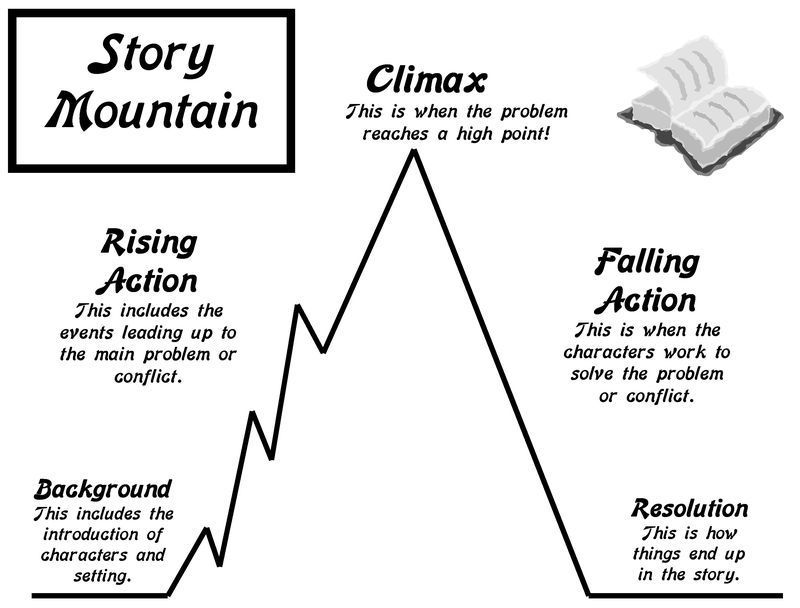
Is a series of episodes in a narrative which occur after the exposition and lead to the climax of the story. It usually comprises the majority of the plot, as the author must include all necessary events and information for the eventual climax and denouement to be significant to the reader.
Rising Action
Effects:
All novels and works of drama contain rising action. After the audience is introduced to the characters and the conflict (and what’s “at stake”), the author describes events in which the characters try to solve the conflict and interact with each other. This is a natural part of story-telling; if we learned of the end of the story first, there would be hardly any need to find out what happens before the end. The rising action in a story is what makes us care what finally happens.
The highest point of tension or drama in a narratives’ plot. It is also when the main problem of the story is faced.
Climax
Effects:
- Climax is the high point of a story.
- Without climax, a story lacks excitement or an overarching meaning.
- Climax is considered an absolutely necessary element of plot. Beyond basic stories, climax is an essential element of many poems, movies, television shows, advertisements, and songs.
The section of the plot following the climax, in which the tension stemming from the story’s central conflict decreases and the story moves toward its conclusion.
Falling Action
Effects:
- To carry the plot from its climax to a resolution.
- To allow time for “unwinding” or de-escalating some of the tension that was built up during the rising action by showing the characters going through the process of re-ordering their lives or restoring the natural balance.
- To keep the audience engaged after the climax by introducing one or more smaller conflicts during the falling action.
The final section of a story’s plot, in which loose ends are tied up, lingering questions are answered, and a sense of resolution is achieved. The shortest and most well known one, it could be said, is “And they lived happily ever after.” Most stories, however, require a longer concluding section to achieve a sense of resolution.
Dénouement
Effects:
- To allow time at the end of the story for tying up loose ends and answering questions that arose during the rising action.
- To provide the audience with a sense of closure.
- To explain the preceding events in a way that shows their larger significance.
- To show how the events of the story changed or impacted the lives of the main characters.
- To suggest what might be in store for the characters going forward.
- To bring the story to an end.
Is the first paragraph or paragraphs in which the characters, setting (time and place), and basic information is introduced. A lot of movies show thid by panning over the city or countryside and showing the main character doing something such as walking, working, or waking up. These scenes allow the readers to understand where the story is taking place and who’s in it.
Exposition
Effects:
- Exposition locates readers in the world of the story: it establishes the “who, what, where, when,” and sometimes “why” of a plot.
- Depending on a writer’s goals and the style in which they are writing, they may place exposition at the beginning of a story, or they may introduce it gradually throughout the text, often with the aim of creating mystery or building suspense by withholding key details that contextualize important events and explain characters’ world-views or motivations.
Is usually a character who opposes the protagonist (or main character) of a story, but the it can also be a group of characters, institution, or force against which the protagonist must contend.
Example:
A simple example is the Queen in Snow White and the Seven Dwarfs, who opposes and wants to destroy Snow White
Antagonist
Effects:
- The antagonist is who or what creates the tension or conflict that makes that goal harder for the protagonist to reach.
- Without an antagonist, many stories would seem to lack a sense of drama or action, and the protagonist wouldn’t face any challenges in reaching their goal.
- Conflicts brought about by an antagonist can also test the morals and beliefs of characters, which shows the audience who the main characters really are and what they stand for.
The main character of a work of literature; the audience is generally supposed to empathize with this person and understand the motivations that propel the character to do what he or she does. The story circles around this character’s experiences, and the audience is invited to see the world from his or her perspective. The person is not necessarily a “good guy.” Although most of the time the he/she is some kind of hero, sometimes we see the whole story from the perspective of a villain.
Protagonist
Effects:
- Protagonists give the audience someone to focus on and lend narrative unity to the story.
- Without a protagonist, the story’s various elements would have nothing to tie them together.
- And if the protagonist is boring, then the story will not be compelling and readers will not care what happens next.
A plot device often used in literature to highlight the difference between a character’s understanding of a given situation, and that of the audience.
The reader or audience has knowledge of some critical piece of information, while the character or characters to whom the information pertains are “in the dark”—that is, they do not yet themselves have the same knowledge as the audience.
Dramatic Irony
Effects:
- Dramatic irony is often used for laughs — our extra information makes the characters appear ridiculous because we know what they’re doing won’t work.
- Perhaps more often, though, it’s a way of building tension. When we have information the characters don’t have, we want to shout a warning through the screen. Audience members end up on the edge of their seats, anticipating that something terrible is going to happen that the characters can’t see coming.
- There’s something about this tension that reminds us of our own vulnerability — after all, if the character on screen can’t see the murder creeping up behind them, then maybe you can’t either…
Character undergoes substantial internal changes as a result of one or more plot developments. The change can be extreme or subtle, as long as his or her development is important to the book’s plot or themes.
Dynamic Character
Effects:
- Can make a story feel more realistic. The majority of people change (a lot!) over the course of their lives, so dynamic characters are often more sympathetic or relatable than static characters.
- Can show how life experiences (especially adverse ones) can create change and build character.
- Can move the plot forward as well, setting new conflicts into motion or resolving old ones.
- Having a character undergo changes can be revealing about who the character really is, what they value, and how they respond to conflict.
The use of informal words or phrases in writing or speech.
Examples:
- Regional differences: One famous difference of this in the US is the way a person refers to a carbonated beverage. There are regional borders that separate the usage of the words “soda”, “pop”, “soft drink”, and “Coke” (used as a generic term and not just to refer to the brand). There are numerous differences between American English and British English, such as “truck”/“lorry”, “soccer”/“football”, and “parakeet”/“budgie”.
- Contractions: Words such as “ain’t” and “gonna” are examples of this, as they are not used widely throughout English-speaking populations.
Colloquialism
Effects:
- Writers use colloquialism to create realistic voices for their characters, both in dialogue and first-person narration.
- Colloquialism can be an excellent tool for characterizationbecause a person’s use of colloquialisms and the dialect they speak can help denote the region or country they come from, their socio-economic or ethnic background, and even the period of time in which they live
A plot device whereby an unsolvable conflict or point of tension is suddenly resolved by the unexpected appearance of an implausible character, object, action, ability, or event.
For example:
If a character fell off a cliff and a flying robot suddenly appeared out of nowhere to catch them,
Deus Ex Machina
Effects:
- The goal of this device is to bring about resolution, but it can also introduce comedic relief, disentangle a plot, or surprise an audience.
- Deus ex machina can be surprising and exciting for readers or audiences, since shocking endings can make for compelling narratives.
- When a writer finds him or herself with no other option for moving a plot toward a resolution, deus ex machina can be used (though such usage of deus ex machina is usually seen as lazy writing).
- If a writer wants to change the arc of a story so it doesn’t reach a point of crisis that seems inevitable, a deus ex machina can be introduced to save the day.
- Because deus ex machina is often criticized, it can be a great and subversive tool for undercutting literary conventions and expectations. In this way, it can open up new artistic possibilities.
- Is a writer’s unique style of expression, especially his or her choice and arrangement of words.
- A writer’s vocabulary, use of language to produce a specific tone or atmosphere, and ability to communicate clearly with the reader;
- A writer favors specific words or phrases and uses them throughout his or her work; though a writer might also modify his or her diction to achieve certain effects, such as to create characters of different types and backgrounds.
Diction
Effects:
Diction allows writers to develop characters, manipulate tone, and reference past literary works, which are all core aspects of literary writing. Perhaps more important, though, is that a writer’s diction determines their ability to connect with a particular audience. Diction is not simply about manipulating language to achieve an effect; it’s also about shaping language so that it is clear enough for the reader or listener to understand.
A short quotation, phrase, or poem that is placed at the beginning of another piece of writing to encapsulate that work’s main themes and to set the tone.
Examples:
One of the most famous in the English literature starts Jane Austen’s masterpiece “Pride and Prejudice”:
‘It is a truth universally acknowledged, that a single man in possession of a good fortune must be in want of a wife’. - The whole novel revolves around the problems of marriage, as they are intertwined with the problems of money and social position so that the first sentence brings out the main theme
Epigraph
Effects:
- To place their work in dialogue with the work of a writer they respect, or whose work they see as being related to their own.
- To suggest one of the main themes of the work before the reader begins reading.
- To set the tone or mood of the work.
- To create an association in the reader’s mind—with a certain time period, artistic movement, idea, or image.
A problem, antagonism, or struggle that takes place between a character and an outside force. It drives the action of a plot forward.
Examples:
- a character may be struggling against another character, the natural world, or society.
External Conflict
Effects:
Without a problem or conflict, most stories wouldn’t go anywhere: the protagonist would stay at home, or perhaps they would achieve their goals without any of the challenges or struggles that make a good story interesting to read.
A character is said to be one-dimensional or lacking in complexity. Typically, they can be easily and accurately described using a single word (like “bully”) or one short sentence (like “A naive and idealistic schoolteacher with a fragile heart of gold”). The important thing about this type of character is that they never transcend or break with the formula that defines them.
Flat Character
Effects:
- Flat characters can be necessary to move a story along. Having too much information about minor characters can detract attention from the protagonist and the story’s primary themes and conflicts.
- In stories that are allegorical or instructive, flat characters might be used as a part of symbolism. In other words, a writer might use a flat character like a “bully” as a stand-in for the idea of negativity or violence more generally—which wouldn’t be possible if the bully felt too nuanced and real as a character.
- Flat characters are particularly common in genre fiction (such as science fiction, horror, and crime), where character development isn’t emphasized and stories are generally very plot-driven. These stories are populated with flat characters so the reader can focus on the plot rather than character development.
- A flat character can be used to parody cultural stereotypes, and thus their flatness and the audience’s ability to clearly recognize what cultural group they represent, can be used for comedy or political commentary.
A literary term that refers to a tragic flaw or error that leads to a character’s downfall. A character’s tragic flaw isn’t necessarily a morally reprehensible one. On the contrary, the flaw is sometimes an apparently positive quality, such as trusting others.
Examples:
In the novel Frankenstein, Victor Frankenstein’s arrogant conviction that he can usurp the roles of God and nature in creating life directly leads to ruinous consequences for him, making it an example of this.
Hamartia
In literature and drama, hamartia is what creates tragic heroes. It can lead to a critical discovery on the hero’s part, and works to create complicated and relatable characters.
Refers to excessive pride or overconfidence, which drives a person to overstep limits in a way that leads to their downfall. Both heroes and villains can display this.
Examples:
In Greek mythology, Icarus is given artificial wings made of wax and feathers so that he can fly (a superhuman feat), but he ignores his father’s warnings and flies too close to the sun, melting his wings and drowning in the ocean.
Hubris
Effects:
- Serves a cautionary purpose
- Propels a story’s plot
- Hubris makes characters relatable
The general atmosphere or emotional complexion—in short, the array of feelings the work evokes in the reader. Every aspect of a piece of writing can influence this, from the setting and the imagery to the author’s word choice and tone. It is often confused with tone, which is related but different in that tone refers to the attitude of a piece of writing, not its atmosphere.
Example:
For instance, a story that begins “It was a dark and stormy night” will probably have an overall dark, ominous, or suspenseful one.
Mood
Effects:
- It enables writers to take their readers on a journey that is emotional in addition to being imaginary or imagistic.
- It helps convey the central themes of the work. For instance, a play about death might have a mournful or gloomy mood.
- It can help the reader identify more fully with the writer or characters by causing readers to feel the same emotions the writer or characters feel.
- It helps works of literature “come alive” by imbuing the language with human emotions.
Is a piece of information in a story that distracts readers from an important truth, or leads them to mistakenly expect a particular outcome.
Examples:
Most often, it is used to refer to a “false clue”—a piece of evidence that misleads readers to believe that a crime (or other action) was committed by someone other than the actual culprit.
Red Herring
Effects:
- Without misleading evidence to lead them astray, it would often be too easy for clever readers to guess how a story will end. Therefore, writers rely on red herrings to build suspense in their stories and keep readers guessing about what will happen next.
- Many readers like to try to “solve” the mystery at the center of a story as they read, guessing ahead about how it will end. Yet, many of the most memorable stories reach an entirely different conclusion from the one readers were led to expect.
- The exciting and satisfying plot twists that make so many novels and films suspenseful would not work without the red herrings which lead the audience to mistakenly expect the story to resolve in a different way.
A character that is said to be lifelike or complex. They have fully fleshed-out and multi-faceted personalities, backgrounds, desires, and motivations.
Example:
Jay Gatsby in F. Scott Fitzgerald’s The Great Gatsby is this type of character. A wealthy man who throws lavish parties for high-society New Yorkers, at first glance Gatsby may seem quite simple, but over the course of the book he is revealed to have a deep and complicated personal history that gives rise to some surprising motivations: his relentless pursuit of wealth and stature is driven by his desire to get close to the woman he loves.
Round Character
Effects:
- The more details a writer shares about a character, the more likely it is that readers will be able to empathize with that character, or become intrigued enough to care about what happens to them as the story unfolds.
- Because round characters are complex, they tend to be more believable to readers, lending credibility to the story as a whole.
- A complicated character can, in turn, reveal complicated themes and ideas about the society in which they are a part, or about humanity in general.
- A character whose depth and complexity are revealed to a reader gradually—and whose psychology becomes more complicated and nuanced as a result—can imbue a story with a sense of suspense.
Is where and when a story or scene takes place. The where can be a real place like the city of New York, or it can be an imagined location, like Middle Earth in J.R.R. Tolkien’s The Lord of the Rings. Similarly, the when can be a real time period (past or present) or imagined (the future). Landscape, architecture, time of day, social context, and weather can also determine this.
Example:
The setting of Jane Austen’s Pride and Prejudice is the upper-middle class countryside of 19th century England,
Setting
Effects:
- Reflect or emphasize certain character traits belonging to people who inhabit certain settings. For example, in the Pride and Prejudice quotation above, Austen’s descriptions of Mr. Darcy’s graciousness and of his estate’s natural beauty mirror one another.
- Give physical form to a theme that runs throughout the narrative.
- Indicate the social and economic statuses of their characters, as well as how those characters do or do not conform to those statuses.
- Create a source of pressure or stress that causes characters to act in a certain way.



