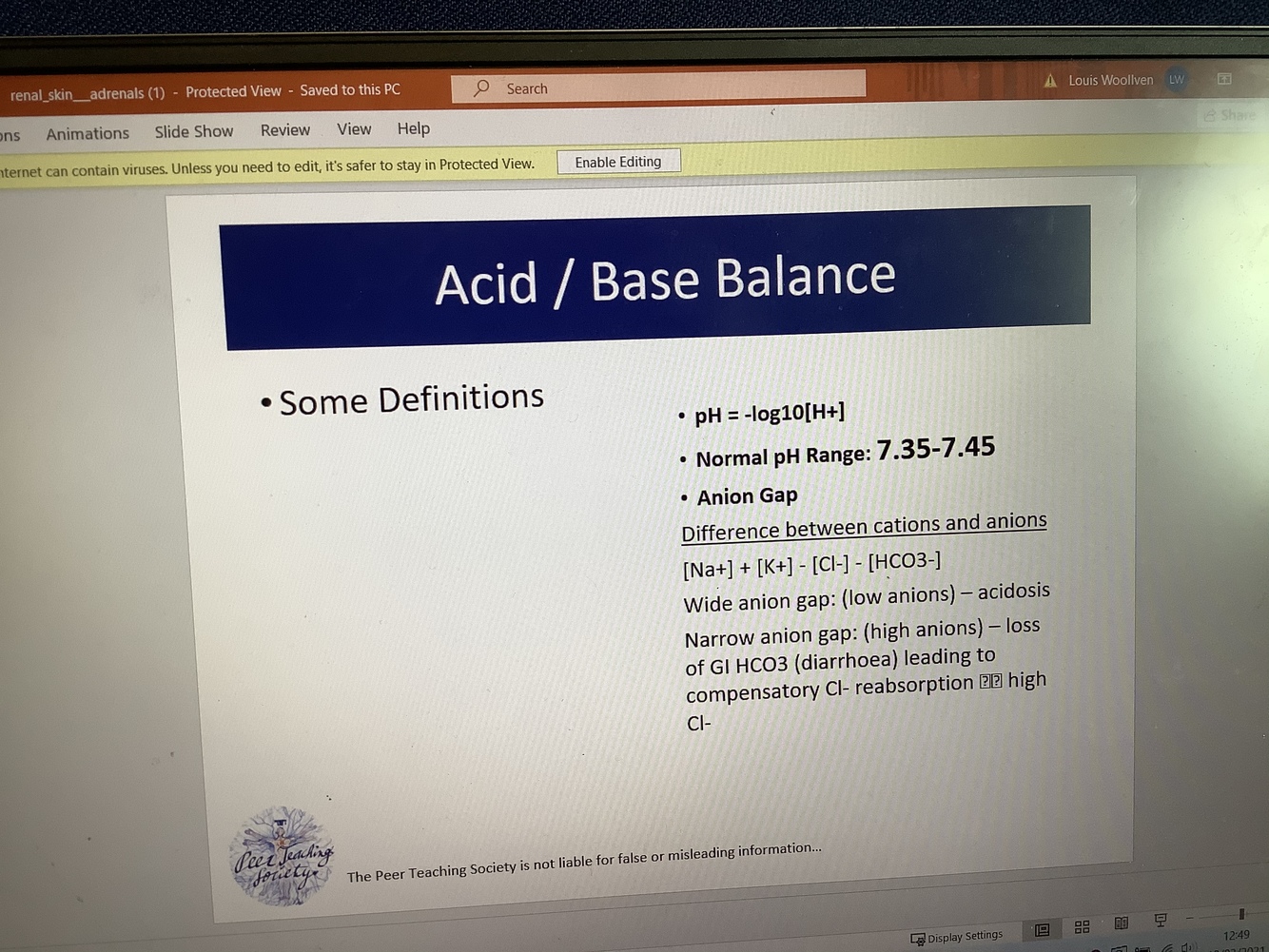
What is the equation for pH? What is the normal range?
- pH = -log10[H+]
- Normal range of pH = 7.35-7.45
What do these terms mean:
- Base
- Acid
- Base excess
- Standard base excess
- Acidosis
- Alkalosis
- Acidemia
- Alkalemia
- Base = accepts H+ ions
- Acid = donates H+ ions
- Base excess = quantity of acid required to return plasma pH back to normal
- Standard base excess = quantity of acid required to return ECF back to normal
- Acidosis = blood more acidic than normal
- Alkalosis = blood more alkaline than normal
- Acidemia = low blood pH
- Alkalemia = high blood pH
What is the anion gap? What does a wide anion gap mean? What does a narrow anion gap mean?
- Anion gap = the difference between measured anions (negative) and cations (positive)
- Anion gap = [Na+] + [K+] - [Cl-] - [HCO3-]
- Normal = 10-16
- Wide anion gap (low anions) = acidosis
- Narrow anion gap (high anions) = loss of GI HCO3- leading to compensatory Cl- reabsorption = high Cl-
What is the aim of urinary buffers? What are the two types? Where do these take place?
- Urinary buffers aim to add alkalinity to the blood
- 2 types = phosphate and ammonium
- Take place in proximal tubule
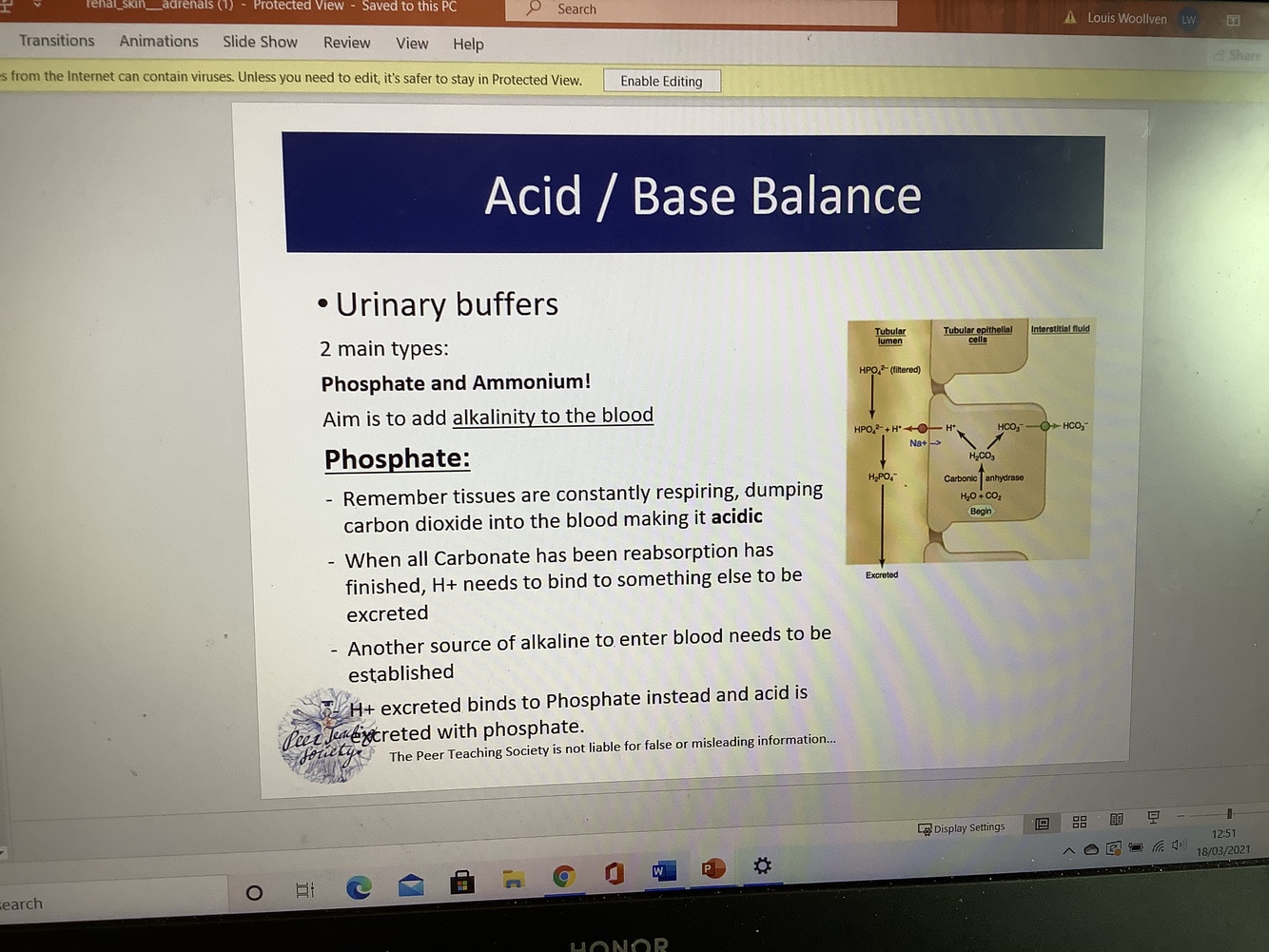
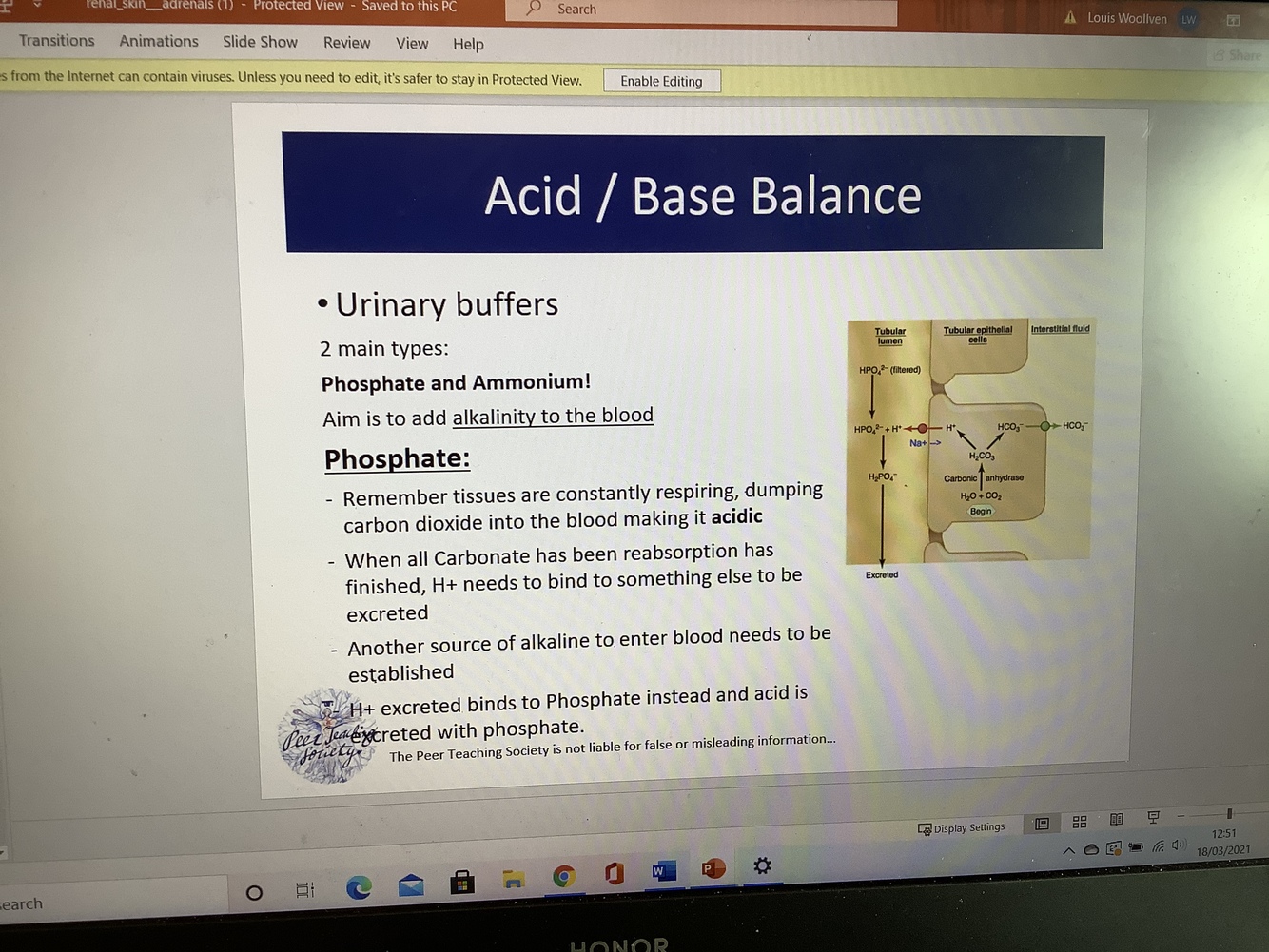
What does the urinary phosphate buffer do?
- Tissues are constantly respiring, dumping CO2 into the blood to make it acidic
- Alkaline phosphate (HPO4 2-) = commonest urinary buffer
- When all the carbonate reabsorption has finished ( HCO3- + H+ = H2CO3), H+ needs to bind to something else to be excreted
- Another source of alkaline to enter the blood needs to be established - this is HPO4 2-
- H+ excreted from dissociation of H2CO3 combines with HPO4 2- to form H2PO4 2-, which is then excreted in urine
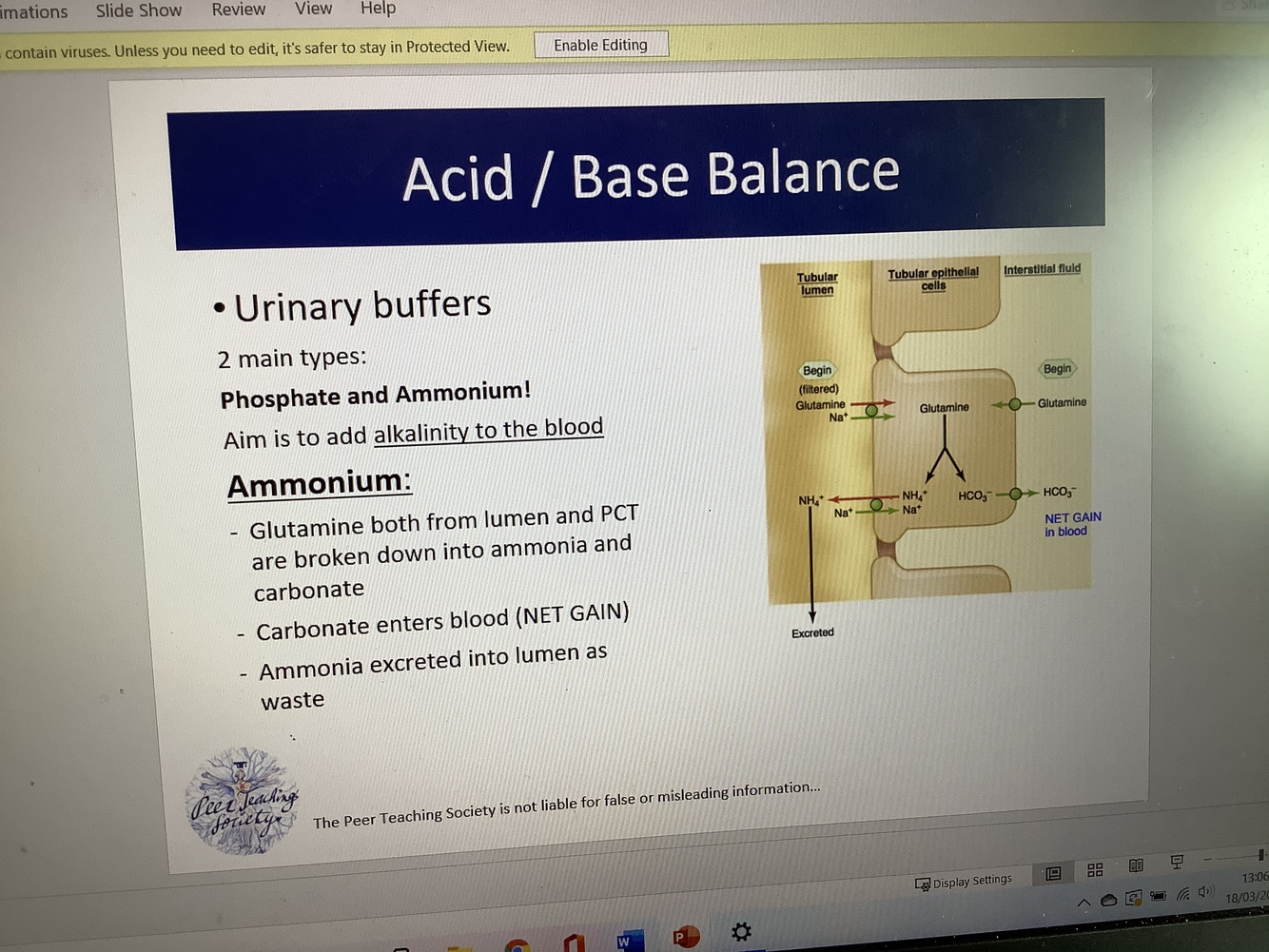
What does the ammonium urinary buffer do?
- Tubular cells, mainly those of the proximal tubule, take up glutamine both from the glomerular filtrate + peritubular plasma and metabolise it to form NH3 (ammonia) and HCO3- (bicarbonate)
- HCO3- moves into blood, alkalising the blood plasma
- NH3 reacts with H+ and is excreted into the lumen and then excreted as waste
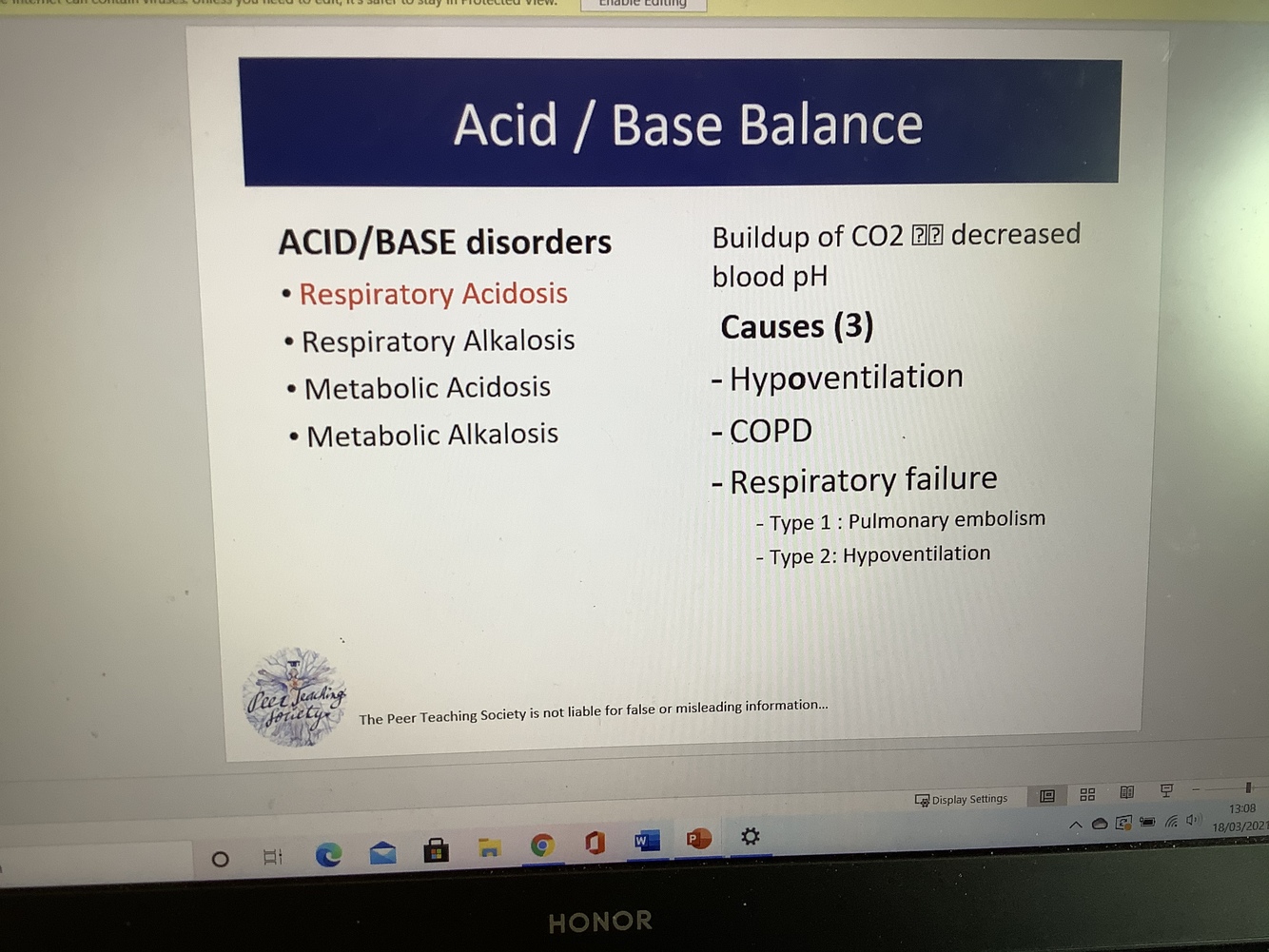
What is respiratory acidosis? What are the causes?
- Respiratory acidosis = buildup of CO2 = decreased blood pH
- Causes:
- Hypoventilation
- COPD
- Respiratory failure (type 1, e.g. pulmonary embolism and type 2, e.g. hypoventilation)
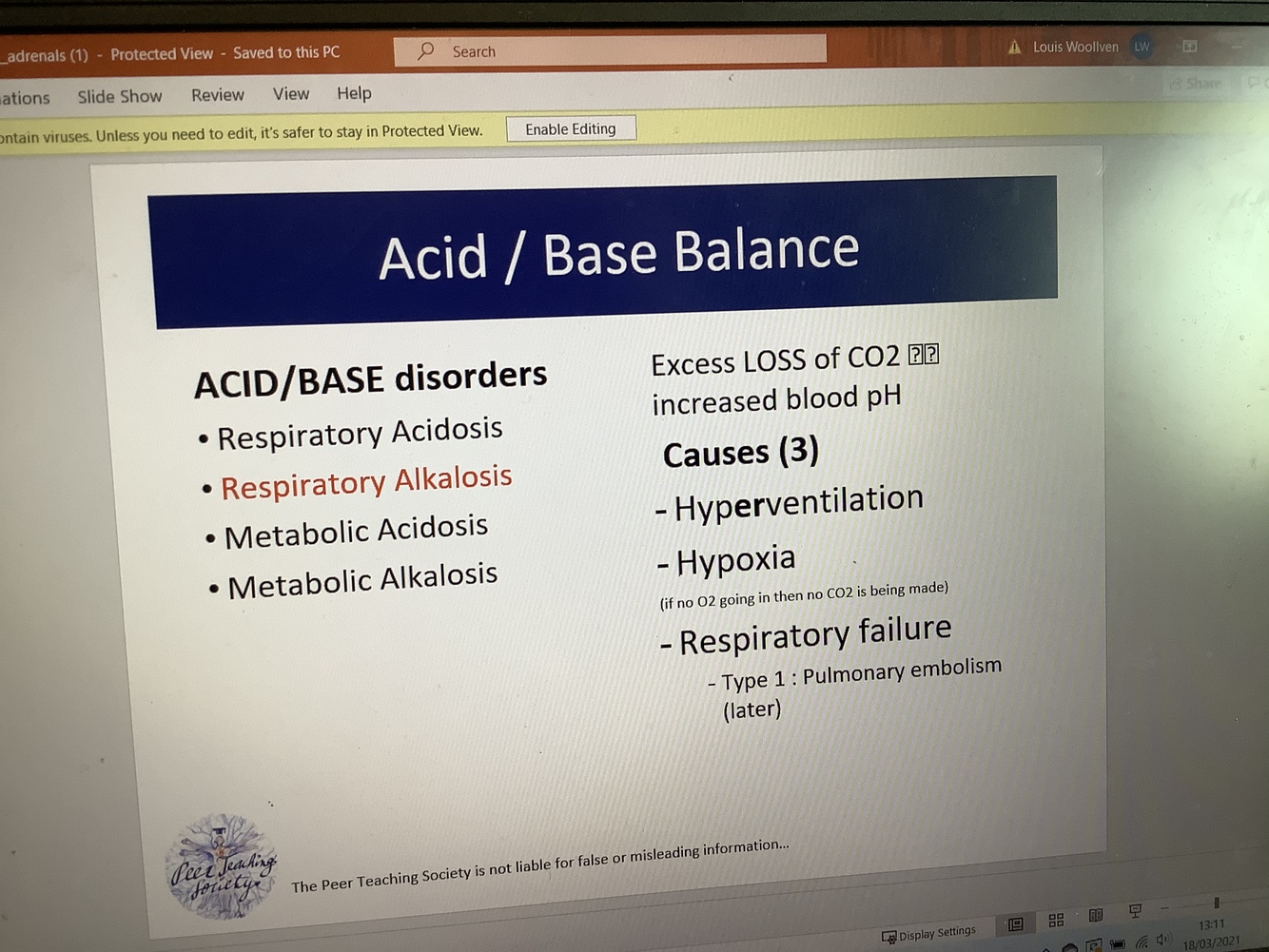
What is respiratory alkalosis? What are the causes?
- Respiratory alkalosis = excess loss of CO2 = increases blood pH
- Causes:
- Hyperventilation
- Hypoxia (no O2 going in then no CO2 being made)
- Respiratory failure (type 1, e.g. pulmonary embolism)
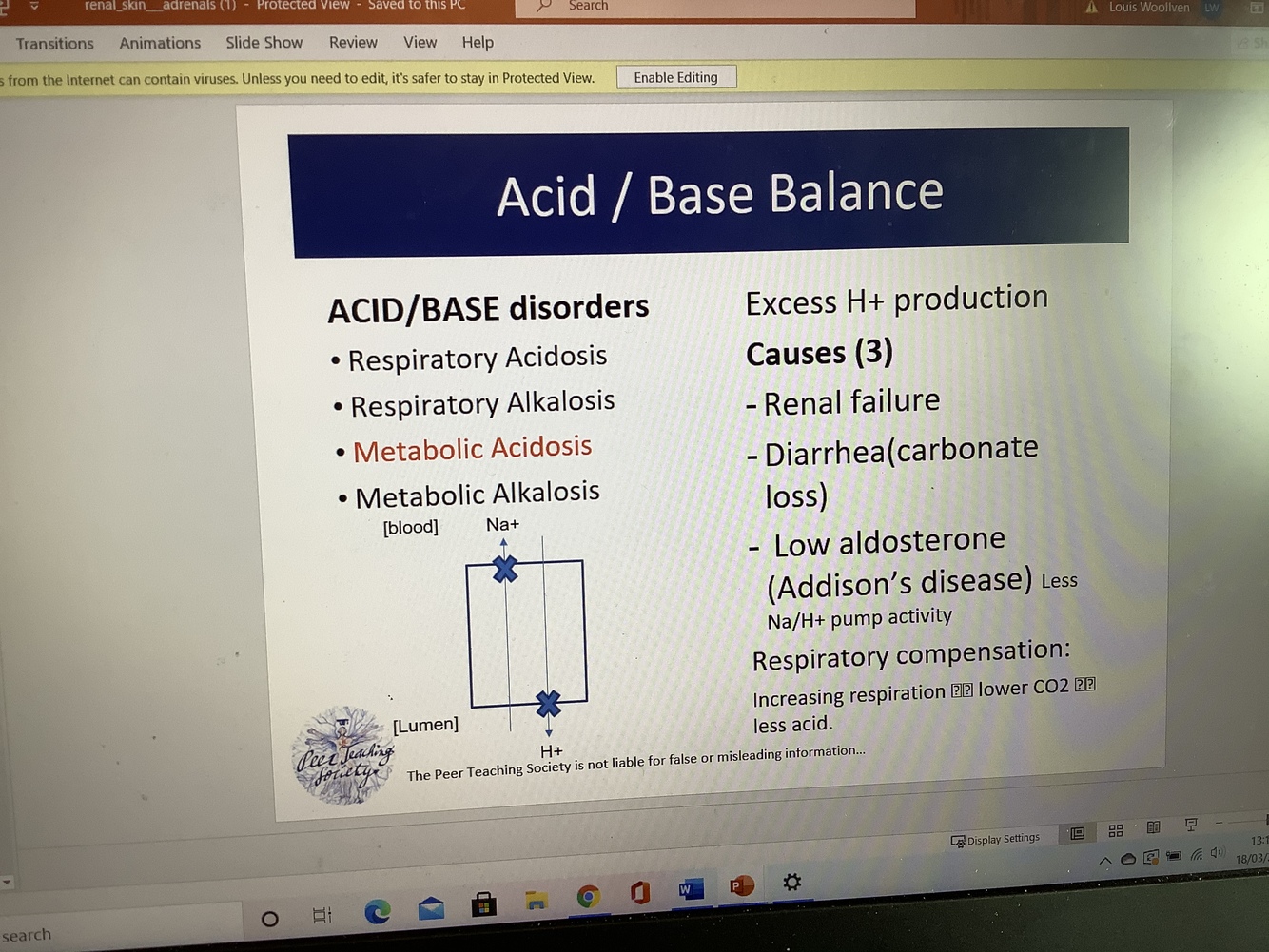
What is metabolic acidosis? What are the causes?
- Metabolic acidosis = excess H+ production
- Causes:
- Renal failure
- Diarrhoea (carbonate loss)
- Low aldosterone (Addison’s disease) = less Na+/H+ pump activity. Respiratory compensation = increasing respiration = lower CO2 = less acid
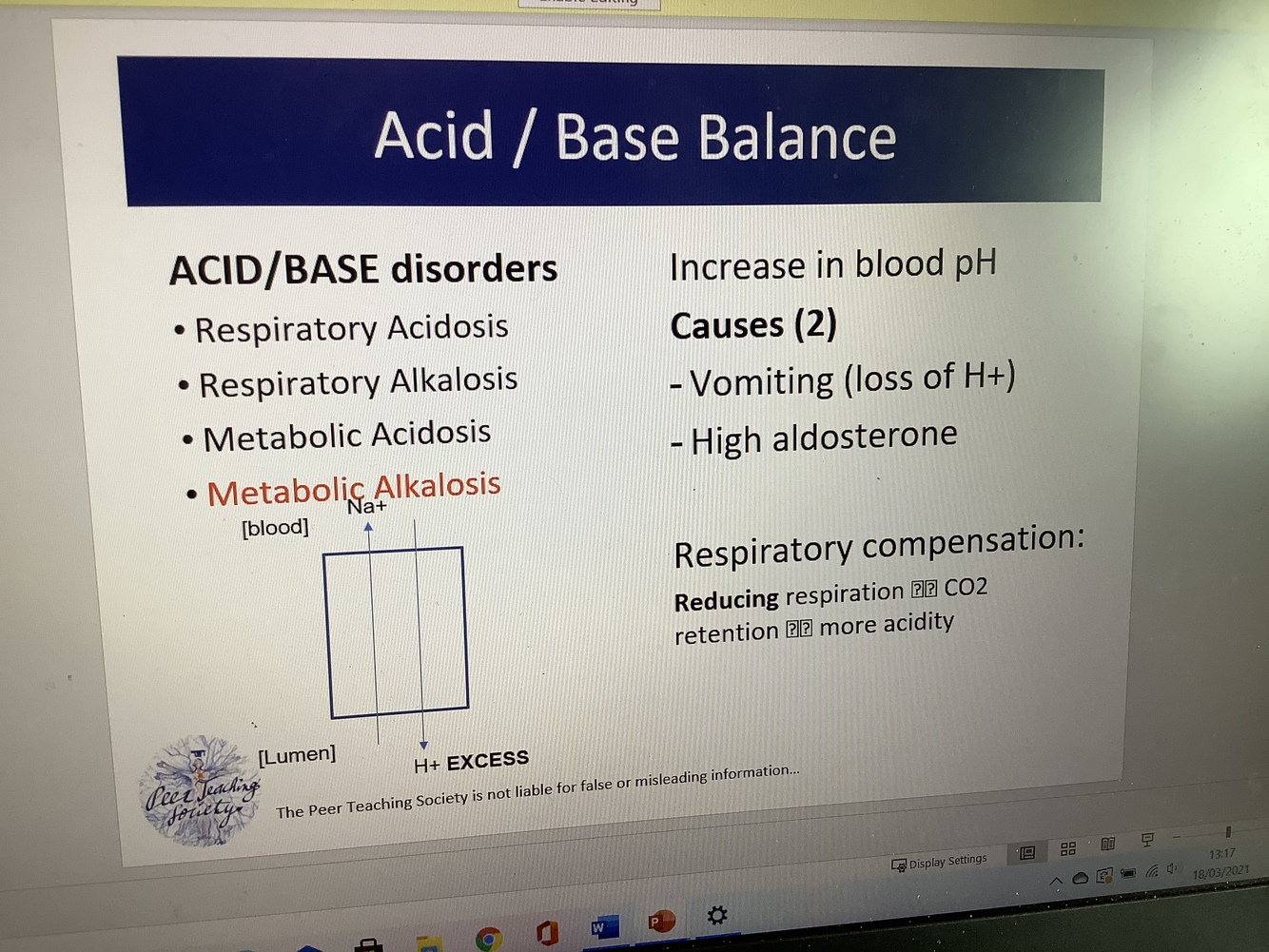
What is metabolic alkalosis? What are the causes?
- Metabolic alkalosis = increase in blood pH
- Causes:
- Vomiting (loss of H+)
- High aldosterone. Respiratory compensation = reducing respiration = CO2 retention = more acidity
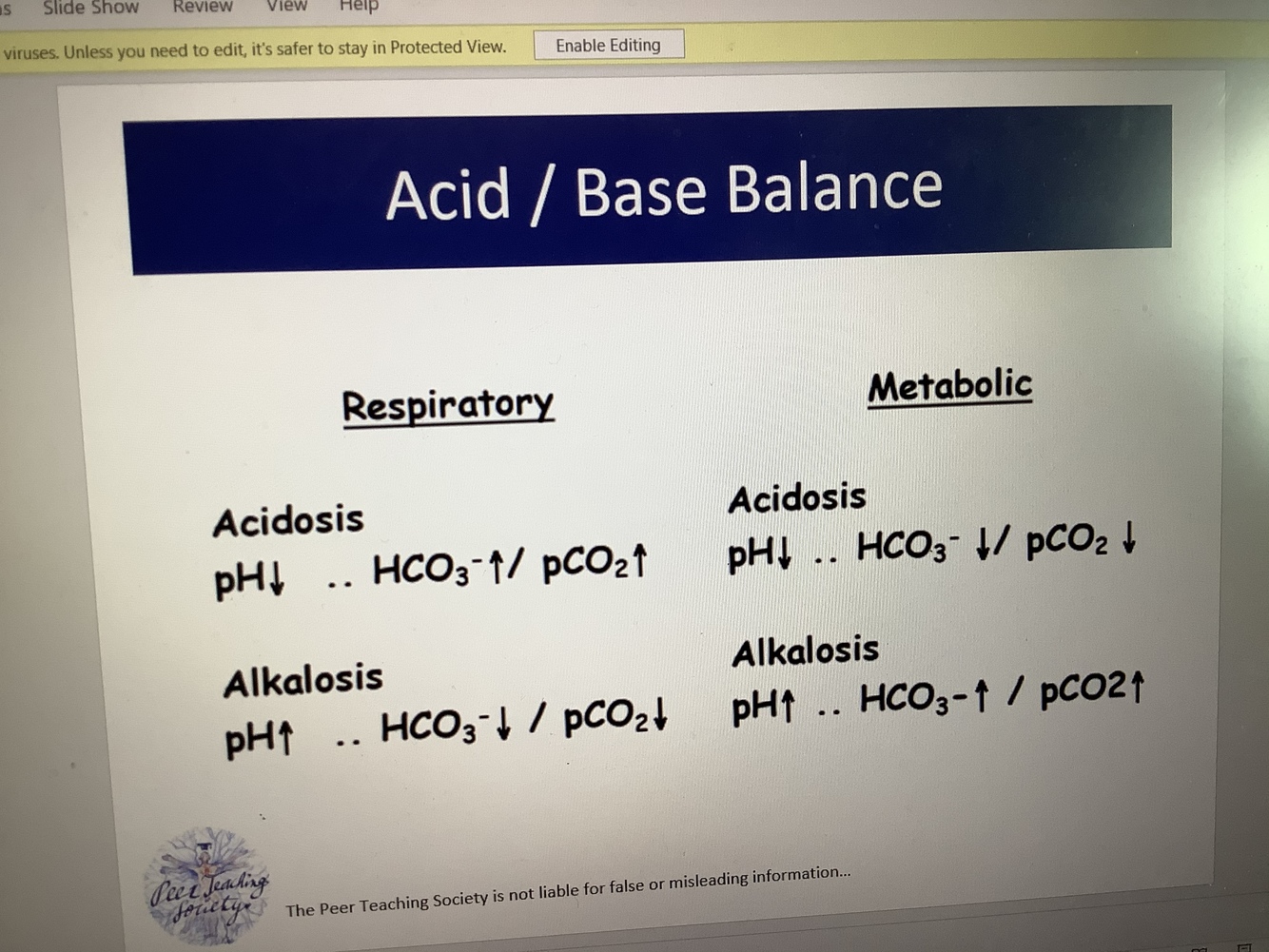
What happens to pH, HCO3- and pCO2 levels in respiratory and metabolic acidosis/alkalosis?
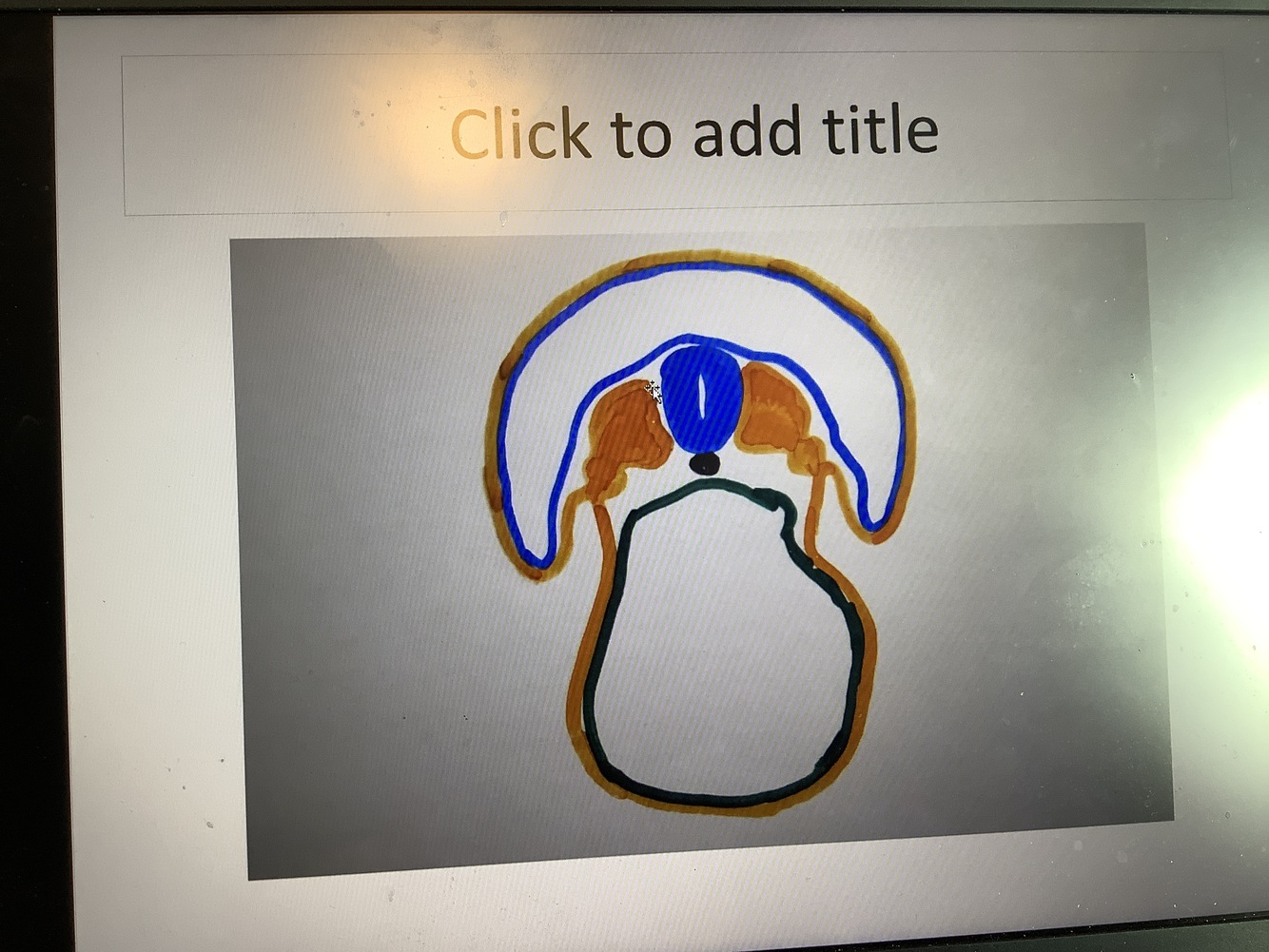
Which part of the mesoderm develops into the genito-urinary system?
Intermediate mesoderm (smaller orange circle)
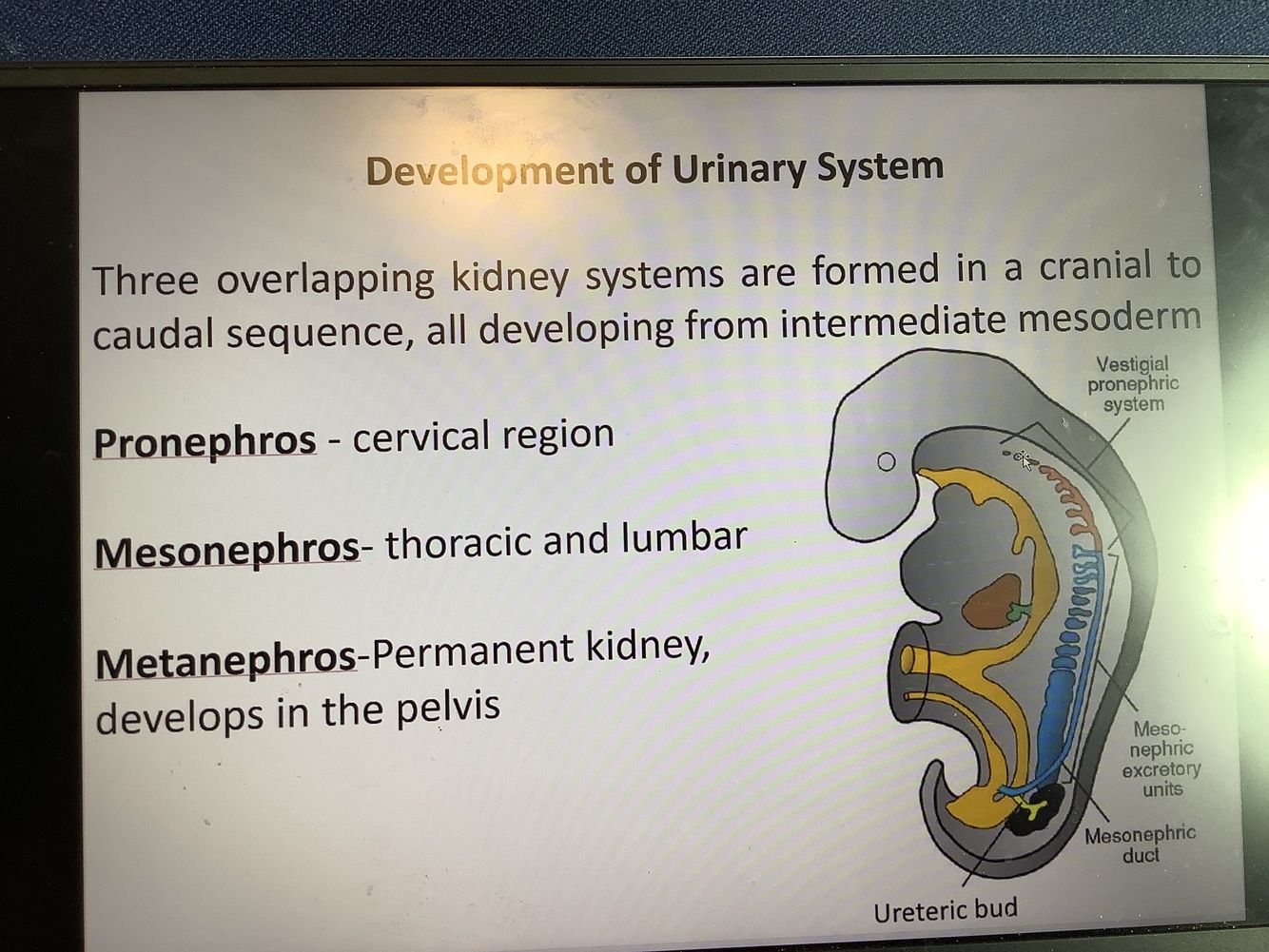
What are the three overlapping kidney systems that develop from the intermediate mesoderm? Where are they found?
- Pronephros = cervical region
- Mesonephros = thoracic and lumbar
- Metanephros = permanent kidney (one we are born with), develops in pelvis
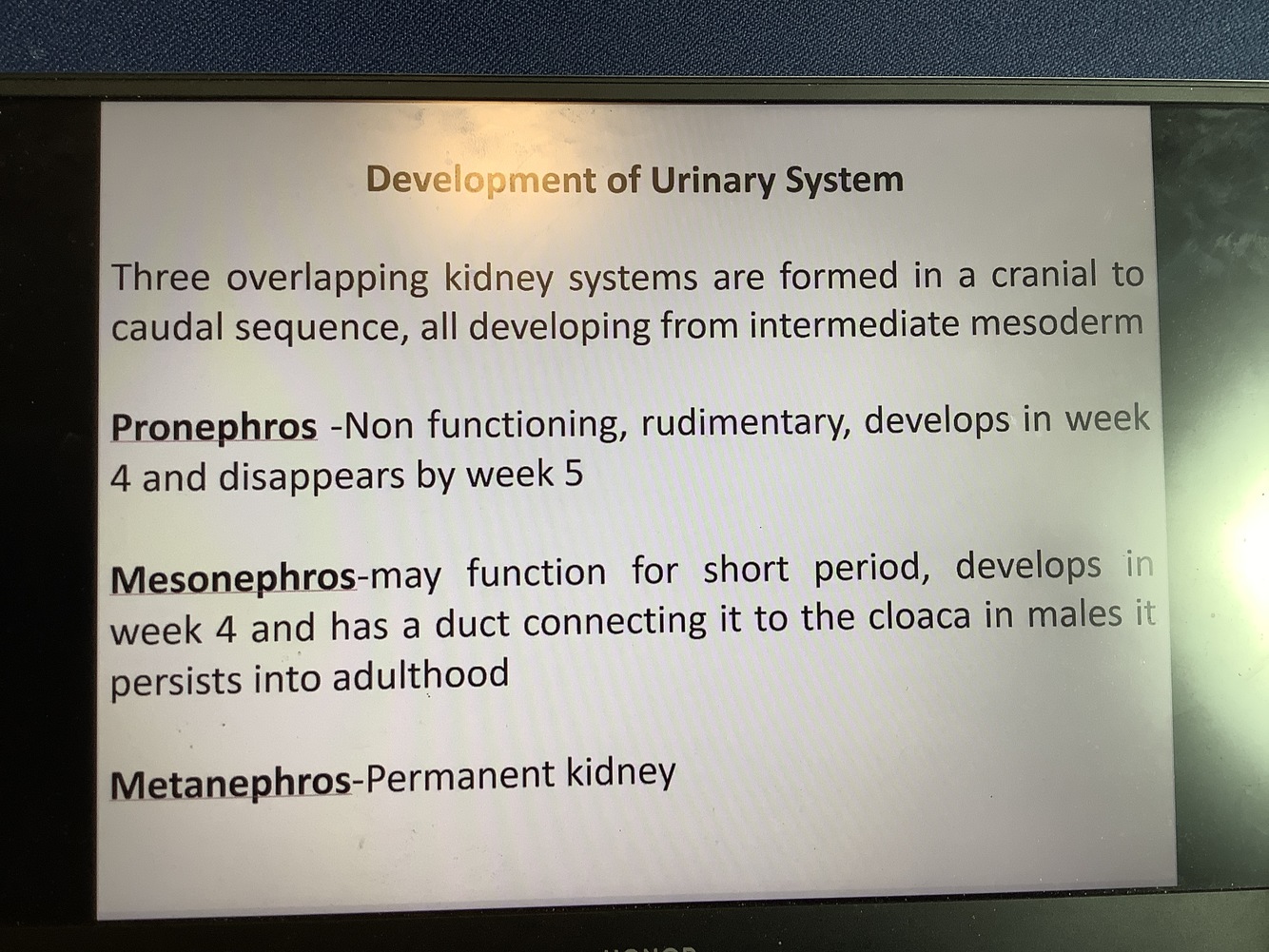
What happens to the pronephros, mesonephros and metanephros?
- Pronephros = non-functioning, lasts from weeks 4-5
- Mesonephros = may function for short period, develops in week 4 and has duct connecting it to cloaca in males
- Metanephros = permanent kidney
What does the mesonephros comprise? What does the duct form? Is this different in females?
- Comprises a ridge and a duct
- Mesonephric duct (Wolffian duct) will form the vas deferens in males - this disappears in females
- Mesonephric duct ends in cloaca
- Bladder forms from the cloaca
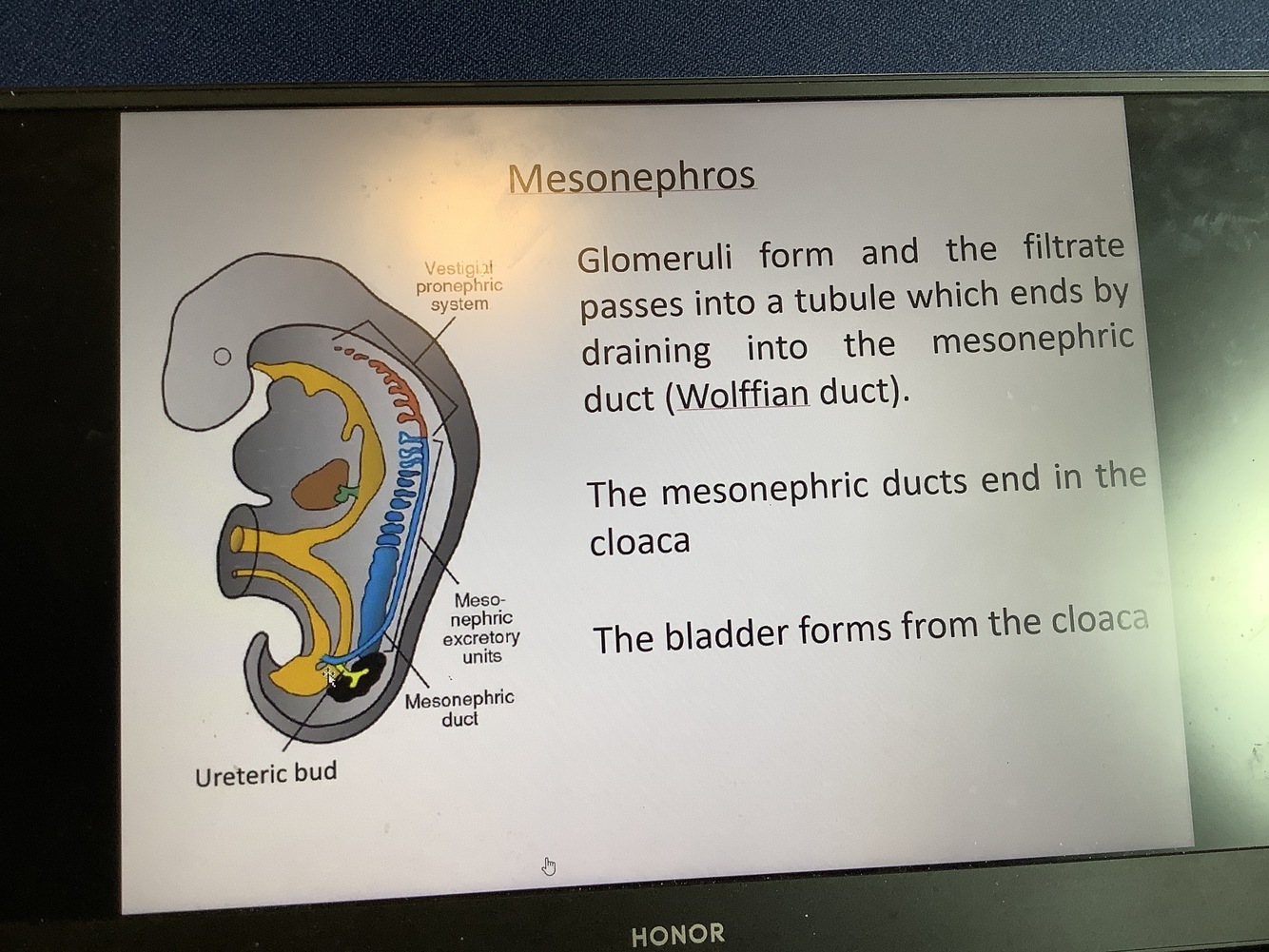
What is the ureteric bud a protrusion from? What does it form?
- Ureteric bud is a protrusion from the mesonephric bud
- Ureteric bud forms the collecting ducts and ureter
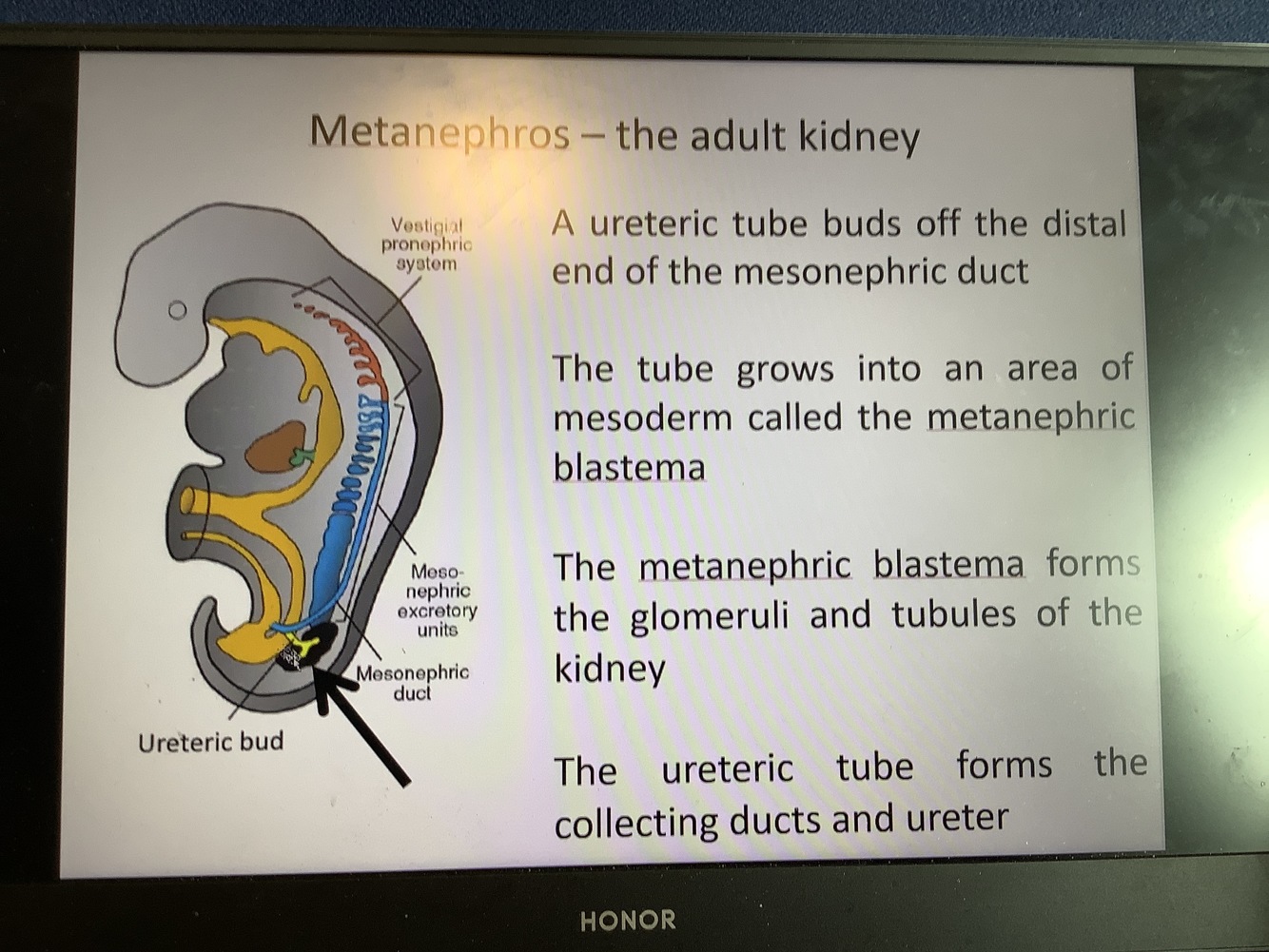
Which two sources does the metanephros develop from?
- Metanephric blastema = develops from blastema and gives rise to excretory units
- Ureteric bud
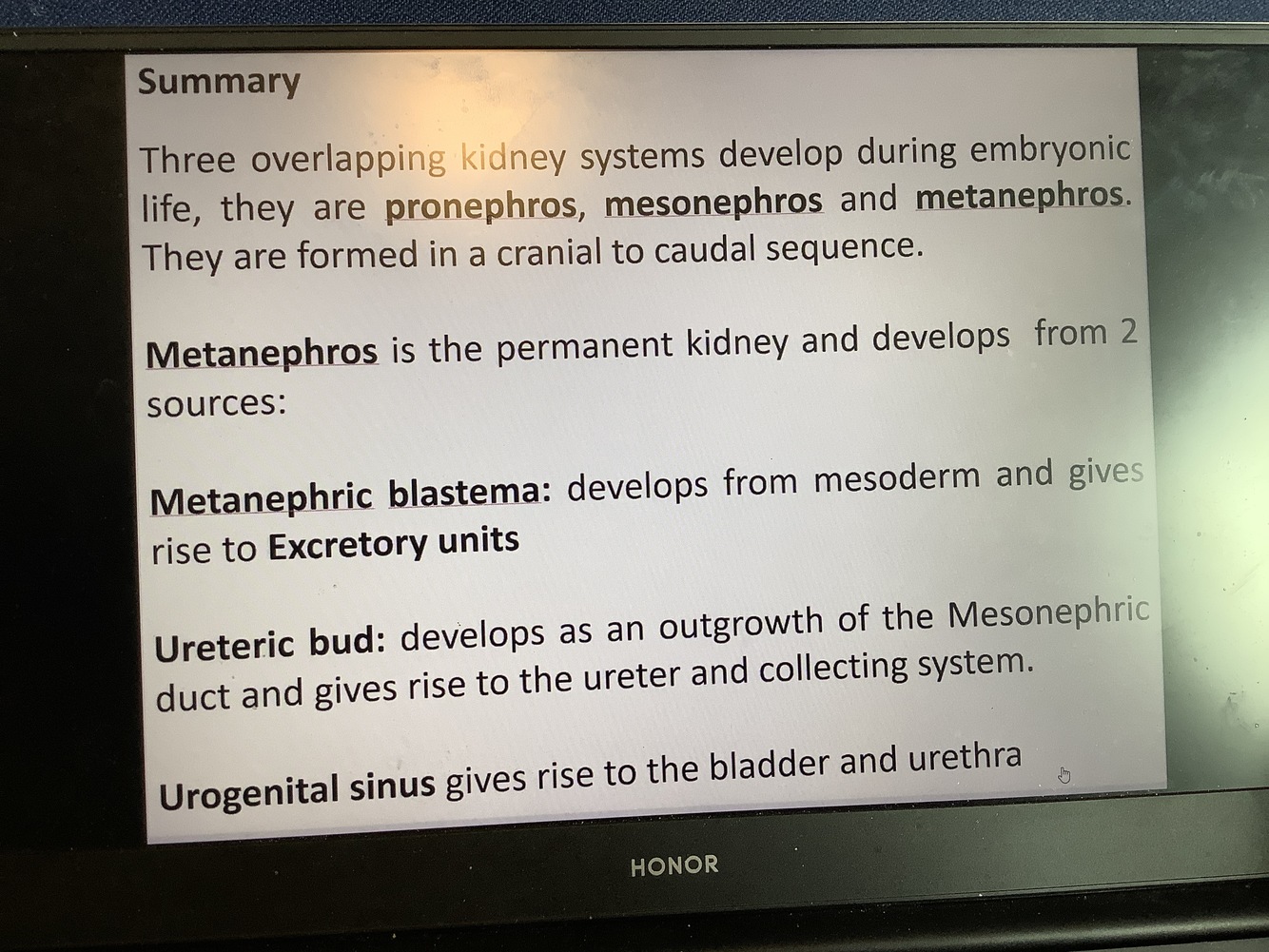
What happens when the ureteric bud enters the blastema?
It divides and dilates, forming the primitive renal pelvis. It repeatedly divides to form the minor and major calyces
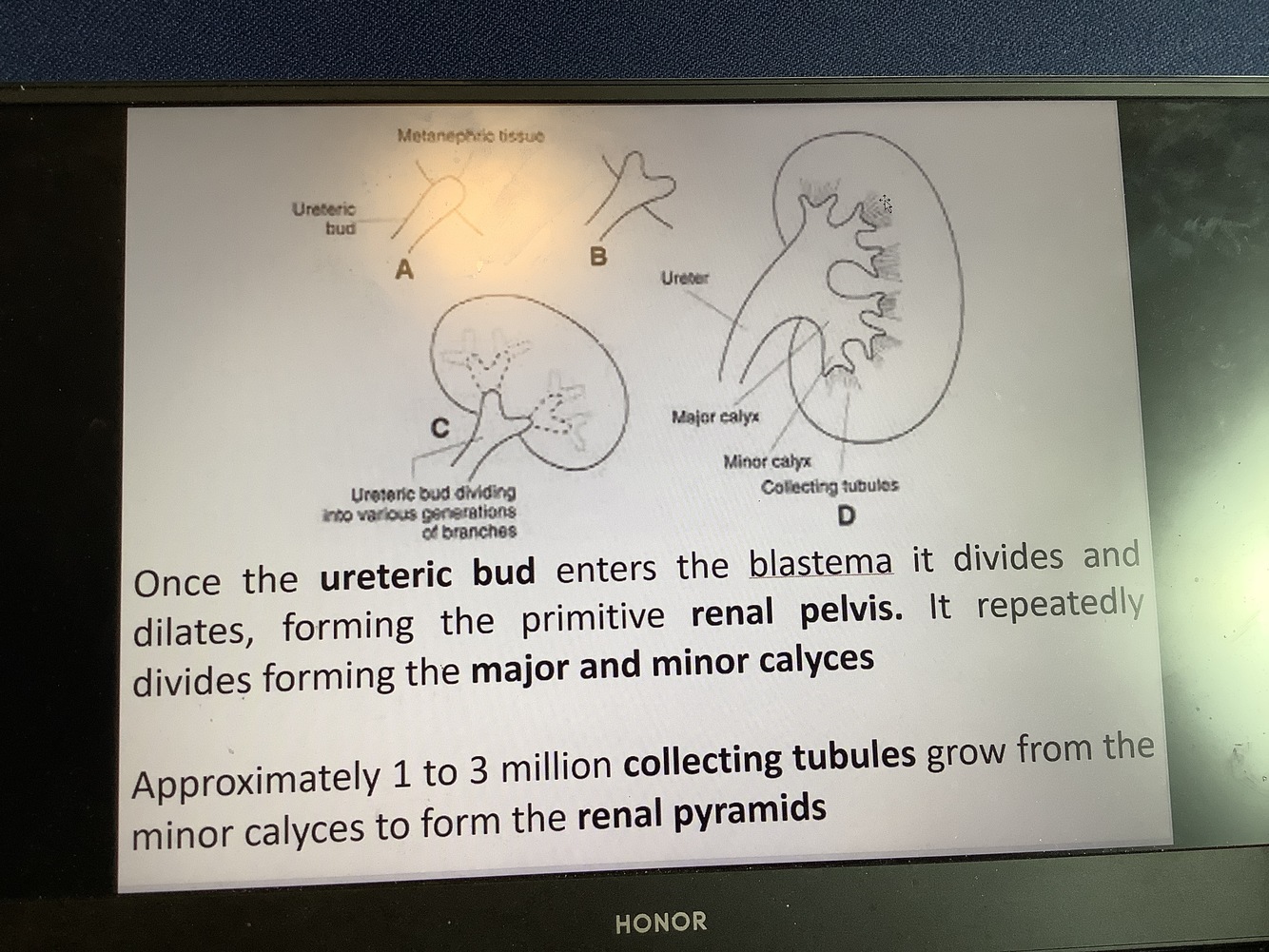
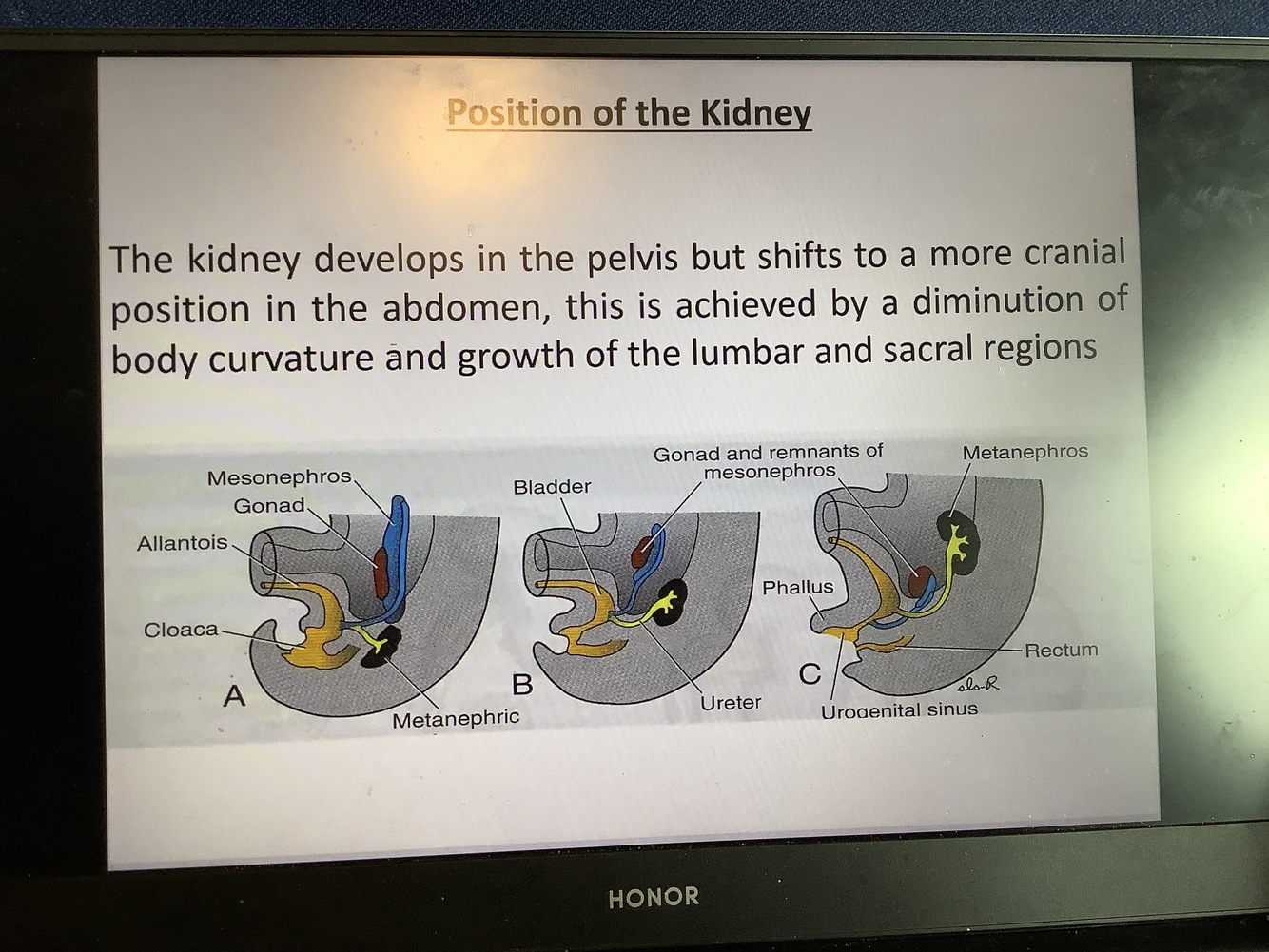
Why does the kidney shift to a more cranial position in the abdomen?
- Diminution of body curvature and growth of lumbar + sacral regions
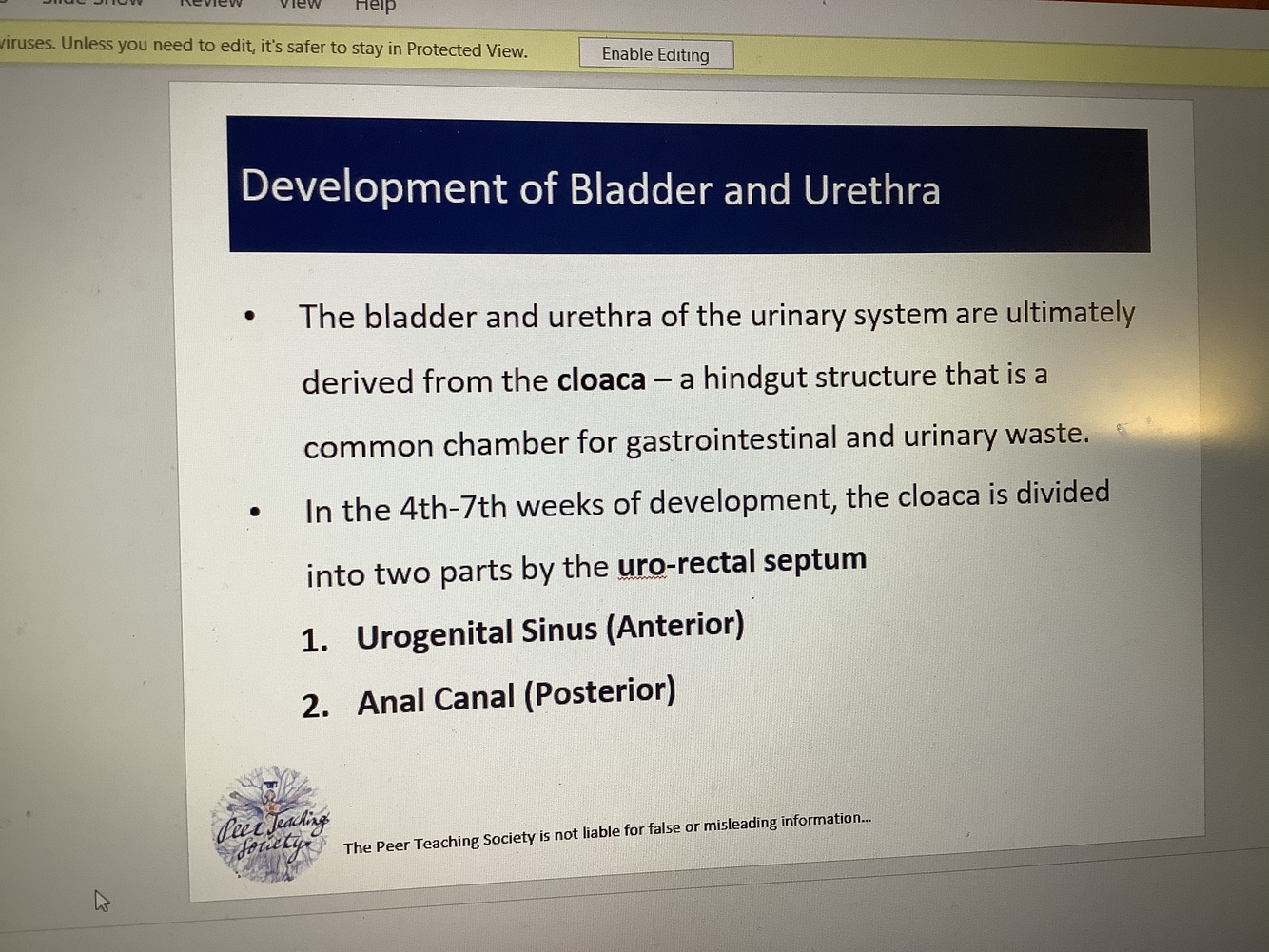
Where are the bladder and urethra ultimately derived from? What is this structure divided into?
- Bladder and urethra ultimately derived from cloaca - a hindgut structure that is a common chamber for gastrointestinal and urinary waste
- In the 4th-7th weeks of development, the cloaca is divided into two parts by the uro-rectal septum:
- Urogenital sinus (anterior)
- Anal canal (posterior)
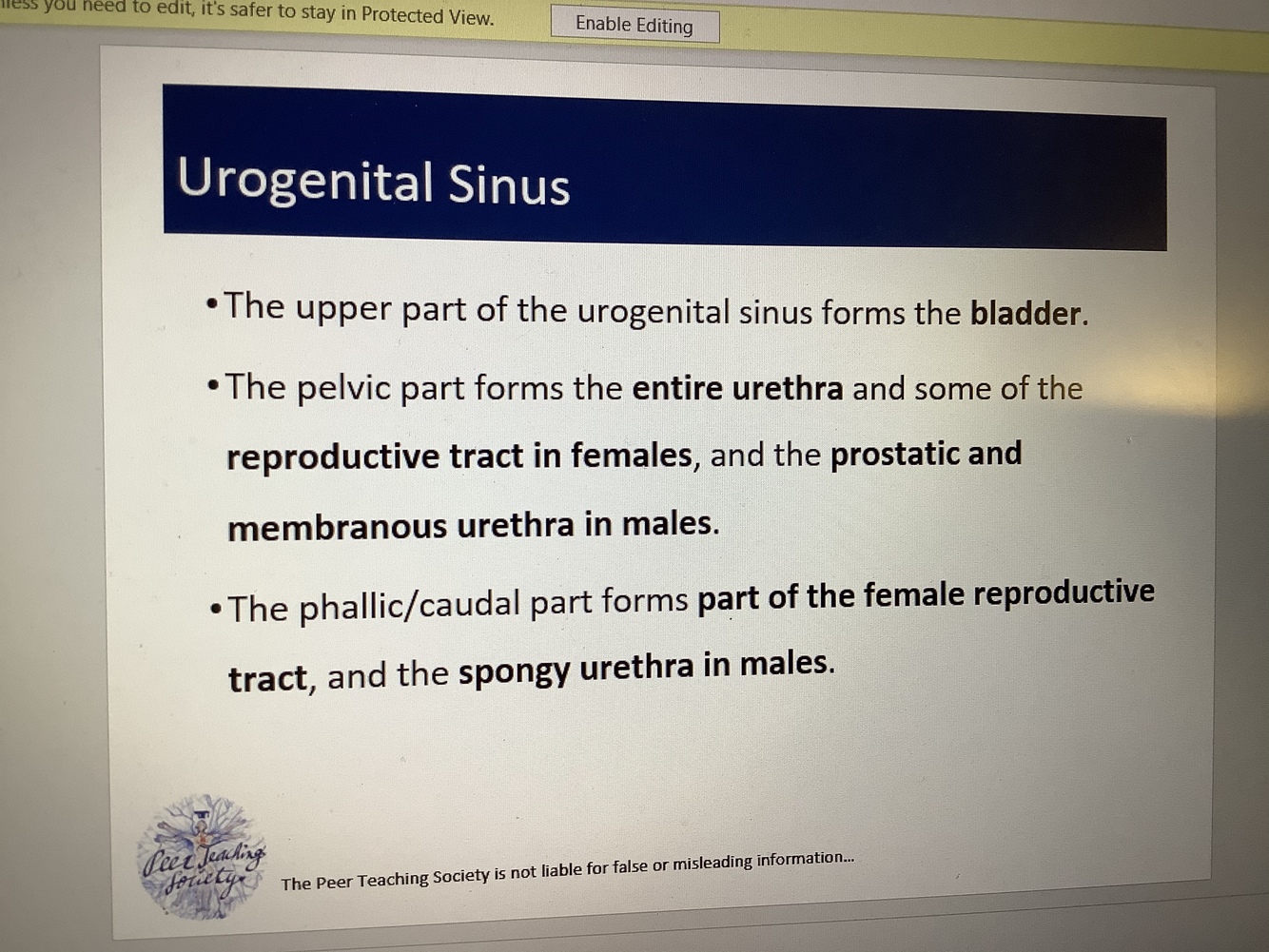
What are the three parts of the urogenital sinus? What do these form?
- Upper part = forms bladder
- Pelvic part = forms entire urethra, some of the reproductive tract in females, and prostatic and membranous urethra in males
- Phallic forms part of the female reproductive, and the spongy urethra in males
How are the glands of the prostate formed?
Epithelium of prostatic urethra proliferate and form a number of outgrowths that penetrate the mesenchyme and form the glands of the prostate
Where do both the male and female gonads derive from embryologically? Are the primordial gonads differentiated at 6 weeks?
- Male and female gonads derive embryologically from the UROGENITAL RIDGE
- Up until the 6th week of uterine life, primordial gonads are UNDIFFERENTIATED
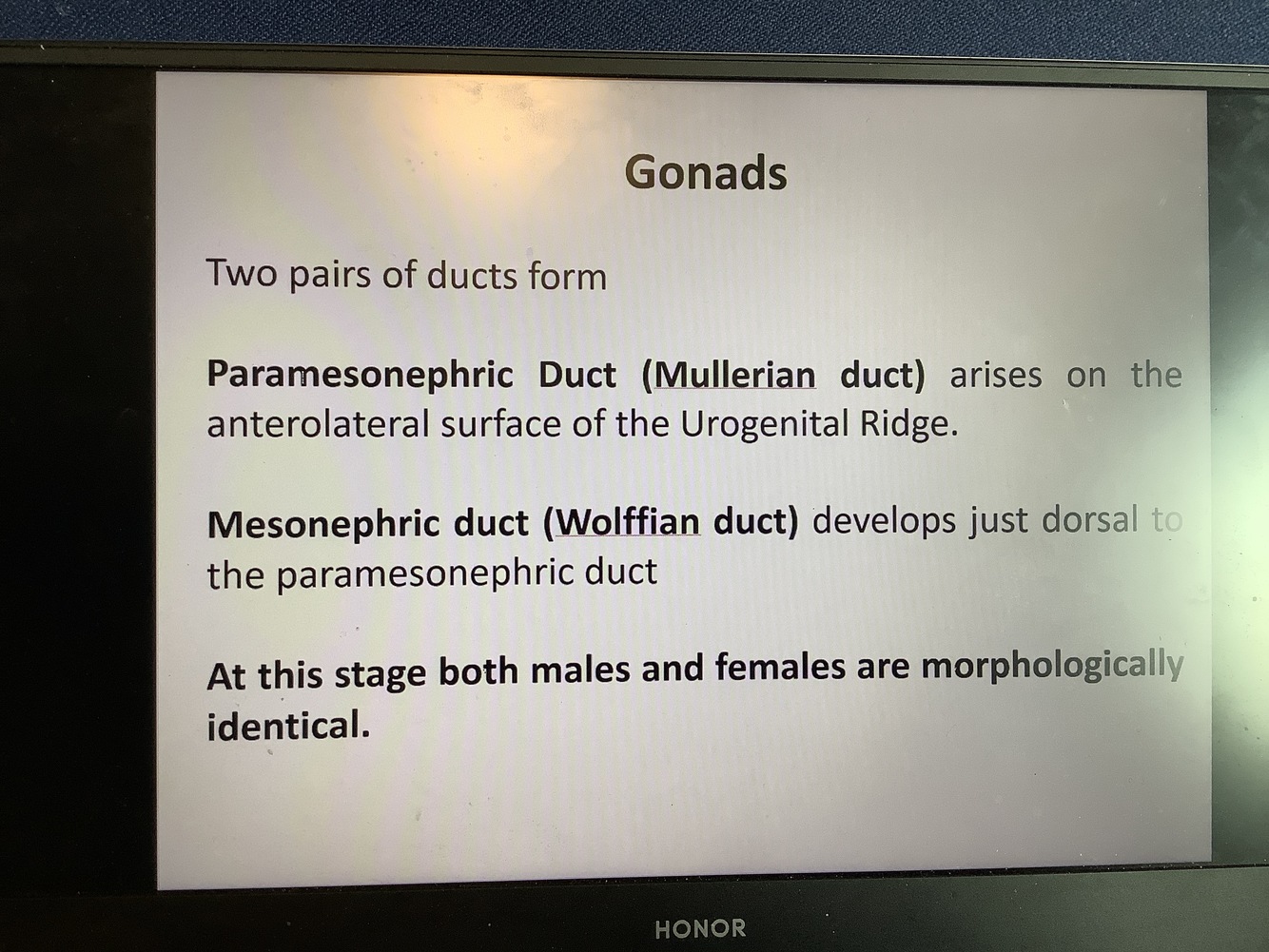
Before the functioning of the fetal gonads, the undifferentiated reproductive tract includes a double genital duct system comprised of what?
- Wolffian ducts
- Müllerian ducts




































-
Anatomy - Introduction100
-
Public Health142
-
IMMS277
-
Histology - IMMS127
-
Critical Numbers140
-
Embryology27
-
Histology - Cardiovascular/Respiratory86
-
Cardiovascular177
-
Anatomy972
-
Respiratory186
-
Histology - Gastrointestinal71
-
GI and Liver236
-
Neuroscience237
-
Histology - SUGER188
-
SUGER207
-
MSK99
-
Histology - MSK45



