Components of vascular assessment
- skin temperature (is it warm?)
- skin appearance (is it pale?)
- cap refill
- pulse and its character
Compare both sides
What to do if you can’t feel the pulse?
Use doppler
(if still cannot do with doppler → CT angiogram to confirm vascular compromise)
What does triple immobilisation of spinal cord consist of? (3)
- hard collar
- block (sides)
- tape over forehead
What is used to look for internal haemorrhage in the trauma setting?
Where to look for haemorrhage using FAST scan? (4)
- thorax
- abdo
- pelvis
- limbs
Why do we put a pelvic binder on every patient in a trauma setting?
to close pelvic injury/fracture → to minimise potential bleed
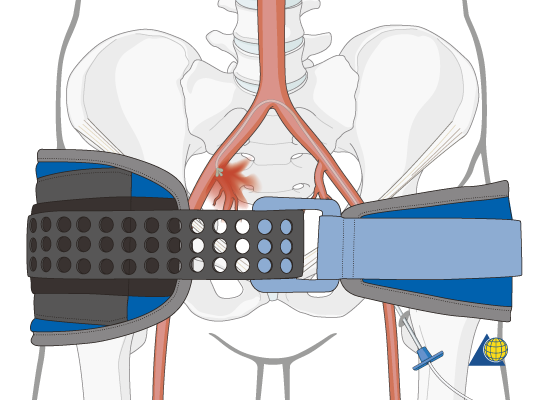
What to do first in a fracture of a long bone and a bleed?
Put the bone in a better alignment to prevent significant bleed
What is the secondary assessment in trauma setting?
- head to toe examination done by an orthopaedic
(looking and assessing any lesions, bruises, deformities, fractures)
- to identify the need for extra imaging
What’s a tertiary assessment?
- Done on the ward (once a traumatic patient has stabilised)
- It is a repetition of secondary assessment to make sure nothing has been missed during a trauma setting (pressure, easy to miss some minor injuries)
What the most important analgesic in the management of fractures?
Reduce the fracture!
This helps to reduce pain (due to less tension on soft tissues, vessels and skin)
Do we leave a ‘metalwork’ in? E.g. plate and screws
Usually in unless:
- infection
- children up to 16 years of age (as the bone will grow)
- clavicle/ ankle → thin skin so the metalwork will be visible and maybe catching on clothes etc
Mono-lateral external fixator
- use
- how long do we leave it in for?
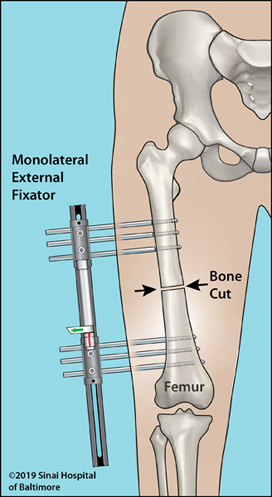
Use: When a tissue around the fracture is to distorted/swollen to be able to close in again after a potential surgery → to temporarily fixate the bone until swelling settles down → further surgery will be required to fix the bone properly
How long for: max 2 weeks due to risk of infection → then further fixation (surgery)
Mechanism of injury leading to spiral fracture
twisted/torsional force
A child with a long bone spiral fracture - what is the possible mechanism of injury?
Possibly non-accidental injury
Possible mechanism of a transverse fracture?
Side force
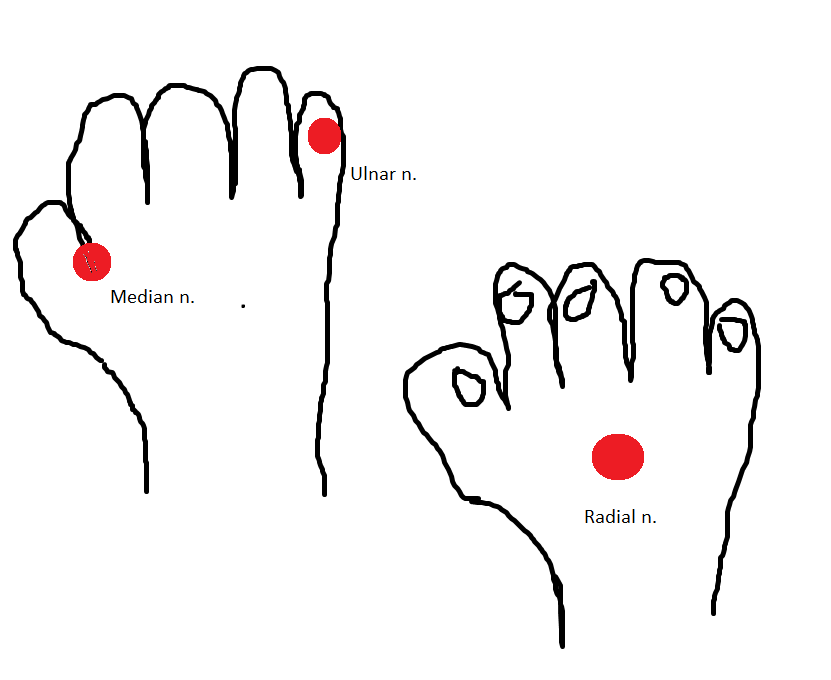
Where to test for sensation (possible neurological compromise) for medial, radial and ulnar nerve? (3)
In the point where there is no anatomical overlap
- Medial: in between of thumb and index finger (hand surface)
- Ulnar: little finger (palm surface)
- Radial: dorsum of the hand
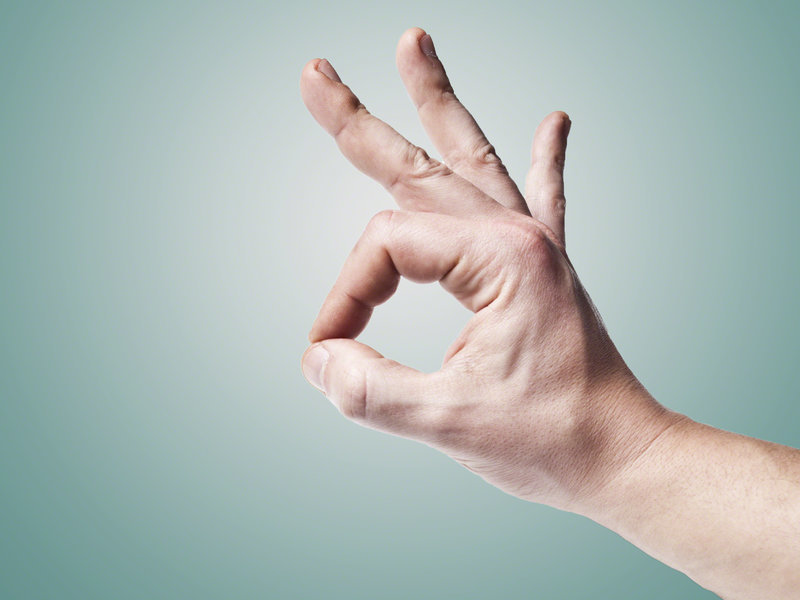
How to test for a motor function of (neuro compromise assessment):
- Median n.
- Ulnar n.
- Radial n.
- Median → ‘OK’ sign (circle made of thumb and index finger)
- Ulnar → fingers spread out and back together
- Radial → wrist and finger extension (‘cock wrist back’)
How to test for motor function (neuro compromise) in children?
Play ‘paper, rock, scissors’
- Median n. → rock
- Radial n. → paper (wrist + finger extension)
- Ulnar n. → scissors
What do we MUST do before attempting a reduction of a shoulder dislocation?
Check for axillary nerve injury:
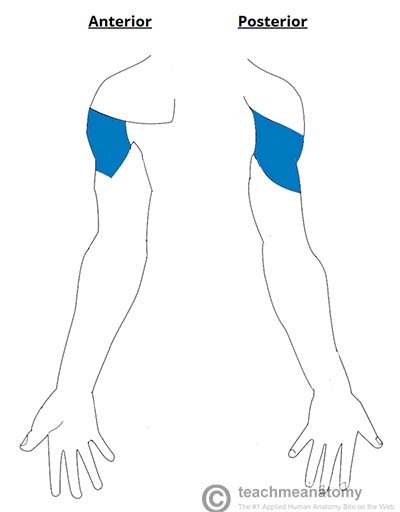
- ‘regiment badge’ sensation (below deltoid)
- motor function - ask to move deltoid muscle (even little flicker will be enough for a positive motor function) we can do it by asking a patient ‘can you push in’ (with shoulders)

-
Surgery: Opthalmology74
-
Surgery: Upper Limb (Orthopedics)72
-
Surgery: Benign Breast Disease61
-
Surgery: Breast Cancer45
-
Surgery: ENT95
-
Surgery: Lower Limb (orthopedics)55
-
Surgery: Ortho_extra notes19
-
Surgery: BPH and Prostate Cancer57
-
Surgery: Scrotal lumps61
-
Medicine: AKI and CKD47
-
Medicine: Imaging and investigations22
-
Medicine: Restrictive lung diseases, Pulmonary hypertension and O2 therapy30
-
Medicine: ECG interpreatation35
-
Medicine: Cerebrovascular disease37
-
Medicine: VTE48
-
Obs&Gyn: Infertility40
-
Obs&Gyn: Gyn malignancies45
-
Obs&gyn: Obesity42
-
Obs&Gyn Urinary incontinence36
-
Paeds: Mental Health (1)35
-
Paeds: Mental Health (2)28
-
Paeds: Endocrinology (1)30
-
Paeds: Endocrinology (2)35
-
Mental Health: Schizophrenia (1)56
-
Paeds: The Limping Child (1)30
-
Paeds: The Limping Child (2)32
-
Paeds: The Limping Child (3)30
-
Mental Health: depression34
-
Mental Heatlh: Mental Health Act40
-
Peads: Diabetes in children45
-
Mental Health: Substance Abuse65
-
Radiology 130



