SWE: What does it mean for function f(n) to be big-O of g(n), or f(n) in O(g(n)), or f(n) = O(g(n))
There exists number n* and constant c so for all n > n*,
f(n) < cg(n)
SWE: When we use big-O, are we typically describing best-case, worst-case, or expected-case run time?
Worst case. (But it can be used for the other two.)
SWE: What are the two main rules for calculating big-O of a function f(n)?
Drop any constants, either multiplicative or additive, and drop any additive terms that are asymptotically not the largest.
SWE: What is big-O of f(n) = 4*2n + 3n10 + 10?
O(2n)
SWE: If we have two arrays with lengths a and b respectively, what is big-O run time for nested loops iterating through all elements of one array for all elements of another?
O(ab)
SWE: What “general pattern” emerges for O(log n) runtimes?
Continually dividing n by some constant, such as 2, until you reach 1. (Or, continually multiplying a constant by another constant until you reach n.)
SWE: Why can string questions be approached as array questions, and vice versa?
Because a string is just an array of characters.
SWE: What is a (singly) linked list?
A list of nodes, where each node has a value and a pointer to the next node.
SWE: What is a double linked list?
A list of nodes, where each node has a value and a pointer to both the previous and next node.
SWE: Are linked list problems commonly recursive or iterative?
Recursive, because linked lists have a naturally recursive structure. (But there are many problems with iterative solutions too!)
SWE: What is the runner technique for linked lists?
You examine the linked list using two pointers: one that is “slow”, and one that is “fast” and is generally at a farther position in the linked list, and which moves faster than the other.
This is a pretty general technique, but be aware that it exists: examining with two pointers might be handy for many problems.
SWE: What is a hash table used for, and what makes it so useful?
A hash table is a data structure that maps keys to values; you insert key-value pairs, and then search for a key to get its value.
It is useful because it enables fast lookup of elements, in basically constant time as long as your hash table has enough available memory.
SWE: What Python data structure implements the hash table?
Dictionaries (or defaultdicts, which are convenient)
SWE: How is a hash table implemented? What components are needed, and how are they used to insert a key-value pair, or retrieve a key-value pair? (There are multiple possible implementation strategies, we just focus on one in particular.)
Our hash table is an array of linked lists. So each entry in the array is its own linked list.
We use a hash function to map keys to an entry in the array, and this mapping is used for both insertion and retrieval.
To insert pair (key,val), get your hash value h(key), and then find your array index using h(key)%m, where m is the length of the array. We use modulus to keep the index within bounds. We then add our (key,value) pair to the linked list: if the key is already there, we update the value; otherwise, we add a new node with that key-value pair.
To check the value for a key, we get our index h(key)%m again, and look for our key in the linked list at that index. If it isn’t there, then that key hasn’t been inserted.
SWE: What is a hash function? What in general makes a “good” hash function in the context of, say, a hash table?
A hash function maps some value to an integer, in a non-random way. A good hash function will “evenly distribute” values across the different integers. In the context of a hash table, it should distribute the integers evenly across each of the cells of the array. This is good because it leads to fewer long chains in the hash table.
SWE: What is the worst-case runtime for a lookup in a hash table, in terms of the number of keys n? In what sorts of situations would this happen, and how do these situations cause this runtime?
The worst-case runtime is O(n). This would happen if your array isn’t large enough, and as a result you have some long chains in some of the array indexes.
When looking for a key in a chain, it is O(k), where k is the number of keys in the chain. If you have a lot of keys in the chain – an amount that becomes substantively “on the order of” n, such as say n/10, then you’re looking at linear time.
SWE: When using a hash table, how can we assure constant-time insertion and lookups?
You need to keep your load factor low; you need to have a large enough array so there are few collisions, leading to chains that are at most a few elements long.
SWE: Is a stack first-in-first-out or first-in-last-out? Is a queue first-in-first-out or first-in-last-out?
A stack is first-in-last-out
A queue is first-in-first-out
SWE: What is a stack? How is it used at a high level?
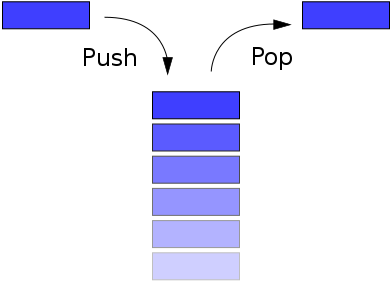
A stack is a data structure which stores elements. You can add an element (or “push” it), and you can remove an element (or “pop” it). Elements are removed in reverse order of how they’re added, or first-it-last-out. This is like a stack of blocks where you continually add a blocks to the top when you want to add, and remove a blocks from the top when you want to remove.
SWE: How do you simply implement a stack – with pop, push, peek and isEmpty methods – if you already have an implementation of another key data structure?
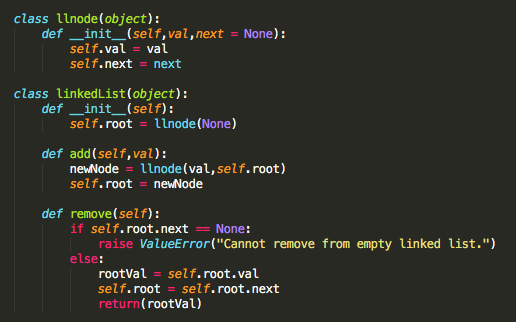
You need a linked list implementation. Recall that a linked list has a null node as the “final node” on the right with no descendants, and the “first node” being the root node which has nothing pointing to it. To add an element to the linked list, you make it the root and make the old root its descendant. To remove an element, you make its descendant the root.
In other words, a linked list is basically already an implementation of a stack. To push, you just add the value to the LL. To pop, you just remove the root from the LL. To peek, you just look at the value in the root of the LL. To check if it’s empty, you see if the root node is the null node.
SWE: What is a queue? How is it used at a high level?
A queue is a data structure which stores elements. You can add an element (or “push” it), and you can remove an element (or “pop” it). Elements are removed the same order as how they’re added, or first-it-first-out. This is like a queue of people who are waiting in line, where the first person to get in line is the first person to get out.
SWE: How do we implement a queue, with push, pop, peek, and isEmpty, using another common data structure?
We will implement the queue using a slight variation of a linked list.
With a normal linked list, the list is visualized several nodes with arrows pointing left to right. On the far left is the root node; the linked list data structure keeps track of the root node, and a newly inserted value enters on the left and becomes the new root. The linked list also has a null node to the far right.
In a queue, we are going to insert elements on the right side of the linked list, or the back, and we (same as a normal linked list) remove elements from the left side of the linked list, or the front. So the arrows between nodes point from front to back, which may seem unintuitive.
Thus, we now keep track of two nodes rather than just one. We keep track of the front, or the root, as well as the back, which is the last node in the list. The back node doesn’t point to anything; it’s easier in a queue to not have a null node and instead keep an “empty” bool in the data structure. When the queue’s empty, set the front and back pointers to just point to NULL.
To push a value onto the back of the list, we make a new node, have the current back point to it, and set the new node as the back. To pop a value from the list, we set the front’s descendant as the new front. To peek, we return the value at the front. For isEmpty, we check the bool.
SWE: What is a tree?
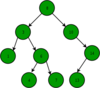
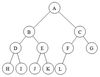
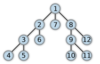
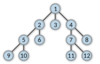
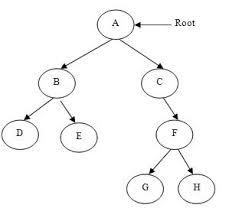
A tree is a data structure which organizes nodes in terms of parent-child relationships, where each node can have at most one parent, but nodes could have several children.
A tree is basically a DAG, or directed acyclic graph, that is also connected, meaning it’s not like two or more graphs that don’t touch each other.
SWE: In trees, what is a leaf? What is the root?
A leaf is a tree with no descendants; the root is a tree with no parents.