How is the Rf value in chromatography calculated?
dspot / dsolvent
Describe how paper chromatography is carried out.
- Draw pencil (insoluble) line 1 cm from base of chromatography paper (stationary phase)
- Using capillary tubes, spot test mixture + pure reference samples along line
- Suspend plate in beaker containing solvent reaching max height 5 mm
- Cover with watch glass (prevents evaporation)
- Remove paper when solvent front nears the top; mark point reached + allow to dry
- Measure height of spots + calculate Rf values = dspot/dsolvent
- Match with those of known compounds in this solvent
What is thin layer chromatography used to do?
- Separate small quantities of organic compounds
- Purify them / check their purity
- Follow the progress of a reaction
Thin layer chromatography is used to:
- Separate small quantities of organic compounds
- Purify them / check their purity
- Follow the progress of a reaction
Describe the principle upon which this technique is based.
- Organic compounds have different affinities for a given solvent
- So are carried through the chromatography (silica / alumina) plate at different rates
Describe how thin layer chromatography is carried out.
- Draw pencil (insoluble) line 1 cm from base of silica (SiO2) / alumina (Al2O3) plate (stationary phase)
- Using capillary tubes, spot test mixture + pure reference samples along line
- Suspend plate in beaker containing solvent reaching max height 5 mm
- Cover with watch glass (prevents evaporation)
- Remove plate when solvent front nears the top; mark point reached + allow to dry
- Locate spots with UV lamp
- Measure height of spots + calculate Rf values = dspot/dsolvent
- Match with those of known compounds in this solvent
What can be used to locate spots in TLC?
- UV lamps
- Iodine
- Ninhydrin
Describe how you would carry out a titration to find the concentration of a sodium hydroxide solution, using 0.2 mol dm-3 ethanoic acid.
Describe how you would use the titre to calculate the concentration of the sodium hydroxide solution.
- Rinse + fill burette with CH3COOH(aq)
- Record initial reading to nearest 0.05 cm3
- Rinse + fill graduated pipette with NaOH(aq)
- Use pipette filler to add 25 cm3 to a conical flask
- Add indicator to flask
- Perform rough titration
- Repeat, adding acid dropwise when 1 cm3 below end-point
- Repeat to obtain 3 concordant titres within 0.1 cm3
- Calculate average titre
- [NaOH] = mol / volume = (0.2 x titre x 10-3) / (25 x 10-3)
A student performs a titration of sodium thiosulfate (in the burette) and potassium iodate(V) (in the conical flask) and gets a titre of 0.48 cm3.
- Why is their teacher disappointed?
- How could their method be improved?
- Large % uncertainty due to small titre (21%)
- Use more dilute thiosulfate or more concentrated iodate(V)
What are iodine-thiosulfate titrations used for?
Finding the concentration of a strong enough oxidising agent to oxidise I- to I2.
An iodine-thiosulfate titration can be used to find the concentration of a solution of chlorate(I) ions, which react as follows:
A: ClO- + I- + H+ →I2 + Cl- + H2O
B: S2O32- + I2 → I- + S4O62-
- Balance equations A and B.
- Describe how the titration would be carried out, but do not include details of the procedure. Refer to equations A and B in your answer. Include details of the observations which would be made.
1.
A: ClO- + 2I- + 2H+ →I2 + Cl- + H2O
B: 2S2O32- + I2 → 2I- + S4O62-
2.
- Add excess I-(aq) to ClO-(aq). Forms brown mixture since iodine is formed in A.
- Titrate I2 produced with thiosulfate ions. When mixture turns from brown to pale yellow, add a few drops of starch solution. End-point is when blue-black colour, due to iodine-starch complex, disappears, since all I2 has been reduced, as in B.
An iodine-thiosulfate titration can be used to find the concentration of a solution of chlorate(I) ions, which react as follows:
A: ClO- + 2I- + 2H+ →I2 + Cl- + H2O
B: I2 + 2S2O32- → 2I- + S4O62-
Describe how a titration would be carried out to find the concentration of a solution of chlorate(I) ions, using standard 0.1 mol dm-3 sodium thiosulfate solution. Include details of the observations which would be made.
A: ClO- + 2I- + 2H+ →I2 + Cl- + H2O
- Rinse + fill graduated pipette with ClO-(aq)
- Use pipette filler to transfer 25 cm3 to conical flask
- Add excess KI(aq)
- Add excess H2SO4(aq)
- Mixture turns brown since iodine forms
B: I2 + 2S2O32- → 2I- + S4O62-
- Rinse + fill burette with standard 0.1 mol dm3 S2O32-(aq)
- Run some out to remove bubbles in jet
- Record initial reading to nearest 0.05 cm3
- Place conical flask onto white tile
- Perform rough titration
- When mixture turns pale yellow, add a few drops of starch solution
- End-point is when mixture turns from blue-black, due to iodine-starch complex, to colourless
- Repeat to get accurate titres, adding dropwise when 1 cm3 below rough end-point
- Repeat to obtain 3 concordant titres within 0.1 cm3
- Calculate average titre
- [ClO-] = mol / vol = (0.1 x titre x 10-3 x 1/2) / (25 x 10-3)
The concentration of a solution of Fe2+ ions can be found by titration with a standard potassium manganate(VII) solution. Other than from the uncertainty in burette and mass balance readings, suggest potential sources of error in the prodedure.
- Loss of material during transfer between vessels
- Parallax error in reading burette, volumetric flask + pipette
- Drips inside burette increasing titre
- Random error in judging end-point; titre may be too small or large
A solution of Fe2+ ions is made up by dissolving a certain mass of thyme in water. Some of the solution formed is transferred to a conical flask.
A student wants to determine the iron content of thyme. They do this by finding the concentration of the Fe2+ solution, by titration with standard potassium manganate(VII) solution.
Describe how the percentage uncertainty of the method could be minimised.
- Use a greater mass of thyme, in order to:
- reduce % uncertainty in mass balance reading
- make Fe2+(aq) more concentrated, to achieve a larger titre, to reduce % uncertainty in burette reading
- Use more dilute manganate(VII) solution to achieve a larger titre, to reduce % uncertainty in burette reading
The concentration of a solution of Fe2+ ions can be found by titration with a standard potassium manganate(VII) solution.
- Describe how the titration would be carried out.
- State how the end-point can be recognised and explain why an indicator does not need to be added.
- Rinse + fill burette with standard MnO4-(aq)
- Rinse + fill graduated pipette with Fe2+(aq)
- Use filler to transfer 25 cm3 to conical flask
- Add excess H2SO4 to flask
- Titrate until pink colour remains due to excess MnO4-(aq); no indicator required
- Repeat to obtain 3 concordant results within 0.1 cm3
Don’t use HCl as easily oxidised to toxic Cl2
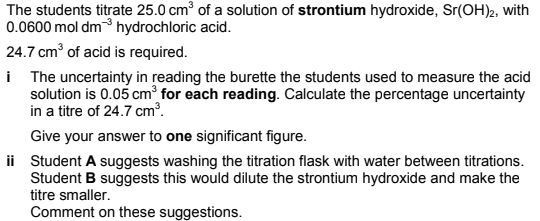
- 2 x 0.05 x 100 / 24.7 = 0.4%
- Student A correct; titre unaffected since mol Sr(OH)2 unaltered
- What 2 instruments can be used to determine the concentration of a coloured solution?
- Distinguish between the two.
- Colorimeter (gives data for restricted wavelengths of light due to specific filters)
- Visible spectrophotometer (gives data for any visible wavelength)
Describe how a colorimeter would be used to measure the concentration of a sample.
- Select filter of complementary colour to sample
- Zero colorimeter with tube of pure solvent (usually water)
- Prepare range of 5+ standard test solutions, with concentrations above and below that of sample
- Measure absorbance of standard solutions + sample of unknown concentration
- Plot calibration curve of concentration against absorbance for samples of known concentration
- Read off unknown concentration
A student has test tubes containing solutions of 0.010 mol dm-3, 0.020 mol dm-3, 0.030 mol dm-3, and 0.040 mol dm-3 of MnO4- ions.
How could they use a colorimeter to measure the concentration of a solution containing approximately 0.025 mol dm-3 MnO4- ions?
- MnO4-(aq) is purple so select yellow (complementary colour) filter
- Zero colorimeter with tube of pure water
- Use colorimeter to measure absorbance of all MnO4- solutions, including sample of unknown concentration
- Plot calibration curve of concentration against absorbance for samples of known concentration
- Read off unknown concentration
The standard electrode potential of a half-cell may be measured by connecting it to which two types of half-cell?
- Standard hydrogen half-cell
- Calibrated reference half-cell (calibrated with H2 half-cell)
Draw a diagram of the apparatus used to determine the standard electrode potential of a Zn(s)/Zn2+(aq) half-cell.
Also: H2 half-cell electrode should be labelled as Pt(s) or graphite
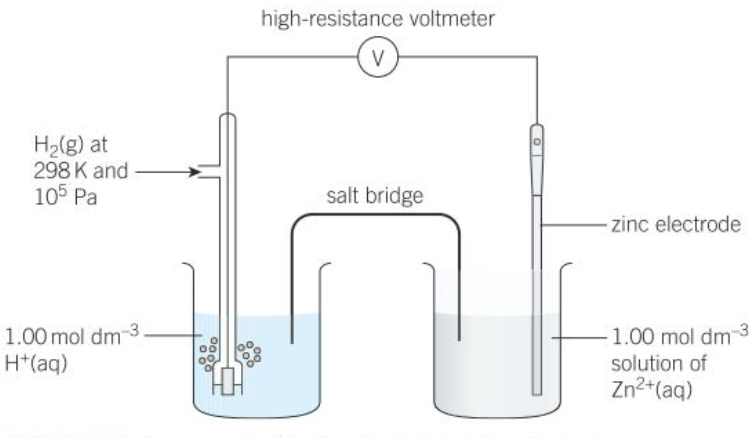
Describe a technique which could be used to determine the standard potential of a Fe3+(aq)/Fe2+(aq) half-cell.
- Set up Fe3+/Fe2+ half-cell:
- Use platinum / graphite electrode
- Fe3+ and Fe2+ in solution
- Set up standard hydrogen half-cell:
- Use platinum / graphite electrode
- H+ in solution
- Feed H2(g) at 100 kPa into solution using porous glass tube covering electrode
- Concentrations of solutions all 1 mol dm-3
- Temperature of solutions and H2(g) 298 K
- Connect solutions with salt bridge
- Connect electrodes with high-resistance voltmeter
- Record voltmeter reading (switch connections if negative)
- This gives Ecell and therefore Eo (since Eo for H2 half-cell = 0 V)
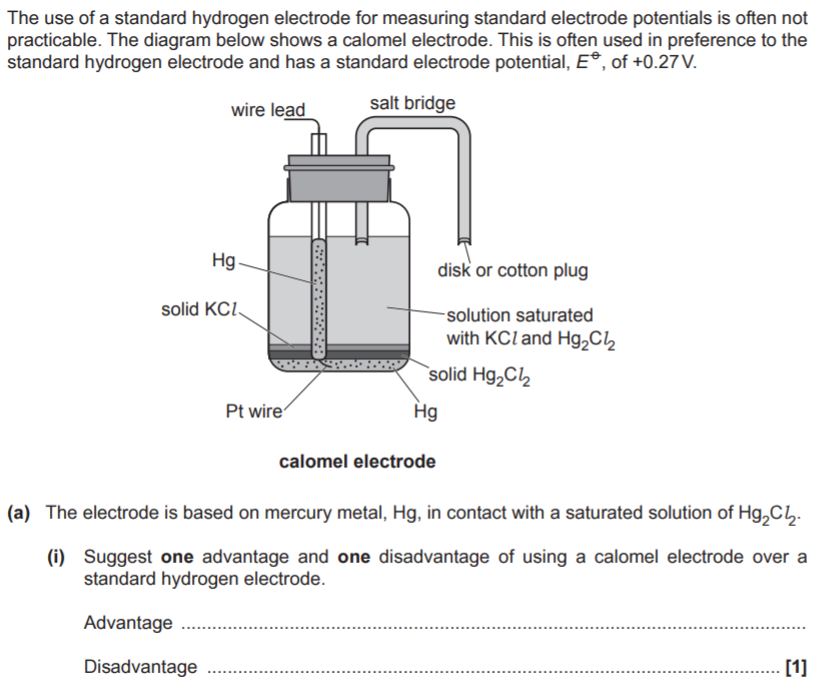
Advantage: portable / no gas involved
Disadvantage: mercury is toxic / poisonous
Ignore references to cost. Mercury being “harmful” is too vague
Before using a pH probe (pH electrode), it must be calibrated for which two quantities?
- Temperature
- pH
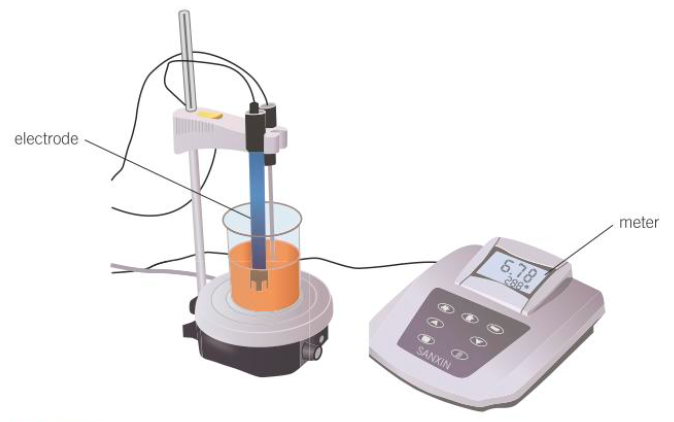
Describe how to calibrate a pH probe.
- Rinse probe with distilled water
- Immerse in buffer solution of pH 7.00
- Connect to meter
- Calibrate for temperature (if not automatic)
- Set meter pH reading to 7.00
- Re-rinse probe
- If intending to measure a wide range of pH values, calibrate with acidic + alkaline buffer solutions too


-
EL 1&2: Mass spectrometry; fusion; emission/absorption spectra33
-
EL 3&4: Electronic configuration, atomic structure21
-
EL 5&6: Covalent bonding, shapes of molecules, amount of substance30
-
EL 7&8: Ionic bonding, precipitation reactions, ionisation enthalpy31
-
EL 8&9: Properties of s-block (mostly G2) compounds, acid-base equilibria20
-
DF defg: Energetics33
-
DF lmhij: Organic functional groups & nomenclature; catalysis; cracking20
-
DF boq: Organic bonding; electrophilic addition of alkenes22
-
DF aprst: Polymers; ideal gas equation; isomerism22
-
DF knu: Combustion; pollutants; fuels & sustainability32
-
ES bdefghijk: Properties of the halogens; oxidation states; redox27
-
ES copq: Electrolysis; equilibrium18
-
ES almn: Risks & benefits of chlorine; iodine-thiosulfate titrations; hydrogen halides18
-
OZ efgh: Kinetics; catalysis15
-
OZ abcdk(i)n: Electronegativity; intermolecular bonding22
-
OZ jk(ii)lm: Amines, haloalkanes; nucleophilic substitution14
-
OZ istu: Percentage concentration & ppm; energy-matter interactions11
-
OZ opqr: Bond fission; radical reaction mechanisms; formation, effects & depletion of ozone19
-
WM ab: Organic functional groups17
-
WM cdhg: Organic reactions (alcohols & phenols); green chemistry32
-
WM ij: Modern analytical techniques: mass spectrometry; IR spectroscopy20
-
CI j: Nitrogen chemistry25
-
CI abcde: Kinetics: rates & orders of reactions; Arrhenius equation23
-
CI fghk: Equilibrium; industrial sustainability20
-
PL hkop: Organic functional groups; esterification28
-
PL lnop: Amines, amides, acyl chlorides, nylons34
-
PL m: Ester, polyester, amide & nylon hydrolysis21
-
PL aijq: Amino acids; peptide bonding; optical isomerism25
-
PL befg: Protein structure; enzyme catalysis & kinetics; molecular recognition23
-
PL cd: Nucleic acids; transcription; translation12
-
PL rst: Modern analytical techniques: high-resolution mass spectrometry; NMR spectroscopy21
-
O abc: Enthalpies of ionic lattices & solutions23
-
O ijklm: Acid-base equilibria42
-
O hn: Solubility product; greenhouse effect17
-
O defg: Entropy26
-
DM ghl: D-block electronic configurations; transition metal catalysis29
-
DM bijkm: Complexes & associated colour34
-
DM ac: Redox titrations & equations22
-
DM def: Electrochemistry; rusting43
-
CD ik: Reactions of carbonyl compounds10
-
CD deg: Aromatic compounds & their reactions39
-
CD abhm: Origins of colour in organic compounds; diazonium and azo compounds; dyes39
-
CD cn: Fats & oils; gas-liquid chromatography18
-
CD f: Tests for functional groups throughout spec0
-
CD j: Organic synthesis30
-
T&P Measurement18
-
T&P Synthesis14
-
T&P Purification14
-
T&P Analysis35
-
T&P Terminology6



