Tactical ventilation
What is ‘defensive ventilation’?
This is carried out away from the fire to improve firefighting and searching conditions. It involves the venting of adjoining and outer compartments after the fire compartment has been isolated and suppressed.

Tactical ventilation
What is ‘offensive ventilation’?
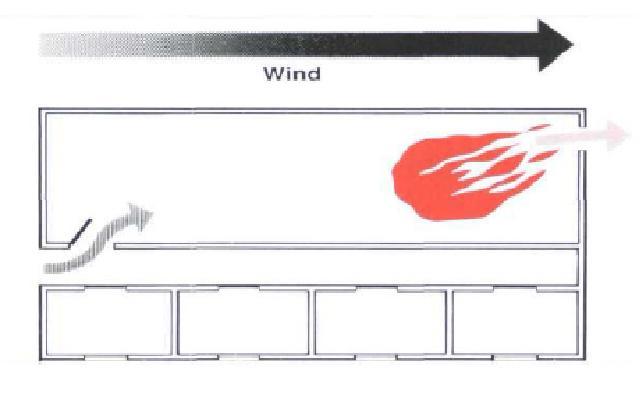
This is carried out to directly affect the fire itself, to limit fire spread and improve conditions within the fire compartment. It also makes the approach route safer for firefighters
Tactical ventilation
During what stages of a fire can tactical ventilation be used?
- After the arrival of the Brigade but before control is achieved.
- After control but before fire extinction.
- After fire extinction.
Tactical ventilation
What are the benefits of tactical ventilation?
- Assist the escape of occupants by restricting the spread of smoke.
- Improve conditions for trapped occupants.
- Speed up rescue operations and fire attack by reducing heat and smoke.
- Increase the safety of firefighters by reducing the risk of flashover and backdraught.
- Reduce fire spread and property damage by limiting the movement of hot smoke and gases
Tactical ventilation
What considerations should be made when decing to use tactical ventilation?
- The IC should carefully consider tactical ventilation and its likely effects.
- In most cases, tactical ventilation should not be used until the fire has been located. firefighters should use a (TIC) to help gather information.
- Once the location of the fire is identified, any decision to start tactical ventilation must form part of an overall strategy of controlling air movements within the building
Tactical ventilation
How can wind effect tactical ventilation?
Wind strength and direction are important considerations in tactical ventilation. In most cases the location of the vents will indicate the direction in which the smoke and hot gases will move within the building.
Remember: wind direction in high rise buildings may be different to that at ground level.
Tactical ventilation
In what situations should tactical ventilation should be considered?
- If the escape route from the building contains smoke, and there are still people in the building, ventilation can help clear the route.
- Ventilation can also be used to remove hot gases and smoke to improve conditions for firefighting operations and reduce the likelihood of rapid fire development.
- If a risk of backdraught has been identified, flammable gases need to be released from the compartment in a controlled manner. Properly applied, ventilation can release these gases externally, reducing the risks to firefighters.
- As part of information gathering, the IC should establish if the building has any built-in ventilation systems. Automatic systems specifically designed for fire ventilation may have activated before the arrival of the Brigade. The incident plan should allow for the effects of these systems.
- The incident plan should also take into account any air conditioning systems. These can cause fresh air to be supplied to the fire and hot combustion products to be drawn into hidden ducts and voids, increasing the likelihood of fire spread.
- Conversely, air conditioning systems can be used as part of tactical ventilation. The IC should not use them to provide outlet vents unless they are sure that it will not lead to fire spread
Tactical ventilation
Before offensive ventilation is used, the risk of potential fire spread must be weighed against the benefits of improved conditions, What are they?
- If used correctly, offensive ventilation can reduce the risk of fire spread by removing hot gases while supplying fresh air. However, if applied incorrectly, this method can cause rapid fire development. The decision to use offensive ventilation must be made using a thorough risk assessment and a high level of knowledge.
- Where it is felt that defensive ventilation is a more appropriate approach, the risks are proportionately less.
- Defensive ventilation does not have to form part of a major attack on a fire. It can be part of the build up to the attack, helping to clear escape and attack routes, or part of operations once the fire is under control.
- When the defensive ventilation method is used before the extinction of the fire, the compartment must be controlled to minimise the chance of fresh air affecting the fire.
Tactical ventilation
Where it is felt that defensive ventilation is a more appropriate approach, the risks are proportionately less. What are they?
- Defensive ventilation does not have to form part of a major attack on a fire. It can be part of the build up to the attack, helping to clear escape and attack routes, or part of operations once the fire is under control.
- When the defensive ventilation method is used before the extinction of the fire, the compartment must be controlled to minimise the chance of fresh air affecting the fire.
Tactical ventilation
To ventilate efficiently, the IC must consider how and where hot gases and smoke will leave the building and fresh air will be allowed to enter. What are the 2 options?
- Vertical ventilation.
- Horizontal ventilation.
Tactical ventilation
What is the difference between horizontal and vertical ventilation?
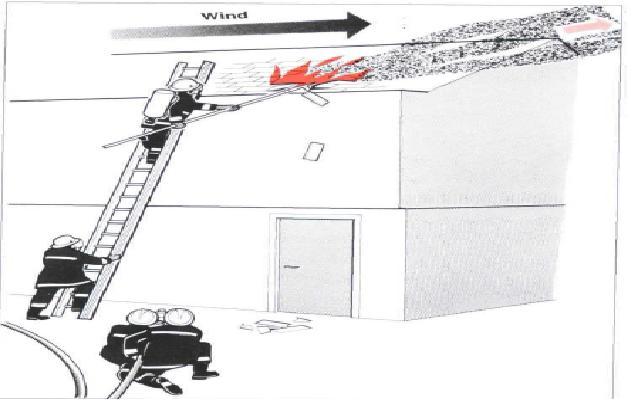
Vertical and horizontal ventilation differ in the location of the outlet vent. In vertical ventilation, the outlet vent is placed as high as possible in the building (usually the compartment roof) and as close to the fire as possible. In horizontal ventilation, an outlet vent (usually a window) is chosen which is as high as possible in the compartment wall
Tactical ventilation
What are the advantages of vertical ventilation?
- It minimises the risk of a backdraught, as the overpressure in the compartment will drive out the hot gases.
- It minimises fire spread, as the hot gases travel the shortest route before leaving the building.
- It provides rapid smoke clearance because of the velocity of the hot gases through the vent.
Tactical ventilation
What are the disadvantages of vertical ventilation?
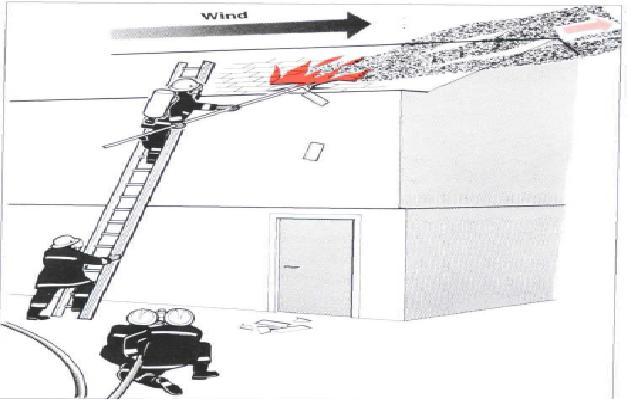
The main disadvantage of vertical ventilation is that firefighting operations may be required on the roof above the fire, which can be extremely hazardous
Tactical ventilation
When is horizontal ventilation most effective?
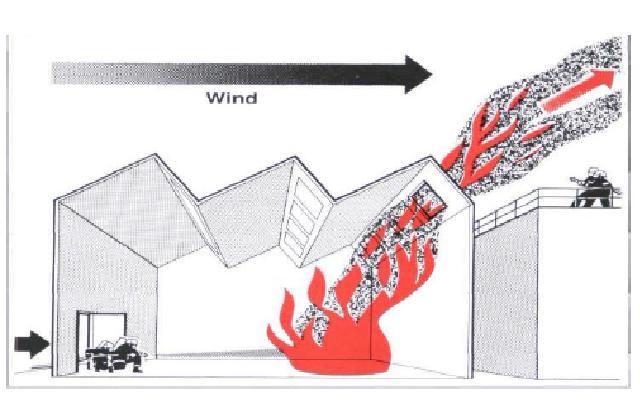
It is most effective when the outlet vent can be opened first (high on the downwind side of the building) to release the products of combustion, followed by the inlet vent (low on the upwind side) to allow fresher air into the building.
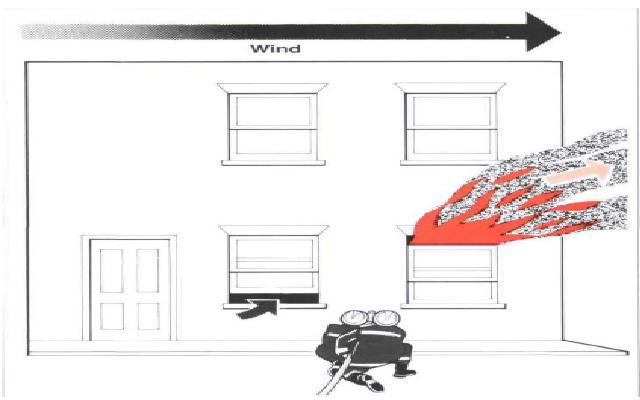
Tactical ventilation
Describe offensive horizontal ventilation?
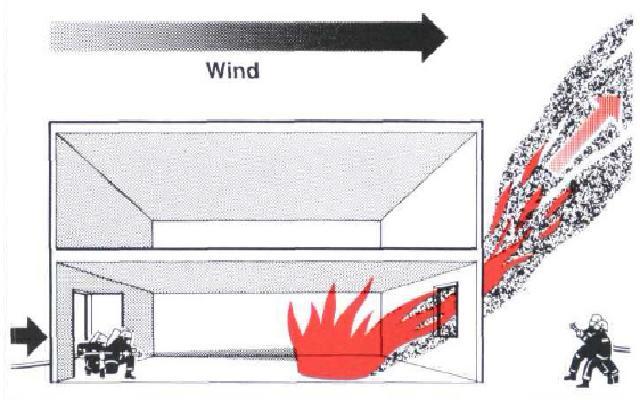
Tactical ventilation
Describe defensive horizontal ventilation?
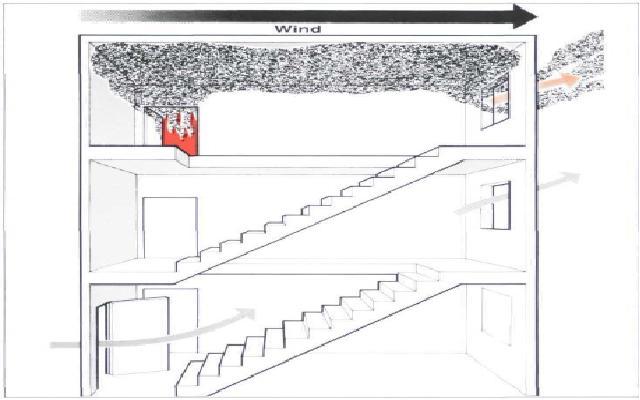
Tactical ventilation
What are the considerations when making vents?
- When using natural rather than forced ventilation, the outlet vent should be the same size or smaller than the inlet. When making vents, staff should try to use the layout and features of the building to help them.
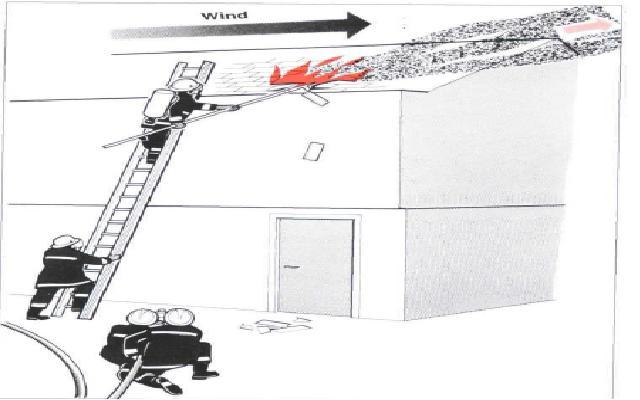
- Firefighters creating vents should never position themselves above the outlet. They should always be protected by BA and a covering jet.
- Outlet vents should be made first, followed by inlet vents as soon as possible.
- If, as part of the ventilation plan, it is decided that firefighting should be carried out inside in the building, outlet vents should always be created in front of advancing crews.
- Ideally, this should be done on the side of the fire furthest from the advancing crews. This will avoid fire and combustion products being drawn towards them
Tactical ventilation
What is the simpliest way of creating a vent?
The simplest way of creating a vent is to open a window or door. Opening windows rather than breaking them means they can be closed if necessary.
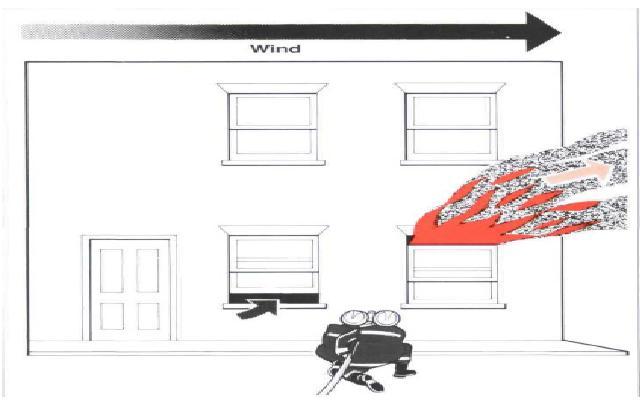
Tactical ventilation
Whats the easiest way of creating vertical ventilation?
The easiest way of making a roof vent is to take advantage of building features such as roof lights or dormer windows. If there are none, firefighters can sometimes lift slates and tiles and cut through whatever lies underneath.
The safest way to perform this task is from an aerial appliance. Without knowledge of the construction method or the effect of the fire on the roof structure, it is not advisable to attempt this method of ventilation.
Tactical ventilation
What control measures need to be put in place before carrying out tactical ventilation?
- Make sure adequate resources are available.
- Identify the wind direction.
- Decide whether vertical or horizontal ventilation is more appropriate.
- Select inlet and outlet vents and decide how they will be made.
- Make sure the outlet vent is covered by a charged hoseline.
- Make sure there is effective communication between firefighters performing other activities inside the building, the IC, and firefighters conducting ventilation activities.
- Consider withdrawing any firefighters inside the building while ventilation takes place.
- Notify all staff of the intention to start ventilation.
- Make an outlet vent first, followed by an inlet vent as soon as possible (this may already be the point of access).
- Closely supervise the effects of ventilation and make sure progress and conditions within the building are reported.




