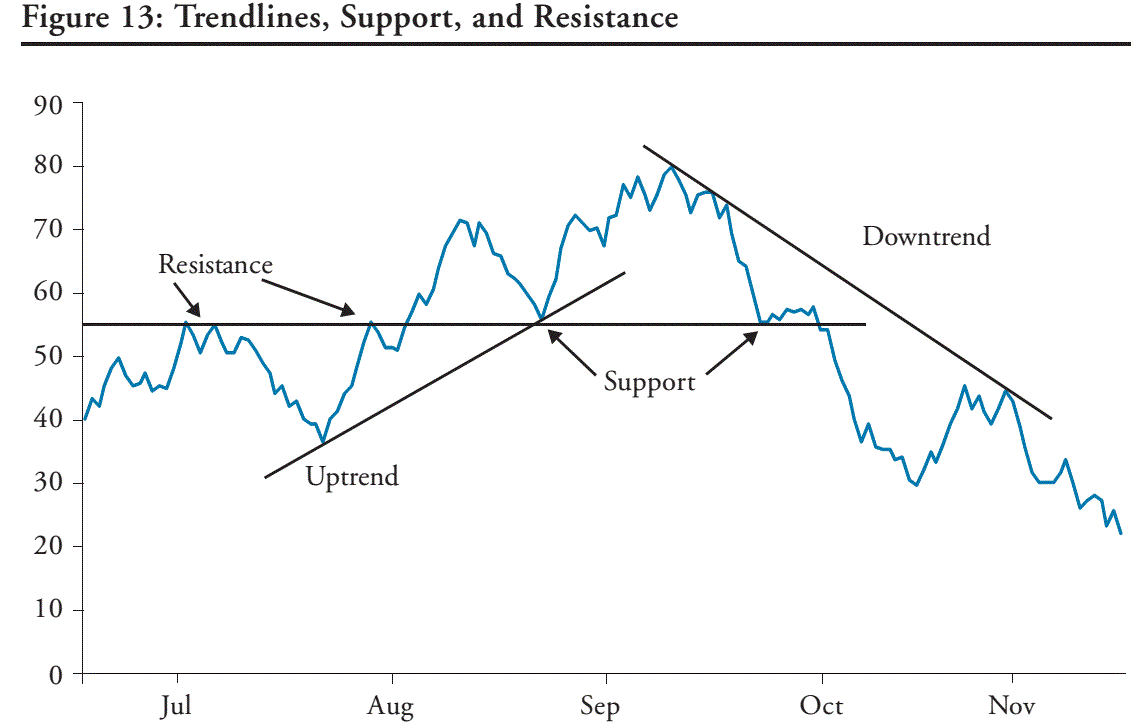
Trendlines, Support, and Resistance
Reversal pattern
Reversal patterns: Head-and-shoulders; double top; triple top; inverse head-and- shoulders; double bottom; triple bottom. These price patterns are thought to indicate that the preceding trend has run its course and a new trend in the opposite direction is likely to emerge.
Continuation patterns
Continuation patterns: Triangles; rectangles; flags; pennants. These indicate temporary pauses in a trend which is expected to continue (in the same direction).
Price Target = Breakout Price + size of pattern
Price-based indicators:
- Moving Averages:
Moving average lines can help illustrate trends by smoothing short-term fluctuations, but when the number of periods is large, a moving average line can obscure changes in trend.
- Bollinger bands:
drawn a given number of standard deviations above and below a moving average line. Prices are believed to have a higher probability of falling (rising) when they are near the upper (lower) band.
- Momentum oscillators: (rate of change, RI, stochastic, MACD):
Sentiment indicators
Technical analysts also use indicators based on investors’ bullish (investors expect prices to increase) or bearish (investors expect prices to decrease) sentiment.
Sentiment indicators include the following:
- Put/call ratio: Put option volume divided by call option volume.
- Volatility index (VIX): Measure of volatility on S&P 500 stock index options.
- Short interest ratio: Shares sold short divided by average daily trading volume.
- Amount of margin debt outstanding.
- Opinion polls that attempt to measure investor sentiment directly.
Contrarian Perspective
Contrarians believe markets get overbought or oversold because most investors tend to buy and sell at the wrong times, and thus it can be profitable to trade in the opposite direction from current sentiment.
High levels of the put/call ratio, VIX, and short interest ratio indicate bearish market sentiment, which contrarians interpret as bullish. High levels of margin debt indicate bullish sentiment, which contrarians interpret as bearish.
Refer to “Sentiment Indicator”.
Flow of funds indicators
Indicators of the flow of funds in the financial markets can be useful for identifying changes in the supply and demand for securities. These include:
- Arms index or short-term trading index (TRIN), which measures funds flowing into advancing and declining stocks;
- Margin debt (also used as a sentiment indicator);
- New and secondary equity offerings; and
- Mutual fund cash as a percentage of net assets.
Convergence vs. Divergence
- Convergence occurs when the oscillator shows the same pattern as prices, suggesting the price trend is likely to continue.
- Divergence occurs when the oscillator shows a different pattern than prices, indicating a potential change in trend in the near term.
Estimate of the price target using head and shoulders pattern
Price target = Neckline − (Head − Neckline)
Multivariate Normal Distribution
A multivariate normal distribution for the returns on n stocks is completely defined by three lists of parameters:
- the list of the mean returns on the individual securities (n means in total);
- the list of the securities’ variances of return (n variances in total); and
- the list of all the distinct pairwise return correlations: n(n − 1)/2 distinct correlations in total.
Definition of p-value
The p-value is the smallest level of significance at which the null hypothesis can be rejected.
- p-value > level of significance, fail to reject H0
- p-value < level of significance, reject H0
Relative Strength Index
The relative strength index (RSI) is a momentum oscillator and provides information on whether or not an asset is overbought or oversold. An RSI greater than 70 indicates that a stock is overbought; an RSI lower than 30 suggests that a stock is oversold.




