<p>T/F: Ocean nergy is Renewable energy.</p>
<p>T</p>
<p>Done recently.</p>
<p>MNREhas clarified to all the stakeholders thatenergy produced using various forms of ocean energy such as tidal, wave, ocean thermal energy conversion etc. shall be considered as Renewable Energy and shall be <strong>eligible for meeting the non-solar Renewable Purchase Obligations (RPO).</strong></p>
<p>Total identified potential of Tidal Energy?</p>
<p>about 12455 MW, with potential locations identified at Khambat & Kutch regions, and large backwaters, where barrage technology could be used.</p>
<p>potential of wave energy in India?</p>
<p>about 40,000 MW</p>
<p>Top supplier of Crude oil to INdia?</p>
<p>As of Dec 2019</p>
<ol>
<li>Iraq: 25%</li>
<li>Saudi Arabia: was at top till 2017-18</li>
<li>Nigeria: earlier Iran but India stopped importing after US sanctions</li>
<li>UAE</li>
<li>Venezuela</li>
<li>USA</li>
</ol>
<p></p>
<p>Iran was the second largest supplier of crude oil, after Saudi arabia, until 2010-11, but then sanctions was imposed on her by USA</p>
<p>Top supplier of Natural Gas to INdia?</p>
<p>India imports 45% of the total amount of natural gas it consumes.</p>
<p>Highest being Qatar</p>
<p>SARAL – ‘State Rooftop Solar Attractiveness Index’?</p>
<ol>
<li>by <strong>MNRE</strong>,Shakti Sustainable Energy Foundation (<strong>SSEF</strong>), <strong>ASSOCHAM </strong>andErnst & Young (<strong>EY</strong>).</li>
<li>this is a first-of-its kindIndex that <strong>evaluates Indian states based on their attractiveness for rooftop development.</strong></li>
<li>five key aspects:
<ol>
<li>robustness of policy framework</li>
<li>implementation environment</li>
<li>investment climate</li>
<li>consumer experience</li>
<li>business ecosystem</li>
</ol>
</li>
<li><strong>Findings:KN </strong>placed First;Telangana, Gujarat and Andhra Pradesh have got 2nd, 3rdand 4th</li>
<li><strong>Potential </strong>fr Rooftop solar in India: <strong>124GW; hwever only 1.25 GW</strong> has been installed by 2016.</li>
</ol>
<p>"Transitioning from coal won't be easy"?</p>
<p>Coal phase out is a must for any eventual target of net zero emission.</p>
<ol>
<li>over dependence on coal for energy needs. 70% as of now.In FY20, India consumed approximately 942 million tonnes (MT) of coal, 730 MT of which was produced domestically. Of this, approximately 666 MT was produced by CIL and SCCL</li>
<li>phaseout plan also carries elements of a “just transition” i.e. it mustrecognisethat there will be broader social and economic consequences of transitioning to clean energy</li>
<li>roadmap for workers and communities dependent on fossil fuels
<ul>
<li>eg.German coal phaseout plan seeks to end coal burning by 2038 and calls for an investment of more than 50 billion euros for mining and plant operators, impacted regions and employees.</li>
<li>Using different employment factors, one study has pegged direct coal jobs at 7,44,984, while another study pegs it at approximately 12,00,000. This figure does not even include contract employees, those in ancillary services as well as those engaged in statecraft coal (non-legal small scale coal mines in NE) and subsistence coal (small-scale collieries run on village commons usually bordering formal mines)</li>
</ul>
</li>
<li>factors like education, skill levels, willingness to migrate, and caste. Without adequate information on these parameters, it becomes difficult to decide how and where to finance the transition.</li>
<li>revenues from coal and allied activities.In FY20, the Centre alone collected approx.Rs 29,200 crore in GST compensation cess from coal.</li>
</ol>
<p>Northeast gas pipeline grid project?</p>
<p>willconnect Guwahati to the major Northeast cities and major load centers.</p>
<p>It is 1, 656 km long.</p>
<p>implemented by Indradhanush Gas Grid, a joint venture of state-owned GAIL India, IOC, ONGC, OIL and Numligarh Refinery Ltd.</p>
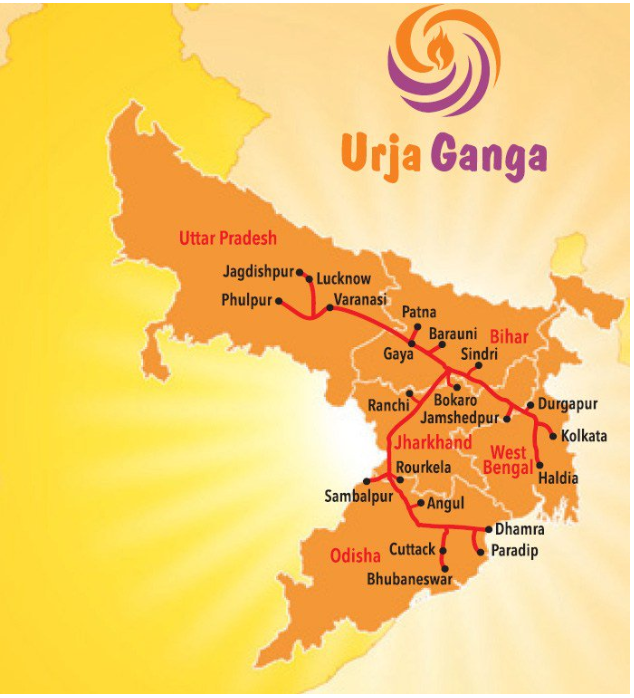
<p>being implemented under ambitiousUrja Ganga Gas Pipeline Project.</p>
<p>pipeline will also connect withthe National Gas Gridthrough Barauni-Guwahati Gas Pipeline, which is being laid by GAIL.</p>
<p></p>
<p>National Gas Grid?</p>
<p>At present, about 16,788 km natural gas pipeline is operational and about 14,239 km gas pipelines are being developed</p>
<p>objectives of the National Gas Grid are:</p>
<ul>
<li>To remove regional imbalance within the country with regard to access for natural gas</li>
<li>To connect gas sources to major demand centres and ensure availability of gas to consumers in various sectors.</li>
<li>Development of City Gas Distribution Networks in various cities for the supply of CNG and PNG.</li>
</ul>
<p>In Dec 2018, PNGRB started<strong>City Gas Distributions(CGD) Project to</strong>distribute gas to around half of the country's population in 26 states andUTs</p>
<p>India's Coal sector?</p>
<p>India has world's 4th largest coal reserves</p>
<p>However, India imported 235 MT of coal last yr</p>
<p>80% of domestic production in India is by Coal India</p>
<p>India’s state-run coal gianthas beenunable to meet growing demanddespite abundant resources. It has fallen short of productiontargets in the last few yrs</p>
<p></p>
<p>Pradhan Mantri Urja Ganga project?</p>
<ol>
<li>gas pipeline projectaims to <strong>provide piped cooking gas</strong> to residents of <strong>Varanasi </strong>and later to millions of people in states like <strong>Bihar, Jharkhand, West Bengal and Odisha.</strong></li>
<li>It is <strong>2,655 km </strong>long gas pipeline project originating at <strong>Jagdishpur</strong> (Uttar Pradesh). The main trunk of pipeline ends to <strong>Haldia</strong> (West Bengal) and <strong>Dhamra </strong>(Odisha).</li>
<li>being implemented by <strong>GAIL</strong></li>
<li>According to GAIL, with the Urja Ganga project, <strong>20 lakh households will get PNG connections.</strong></li>
<li>government estimates that around <strong>5 lakh gas cylinders will be sent at rural areas annually.</strong></li>
<li><strong>Will help the govt</strong>to <strong>raise the share of natural gas in the country’s energy mix to 15% by 2030 from current 6.2%.</strong></li>
</ol>
<p>DraftElectricity (Amendment) Bill, 2020 : policy amendments?</p>
<p><em><u><strong>NOT PASSED</strong></u></em></p>
<p><u><strong>POLICY AMENDMENTS</strong></u></p>
<ol>
<li>RE: delegates CGwith the power to prepare and notify a National Renewable Energy Policy “for promotion of generation of electricity from renewable sources”, in consultation with State Governments;seeks to give special attention to hydro power.</li>
<li>Cross Border Trade: CGhas been delegated with the power to prescribe rules and guidelines to allow and facilitate cross border trade of electricity.</li>
<li>ECEA:inserted a new chapter in the Act which prescribes the creation and functioning of the Electricity Contract Enforcement Authority.The existing authorities, i.e. APTEL (<em>in consti bodies FCs</em>), CERC and SERCs constituted under the Electricity Act, 2003 do not have the jurisdiction to deal with the matters pertaining to the enforcement of contract, unless such issue pertaining to enforcement is anywhere related to determination of tariffs, licensing, metering and related matters.</li>
</ol>
<p>DraftElectricity (Amendment) Bill, 2020: Functional amendments?</p>
<p><em><u><strong>NOT PASSED</strong></u></em></p>
<ol>
<li><strong>Payment Security</strong>:It proposes a mechanism wherein “no electricity shall be scheduled or despatched under such contract unless adequate security of payment as agreed upon by the parties to the contract, has been provided”.</li>
<li>Constitution of <strong>selection committee to recommend members for commissions/ authorities</strong>:likeAppellate Tribunal and the Chairperson and Members of Central Commission, Electricity Contract Enforcement Authority, State Commissions and Joint Commissions.</li>
<li><strong>Grant of Subsidy mandated</strong>:The benefit of subsidy to be granted directly to the consumervia DBT and the licensee shall charge the consumers as per the tariff determined by the Appropriate Commission. The determination of tariffs shall be fixed by the commission without accounting for subsidies. Further, basisthe tariff policies, surcharges and cross subsidies shall be progressively reduced.</li>
<li><strong>Inclusion of Distribution Sub-licensee and Franchisee</strong>:To ease the burden of distribution licensees and in order to <strong>promote some form of demographic specialization</strong>, the <strong>distribution licensees, can appoint another entity</strong> for distribution of electricity on its behalf, within its area of supply.</li>
<li><strong>Enhancement of the powers of the Appellate Tribunal of Electricity</strong>:APTEL is proposed to havethe <strong>powers of a High Court</strong> to deal with wilful disobedience of persons and entities <strong>under the Contempt of Courts Act, 1971</strong>.Additionally,any person can appeal the decisions of the Authority which is introduced by this Amendment in front of the APTEL.The <strong>numbers of members at the APTEL have also been proposed to be increased</strong> by the Amendment.</li>
<li><strong>Time limit for adoption of tariff</strong> so determined:Amendment has prescribed a period of<strong> 60 days</strong> to adopt the determined tariffs. Failing such timeline of 60 days, the tariff would be deemed to be accepted. Such deemed acceptance is a good method to not allow red-tapism</li>
</ol>
<p>DraftElectricity (Amendment) Bill, 2020:Composition and powers of Electricity Contract Enforcement Authority?</p>
<p>NOT PASSED</p>
<ol>
<li>The Authority will be headed by a retired Judge of the High Court.</li>
<li>It is proposed to be set-up with powers of the Civil Court.</li>
<li>It will enforce performance of contracts related to purchase or sale or transmission of power between a generating, distribution or transmission companies.</li>
</ol>
<p>DraftElectricity (Amendment) Bill, 2020: opposition and issues?</p>
<p><u><em><strong>NOT PASSED</strong></em></u></p>
<p>States like WB, PJ, Kerala, RJ, JH, CHH, MH, Dehi etc.called the draft Billa violation of “the spirit of co-operative federalism”and accused the Centre of failure to consult the States on the Bill sinceelectricity is on the Concurrent List.</p>
<ul>
<li>States are worried about ending subsidies</li>
<li>draft also“divests” the States of their power to fix tariffand hands over the task toa Central government-appointed authority</li>
<li>Another provision makes itcompulsory for the State power companies to buy a minimum percentage of renewable energy fixed by the Centre.</li>
</ul>
<p>National Load Despatch Centre?</p>
<p>constituted in 2009</p>
<p>constituted as per Ministry of Power (MOP) notification</p>
<p>is the apex body to ensure integrated operation of the national power system.</p>
<p>DISCOM sector: prevalent problems?</p>
<ol>
<li>High Legacy debt:: DISCOMs have not been able to clear their past debts to Generators. The PFC’s Report on Utility Workings for 2018-19 showed dues to generators were ₹2,27,000 crore, well before COVID-19. As per and Crisil report predicts 30 per cent increase in their debt to ₹4.5-lakh crore in coming times.</li>
<li>high AT&C losses: avg 21.4% compared to 6-7% in UK and US;several discoms have losses in excess of 40%.It is common knowledge that it is possible to bring down losses from 40 per cent to about 15 per cent without any significant investments in infrastructure. Investments, however, would be required to bring down losses further to a single-digit level since all low-hanging fruits would have been consumed by then.</li>
<li>Billing Issues</li>
<li>issues related to tariffs: lack of cost reflective tariffs (gap between theaverage per-unit cost of supply (ACS) and average revenue realised (ARR)) and distorted cross subsidies (leading to may industries switching to captive power generation) andabsence of tariff hikes</li>
<li>state monopoly</li>
<li>delays in subsidy and other payment disbursals y states like andhraP, Chh, KN, PJ and RJ, esp in the wake of pandemic</li>
<li>other losses:Expensive thermal power purchase agreements (PPAs), and a lack of modern technology and infrastructure development.</li>
</ol>
<p>DISCOM sector: UDAY scheme?</p>
<p>GoI launched Ujwal DISCOM Assurance Yojana (UDAY) in 2015 to turn around the precarious fin position of state DISCOMs</p>
<p>need:by March 2015, discoms' accumulated losses were approximately Rs 3.8 lakh crore — more than 3.5% of the GDP.</p>
<p>UDAY is basically a debt restructuring plan for the DISCOMs and was optional for the states.</p>
<p>components:</p>
<ol>
<li>takeover of discoms debt by SGs: SGstook over 75% of the debt of their discoms and issuedlower-interest bondsto service the rest of the debt.</li>
<li>In return, discoms were given target dates (2017-19) tomeet efficiency parameters: AT&C losses were to be reduced from 22% to 15%</li>
<li>This has to be matched up bytimely tariff revisions and elimination of the gap between ACS and ARR by 2019</li>
<li>
<p>Improvement of operational efficiency through compulsory smart metering, up-gradation of transformers, meters, etc. Also, the adoption of energy efficiency measures like the promotion of efficient LED bulbs, agricultural pumps, fans & air-conditioners would be initiated.</p>
</li>
<li>
<p>CG did not grant any money to SGs for the purpose btpromised to help the states in reducing the cost of power through coal linkage rationalisation, etc.</p>
</li>
</ol>
<p>DISCOM sector: UDAY scheme: performance?</p>
<ul>
<li>Book losses of discoms reduced from Rs 51,562 crore in the financial year 2016 to Rs 15,132 crore in 2018. However, the losses in 2019 have nearly doubled to Rs 28,036 crore vis-a-vis 2018.A recent report of Niti Aayog has assessed the losses to be about Rs 90,000 crore in 2020-21. This points that discoms are lagging behind in eliminating theACS-ARR gap— the same issue that had led to the floundering of the previous two schemes -Accelerated Power Development and Reforms Programme (APDRP)andRestructured APDRP (R-APDRP).</li>
<li>Discoms have also missed the year 2019 UDAY target to bring down their (AT&C)losses to 15%.</li>
<li>According to the government’s UDAY portal, AT&C losses were 18.9% and ACS-ARR gap was Rs 0.42/unit at the end of FY20. In FY16, when the scheme was launched, AT&C losses were 20.7% and the ACS-ARR gap was Rs 0.59/unit.</li>
<li>government has cited factors such as inadequate hikes in power tariffs, inadequate rise in ‘open access’ transactions and outstanding dues accumulating from state government departments among the reasons for the discoms not meeting the UDAY targets.</li>
<li>states have recorded improvements in subsidy disbursals, with all states except Himachal Pradesh, Andhra Pradesh, Karnataka, Rajasthan, Telangana and Punjab releasing entire subsidy booked by their respective discoms in FY18</li>
</ul>
<p>DISCOM sector: reforms based and results linked revamped distribution scheme 2021?</p>
<ul>
<li>aim:improve the operational efficiencies and financial sustainability of all DISCOMs excluding pvt sector</li>
<li>schemes subsumed: Integrated power Deveopment Scheme + DDUGJY</li>
<li>scheme will provide conditional financial assistance to DISCOMs for strengthening of supply infrastructure.</li>
<li>eligibility for funding:DISCOMs have to score a minimum of 60% of marks and clear a minimum bar in respect to certain performance parameters like aggregate AT&C losses, ACS-ARR gap, infrastr upgrade performance, consumer services, hrs of supply, coporate governance etc.</li>
<li>scheme available till yr 2025-26</li>
<li>nodal agencies: REC Ltd and Power Fin Corporation</li>
<li>Fin outlay: 3.03 L Cr</li>
<li>Financial assistance for
<ul>
<li>prepaid smart metering fr all consumers except Agri consumers:<em>Grant of Rs 900 or 15% (whichever is lower) of the cost per consumer meter worked out for the whole project (Rs 1350 or 22.5% for Special Category States)</em>.</li>
<li>for works other than smart metering:Maximum financial assistance given to DISCOMs will be 60% of the approved cost (90% for Special Category States)</li>
<li>In addition, the DISCOMs can also avail of an additional special incentive of 50% of the aforementioned grants if they install the targeted number of Smart meters by December 2023.</li>
</ul>
</li>
<li>feeder segregation for unsegregated feeders</li>
<li>Convergence with the Pradhan Mantri Kisan Urja Suraksha Evem Utthan Mahabhiyan (PM-KUSUM) Scheme to solarize all feeders</li>
</ul>
<p>DISCOM sector: reforms based and results linked revamped distribution scheme 2021: issues?</p>
<p>inherent problems with parameters like ACS and ARR since they keep fluctuating and it is very difficult to fathom their trend on a quarter-wise basis, rendering the release of funds to be tricky and cumbersome.</p>
<p>In the scheme now announced by the government, monitoring will be all the more complex since about 26 parameters will be taken into consideration and assigned a score.for some of the parameters, it may be difficult to assign a score across discoms which may lead to some amount of subjectivity. Some examples being — providing accurate energy accounts, tariff reforms initiated, consumer rights and grievance redressal handled.</p>
<p>Some of the parameters are even questionable, for instance, liquidation of regulatory assets, since these are mandated by the regulatory commissions and therefore, the discoms have no role to play in them.</p>
<p>DISCOM sector: suggestions?</p>
<ul>
<li>an alternate approach: providing only transitional financial support to all discoms, which are privatised under the PPP mode. Case study of Delhi,A transitional support of Rs 3,450 crore spread over five years proved to be exceedingly beneficial since it allowed the privatised utilities some breathing time to bring down their losses.The onus would be on the privatised utility to use this support judiciously under the supervision of the regulatory commission. Targets of loss reduction can be laid down on a year-wise basis and if these targets are not met, the privatised utilities would have to bear the loss. Incentives could also be thought of in case there was over-achievement vis-à-vis the targets. This is exactly the approach followed in the case of Delhi.</li>
<li>Making fiscal headroom through subsidy reductiono Taking lessons from the existing Direct Benefit Transfer (DBT) models in Andhra Pradesh, Madhya Pradesh, Punjab, etc.Developing framework for targeting of subsidies to domestic and agriculture consumers</li>
<li>Mandate No Dues Certificates for state departments to avoid dues build up.</li>
<li>Issuing of bonds through securitization of receivables against the DISCOM’s regulatory assets as has been done in Rajasthan.</li>
<li>Inflation adjusted tariff hikes.</li>
</ul>
<p>India's largest floating solar project? advantages of floating power plants?</p>
<ul>
<li>India’s largest floating PVprojectof 25 MW has been commissioned by NTPC on the reservoir of its Simhadri thermal station in Visakhapatnam, Andhra Pradesh.</li>
<li>Once operational it is expected to minimize 46,000 tons of CO2 annually. It is also believed to conserve 1,364 million liters of water per annum.</li>
<li>This is also the first solar project to be set up under the Flexibilisation Scheme,notified by the Government of India in 2018.</li>
</ul>
<p>advantages of floating power plants</p>
<ul>
<li>acc to WB,floating solar plants represent “new opportunities for scaling up solar generating capacity, especially in countries with high population density and competing uses for available land”</li>
<li>benefits of“improved energy yield thanks to the cooling effects of water and the decreased presence of dust”</li>
<li>the water saving comes from reduced evaporation as solar panels cover the surface of a reservoir and absorb the rays of the sun while at the same time limiting “the evaporative effects of wind”.</li>
</ul>
<p>causes for coal shortage in Thermal power plants (Oct 2021)?</p>
<p>shortage stats:</p>
<ul><li><span>India’s coal fired thermal power plants account for 208.8 GW or 54 per cent of India’s 388 GW installed generation capacity.</span></li><li><span>The average level of coal stocks at an increasing number of India’s thermal power plants have come down to four days worth of stock compared to the govt recommendations that TPPs hold 14 days worth of coal stock.</span></li><li><span>In total, plants with a power generation capacity of 132 Gigawatts (1GW is 1,000 MW) of the 165 GW of capacity monitored daily, had critical or super critical levels of coal stock.</span></li><li><span>shortage of coal is more acute in non-pithead plants or plants which are not located close to coal mines</span></li></ul>
<p><span>Causes:</span></p>
<ul><li><a><strong>A sharp uptick in power demand</strong></a><strong>: </strong><span>India consumed 124 billion units of power in August 2021 compared to 106 billion units of power in August 2019 i.e. even higher than pre pandemic level</span><ul><li><span>recovery from pandemic, and</span></li><li><span>government has connected an additional 28.2 million households and these households are buying lights, fans and television sets leading to an increase in power demand, leading to uptick in daily energy demand across the country</span></li></ul></li><li><span>Coal fired thermal power plants have also supplied a higher proportion of the increase in demand: share of TPPs in India’s power mix increasing to 66.4% from 61.9% in 2019.</span></li><li><span>lower than normal stock accumulation by thermal power plants in the April-June period</span></li><li><span>continuous rainfall in coal bearing areas in August and September which led to lower production and fewer despatches of coal from coal mines.</span></li><li><span>A consistent move to lower imports coupled with high international prices of coal have also led to plants cutting imports.</span></li></ul>
Recent reforms in Coal sector 2021?
- Commercial mining of coal allowed, with 50 blocks to be offered to the private sector.
- Entry norms will be liberalised as it has done away with the regulation requiring power plants to use “washed” coal.
- Coal blocks to be offered to private companies on revenue sharing basis in place of fixed cost.
- Coal gasification/liquefaction to be incentivised through rebate in revenue share.
- Coal bed methane (CBM) extraction rights to be auctioned from Coal India’s coal mines.
- The “captive mines”, will now be allowed to sell 50% of their annual output in the open market. The Ministry of Coal has amended Mineral Concession Rules, 1960 in this regard. (Oct 2021)
Coal gasification?
It is the process of producing syngas, a mixture consisting carbon monoxide (CO), hydrogen (H2), carbon dioxide (CO2), natural gas (CH4), and water vapour (H2O).
- During gasification, coal is blown with oxygen and steam while also being heated under high pressure. During the reaction, oxygen and water molecules oxidize the coal and produce syngas.
- Benefits of gasification:
- Transporting gas is a lot cheaper than transporting coal.
- Help address local pollution problems.
- Has greater efficiency than conventional coal-burning because it can effectively use the gases twice: the coal gases are first cleansed of impurities and fired in a turbine to generate electricity. The exhaust heat from the gas turbine can be captured and used to generate steam for a steam turbine-generator.
- Concerns and challenges:
- Coal gasification is one of the more water-intensive forms of energy production.
- There are also concerns about water contamination, land subsidence and disposing of waste water safely.
Coal Liquefaction?
Also called Coal to Liquid (CTL) technology, it is an alternative route to produce diesel and gasoline and makes economic sense only in a world of high crude oil prices.
- The process involves gasification of coal, which in turn will produce synthetic gas (a mix of CO+H2). The synthetic gas can be liquefied to its fuel equivalent in presence of cobalt/iron-based catalysts at higher pressure and temperature.
- However, liquefied coal emits twice as much CO2 as burning oil. It also emits a large volume of SO2.
Benefits of liquefaction:
The CO2 emissions are more readily and cheaply captured from CTL plants than from conventional coal-fired power stations. The captured CO2 can be transported and injected into underground storage reservoirs (a procedure known as “carbon capture and storage”—CCS—or “geosequestration”).
GoI initiatives wrt coal gasification and liquefaction?
- India aims for 100 million tonnes (MT) coal gasification by 2030 with investments worth over Rs. 4 lakh crores.
- For encouraging use of clean sources of fuel, government has provided for a concession of 20% on revenue share of coal used for gasification. This will boost production of synthetic natural gas, energy fuel, urea for fertilisers and production of other chemicals.
Captive and Non-Captive mines?
- Captive Mines: Captive mines are the mines that are owned by companies. The coal or mineral produced from these mines is for the exclusive use of the owner company of the mines. The company cannot sell coal or mineral outside. Some electricity generation companies used to have captive mines.
- Non- Captive Mines: Non-captive Mines are mines from which the produced coals of minerals could be used for its own consumption and as well as for selling it.
Mines and Minerals (Development and Regulation) Act, 1957 empowered central to reserve any mine for the particular end-use. These were the captive mines. Now, the Mines and Minerals (Development and Regulation) Amendment Bill, 2021 removed the distinction. Now captive mines will also be able to sell their stock.
Why in News?
The “captive mines”, will now be allowed to sell 50% of their annual output in the open market. The Ministry of Coal has amended Mineral Concession Rules, 1960 in this regard.
India's installed power generation capacity: stats?
Increased from 125 GW in 2006 to 373 GW in Sept 2020
- % share of coal: remained the same ~55%
- % share of Gas: decreased from 10% to 6.5%
- % share of Hydro: decreased from 26% to 12.3%
- % share of Renewable Energy sources like soalr, wind and biomass- increaed from 5% to 24%
- % share of Nuclear: slightly decreased from 2.7% to 1.8%
History of coal sector in India?
- Coal sector in India started in 1774 with the commercial exploitation of the Raniganj Coalfield in West Bengal by the East India Company.
- However, it was only in 1853 when the sector really surged forward with the introduction of steam engine, driving the demand for coal. The two World Wars also contributed to increase in coal production.
- The National Coal Development Corporation was set up in 1956 to improve the sector further. The nationalisation of the private coal mines was by 2 phases:
- The nationalisation of the coking coal mines in 1971-1972.
- The nationalisation of the non-coking coal mines in 1973.
- Coal Mines (Nationalization) Act, 1973 was enacted to nationalise all the coal mines in India. It was repealed in 2018.
- The demand-supply mismatch started in 1991 (the liberalisation period) and started widening. This led the government to allow captive mining. mining for own use only. This coal cannot be sold to other players.
- The 2015 legislation (Coal Mines (Special provisions) Act, 2015) allowed re-entry of private players into the sector. It enabled auctioning of coal mines.
"India emerged as a world leader in the Energy Transition"
OR
“Achievements of INdia in transition to RE”
- India has witnessed the fastest rate of growth in renewable energy capacity addition among all large economies, during the last 7.5 years with renewable energy capacity growing by 2.9 times and solar energy expanding by over 18 times
- Renewable energy (excluding large hydro) constitutes over 24.71 percent of the country’s installed power capacity and around 10.7 percent of the electrical energy generation for year 2020-21. As of 31 October 2021, India’s total renewable energy installed capacity (excluding hydro power above 25 MW) has reached
over 103.05 GW. - During the last 7.5 years, if large hydro is included, the share of renewable energy in electric installed capacity is estimated to be about 38.27 percent (as of October 2021) and its share in electric energy generation is estimated to be about 26.96 percent
- to facilitate renewable power evacuation and reshaping the grid for future requirements, the Green Energy Corridor (GEC) projects have been initiated
- India increased its NDCs in COP26 under Paris Agreement.
- Net Zero emission by 2070
- By 2030 non-fossil fuel generation to increase to 500GW (target of 450GW committed in 2015 Paris agreement)
- By 2030, 50% of installed capacity to be of RE
- Carbon emissions to be reduced by 1BnTonne.
- 45% reduction in Carbon intensity (increased from 33-35% commitment in 2015)
- Green Hydrogen Policy
- The 2020 Climate Transparency report said India is the only country, among the G20 nations, doing its share of actions to make it compatible with the goal of curbing global warming by 2 degrees Celsius by the end of this century
- Many Breakthrough Projects
- Deen Dayal Upadhyay Gram Jyoti Yojana followed by Saubhagya scheme
- PM Ujjwala scheme
- The Cochin international airport in Kerala is the world's first airport to fully run-on solar power
- world's largest RE park in state of Gujarat is expected to produce 30 GW through solar-wind hybrid projects.
- world's largest (600 MW) floating solar project is being constructed in Madhya Pradesh
- RE sector is also one of India's champion sector under the Make in India campaign.
Green Energy Corridor (GEC) project?
- In order to facilitate renewable power evacuation and reshaping the grid for future requirements, the Green Energy Corridor (GEC) projects have been initiated.
- The GEC Project aims at synchronizing electricity produced from renewable sources, such as solar and wind, with conventional power stations in the grid.
- The first component of the scheme
- GEC-Intra State Transmission System(InSTS) project was sanctioned in 2015-16, for evacuation and integration of the renewable energy capacity through setting up of transmission lines and increasing transformation capacity of substations.
- It is being implemented by eight renewable-rich states of Tamil Nadu, Rajasthan, Karnataka, Andhra Pradesh, Maharashtra, Gujarat, Himachal Pradesh, and Madhya Pradesh
- Intra-state GEC with target capacity of 9700 circuit kilometer (ckm) transmission lines and 22600 MVA capacity sub-stations, was completed in March 2020.
- The purpose is to evacuate over 20,000 MW of large-scale renewable power and improvement of the grid in the implementing states.
- The funding mechanism consists of 40% Government of India Grant (total Rs. 4056.67 crores), 20% state equity and 40% loan from KfW, Germany
- The second component -
- It is being implemented in seven States namely, Gujarat, Himachal Pradesh, Karnataka, Kerala, Rajasthan, Tamil Nadu and Uttar Pradesh.
- Under this phase, the target is to install 10,750 circuit km of transmission lines and 27,500 MegaVolt-Amperes(MVA) transformation capacity of substations by 2025-26.
- The Centre will provide assistance at 33% of the cost of the project
- Need/benefits
- India's NDCs
- 450GW RE installed capacity by 2030
- long term energy security
- employment generation
- GEC will help in offsetting the intra-state transmission charges and keep the power costs down.
India's self reliance for RE tehc mfg?
- The World bank in its report Minerals for Climate Action has in its report mentioned that this transition from conventional
fossil fuel-based energy to clean energy as well as battery storage will be more mineral intensive. Minerals and metals like copper, aluminum, iron, manganese, nickel etc are critical for developing clean energy sources like solar PV, wind, nuclear while minerals like lithium and graphite are important for energy storage - RE sector is one of India's champion sector under the Make in India campaign
- Solar sector:
- PLI scheme for solar energy sector: National Programme on High Efficiency Solar PV Modules’, with an outlay of Rs. 4,500 crore: supporting setting up of integrated manufacturing units of high efficiency solar PV modules by providing PLI on sales of such PV modules.
- targets direct employment to 30,000 people and indirect jobs to 1.2 lakh people.
- targets an additional 10,000 MW of integrated domestic manufacturing capacity of high efficiency solar PV modules with an investment of around Rs.17,200 crore.
- M-SIPS Scheme of MeiTY provides subsidy for capital expenditure – 20% for investments in Special Economic Zones (SEZs) and 25% in non-SEZs.
- Preference to ‘Make in India’ in Public Procurement in Renewable Energy Sector
- Under some of the current schemes of the MNRE, namely CPSU Scheme Phase-II, PM-KUSUM and Gridconnected Rooftop Solar Programme Phase-II, wherein government subsidy is given, it has been mandated to source solar PV cells and modules from domestic sources.
- Imposition of Basic Customs Duty on import of solar PV cells & modules
- PLI scheme for solar energy sector: National Programme on High Efficiency Solar PV Modules’, with an outlay of Rs. 4,500 crore: supporting setting up of integrated manufacturing units of high efficiency solar PV modules by providing PLI on sales of such PV modules.
- Wind sector:
- India has achieved 70-80 percent of indigenization of wind turbines and over 17 different companies including major global players are manufacturing 44 different models of wind turbines in India.
rooftop solar scheme?
implemented by MNRE. being implemented in the state by DISCOMs
Obj:
● To promote the grid-connected SPV rooftop and small SPV power generating plants among the residential, community, institutional, industrial and commercial establishments.
● To mitigate the dependence on fossil fuel based electricity generation and encourage environment-friendly Solar electricity generation.
● To create an enabling environment for investment in the solar energy sector by the private sector, state government and the individuals.
● To create an enabling environment for the supply of solar power from rooftop and small plants to the grid.
Presently under implementation is the Grid-Connected Rooftop Solar Scheme (Phase II): It aims to achieve a cumulative capacity of 40,000 MW from Rooftop Solar Projects by the year 2022
● Under this scheme the Ministry is providing a 40% subsidy for the first 3 kW and 20% subsidy beyond 3 kW and upto 10 kW of solar panel capacity.
● The residential consumer has to pay the cost of rooftop solar plant by reducing the subsidy amount given by the Ministry as per the prescribed rate to the vendor
What is the potential for rooftop solar in India?
MNRE has pegged the market potential for rooftop solar at 124 GW.
Challenges in India's solar rooftop Program?
According to the data available on the website of the Union Ministry of New and Renewable Energy (MNRE), India could install just 6GW of Rooftop Solar (RTS) power by the end of October 2021 under the rooftop solar scheme.
Challenges
- According to a report released in September, 2021, the lockdowns slowed renewable energy installations in the country and the pace of such installations is lagging India’s 2022 target.
- Flip Flopping policies
- Industry executives point out RTS was becoming attractive for several consumer segments when discoms and state governments started tightening regulations for the sector
- GST Council recently hiked the GST of many components of the solar system from 5% to 12%. It will increase RTS's capital cost by 4-5%.
- Regulatory Framework
- absence or withdrawal of state-level policy support for the RTS segment, especially for the business and industrial segment, which makes up the bulk of target consumers.
- Inconsistent rules in Net and Gross Metering
- Power ministry’s new rules that excludes rooftop solar systems above 10 kilowatts (kW) from net-metering would stall adoption of larger installations in India affecting the country’s rooftop solar target.
- The new rules mandate net-metering for rooftop solar projects up to 10 kW and gross metering for systems with loads above 10 kW.
- Net metering allows surplus power produced by RTS systems to be fed back into the grid.
- Under the gross metering scheme, state power Distribution Companies (DISCOMS) compensate consumers with a fixed feed-in-tariff for the solar power supplied to the grid by the consumer.
- Low FInancing
enumerate various schems by GoI for promoting solar energy usage?
- National Solar MIssion: a part of NAPCC
- National Wind-Solar Hybrid Policy: The main objective of the National Wind-Solar Hybrid Policy, 2018 is to provide a framework for promotion of large grid connected wind-solar PV hybrid systems for optimal and efficient utilisation of wind and solar resources, transmission infrastructure and land.
- Rooftop solar program
- Green energy Corridor
- Renewable Energy Purchase Obligations (RPOs) of DISCOMs
- PM-KUSUM (covered in f/c agri), Canal bank & Canal top Scheme, Bundling Scheme
- Solar park scheme: Scheme for Development of Ultra Mega Renewable Energy Power Parks
- Suryamitra Skill Development Programme: To provide skill training to rural youth in handling solar installations.
- Atal Jyoti Yojana (AJAY): AJAY scheme was launched in September 2016 for the installation of solar street lighting (SSL) systems in states with less than 50% households covered with grid power
- International SOlar Alliance
- One Sun, one World, One Grid
Ultra-Mega Renewable Energy Power Parks (UMREPP) scheme?
by MNRE in 2014
under the existing Solar Park scheme
The objective of the UMREPP is to provide land upfront to the project developer and facilitate transmission infrastructure for developing Renewable Energy (RE) based UMPPs with solar/wind/hybrid and also with storage system, if required.

-
environment and conservation532
-
Economy- planning, mobilization of resources, growth, development and employment311
-
govt budgeting0
-
agriculture, food processing, PDS and Land reforms180
-
liberalization and industrial policy6
-
infrastr and investment models161
-
S&T and IPR276
-
disaster management54
-
extremism and internal security58
-
media and social media26
-
border areas, terrorism, money-laundering and cyber security61
-
temp39
-
generic conclusions for GS-III1
-
Ecology question bank51
-
NCERT-Biology188
-
Bihar32



