Quartz
SiO2
Muscovite
KAl2(AlSi3O10)(OH)2
Orthoclase
(K-feldspar)
KAlSi3O8
Augite
(Ca,Mg,Fe,Na)(Mg,Fe,Al)(Si,Al)2O6
Biotite
K(Mg,Fe)3(AlSi3O10)(OH)2
Olivine
(Mg,Fe,Mn)SiO4
In what tectonic environments is magma formed? (7)
- Mid-oceanic ridges
- Intracontinental rifts
- Island arcs (convergent)
- Active continental margins
- Back arc basins (Japan)
- Ocean island basalts (hot spots)
- Miscellaneous oddities
How does the geothermal gradient vary by location?
Tectonically stable: <25°C/km
Oceanic trenches: 5-10°C/km
Mid-oceanic ridges & volcanically active areas:
_>_50°C/km
What is the geothermal gradient?
Temperature decreases with depth
How are C° and K related?
K=C°+273
How is heat transferred within the solid Earth? (3)
- conduction – transfer by molecular vibration
- convection – buoyancy-driven exchange of heat
- advection – passive heat transfer by motion of rock
What are the sources of heat within the Earth? (3)
- Residual heat from early accretion
- Crystallization of inner core
- Radioactive decay of U, Th, K, etc. (30-50% of heat reaching the surface comes from radioactive decay)
Types of pressure (4)
- Lithostatic – by overlying rocks; same in all directions; does not deform rocks
- Deviatoric – different pressures in different directions
- Hydrostatic – exerted by a column of water
- Fluid – exerted by film of fluid in pore spaces
Different units of pressure
SI unit: Pascal
1 bar = 0.987 atm = 14.5 psi
1 kbar = 1000 bars
1 bar = 105 Pa
1 kilobar = 0.1 GPa
How are pressure and depth related?
P = ϱ g h
P = pressure
ϱ (rho) = density
h = height
g = gravity
Characteristcs of the core
- Fe-Ni metallic alloy
- Outer core is liquid
- Inner core is solid
Characteristics of continental crust
- Felsic
- Thick, light (~35km avg. thickness)
- Highly variable composition
Characteristics of the mantle
- Ultramafic
Low velocity layer: 60-220 km; seismic waves slow down
410 km: olivine condenses to spinel structure
660 km: spinel structure condenses to perovskite structer
Lower mantle: gradual velocity increase
General characteristics of oceanic crust
- Mafic
- Dense & thin (<10 km thick)
- Relatively uniform
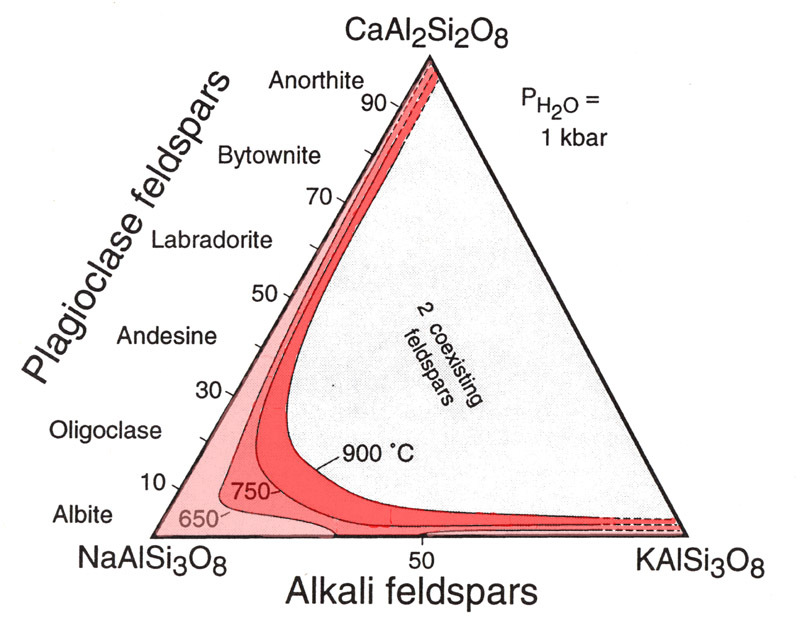
Plagioclase feldspar
Albite: NaAlSi3O8
Anorthite: CaAl2Si2O8
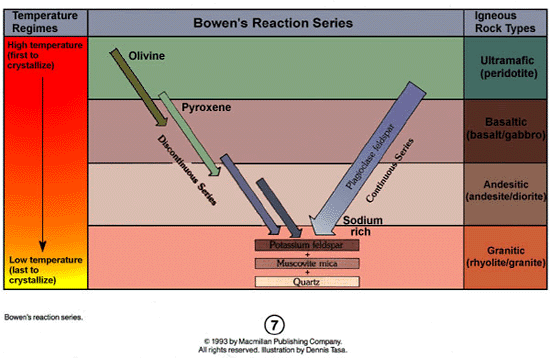
Bowen’s Reaction Series
Feldspar ternary diagram
Pyroxene quadrilateral

Pluton vs. Country Rock
- Pluton is intrusive
- Country rock is rock that was originally there






