Identify the four characteristics of development
- Lifelong
- Multidirectional and multidimensional
- Plastic
- Influenced by multiple, interacting forces
Discuss different research approaches to G & D
- Observation (questionnaires etc.)
- Experimentation
Differentiate between cross-sectional, longitudinal and cross-sequential design methods.
- Cross sectional: different groups at a specific point in time
- Cross sequential: Looking at something cross sectional and longitudinally
- Longitudinal: same group over a long period of time
Discuss how the major conflicts shape Freud’s psychosexual stages.
- Psychoanalysis
Describe how crisis formed Erikson’s psychosocial theory.
- Psychosocial - “something vs. something”
Differentiate between the behavioral theories of classic and operant (Skinner/Watson) conditioning.
- Behaviorists believed we could use reinforcers to promote behavior
- Classical conditioning: stimulus-response
- Operant conditioning: reinforcers and punishment
Describe what is meant by Piaget’s stages of cognitive development.
- Our abilities are tied to our brain growth
- We are only able to learn certain concepts at certain ages (developmental milestones)
Normative transitions
Happens to everyone at a specific time (ie. starting kindergarten)
Non-normative transitions
Things we do not expect everyone to go through (ie. natural disaster, death in the family, etc.)
Cohort
A group of people who were born around the same time
Socioeconomic status
- Income, educational levels
- Affords different opportunities, education, nutrition, etc
Differentiate between genetics and genomics.
- Genetics: the study of our inheritable traits
- Genomics: the things that influence our genes (environmental factors that influence gene expression)
Differentiate between the male and female reproductive systems.
- Men need to be sensitive to temperature (which is why their anatomy is on the outside), because they need to make sperm
Differentiate between monzygotic and dizygotic twins.
- Monozygotic: identical twins – one egg that splits in two
- Dizygotic: two eggs released and fertilized at the same time (two sets of DNA, two sacs, two placentas etc)
Teratogen
Something harmful that can change the growth of a fetal structure
Chromosomal abnormalities
- Due to disruptions in reproduction, not environment
- Could be influenced by maternal age
Genetic disorders
Hereditary disorder passed through the genes (two recessive genes may lead to an expression of a genetic disorder)
Identify the most common methods of post-conception testing.
- Amniosynthesis: amniotic fluid sample
- Chorionic villas sampling: taking a piece of the placenta
- Ultrasound
Provide a brief overview of the phases of pregnancy (1st – 3rd trimester).
First trimester: months 1-3 (morning sickness)
Second trimester: months 4-6 (woman looks pregnant, quickening begins)
Third trimester: months 7-9
Provide an overview of germinal, embryonic, and fetal stages
Germinal: weeks one and two (zygote become blastocysts and implants in uterus)
Embryonic: Weeks 3-8 (major organs and structures)
Fetal: Weeks 9-39 (massive growth and brain development)
Explain the four basic teratogenic principles.
- Dose (how much)
- Duration (how long)
- Timing (which period)
- Genetic make-up (susceptibility)
Identify sensitive periods of fetal development
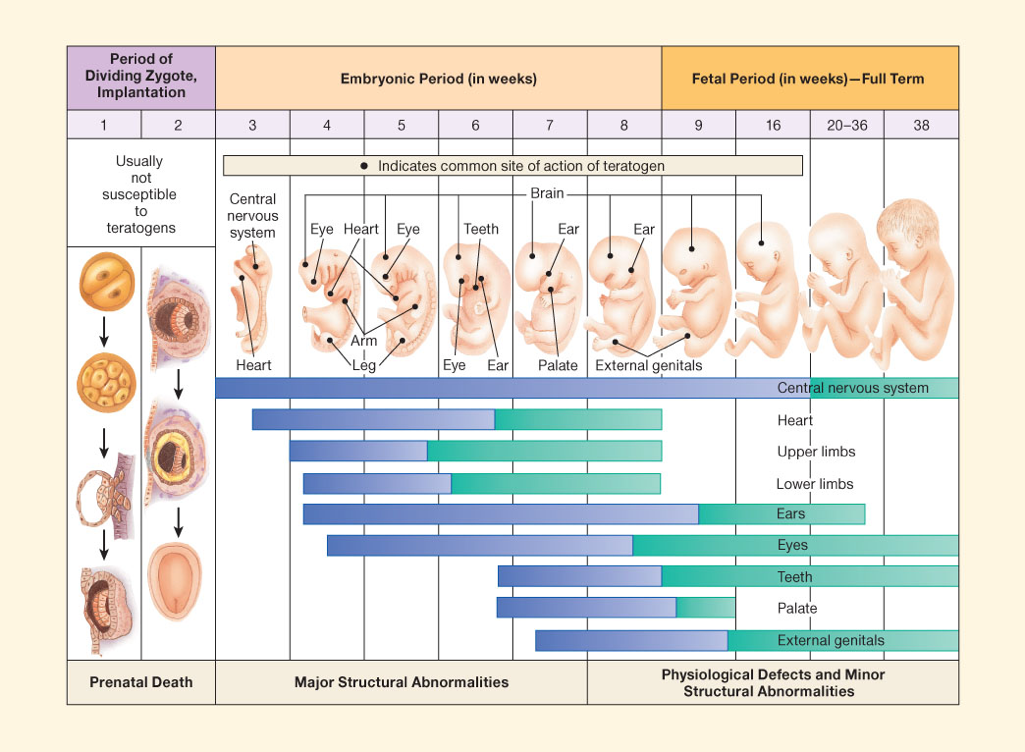
Discuss the role of HCG in post-conception testing.
Hormone comes out in urine – indication of pregnancy
Discuss the importance of age of viability.
22 weeks - baby can (hypothetically) survive outside the womb




