General Concerns of Anesthesia
- Anesthetized horses – due to size subject to significant hypoventilation and possible hypoxemia- atelectasis;ventilation/ pulmonary mismatch
- Heavy horses, heavily muscled -improper positioning and padding can lead to muscle myositis or nerve paralysis
- Proper and vigilant monitoring of vital signs necessary to prevent/recognize hypotension and other abnormalities in order to institute corrective measures in a timely manner
Evaluation
- Good history –
- Exercise capacity – poor performance may be associated with cardiac or pulmonary disease
- Quarter Horse- genetic testing HYPP
- Past episodes of exertional
rhabdomyolysis – increased risk of post –operative myositis
• History of drug reactions? – ie. antibiotics
HYPP
Hyperkalemic Periodic Paralysis
Inheritable disease of a genetic defect in Na channels of muscle in QH ( ~4% of all QH)
- Point mutation in Na channel gene – results in ‘leaky’ channel leading to inability to regulate K levels in blood
- Muscle excitability, muscle tremors; weakness –respiratory failure; hyperkalemia- fatal
- Maintenance or recovery phase
- Pre-operative acetazolamide-( diuretic – helps excretion K) - be prepared for hyperkalemia treatment ( Ca+; Na HCO3; glucose/insulin)
Preparation
14 ga long IV catheter should be placed in the jugular for standing surgical procedures as well as for general anesthesia – including field anesthesia ideally
- Proper clip and surgical prep necessary
- Lidocaine bleb; small stab incision with blade or 14 ga needle
What do you need to avoid when placing a jugular catheter?
AVOID THE CAROTID ARTERY
An injection of xylazine into the carotid artery – will produce violent reaction, possible seizure
Preparation
- No grain 24 hr –hay withheld 6 hrs, but water always- However some still fast for 8- 12 hrs
- Shoes should be removed ( general anesthesia ) and soles are picked and washed; horse brushed to remove surface dirt; straw, etc
- Most people wrap all legs for protection
- If intubation is planned rinse mouth ( dose syringe) with water until no evidence of hay runs out
- Antibiotics – generally are given immediately before or during premedication
Sedatives
Alpha 2 agonists – most effective sedation/ restraint in the equid
• Duration of action detomidine > ;
romifidine> xylazine ( all approved for equine)
• Dexmedetomidine is sometimes used as CRI intraoperatively ( not approved for equine)
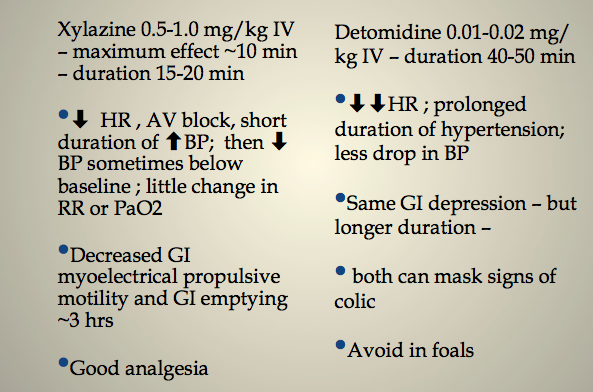
Xylazine Vs Detomidine
Ace
Mild sedation; indifference to suroundings –but unpredictable calming -given prior to α2 agonist sedation – not a replacement
- Will potentiate effects of other sedatives
- 0.02-0.05 mg /kg IM ( 0.01-0.03mg/kg IV) – can use with
Xylazine 20 - 30 min after Acp
- Avoid in ill/cardiovascular compromised horses; young foals
- Caution in breeding stallions – possible persistent penile paralysis ( < 1 in 10,000)
- Excited stressed horses - - more prone to hypotension (circulated epinephrine β2 vasodilation )
Opiods
- Opioids, although are used for analgesia, do not result in the quality of sedation as seen in dogs and should never be used alone in the equid
- •
•
Increased motor activity; sweating; excitement side effects if dosage rate is too high (rates are lower than in small animals)
Pure agonists – controversial – susceptable to colic? ( but can be used) – but may produce ileus; constipation- usually from high or repeated dosages
but α2s also have similar effects
A Word about Ketamine
- Dissociative anesthetic –produces cateleptic state - trance, loss of sensation and consciousness with muscle regidity
- All animals but especially equids – must be well sedated before ketamine – otherwise, excitation, seizure –like activity may occur
- Eyes remain open; palpebral often present; which makes depth evaluation a little difficult to evalute
- Often we include diazepam ( midazolam) with the ketamine induction even after the xylazine- improved muscle relaxation
- Xyl + butorphanol – then diazepam and ketamine
- Ketamine/diazepam inductions are the preferred induction for equids by most – small volume( 10-15 ml) given rapidly; consistent, reliable fall ‘dog sit ‘
Adequately sedated horse
- Dropped head
- Extruded penis
- Horse – obligate nose breather – avoid nasal edema must keep/hold head up
Injectable anesthesia- #1 castration
- Xylazine1.1waitforsedation+ ketamine 2.2 mg/kg IVmg/kg ketamine)
- 10-20 minutes anesthesia
- Add butorphanol -0.02-0.05 mg/kg IV –after the xylazine ( ~ 1/10 of dog dose) increases duration ~30-35 min ; better quality sedation
- Morphine 0.1 mg/kg – not as good sedation, IMO
- ‘Top up doses’ – ketamine/ xylazine 1/3 -1/2 original doses – 10-15 min
Guaifenesin (GG)
GG 5 % centrally acting muscle relaxant – no/very little sedation/no analgesia
- Will cause serious tissue necrosis if not in vein!!!!!
- To improve quality of induction; muscle relaxation; reduces dosage rate of the anesthetic
- No/minimal cardiovascular or respiratory depression unless very high dosages ( > 100 mg/kg )
Triple Drip ‘
Add to 500 ml GG 5 %: 500 mg ketamine and 250 mg xylazine
Start immediately after induction – at 1-1.5 ml/kg/ hr ( or to effect by maintaining adequate depth
Respiration and hemodynamic values usually remain normal limits unless excessive GG dose
Intubation in a horse
• Check pulses and color-!
• Head extended – blind intubation
- PVC pipe –mouth speculum
- Advance and rotate tube , aiming‘up’- if resistance pull back and try again
- Usually falls right in; inflate cuff
Where do you place the arterial catheter in a horse?
Transverse facial, facial, dorsal metatarsal
Expected- normal values for anesthesia
HR – ⊀ 25 ⊁60 bpm – prefer 35-45 bpm Ventilator -6-8 bpm with a tidal volume ~10
ml/kg to maintain ETCO2 30-35 mmHg • PaCO2 will be ~ 5-10 mmHg higher
Keep MAP at least 70 mmHg
Expect SPO2 –> 97 ( should be 100%) Arterial blood gas to confirm PaO2 , PCO2
Hypercarbia/hypoxemia
Horses will hypoventilate the longer they are down and hypercarbia worsens with time- unless on a ventilator
- If no oxygen is provided- hypoxemia will develop –
- Reason why injectable/field procedures should not exceed ~1 hr ( if no oxygen and ventilatory measures are available)
- General anesthesia – if procedures > 1 hr- horses should ventilated to maintain PaCO2
- However, anesthetized large animals may ( often) develop significant ventilation/perfusion mismatch- which may result in hypoxemia – even on 100% oxygen
- Reason we evaluate blood gases
What is the recovery rate in horses like?
recovery complication rate is the highest among species

-
Test 1- Week 157
-
Test 1- Week 259
-
Test 1- Pre-meds58
-
Test 1- Induction meds22
-
Test 1- IV anesthesia and analgesia11
-
Test 1- Inhalant Anesthesia46
-
Test 1- Recovery21
-
Test 1- Blood Gas Analysis35
-
Test 1- Mechanical Ventilation39
-
Test 1- Equine Anesthesia22
-
Test 2- Swine25
-
Test 2- Ruminants24
-
Test 2- NMD22
-
Lab final36



