What ist he stimuli for the auditory system?
Vibrating air molecules.
What does the Pinna do?
Collects sound.
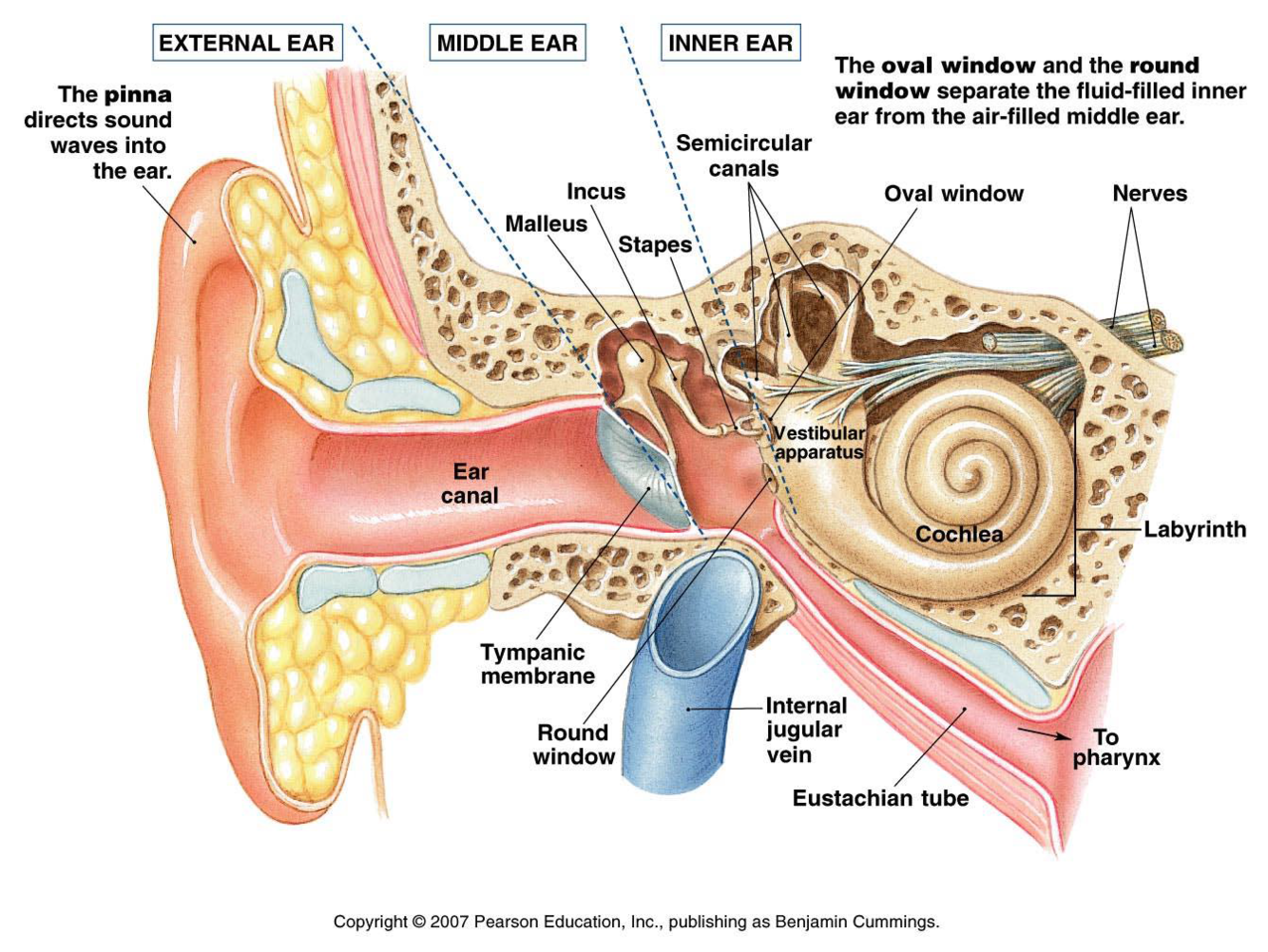
What are the parts of the auditory system?
Pinna (collects sound); ear canal; ear drum; vibrates tiny bones which press on membrane, moving tiny hair cells (the receptors – frequency specific); transmission to brain
What is sound comprised of?
Sound has frequency (pitch) and amplitude (loudness); usually a combination of frequencies
What is the psychological correlation of frequency?
Pitch
What is the range of sound intensity for human hearing (dB)
0 to 140 dB (note that after 140 vibrotactile interpretation, anything over 100 dB can result in permanent damage). Anything below 20dB the ear rapidly loses its ability to detect frequency changes.
120 dB – jet engine; 100 dB – manufacturing; 60 dB, conversation; 20 dB, whisper
What is the psychological correlation of dB to sound intensity?
Loudness
How is dB measured?
dB (a ratio) 20 log (P1/P2)
P1 (sound of interest, sound pressure); P2 (background/baseline)
How is loudness related to dB?
Loudness (what you perceive) related to dB (actual stimuli value)
What is loudness related to?
dB and frequency
When does loudness double?
Doubles with each 10 dB increase
What is threshold?
Threshold – minimum you can hear
What is masking?
Masking – sounds can “hide” other sounds (e.g., similar frequencies; <15 dB difference)
What is equal loudness for dB and frequency?
“equal loudness” – lower dB, higher frequency = to lower frequency, higher dB
What are the three aspects of safety and hearing?
- Noise can cause damage to hair cells – frequency dependent
- Damage depends on intensity, frequency, and duration of exposure
- Effect of continuous exposure can be cumulative
What are two types of thresholds?
- Temporary Threshold Shift (TTS)
- Permanent Threshold shift (PTS)
What are design implications related to safety?
- Equipment, tool selection
- Shielding (mufflers, equipment shields)
- Leave the area (e.g., reduce time of exposure)
- Hearing protection (compliance, comfort, properly worn/fit)
What is temporary threshold shift (TTS)?
Loss in ability to hear after exposure to loud noise (shift in threshold dB 2 minutes after exposure ends); declines over time. E.g., TTS for 100 dB exposure for 100 minutes is 60 dB.
Repeated exposure to TTS producing sounds can cause PTS
What is is permanent threshold shift (PTS)?
- Permanent loss of hearing.
- Time weighted average -> remediation required
- About 75 dBA (dB weighted by frequencies) or less, ok; after that, different limits based on time of exposure
What are 5 aspects of the design of auditory displays (alarms, “earcons”)?
- Not directional (you don’t have to look at them) but don’t persist in time (working memory limitations) 5 dB above background to be heard
- Keep below 85, 90dB
- Consider “rise time” in amplitude to avoid a startling effect
- Make different signals easily discriminable, but not too many of them (pitch, rhythm, timbre)
- Non-verbal audio messages that are used in the computer/user interface to provide information to the user about some computer object, operation or interaction“ (Blattner, 1989)

-
Human Factor: Basic Design and Evaluation Methods26
-
Human Factors Introduction57
-
Introduction to Action, Evaluation, Linking the Info Proc Model to Design31
-
Psychophysical Models11
-
Information Processing15
-
Single Detection Theory46
-
Sensory Systems25
-
Vision51
-
The Auditory System20
-
Haptic Systems7
-
The Olfactory System4
-
Additional Sensory Systems4
-
Issues in Recognition for Sensory Systems8
-
Cognition and Attentional Resources29
-
Cognition and Visual Search & Detection13
-
Basic Gestalt Theory9



