(a) the concept of amount of substance in performing calculations involving atom economy; the relationship between atom economy and the efficient use of atoms in a reaction
- Measure of the proportion of reactant atoms that become apart of the desired product (rather than by-products)
- Greater atom economy = less waste
- Chemical equations with only 1 product (the desired product) have 100% atom economy
- May be more than 1 desired product in a chemical reaction

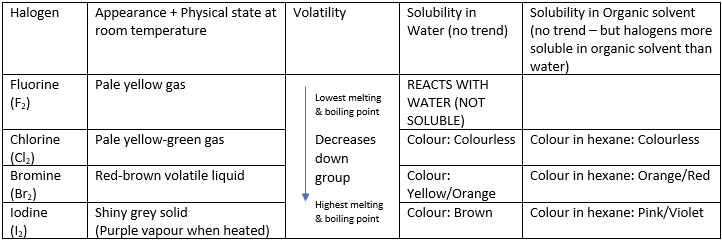
(h) a description of the following physical properties of the halogens: appearance and physical state at room temperature, volatility, solubility in water and organic solvents
Explanation not required
- Halogen (diatomic molecule)
- Not very soluble in water because covalent and non-polar
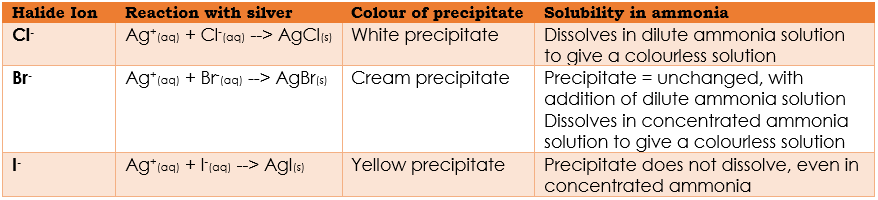
(k) the reactions between halide ions (Cl–, Br– and I–) and silver ions (Ag+) and ionic equations to represent these precipitation reactions, the colours of the precipitates and the solubility of silver halides in ammonia
- Testing for halide ions
- Add dilute nitric acid (removes ions which may interfere with the reaction)
- Add silver nitrate solution (AgNO3(aq))
- Observe colour of precipitate
- AgF = no precipitate, because it is soluble
(d) (ii) redox reactions of s-, p- and d-block elements and their compounds in terms of electron transfer:
the definition of oxidation and reduction as loss and gain of electrons
- OIL RIG
- Oxidation is loss (of electrons)
- Increase in oxidation state
- Increase in charge (becomes more +ve)
- Reduction is gain (of electrons)
- Decrease in oxidation state
- Decrease in charge (becomes more -ve)
(d) (iii) redox reactions of s-, p- and d-block elements and their compounds in terms of electron transfer:
identification of oxidising and reducing agents
- The oxidising agent is reduced itself in a reaction
- gains electrons from another substance
- oxidises other substance
- The reducing agent is oxidised itself in a reaction
- transfers electrons to another substance
- reduces other substance
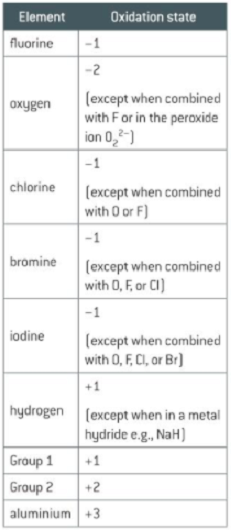
(e) the oxidation states assigned to and calculated for specified atoms in formulae (including ions) and explanation of which species have been oxidised and which reduced in a redox reaction
- Rules to assigning oxidation states:
- Diatomic molecules (e.g. O2, Cl2) have a oxidation number 0
- Oxidation state of a monatomic ion is the same as its charge
- When compounds have no overall charge, the oxidation states of all constituent elements must add up to 0
- Oxidation states of all constituent elements in a compound ion will add up to to the overall charge of the ion
- If oxidation number of an element has decreased –> it has been reduced (gained electrons)
- if oxidation number of an element has increased –> it has been oxidised (lost electrons)
(f) use of oxidation states to balance redox equations that do not also involve acid–base reactions; techniques and procedures in iodine–thiosulfate titrations
e.g. 3Ca + 2Al3+ –> 3Ca2+ + 2Al
but not: MnO4– + 5Fe2+ + 8H+ –> Mn2+ + 5Fe3+ + 4H2O
- Iodine-thiosulfate titrations:
- Involve redox reaction
- used to find concentration of a chemical
- chemical must be a strong enough oxidising agent to oxidise iodide ions to iodine
- the more concentrated the oxidising
(o) the characteristics of dynamic equilibrium
- equilibrium = reversible reaction (represented by ⇌)
- dynamic equilibrium happens in a closed system
- where rate of forward reaction = rate of the backward reaction
- concentration of reactants and products no longer changing
- but not equal –> concentrations dependant on where equilibrium lies
- *(g) use of systematic nomenclature to name and interpret the names of inorganic compounds**
e. g. copper(I) sulfide, sodium chlorate(I), lead(II) nitrate(V), potassium manganate(VII) but not complex ions.
- Systematic names of inorganic compounds have a Roman numeral
- represents the oxidation state of one of the elements in a compound
- Roman numerals only represent +ve oxidation states
- represents the oxidation state of one of the elements in a compound
- Oxidation states only used in systematic names for elements which have variable oxidation states (transition metals, tin, lead, sulfur, nitrogen and halogens)
- The number shows the oxidation state of the preceding element
- Iron(II) oxide, Fe2+
- potassium nitrate(V), KNO3
- nitrate oxidation no. +5
- An oxyanion is a negative ion containing oxygen and another element
- the systematic name of oxyanions ends in -ate
- If Roman numeral present, it refers to the oxidation state of the non-oxygen element
- Halogens usually have an oxidation state of -1, but not when part of an oxyanion
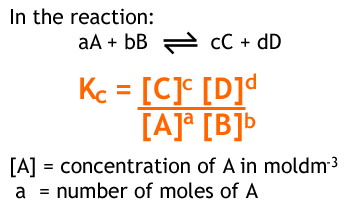
(p) the equilibrium constant, Kc for a given homogeneous reaction; calculations of the magnitude of Kc and equilibrium concentrations using data provided; relation of position of equilibrium to size of Kc, using symbols such as >,<,>>,<<
Units will not be required.
- For Kc expression, products go on the top
- Value for Kc only true for a particular temperature
- Kc >> 1: equilibrium lies far to the right
- much more products than reactants at equilibrium
- (reaction seems to have gone to completion)
- Kc > 1: equilibrium lies to the right
- slightly more products than reactants at equilibrium
- Kc = 1: equilibrium lies in the middle
- concentration of reactants and products at equilibrium will be the same
- Kc < 1: equilibrium lies to the left
- slightly more reactants than products at equilibrium
- Kc << 1: equilibrium lies far to the left
- much more reactants than products at equilibrium
- (reaction seems to not have happened)
- *(q) the use of Kc to explain the effect of changing concentrations on the position of a homogeneous equilibrium; extension of the ideas of ‘opposing change’ to the effects of temperature and pressure on equilibrium position.**
e. g. ‘if a concentration term on the top becomes larger, one on the bottom must also become larger to keep Kc constant, so equilibrium position moves to the left’
- When changing concentration of reactants/products, position of equilibrium will shift to keep Kc constant
- as long as temperature stays constant
- Increase concentration of products (top)
- results in a larger number
- bottom has to increase to keep Kc constant
- equilibrium shifts to the left to increase concentration of reactants (bottom)
- Increase concentration of reactants (bottom)
- results in a smaller number overall
- top has to increase to keep Kc constant
- equilibrium shifts to the right to increase concentration of products (top)
How pressure and temperature affect equilibrium position:
- Pressure: (only affects equilibria involving only gases)
- Increasing pressure shifts equilibrium to side with fewer gas moles to reduce pressure (negate effect)
- Decreasing pressure shifts equilibrium to side with more gas moles to increase pressure (negate effect)
- Temperature:
- Increasing temperature means adding heat
- This will speed up both forward and the backward reaction (faster rate of reaction in both directions)
- equilibrium will shift in the endothermic direction to negate effect
- Decreasing temperature = removing heat
- equilibrium shifts in the exothermic direction to replace heat
(b) the explanation (given the necessary information) of the chemical processes occurring during the extraction of the halogens from minerals in the sea
Recall of processes not required.
(c) (i) techniques and procedures in the electrolysis of aqueous solutions; half-equations for the processes occurring at electrodes in electrolysis of molten salts and aqueous solutions:
formation of oxygen or a halogen or metal ions at the anode
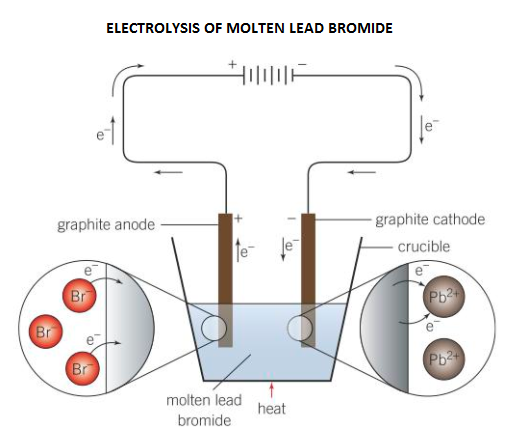
- Electrolysis: Decomposing/breaking down a compound using an electric current
- requires electrolyte to conduct electricity (molten salt or aqueous solution)
- Electrolysis of molten salts:
- Solid ionic compounds do not conduct electricity - because ions not free to move
- If ionic compound = molten, free charged ions are able to carry current
- Inert electrodes used (graphite/platinum) so do not react/interfere with electrolysis
- Substance breaks up into its elements
- Positive ion (cations) migrate to negative electrode (cathode)
- where reduction happens
- Negative ion (anions) migrate to positive electrode (anode)
- Temperature in electrolysis will be hot to keep ion compound molten, so products will not be solid (e.g. bromine gas - bubbles may be seen, Pb(l) for the electrolysis of lead bromide)
- For electrolysis of molten salts - product at anode = non metal, but not hydrogen
- For electrolysis of aqueous solutions - products at anode;
- if solution doesn’t contain a halide –> oxygen formed
- if electrolysing hydroxides (sodium hydroxide)
- 4OH-(aq) –> O2(g) + 2H2O(l) + 4e-
- if electrolysing salt with sulfate/nitrate
- 2H2O(l) –> O2(g) + 4H+(aq) + 4e-
- if electrolysing hydroxides (sodium hydroxide)
- if solution contains a halide
- if solution concentrated –> halogen formed
- if solution dilute –> oxygen formed from H2O
- if solution doesn’t contain a halide –> oxygen formed
(c) (ii) techniques and procedures in the electrolysis of aqueous solutions; half-equations for the processes occurring at electrodes in electrolysis of molten salts and aqueous solutions:
formation of hydrogen or a metal at the cathode
Cathode description in aqueous electrolysis: ‘Group 1 and 2 and aluminium salts give hydrogen, other metals are plated’.
• electrolysis of aqueous solutions
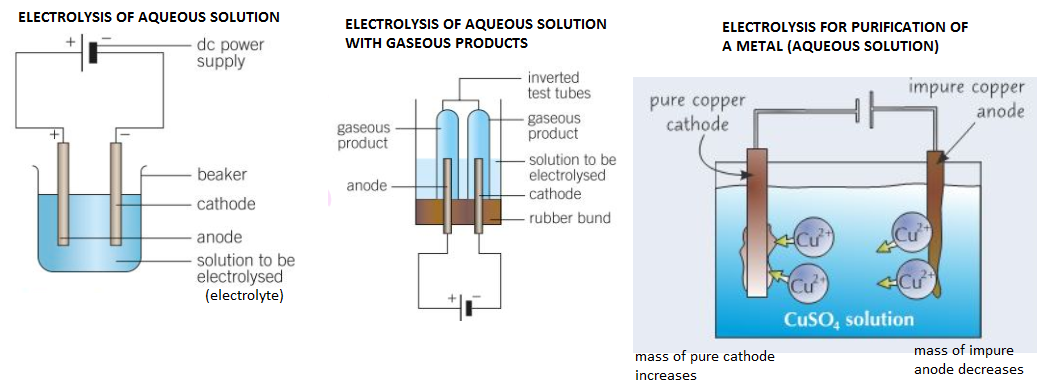
- Electrolysis of aqueous solutions:
- Electric current passed through electrolyte (aqueous solution)
- Electric circuit needs to be set up
- Use wires and clips to connect each electrode to the power suppy (powerpack/batteries)
- Electrode connected to positive terminal will be the anode, electrode connected to negative terminal will be the cathode
- Commonly inert electrodes that conduct electricity are used (graphite/platinum)
- Placed in beaker (making sure they arent touching)
- If products of electrolysis are gaseous;
- inverted test tubes filled with water used
- gas displaces water when produced
- If electrolysis carried out for purification of a metal (e.g.copper)
- anode = impure metal
- cathode = pure metal
- electrolyte must contain ions of that metal
- For electrolysis of molten salts - product at cathode = metal
- For electrolysis of aqueous solutions - product at cathode;
- If metal is less reactive than hydrogen (e.g. silver or copper) –> metal formed (or plated)
- if metal is more reactive than hydrogen (e.g. Group 1, Group 2 and aluminium) –> hydrogen formed as gas
- 2H2O(l) + 2e- –> 2OH-(aq) + H2(g)
- if electrolysing acids (sulfuric acid), hydrogen also produced as gas
- 2H+(aq) + 2e- –> H2(g)
(d) (i) redox reactions of s-, p- and d-block elements and their compounds in terms of electron transfer:
use of half-equations to represent simple oxidation and reduction reactions
Recall of specific reactions is only needed if required elsewhere, e.g. ES(j). ‘Simple’ means not involving acid–base, see also ES(f).
- Half equations show movement of electrons
- Oxidation half equation = loss of electrons
- electrons on right hand side of equation
- never written as minus electrons (always adding electrons)
- Reduction half equation = gain of electrons
- electrons on LHS of equation
- never written as minus electrons (always adding electrons)
- Charges and atoms must balance
(i) the relative reactivities of the halogens in terms of their ability to gain electrons
• test-tube or reduced scale reactions involving the halogens and their compounds [related to (i) to (m)]
- Reactivity of halogens decreases down Group 7
- Gain electrons to get a full outer shell
- Therefore halogens are reduced and are oxidising agents (redox reactions happening)
- Strongest oxidising agents at the top of Group 7
- As you go down the group:
- atoms become larger
- so outer electrons are further from the nucleus
- the outer electrons are also shielded more from the attraction of the positively charged nucleus (because of an extra shell of electrons each period)
- e.g. because fluorine has a higher charge density, it gains an extra electron more readily
(j) the details of the redox changes which take place when chlorine, bromine and iodine react with other halide ions, including observations, equations and half-equations
- Redox reaction between a halogen and a halide is called a displacement reaction
- halogen replaces a less reactive halide (below them in the periodic table)
- Ions that are unchanged in the reaction can be left out in the ionic equation
- these are called spectator ions
- When a displacement reaction happens a colour change takes place (new colour = colour of halogen formed)
- To make the colour changes more distinguishable
- shake reaction mixture with an organic solvent (e.g. hexane)
- halogen present will disolve in the organic solvent and settle as a distinct layer above aqueous solution
(l) the preparation of HCl; the preparation of HBr and HI by using the halide and phosphoric acid; the action of sulfuric acid on chlorides, bromides and iodides
Details of phosphoric acid (and equations involving it) are not required.
Preparation of HCl:
- HCl can be made as a co-product from chlorination of organic compounds
- e.g. manufacture of of poly(chloroethane)/poly(vinyl chloride) (PVC)
- thermal cracking of 1,2-dichloroethane gives chloroethane and hydrogen chloride
- converted to hydrochloric acid by passing it through water
- Hydrogen halide made by adding concentrated acid to solid, ionic halide (e.g. NaCl)
- NaCl
(m) the properties of the hydrogen halides: different thermal stabilities, similar reaction with ammonia and acidity, different reactions with sulfuric acid
Sulfuric acid is reduced to SO2 by HBr and H2S by HI.
- In solution;
- Hydrogen halides = very soluble
- (apart from HF, which is a weak acid –> partially dissociates) all hydrogen halides are strong acids (fully dissociate into a H+ and a halide ion in water)
- Hydrogen halides react with ammonia to make salts (ammonium halides)
- AMMONIUM SALT REACTION IS SALT PRODUCED SOLID OR AQUEOUS???
- Hydrogen fluoride and hydrogen chloride do not react with concentrated sulfuric acid
- because HF and HCl are not strong enough reducing agents to reduce sulfur
- Hydrogen bromide reacts with conc sulfuric acid
- HBr reduces H2SO4 to SO2
- 2HBr + H2SO4 –> Br2 + SO2 + 2H2O
- Hydrogen iodide reacts with conc sulfuric acid
- Iodide ions are a stronger reducing agent than bromide ions
- HI reduces H2SO4 to H2S
- 8HI + H2SO4 –> 4I2 + H2S + 4H2O
- Thermal stability of hydrogen halides;
- DOES HCL and HF break down in heat??
- Thermal stability decreases down Group 7
- because bond strength decreases down Group 7 –> less energy needed to break bond
- due to halide ion getting bigger so bonding electrons are further away from nucleus and shielded more by inner electrons (bond length increasing down Group 7)
(n) the risks associated with the storage and transport of chlorine; uses of chlorine which must be weighed against these risks, including: sterilising water by killing bacteria, bleaching
- Uses of chlorine:
- water treatment: added to water to sterilise it by killing pathogens (e.g. bacteria)
- Used to make bleach
- Dangers of chlorine:
- toxic gas
- corrosive (so must be kept away from eyes ande skin)
- irritates respiratory system (not to be breathed in)
- not flammable but must be kept away from flammable materials because it is a strong oxidising agent
- How chlorine is transported;
- kept as a liquid under pressure in small cylinders




