What is Density?
+Mass per unit volume
+Density is a measure of the “compactness” of a substance.
+it relates to the mass of a substance to how much space it takes up.
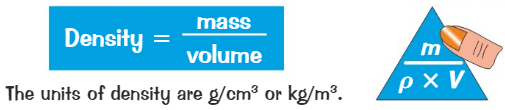
+The symbol for density is a Greek letter rho [p] - it looks like a p but it isn’t.
What is the equation for density?
What does the density of an object depend on?
+What it’s made of.
+Density doesn’t vary with size or shape.
What does the average density of an object determine?
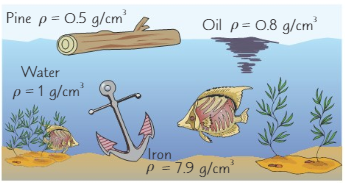
+Whether it floats or sinks - a solid object will float on a fluid if it has a lower average density than the fluid.
How do you find the density of any substance?
+Measure its mass and volume and use the formula
What is the easiest process of finding the density of a liquid?
- +Use a measuring cyclinder
- Use a mass balance to meassure the mass of the empty measuring cyclinder.
- Pour in the liquid to be investigated & measure the mass of the cyclinder again - the difference in mass is equal to the mass of the liquid.
- Finding the volume of the liquid involves reading from the cylinder’s scale [1ml=1cm3]
- [Measuring the volume of a prism involves finding the area of the base then multiplying by height.
What happens when you want to find the volume of an irregular shape?
+You can find its volume using the fact that an object submerged in water will displace a volume of water equal to its own volume.
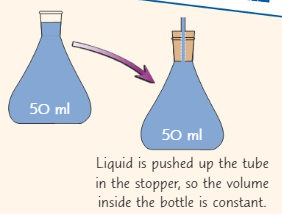
+You can do this using a density bottle
What is the process of using a density bottle to find the volume of an irregular shape?
1. Measure the mass [m1] of the object using a mass balance
- Fill the bottle with a liquid of a known density [eg. water]
- Place the stopper into the bottle and dry the outside
- Measure the mass of the bottle [m2]
- Empty the bottle and place the object into the density bottle [repeat steps 2 and 3] - measure the mass of the bottle [m3]
- Calculate the volume of displaced water: -
- The mass of the displaced water = m2 - [m3 - m1]
- Density of water is 1g/cm3 so you can use V=m/p to find the volume displaced - this equals the volume of the object.
- Calculate the density of the object using p=m/v with the mass you measured in step 1 [m1] and the volume calcualted in step 6.
What can you also use if you don’t have access to density bottles?
+ A eureka can and a measuring cylinder
+This is a density bottle
What are some common densities?
What is Kinetic Theory?
+The particles that make up matter are tiny balls
+You can explain the way that matter behaves in terms of how these tiny balls move, and the forces between them.
What are the three states of matter?
- Solid [eg. ice]
- Liquid [eg. water]
- Gas [eg. water vapour]
+The particles of a substance in each state are the same - only the arrangement and energy of the particles are different.
+If you reverse a change of state, the particles go back to how they were before.
What are changes of state?
+Physical changes [only the form of a substance changes]
+These are different from chemical reactions, where new substances are created by the reaction.
What happens when a change of state occurs?
+When a change of state occurs, the spacing brtween particles changes, so internal energy of the substance also changes.
+As the paticles get closer together, their internal energy decreases.
What happens in solids?
+Strong forces of attraction hold the particles close together in a fixed, regular arrangement.
+The particles don’t have much energy in their kinetic energy stores so they can only vibrate about their fixed positions.
What happens in liquids?
+The forces of attraction between the particles are weaker - the particles are close together, but can move past each other and form irregular arrangements.
+They have more energy in their kinetic energy stores than the particles in a solid - they move in random directions at low speeds.
What happens in gases?
+There are almost no forces of attraction between the particles
+Particles have more energy in their kinetic energy stores than those in liquids and are free to move - they travel in random directions at high speeds.
How do you get from a solid to a liquid?
Melting
How do you get from a liquid to a solid?
Freezing
How do you get from a liquid to a gas?
Evaporation
How do you get from a gas to a liquid?
Condensation
How do you get from a gas to a solid?
Sublimation
How do you get from a solid to a gas?
Sublimation
How is the energy in a substance’s thermal energy store held?
+By its particles in their kinteic energy stores - this is what the thermal energy store actually is.



-
Yr 9 End of Year Revision21
-
Forces0
-
Waves0
-
Distance, Speed, Velocity & Acceleation graphs14
-
Energy transfers19
-
Forces and energy22
-
Electromagnetic spectrum30
-
Light Waves25
-
Sound Waves11
-
Radioactivity54
-
EQUATIONS21
-
Topic 3 - Conservation of energy23
-
Topic 2 - Motion And Forces44
-
Topic 1 - Key Concepts in Physics10
-
Topic 1 - Key Concepts Of Physics17
-
Topic 2 - Motion And Forces COPY46
-
Topic 3 - Conservation of energy COPY30
-
Topic 4 - Waves32
-
Topic 5 - Light and the Electromagnetic Spectrum44
-
Topic 8 - Energy - forces doing work16
-
Topic 9 - Forces and their effects24
-
Topic 10 - Electricity and Circuits134
-
Topic 11 - Static Electricity54
-
Topic 14 - Particle Model84
-
Topic 12 - Magnetism And The Motor Effect15
-
Topic 13 - Electromagnetic Induction13
-
Topic 15 - Forces and Matter51



