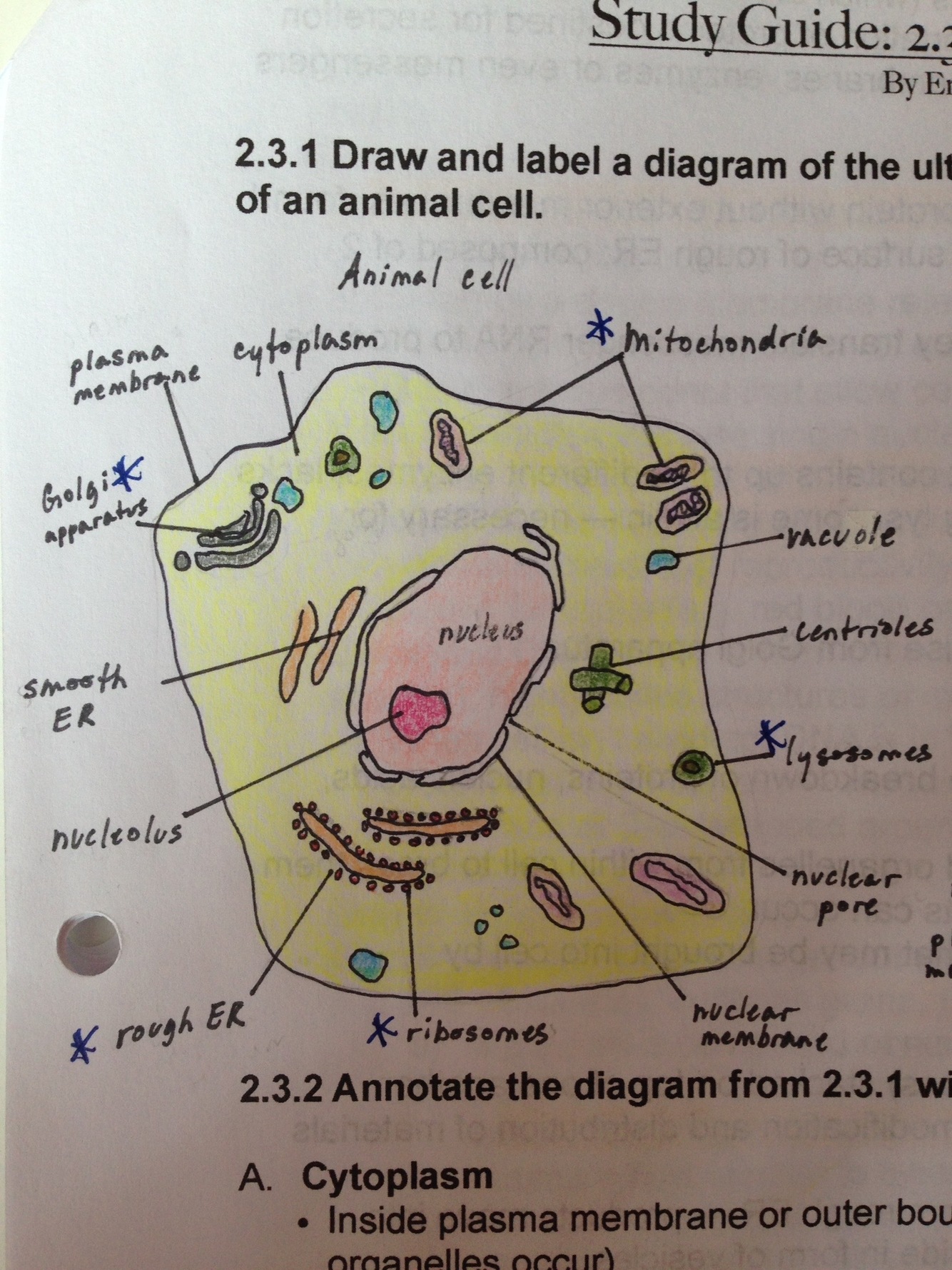
2.3.1 Draw and label a diagram of the ultrastructure of a liver cell as an example of an animal cell.
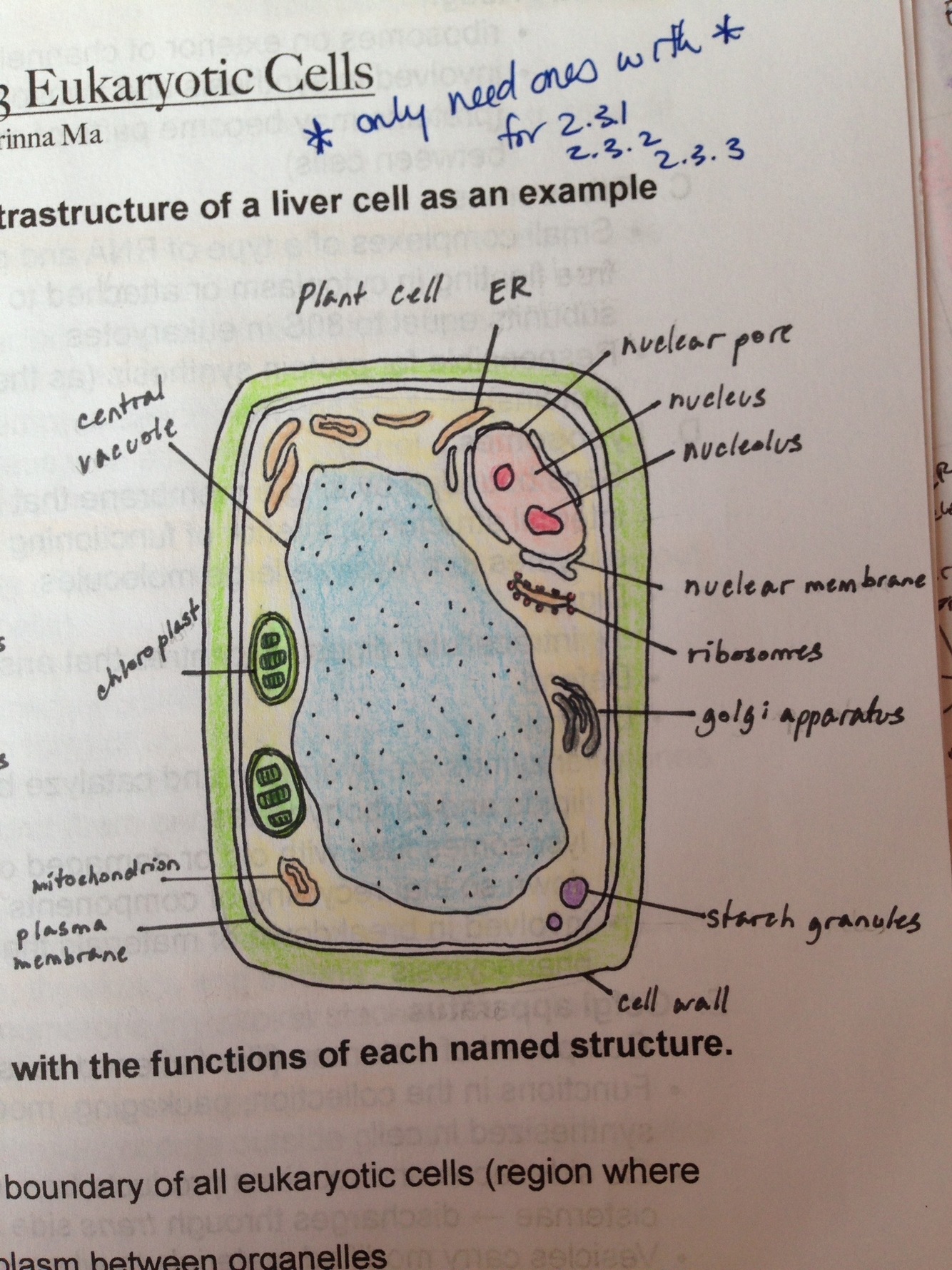
2.3.1 Draw and label a diagram of a plant cell.
2.3.2 What is the function of cytoplasm?
- Inside plasma membrane or outer boundary of all eukaryotic cells (region where organelles occur)
- Cytosol is the fluid portion of cytoplasm between organelles
2.3.2 What is the function of the endoplasmic reticulum?
Extensive network of tubules/channels that extends almost everywhere in cell (nucleus to plasma membrane)
Structure enables ER to transporting materials throughout internal region of the cell (most cells include both types of ER, with rough ER closer to nucleus)
Smooth ER:
- unique enzymes embedded on surface; no ribosomes
- production of sex hormones such as testosterone and estrogen
- production of membrane phospholipids and cellular lipids
- transportation of lipid-based compounds
- detoxification of drugs in liver
- aids liver in releasing glucose into bloodstream when needed
- storage of calcium ions needed for contraction in muscle cells
Rough ER:
- ribosomes on exterior of channels (involved in protein synthesis)
- involved in synthesis and transportation of proteins destined for secretion (proteins may become parts of membranes, enzymes or even messengers between cells)
- think defence, attack and messenger
2.3.2 What is the function of ribosomes?
- Small complexes of a type of RNA and protein without exterior membranes, found free floating in cytoplasm or attached to surface of rough ER; composed of 2 subunits equal to 80S in eukaryotes
- Responsible for protein synthesis (as they translate messenger RNA to produce proteins)
2.3.2 What is the function of lysosomes?
Sacs bounded by single membrane that contains up to 40 different enzymes; lacks internal structures; interior of functioning lysosome is acidic — necessary for enzymes to hydrolyze large molecules
Digest
- lysosomes are intracellular digestive centres that arise from Golgi apparatus
Defend
Destroy
- enzymes = hydrolytic and catalyze breakdown of proteins, nucleic acids, lipids and carbohydrates
- lysosomes fuse with old or damaged organelles from within cell to break them down so that recycling of components can occur
- involved in breakdown of materials that may be brought into cell by phagocytosis
2.3.2 What is the function of the Golgi apparatus?
- Composed of cisternae (like flattened sacs) stacked on top of one another
- Functions in the collection, packaging, modification and distribution of materials synthesized in cell
- Cis side faces and receives products from rough ER → products move into cisternae → discharges through trans side in form of vesicles
- Vesicles carry modified materials to wherever they are needed inside or outside the cell
Golgi apparatus is especially prevalent in glandular cells (e.g. in pancreas) which manufacture and secrete substances
2.3.2 What is the function of mitochondria?
- The ‘cell powerhouse’; rod-shaped; size is close to that of bacterial cell; appears throughout cytoplasm
- Has own DNA (a circular chromosome similar to that in bacterial cells), capable of reproducing independently
- Has double membrane — outer membrane is smooth, inner is folded into cristae (singular, crista)
- matrix (a semi-fluid substance) found inside inner membrane
- area between 2 membranes is called the inner membrane space
- cristae provide huge internal surface area for chemical reactions characteristic of mitochondria to occur
- Most reactions in mitochondria involve production of usable cellular energy called ATP
- Produces and contains its own (70S) ribosomes
- Large number of mitochondria in cells with high energy requirements (e.g. muscle cells)
2.3.2 What is the function on the nucleus?
- Where DNA is
- Bordered by a double membrane referred to as the nuclear envelope
- Allows compartmentalization of eukaryotic DNA
- Has numerous pores that allow communication with cell’s cytoplasm
- Most eukaryotes possess single nucleus with a nucleolus (plural, nucleoli); molecules of ribosomes manufactured in nucleolus → pass through nuclear envelope before assembly as ribosomes
- without nucleus, lost reproductivity often = increased specialization to carry out certain functions (e.g. red blood cells)
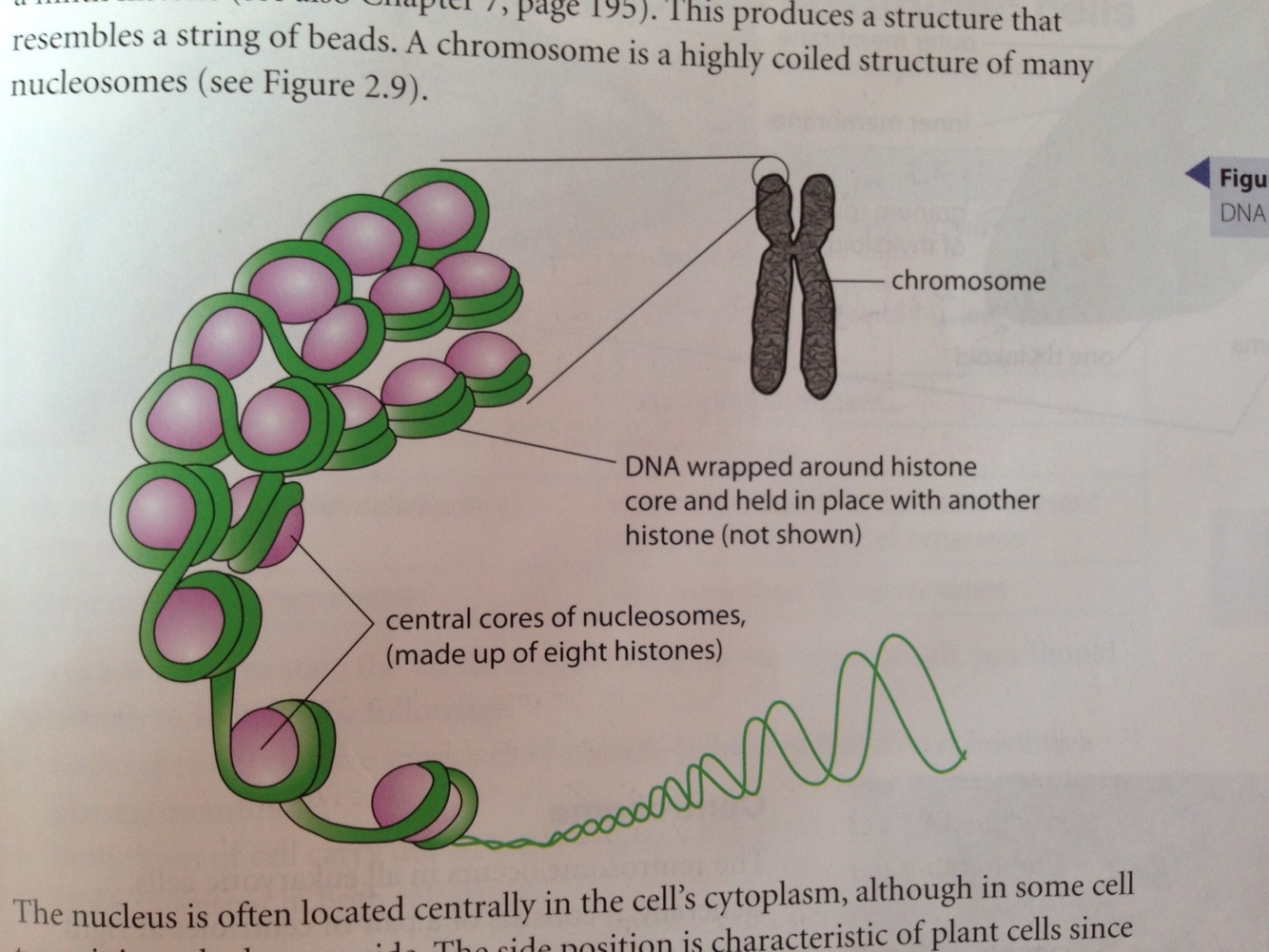
- Eukaryotic DNA occurs as chromosomes (vary in # depending on species), highly coiled structures of many nucleosomes
- When cell isn’t dividing, DNA is in form of chromatin (strands of DNA and proteins called histones) → results in structures called nucleosome (8 histones with strand of DNA wrapped around them and secured with 9th histone)
2.3.2 What is the function of chloroplasts?
- Only in algae and plant cells
- Contains double membrane; about same size as bacterial cell; contains own DNA and 70S ribosomes
- Contains grana, thylakoids and stroma
- a granum is composed of numerous thylakoids stacked like coins
- thylakoids are flattened membrane sacs with components necessary for absorption of light (1st step in photosynthesis)
- stroma = fluid (similar to cytosol); occurs outside grans but within double membrane; contains many enzymes and chemicals necessary in completion of photosynthesis
- DNA = ring
- Capable of reproducing independently of cell
2.3.2 What is the function of centrosomes?
- In all eukaryotic cells, located at one end of cell close to nucleus
- Consists of pair of centrioles at right angles to one another
- Centrioles involved in assembling microtubules (provides structure & allows movement; important to cell division)
- Note: higher plant cells can produce microtubules without centrioles
2.3.2 What is the function of vacuoles?
- Storage organelles formed from Golgi apparatus; membrane bound; large in plant cells
- May store different substances including potential food, metabolic wastes & toxins, and water
- Enable cells to have higher SA:V ratios at larger sizes
- In plants, allow uptake of water that provides rigidity for organism
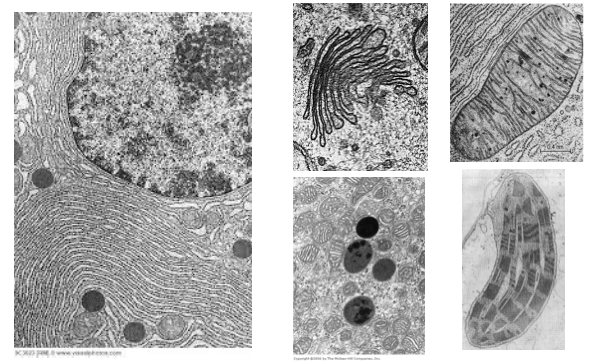
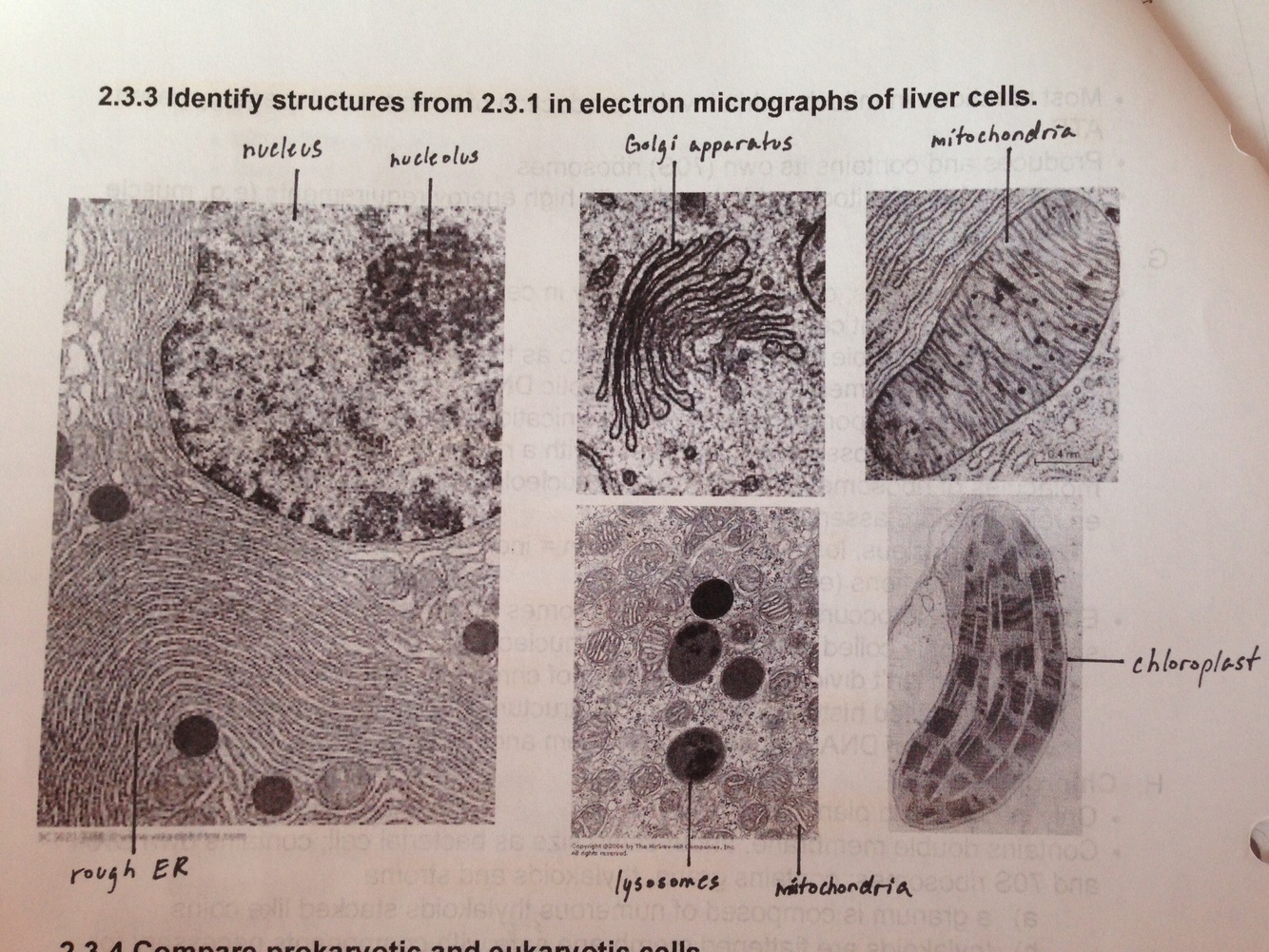
2.3.3 Identify structures from 2.3.1 in electron micrographs of liver cells.
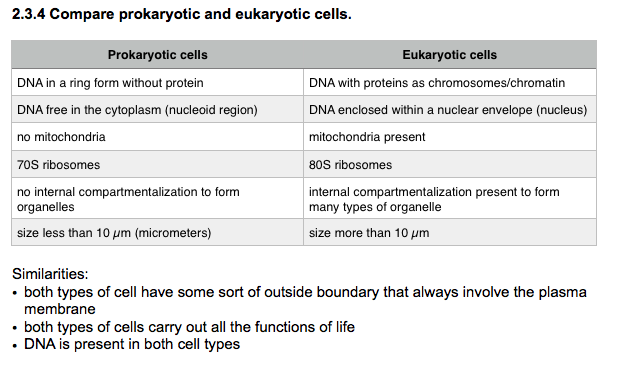
2.3.4 Compare prokaryotic and eukaryotic cells.
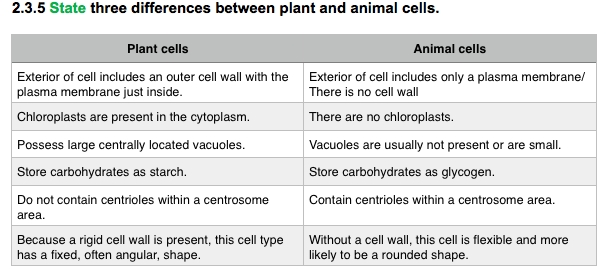
2.3.5 State three differences between plant and animal cells.
2.3.6 Outline two roles of extracellular components.
Plants
Cell wall made from cellulose secreted from the cell, which serves the following functions:
- Provides support and mechanical strength for the cell (maintains cell shape)
- Prevents excessive water uptake by maintaining a stable, turgid state
- Serves as a barrier against infection by pathogens
Animals
Extracellular matrix (ECM) is composed glycoproteins secreted from the cell and collagen fibres. These form fibre-like structures that anchor the matrix to the plasma membrane, which serve the following functions:
- Strengthens plasma membrane and allows attachment between adjacent cells
- Allows cell-to-cell interaction (possibly altering gene expression and bringing about coordination of cell action within tissue)
- Researchers think ECM is involved in directing stem cells to differentiate
- Interactions in ECM appears to be, at least partially, related to cell migration and movement

-
6.5.7-6.5.12; 6.6; 11.4 test21
-
Topic 3.1 Chemical Elements and Water13
-
Topic 2.1 Cell theory10
-
Topic 2.2 Prokaryotic Cells11
-
Topic 2.3 Eukaryotic Cells16
-
Topic 2.5 Cell Division6
-
Topic 3.8 Photosynthesis8
-
Topic 8.2 Photosynthesis10
-
Topic 3.2 Carbohydrates, Lipids and Proteins7
-
Topic 7.5 Proteins7
-
Topic 3.5 Transcription and Translation5
-
Topic 7.3 Transcription4
-
Topic 7.4 Translation7
-
Topic 3.6 Enzymes5
-
Topic 7.6 Enzymes5
-
Topic 3.7 Cell Respiration4
-
Topic 8.1 Cell Respiration8
-
Topic 9.1 Plant Structure and Growth8
-
Topic 9.2 Transport in Angiospermophytes11
-
Topic 9.3 Reproduction in Angiospermophytes6
-
Topic 4.1 Chromosomes, genes, alleles and mutations4
-
Topic 4.2 Meiosis7
-
Topic 4.3 Theoretical genetics12
-
Topic 4.4 Genetic engineering and biotechnology13
-
Topic 10.1 Meiosis5
-
Topic 10.2 Dihybrid crosses and gene linkage6
-
Topic 10.3 Polygenic inheritance2
-
Topic 5.1 Communities and Ecosystems15
-
Topic 5.2 The Greenhouse Effect6
-
Topic 5.3 Populations4
-
Topic 5.4 Evolution8
-
Topic 5.5 Classification5
-
Topic 6.1 Digestion7
-
Topic 6.2 The Transport System8
-
Topic 6.3 Defence Against Infectious Disease8
-
Topic 6.4 Gas Exchange5
-
Topic 6.5 Nerves, Hormones and Homeostasis12
-
Topic 6.6 Reproduction7
-
Topic 11.1 Defence Against Infectious Disease7
-
Topic 11.2 Muscles and Movement8
-
Topic 11.3 The Kidney9



