Equation: Density *
ρ = m / v
ρ = density (kgm⁻³)
m = mass (kg)
v = volume (m-3)
Definition: Archimedes’ Principle
Upthrust is equal to the weight of the water displaced by the object.
Equation: Stoke’s Law *
F = 6πηrv
F = force opposing motion of object moving through fluid (N)
η = viscosity of fluid (Pa s)
r = radius of sphere (m)
v = velocity of object (ms-1)
What are the conditions needed to apply Stoke’s Law?
- Small, spherical object moving slowly.
- Laminar flow.
How does temperature affect viscosity?
As temperature increases, the viscosity decreases.
What is the difference between low and high viscosity?
Low viscosity = runny
High viscosity = sticky
Why does an object released in water accelerate downwards first before reaching a constant velocity?
Initially, the weight of the object is larger than the viscous drag + upthrust. As the object’s velocity increases, so does the viscous drag acting on the object. This occurs until the weight is equal to the viscous drag + upthrust, meaning there is no acceleration.
What is the relationship between forces of an object travelling with constant velocity in a liquid?
W = U + D
W = weight
U = upthrust
D = viscous drag
What are the forces acting on an object moving through a liquid?
Weight
Upthrust
Viscous drag
Why does upthrust decrease as a balloon rises?
Because the density of air decreases meaning the upthrust decreases.
Definition: Hooke’s Law
The extension of an object is proportional to the force applied, provided elastic deformation doesn’t occur.
Equation: Hooke’s Law *
ΔF = kΔx
ΔF = force applied (N)
k = stiffness (Nm⁻¹)
Δx = extension (m)
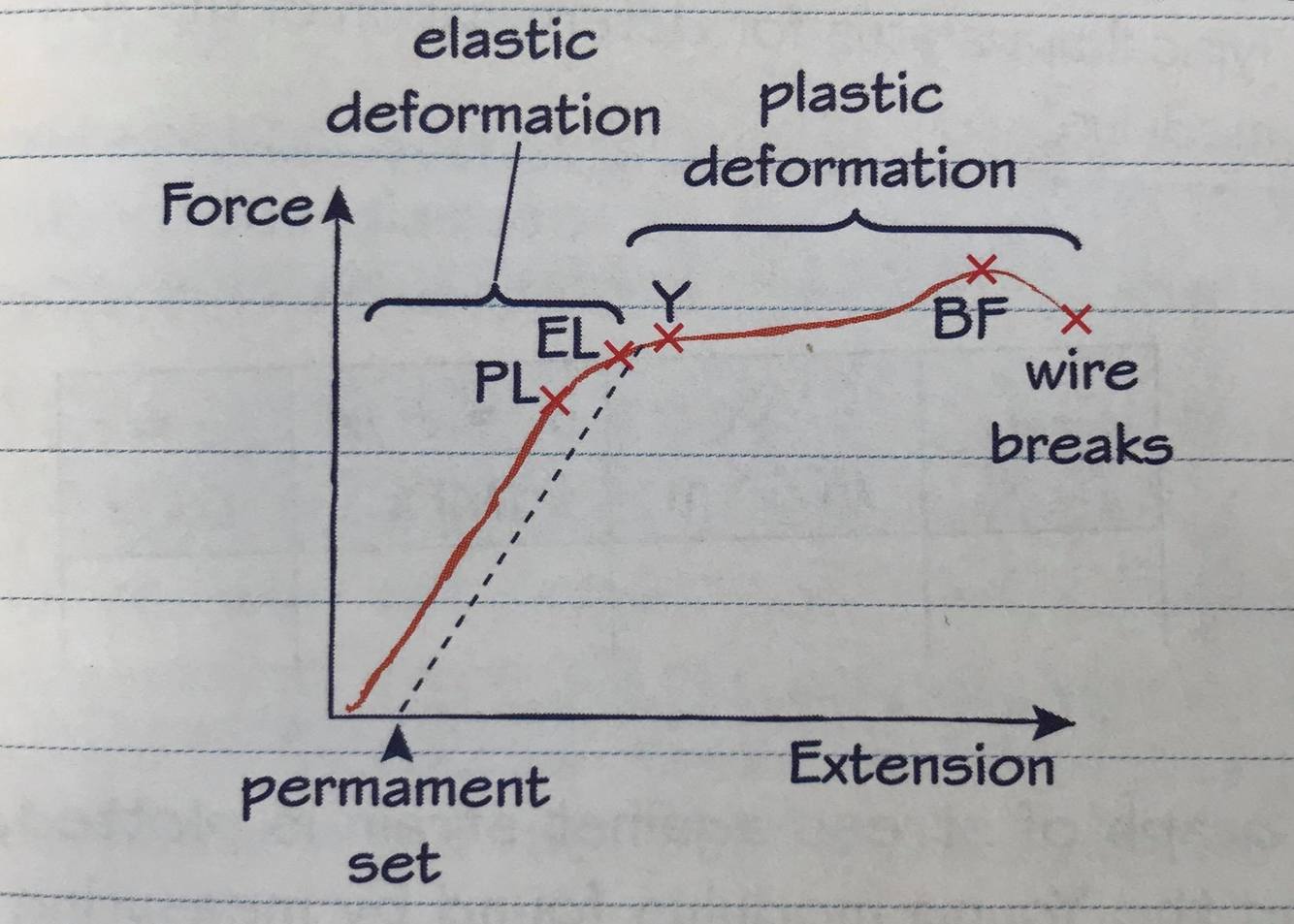
Definition: Limit of proportionality
The point at which an object stops obeying Hooke’s Law.
Definition: Elastic limit
The point at which the object will no longer return to its original length if stretched beyond.
Definition: Yield point
When plastic deformation begins and the extension quickly increases as force is increased.
Definition: Breaking force
The point at which the object will break, even if the force is reduced after this point has been reached.
What are the features of a force-extension graph?
PL = limit of proportionality
EL = elastic limit
Y = yield point
BF = breaking force
Definition: Elastic strain energy
The work done to stretch or compress an object.
How do you stretch an object?
Apply a tensile force.
How do you compress an object?
Apply a compressive force.
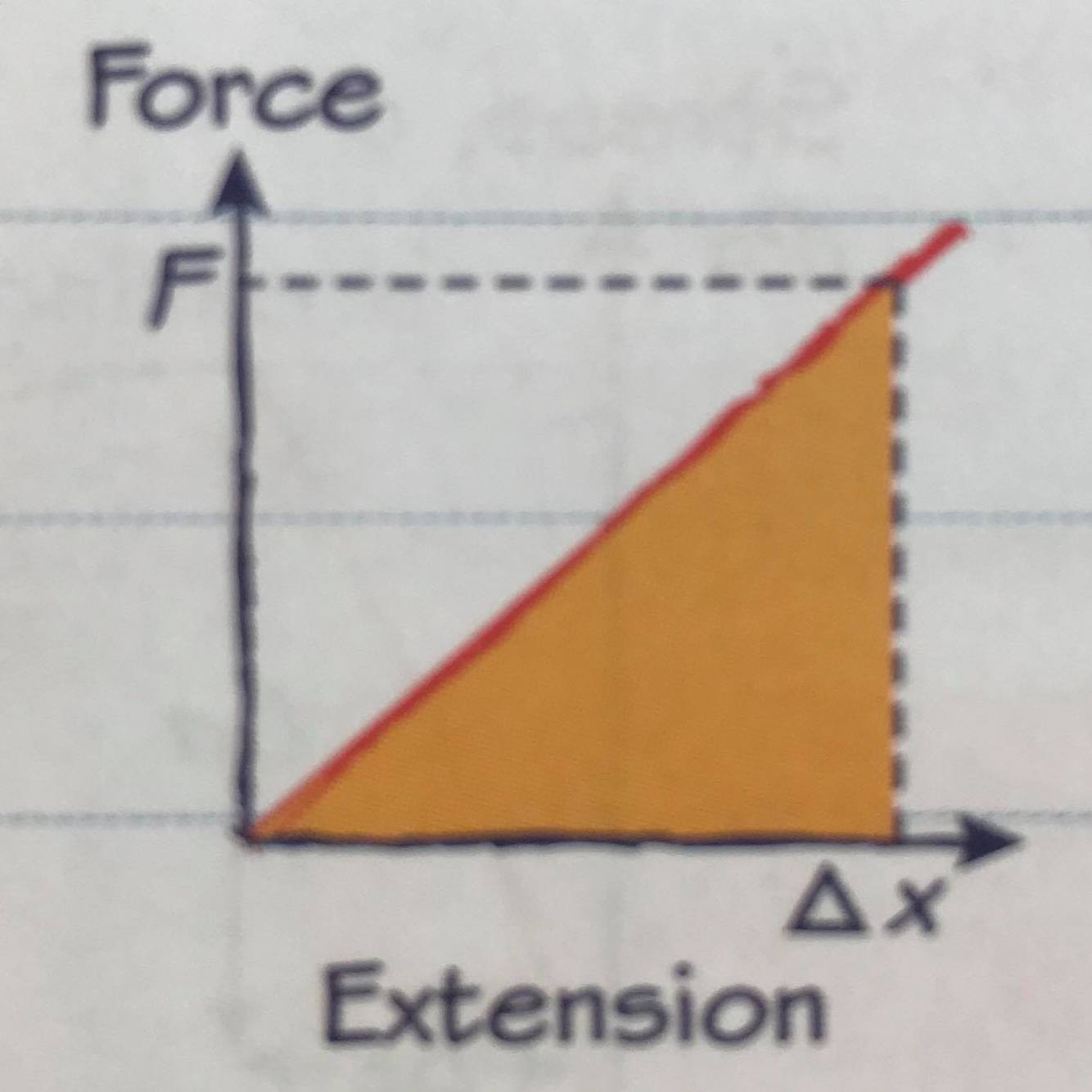
Equation: Elastic strain energy *
ΔEel = ½FΔx
ΔEel = elastic strain energy (J)
F = force applied (N)
Δx = extension (m)
How do you work out elastic strain energy from a graph?
The area below a force-extension graph.
Definition: Stress
The force per unit cross-sectional area acting on an object. (Nm⁻² or Pa)
Equation: Stress *
σ = F / A
σ = stress (Pa or Nm-2)
F = force (N)
A = cross-sectional area (m2)



