Give examples of specialist predators and their mode of feeding
SNAKES
- Sit and wait, often by feeding areas, nests
- Flexible jaws; all parts of mandible move indepently from rest of skull so they can eat large prey
- Two strategies:
- Constrict prey using strong body muscles OR;
- Venom containing toxins to subdue prey eg. Neurotoxins that paralyse prey by blocking the signals from nerves to muscles. Large fangs in front-fanged snakes, or between grooves of teeth in back fanged snakes to deliver venom to prey. Toxins are delivered quickly in one strike, then snake will follow prey til it collapses and eat it whole.
SPIDERS
- Sit and wait
- Some use toxins
- Produce silk to form traps and webs
CATS (Felidae)
- Chase their prey
- Retractable claws
- Powerful jaws and large teeth
- Agility and rapid movement
- Social organisation (hunt in packs)
Describe the role of neurotransmitters, how naturally occurring molecules interfere with their activity and the medical benefits of understanding these processes
THEME MOVEMENT
Neurotoxins are example of convergent evolution. Possible because the neuromascular junction is similar across animals.
In normal functioning neurotransmitters (eg acetylcholine) are released by action potetial at nerve ending and binds with receptor sites at muscle celll membrane causing contraction
Alkaloids like tubocararine are chemically similar to neurotranmsitter so can also bind at receptor preventing nerotransmitter from binding causing muscle to cease movement
Tubocurarine is an acetylcholine antagonist because it inhibitst a response
Nicotine is an acetylcholine agonist because it stimulates a response (increases blood pressure, heart rate etc)
There are different types of acetylcholine receptor sites at different types of muscle tissue (eg. cardiac musle and smooth musle which are not under conscious control v skeletal muscle)
Knowing the molecular structure of alkiloids and how they bind at different sites allows the development of targeted drugs (eg.painkillers).
Alkiloids
Large and diverse group of chemicals, containing nitrogen, often produced as secondary chemicals.
Secondary chemicals
Chemicals produced by organisms that are outside the primary metabolism of the organism. They may be used for defence eg tubocurarine in the Curarea vine used as poison curare by indigenous people
Why are plant-derived compounds useful in medicine?
- Compounds have evolved as defence mechanisms against a wide variety of predators.
- The action of defence mimics natural processes in the human body, such as the behaviour of neurotransmitters.
- Manipulation of neurotransmitter levels can be useful in a variety of medical applications, such as muscle relaxation and pain relief.
- Therefore plant defence compounds (or synthetic analogues of these compounds) offer the opportunity for development of useful medicines
Discuss ways in which prey types are identified amongst existing and extinct species
Extant
- Direct observation eg. direct feeding, carcass damage and predator tracks.
Extinct and Extant
- Carbon-12 and Carbon-13 ratios in mammalian tooth enamel
- Ratios of 12C and 13C indicate whether animal is herbivore or carnivore
- Also indicate whether C4 or C3 plants are preferred in herbivores
- Can be used to determine prey types of fossilised predator remains (eg Soledad et als study into fossilised remains from same time/location looked at carbon ratios and the weights of predators and prey to determine which prey the predators would have taken)
Explain the implications of predator–prey interactions for changes in the abundance of other components of the food web
THEME: INTERACTION
TROPHIC CASCADE - Changes in abundance of species at one trophic level due to changes in abundance at a higher or lower trophic level.
The stronger a predator-prey interaction the more likely the effect the abundance of one will effect the abundance of the other. This effect applies to all interactions within a food web; the relative abundance of one species can affect a variety of others up and down trophic levels.
Eg. Paine (1965) removed predator starfish P. ochraceus from intertidal zone and its prey, the mussel Mytilus californianus, increased vastly in abundance and ended up outcompeting other organisms in area to become dominant competitior. The removal of starfish affected all other organisms in area mediated through a competitive adavantage for the mussels.
These interactions can be tested
- In the field (by adding or removing an organism and seeing effect)
- In the lab (not as good as complex interactions in wild may be missed)
- Computer modelling
TROPHIC CASCADE
Changes in abundance of species at one trophic level due to changes in abundance at a higher or lower trophic level. These can be top-down or bottom-up.
Describe how power-law relationships arise in biology, especially with reference to body size
Power-law relationships arise in biology when a dependent variable eg BMR is linked to the mass of an organism raised to a certain power eg the power-law relationship of BMR and body mass (m) is BMR = 70m ^ 0.75
This relationship is ALLOMETRIC since it pertains to physiogical process and BODY SIZE specifically
This is because they relate to processes to different dimensions eg. Surface area (measured in two dimensions) vs mass (which is measured in 3 dimensions)
Surface area to volume (mass) ratios decrease as an animal gets larger
Power-law relationships
Relationships between two variables in which the dependent variable is raised to a particular power of the independent variable, i.e. y = axb. An example is metabolic activity (y) and body size (x). The latter is an example of an allometric relationship.Power-lP
Allometric relationships
Changes in organism function (e.g. physiology) with body size. Eg Changes in BMR in relation to body size
Interpret phylogenies with age estimates
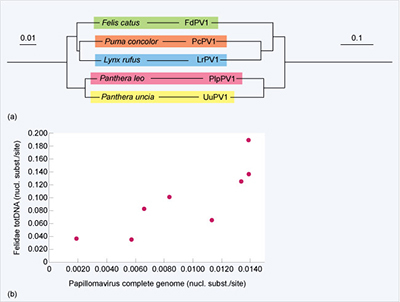
Phylogenies can be used to determine whether coevolution is ocurring between two clades (eg Cats and their respective papillomaviruses)
Similar phylogenies visually may mean that coevolution is occuring
Length and pattern of branches indicate level of change between each member and members molecular relationship
Members on same branch will be most similar as they have shared the same amount of changes
Length of a branch from the branch point represents number of nucleotide substituions present.