Describe the major lines of business in which dealer banks operate and the risk factors they face in each line of business
- Large dealer banks provide a variety of intermediary functions in the markets for over-thecounter (OTC) derivatives, repurchase agreements, and securities. In addition, large dealer banks act as a prime broker for hedge funds and provide asset management for wealthy individuals and institutions.
- Large dealer banks play an important function in the OTC derivatives market. Dealer banks transfer the risk of the derivatives positions requested by counterparties by creating new derivatives contracts with other counterparties. Examples of types of OTC derivatives are interest rate swaps, collateralized debt obligations (CDOs), collateralized mortgage obligations (CMOs), and credit default swaps (CDSs).
- The failure of a large dealer bank would result in increased systemic risk for the OTC market.
- Another important function of large dealer banks is in the short-term repurchase or repo market.
- Dealer banks provide investment banking functions through the management and underwriting of securities issuances. These investment banking functions also include advising corporations regarding mergers and acquisitions and merchant banking functions, such as the buying and selling of oil, metals, and other commodities.
- Large dealer banks act as a prime broker to large investors such as hedge funds. In this context, the services provided by the dealer banks include custody of securities, clearing, securities lending, cash management, and reporting.
- Dealer banks also provide an important function as a counterparty for derivatives for brokerage clients. Dealer banks sometimes operate “internal hedge funds” and private equity partnerships.
- In addition, large dealer banks provide traditional commercial banking functions, such as gathering deposits for corporate and consumer lending.
- Large dealer banks operate in markets that are outside the scope of traditional bank-failure resolution mechanisms, such as conservatorship or receivership. The dealer banks are organized under the umbrella of holding companies in order to provide the wide variety of commercial banking, merchant banking, investment banking, brokerage, and off-balance sheet partnership activities. In addition, dealer banks often have large asset-management divisions that provide custody of securities, cash management, brokerage, and alternative investments vehicles. Dealer banks are also typically the general partner with limited partner clients.
- The recent financial crisis caused many to question the ability of dealer banks to manage risks properly. It is sometimes argued that forming large bank holding companies results in economies of scope with respect to information technology, marketing, and financial innovation. However, the recent financial crisis clearly identified diseconomies of scope in risk management and corporate governance.
Identify situations that can cause a liquidity crisis at a dealer bank and explain responses that can mitigate these risks
- As mentioned previously, when OTC derivatives counterparties question the solvency of a dealer bank, they will begin to reduce their exposures to the dealer. A counterparty could reduce their exposure by borrowing from the dealer or by entering into new offsetting derivatives contracts with the dealer.
- Another means that a counterparty has of reducing their exposure to a dealer is through a novation to another dealer.
- Central clearing mitigates the liquidity risk caused by derivatives counterparties exiting their large dealer bank exposures.
Describe policy measures that can alleviate firm-specific and systemic risks related to large dealer banks
The 2009 Public Private Investment Partnership (PPIP) was instituted by the U.S. Treasury Departments 2008 Troubled Asset Relief Program (TARP) to help dealer banks and the financial industry recover from the crisis at hand. One of the policy objectives was to mitigate the effect of adverse selection in the market for “toxic” assets, such as the CDOs backed by subprime mortgages. Adverse selection is the principle that buyers are only willing to buy the assets at a deep discount due to the information asymmetries that exist regarding the asset’s true value. A dealer bank may be forced to sell illiquid assets in order to meet liquidity needs. This results in additional losses due to the lack of demand for those assets. The PPIP subsidizes bidders of “toxic assets” by offering below-market financing rates and absorbing losses beyond a predetermined level.
Stress Testing Banks
- In the wake of the 2007—2009 financial crisis, regulators and other policymakers realized that standard approaches to risk assessment, such as regulatory capital ratio requirements, were not sufficient. At that point, supervisory stress testing became a popular tool for measuring bank risk. There was a “pop-quiz” quality to the post-financial crisis stress tests. They were difficult to manipulate because they were sprung on banks at short notice. As a result, the information provided by the stress tests to regulators and the market was truly new.
- Stresses are generally of two basic types: scenarios or sensitivities. An example of a scenario is a severe recession. An example of sensitivity is a significant increase in interest rates. Risk managers can stress test the sensitivity of a single position or loan or an entire portfolio.
Describe the historical evolution of the stress testing process and compare methodologies of historical EBA, CCAR and SCAP stress tests
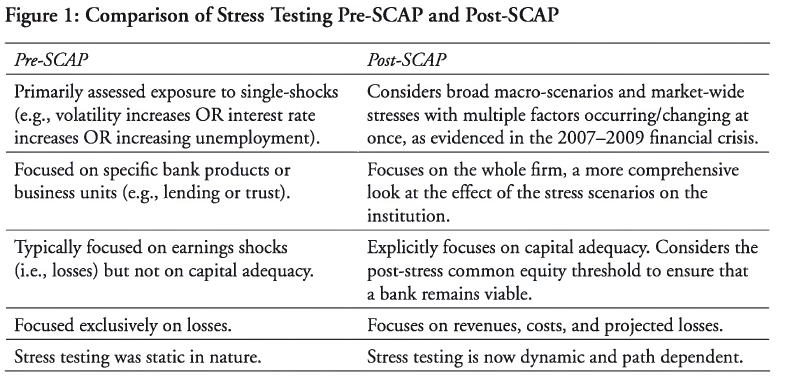
The 2009 U.S. bank stress test, known as the Supervisory Capital Assessment Program (SCAP), was meant to serve that purpose. It was the first macro-prudential stress test after the 2007—2009 financial crisis. Macro-prudential regulation focuses on the soundness of the banking system as a whole (i.e., focuses on systematic risks) while micro-prudential regulation focuses on the safety and soundness of the individual institution.
Explain challenges in designing stress test scenarios, including the problem of coherence in modeling risk factors
- One of the challenges of designing useful stress tests is coherence. The sensitivities and scenarios must be extreme but must also be reasonable or possible (i.e., coherent).
- It is not sufficient to specify one potential problem (i.e., risk factor) because the others do not remain fixed. The supervisor’s key challenge is to specify the joint outcomes of all relevant risk factors.
- Additionally, not everything goes bad at once. For example, if some currencies are depreciating, others must be appreciating. If there is a “flight to quality,” there must also be safe haven assets in the stress model.
- One thing to note is that prior to 2011 all supervisory stress tests imposed the same scenarios on all banks (i.e., a one-size-fits-all approach to stress testing). In recognition of the problem, the 2011 and 2012 Comprehensive Capital Analysis and Review (CCAR) asked banks to submit results from their own stress scenarios in addition to the supervisory stress scenario in an attempt to reveal bank-specific vulnerabilities.
Explain challenges in modeling a bank’s revenues, losses, and its balance sheet over a stress test horizon period
- Current stress tests are based on macro-scenarios (e.g., unemployment, GDP growth, the HPI). One concern is how to translate the macro-risk factors employed in stress testing into micro (i.e., bank-specific) outcomes related to revenues and losses. Although not limited to these products, geographic differences are especially important in modeling losses in both commercial and residential real estate lending.
- The typical stress test horizon is two years. Over this period, both the income statement and balance sheet must be modeled to determine if capital is adequate post-stress. Generally speaking, capital is measured as a ratio of capital to assets. There are different types of capital (e.g., Tier 1 and Tier 2) but in general (and for the sake of simplicity), capital can be defined as common equity. Risk-weighted assets (RWA) are computed based on the Basel II risk weight definitions.
- The challenges of balance sheet modeling exist under both static and dynamic modeling assumptions. The bank must maintain its capital (and liquidity) ratios during all quarters of the stress test horizon. At the end of the stress horizon the bank must estimate the reserves needed to cover losses on loans and leases for the next year. This means that a two-year horizon stress test is actually a three year stress test (i.e., a T-year stress test requires the bank to estimate required reserves to cover losses for T+1 years).
- One of the key contributions of the CCAR was that in both 2011 and 2012 the CCAR required banks to submit the results of their own scenarios, both baseline and stress, not just supervisory stress test results. The Fed also reported dollar pre-provision net revenue (PPNR), gains and losses on available-for-sale and held-to-maturity securities, and trading and counterparty losses for the six institutions with the largest trading portfolios. These firms were required to conduct the trading book stress test. The numbers that were reported were supervisory estimates, not bank estimates, of losses under the stress scenario.
- The key benefit of greater disclosure is transparency. Transparency is especially important in times of financial distress. However, during “normal” times, the costs of disclosure may outweigh the benefits.
Explain how risks can arise through outsourcing activities to third-party service providers, and describe elements of an effective program to manage outsourcing risk
The following risks could arise when a financial institution outsources its operational functions to third-party service providers:
- Compliance risk refers to a service provider not operating in compliance with the relevant local laws and regulations.
- Concentration risk refers to having very few service providers to choose from or that the service providers are clustered in only a few geographic areas.
- Reputational risk refers to a service provider executing its tasks in a substandard manner, resulting in a negative public perception of the financial institution.
- Country risk refers to using a service provider based in a foreign country and subjecting the financial institution to potential economic and political risks in that country.
- Operational risk refers to potential losses sustained by a financial institution as a result of internal control breaches and human error caused by a service provider.
- Legal risk refers to subjecting the financial institution to lawsuits and other costs due to potentially negligent activities of a service provider.
Risk management programs should include (1) risk assessments, (2) due diligence in selecting service providers, (3) contract provisions, (4) incentive compensation review, (5) oversight and monitoring of service providers, and (6) business continuity and contingency plans.
The crucial first step is to perform risk assessments of the applicable business activities to determine whether these activities are best executed in-house or by a third party. Assuming the outsourcing option is consistent with the financial institutions business objectives, then a cost-benefit analysis and a risk analysis of the service provider should be performed.
Explain how financial institutions should perform due diligence on third-party service providers
In performing due diligence on a third-party service provider, a financial institution should involve any relevant technical specialists and/or important stakeholders. The three key areas of review include:
- (1) business background, reputation, and strategy;
- (2) financial performance and condition; and
- (3) operations and internal controls.
Ultimately, the financial institution must ensure that the service provider follows all relevant laws and regulations in performing services on the institution’s behalf.
Describe topics and provisions that should be addressed in a contract with a third-party service provider
Considerations and contract provisions for third-party service providers should include the following elements:
- Scope. A contract will state the rights and responsibilities of each party. Examples include (1) contract duration, (2) support, maintenance, and customer service, (3) training of financial institution employees, (4) policies regarding subcontracting, (5) insurance coverage, and (6) policies regarding the use of the financial institution’s assets and employees.
- Cost and compensation.
- Incentive compensation. A contract should include a provision to allow the financial institution to review the appropriateness of incentive compensation (if applicable).
- Right to audit. A contract could optionally contain a provision to allow the financial institution to audit the service provider.
- Establishment and monitoring of performance standards. A contract should state specific and measurable performance standards (i.e., metrics) with regard to the service provider’s work.
- Oversight and monitoring. A contract should include a provision requiring the service provider to provide annual financial statements (and the annual report, if applicable) to the financial institution to allow the financial institution to monitor the service provider’s ability to continue as a going concern.
- Confidentiality and security of information. A contract must contain extensive provisions concerning the confidentiality and security of information pertaining to both the financial institution and its customers. With regard to nonpublic personal information (NPPI) pertaining to the financial institution’s customers, a contract should address access, security, and retention of NPPI data by the service provider (if applicable) to comply with privacy laws and regulations. A contract should also require the service provider to give notice to the financial institution of any breaches of data.
- Ownership and license. A contract should state when service providers are permitted to use the financial institution’s property (i.e., data and equipment). In addition, clarification is needed regarding the ownership and control of data produced by a service provider. In the event of software purchased from a service provider, it could be necessary to have escrow agreements in place so that the financial institution could access the source code and programs under certain conditions, such as discontinued product support or insolvency of a service provider.
- Indemnification. A contract should require the service provider to indemnify (i.e., hold harmless) the financial institution in the event of any legal proceedings arising from the service provider’s negligence.
- Default and termination. A contract should clarify the types of actions that would constitute a default together with any reasonable remedies that could be undertaken by the financial institution and methods to overcome default by the service provider.
- Dispute resolution. A contract should lay out an agreed-upon dispute resolution plan to resolve disputes quickly and minimize disruption during a dispute.
- Limits on liability. A contract may allow for service providers to limit their liability subject to approval by the financial institutions board of directors and management team.
- Insurance. A contract should stipulate the requirement of service providers to carry sufficient insurance and provide evidence of coverage. In addition, any significant changes in coverage should be communicated to the financial institution.
- Customer complaints. A contract should state which party will deal with customer complaints. If it is the service provider, then they should be required to prepare reports to the financial institution listing the complaints and their status.
- Business resumption and contingency plan of the service provider. A contract should detail how the service provider will continue to provide services should a major disaster occur.
- Foreign-based service providers. A contract could attempt to provide for the law and regulations of only one jurisdiction (i.e., the financial institutions) to apply for the purposes of contract enforcement and resolution of disputes. This would avoid potentially confusing situations where the foreign laws differ substantially from local laws.
- Subcontracting. The subcontractor should be held to the same contract terms in the event that subcontracting is permitted. The contract should explicitly state that the primary service provider is ultimately responsible for all the work performed by the service provider and its subcontractors.
Explain the motivations for introducing the Basel regulations, including key risk exposures addressed, and explain the reasons for revisions to Basel regulations over time
Some countries and/or regulatory authorities were more diligent in their enforcement of capital regulations than others. As banks became increasingly global, banks operating in countries with more lax standards were perceived to have a competitive advantage over banks operating in countries with strict enforcement of capital regulations.
There were additional problems with the existing regime.
- First, high risk loans from international banks to lesser developed countries such as Mexico and Brazil raised questions about the adequacy of existing capital to cover potential losses.
- Second, banks used “accounting games” to record some of these transactions, masking risk.
- Third, bank transactions were becoming more complex. Off-balance sheet transactions in over-thecounter (OTC) derivatives like interest rate swaps, currency swaps, and options were growing. These off-balance sheet deals did not affect total assets, and thus did not affect the amount of capital a bank was required to keep, providing fuel to the growing belief that total assets did not reflect a bank’s total risk.
Explain the calculation of risk-weighted assets and the capital requirement per the original Basel I guidelines
Basel I put forth two capital requirements:
- The bank’s total assets to capital ratio had to be less than 20 (i.e., capital to total assets had to be greater than 1/20 or 5%). This capital requirement was similar to the requirements in many countries prior to 1988.
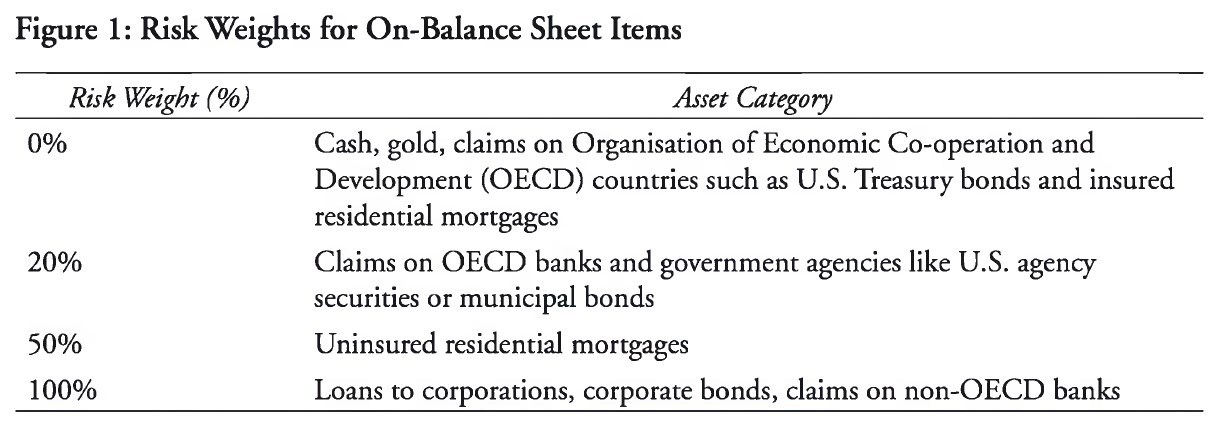
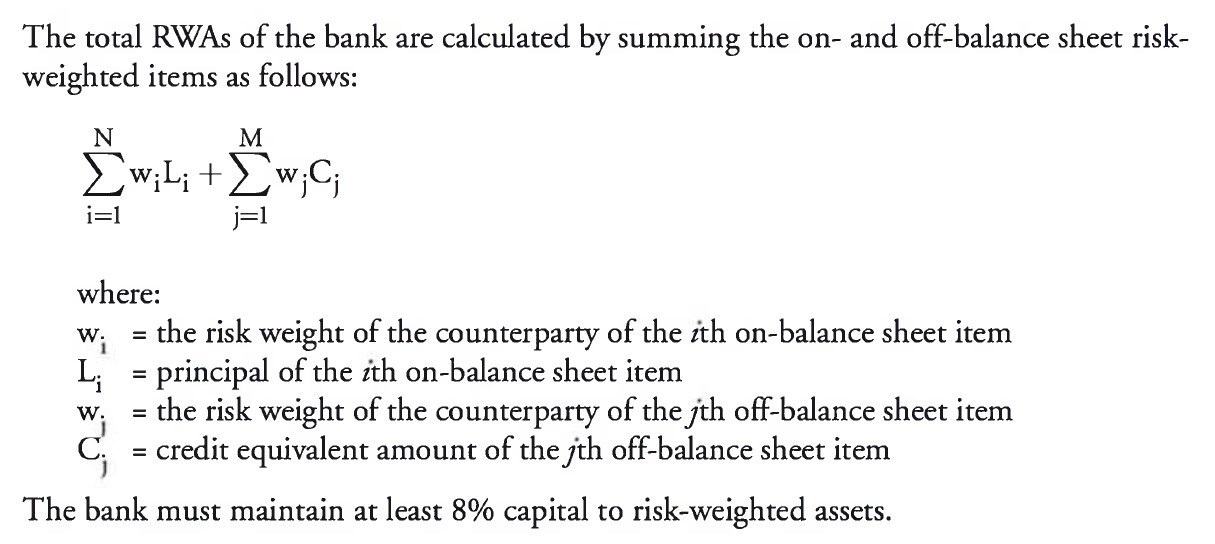
- The bank’s on- and off-balance sheet items had to be used to calculate risk-weighted assets (RWA). RWA is intended to measure a bank’s total credit exposure. The ratio of capital to risk-adjusted assets is called the Cooke ratio, after Peter Cooke from the Bank of England. Basel I stipulated that the Cooke ratio must exceed 8%.
Credit equivalent amount
Off-balance sheet items are expressed as a credit equivalent amount. The credit equivalent amount is, in essence, the loan principal that is considered to have the same credit risk. This means the bank “converts” off-balance sheet items into on-balance sheet equivalents for the purpose of calculating risk-based capital. The weight is then multiplied by the principal amount (i.e., the credit equivalent amount) of the item to arrive at a risk-weighted value. A conversion factor is applied to the principal amount of the instrument for non-derivatives.
Off-balance sheet items that are similar, from a credit perspective, to loans (e.g., bankers acceptances), have a conversion factor of 100%. Other off-balance sheet items, such as note issuance facilities, have lower conversion factors.
For interest rates swaps and other over-the-counter (OTC) derivatives, the credit equivalent amount is calculated as:
max(V, 0) + a x L
where:
- V = current value of the derivative to the bank
- a = add-on factor
- L = principal amount
The first term in the equation [max(V, 0)] reflects the bank’s current exposure. If the counterparty defaults and V, the current value of the derivative, is positive, the bank will lose V If the counterparty defaults and Vis negative, the exposure is 0 (i.e., no gain or loss to the bank). The add-on amount (a x L) allows for the possibility that the bank’s exposure may increase in the future. Add-on factors are higher for higher risk derivatives (e.g., longer maturities, riskier underlying assets).
The credit equivalent amount is multiplied by the risk weight for the counterparty to calculate risk-weighted assets.
Tier 1 capital and Tier 2 capital
According to Basel I, capital has two components, Tier 1 capital and Tier 2 capital.
Tier 1 capital (or core capital) consists of items such as:
- Equity (subtract goodwill from equity).
- Non-cumulative perpetual preferred stock.
Tier 2 capital (or supplementary capital) consists of items such as:
- Cumulative perpetual preferred stock.
- Certain types of 99-year debentures.
- Subordinated debt with an original maturity greater than five years (where the subordination is to depositors).
Equity capital (i.e., Tier 1) absorbs losses. Supplementary capital (i.e., Tier 2) is subordinate to depositors and thus protects depositors in the event of a bank failure.
At least 50% of capital must be Tier 1. This means there is a 4% Tier 1 capital to risk-weighted assets requirement (i.e., 8% x 0.5). Half of the Tier 1 requirement has to be met with common equity. Under Basel I, some countries required banks to have more capital than required by The Accord.
Basel I had a number of shortcomings that were remedied over the coming years with new capital accords. For example, Basel I treats all corporate loans the same in terms of capital requirements. The creditworthiness of the borrower is ignored. Also, Basel 1 did not include a model of default correlation.
Describe and contrast the major elements — including a description of the risks covered — of the two options available for the calculation of market risk capital:
- Standardized Measurement Method
- Internal Models Approach
The goal of the 1996 Amendment to the 1988 Basel Accord was to require banks to measure market risks associated with trading activities and maintain capital to back those risks. Banks must mark-to-market (i.e., fair value accounting) bonds, marketable equity securities, commodities, foreign currencies, and most derivatives that are held by the bank for the purpose of trading (referred to as the trading book). Banks do not have to use fair value accounting on assets they intend to hold for investment purposes (referred to as the banking book). This includes loans and some debt securities. The 1996 Amendment proposed two methods for calculating market risk:
- Standardized Measurement Method. This method assigns a capital charge separately to each of the items in the trading book. It ignores correlations between the instruments. Banks with less sophisticated risk management processes are more likely to use this approach.
- Internal Model-Based Approach. This method involves using a formula specified in the amendment to calculate a value at risk (VaR) measure and then convert the VaR into a capital requirement. Capital charges are generally lower using this method because it better reflects the benefits of diversification (i.e., correlations between the instruments). As such, banks with more advanced risk management functions prefer the internal models approach.
The VaR model does not incorporate company-specific risks such as changes in a firm’s credit spread or changes in a company’s stock price. The specific risk charge (SRC) captures company-specific risks. For example, a corporate bond has interest rate risk, captured by VaR, and credit risk, captured by the SRC.
Tier 3 capital consisting of short-term subordinated, unsecured debt with an original maturity of at least two years could be used to meet the market risk capital requirement at the time of the amendment. Tier 3 capital has subsequently been eliminated under Basel III.
Calculate VaR and the capital charge using the internal models approach, and explain the guidelines for backtesting VaR
According to the 1996 Amendment, the market risk VaR is calculated with a 10-trading day time horizon and a 99% confidence level. The market risk capital requirement is calculated as:
max(VaRt-1, mc x VaRavg) + SRC
where:
- VaRt-1 = previous day’s VaR
- VaRavg = the average VaR over the past 60 trading days
- mc = multiplicative factor
- SRC = specific risk charge
The multiplicative factor must be at least three, but may be set higher by bank supervisors if they believe a bank’s VaR model has deficiencies. This means the capital charge will be the higher of either the previous day’s VaR or three times the average of the daily VaR plus a charge for company specific risks (i.e., the SRC).
Banks calculate a 10-day, 99% VaR for SRC. Regulators then apply a multiplicative factor (which must be at least four) similar to mc to determine the capital requirement. The total capital requirement for banks using the internal model-based approach must be at least 50% of the capital required using the standardized approach.
The bank’s total capital charge, according to the 1996 Amendment, is the sum of the capital required according to Basel I and the capital required based on the 1996 Amendment. For simplicity, the RWAs for market risk capital was defined as 12.5 times the value given in the previous equation. The total capital a bank has to keep under the 1996 Amendment is:
total capital = 0.08 x (credit risk RWA + market risk RWA)
where:
- market RWA = 12.5 x (max(VaRt-1, mc x VaRavg) + SRC)
- credit RWA = Σ(RWA on-balance sheet) + Σ(RWA off-balance sheet)
The 1996 Amendment requires banks to backtest the one-day, 99% VaR over the previous 250 days. A bank calculates the VaR using its current method for each of the 250 trading days and then compares the calculated VaR to the actual loss. If the actual loss is greater than the estimated loss, an exception is recorded. The multiplicative factor (mc) is set based on the number of exceptions. If, over the previous 250 days, the number of exceptions is:
- Less than 5, mc is usually set equal to 3.
- 5, 6, 7, 8, or 9, mc is set equal to 3.4, 3.5, 3.65, 3.75, and 3.85, respectively.
- Greater than 10, mc is set equal to 4.
The bank supervisor has discretion regarding the multiplier. If the exception is due to changes in the bank’s positions during that day, the higher multiplier may or may not be used. If the exception is due to deficiencies in the bank’s VaR model, higher multipliers are likely to be applied. There is no guidance to supervisors in terms of higher multipliers if an exception is simply the result of bad luck.
Describe and contrast the major elements of the Standardized Approach for the calculation of credit risk capital
The standardized approach is used by banks with less sophisticated risk management functions. The risk-weighting approach is similar to Basel I, although some risk weights were changed. Significant changes include:
- OECD status is no longer considered important under Basel II.
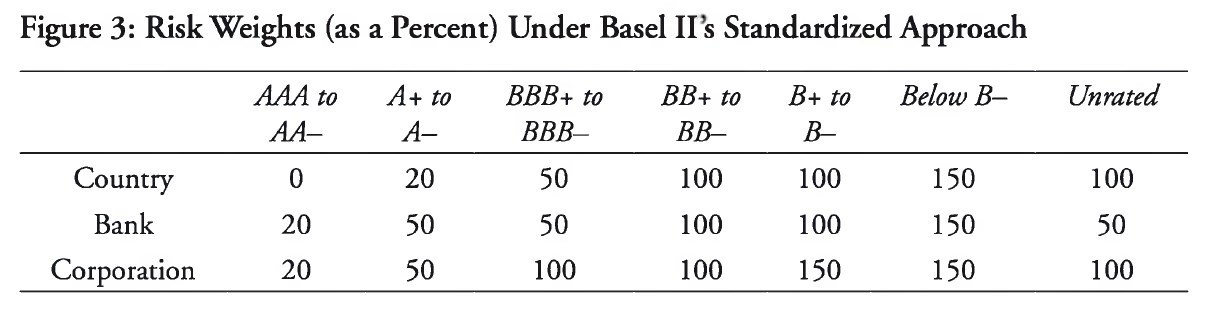
- The credit ratings of countries, banks, and corporations are relevant under Basel II. For example, sovereign (country) risk weights range from 0% to 150%, and bank and corporate risk weights range from 20% to 150%.
- Bank supervisors may apply lower risk weights when the exposure is to the country in which the bank is incorporated.
- Bank supervisors may choose to base risk weights on the credit ratings of the countries in which a bank is incorporated rather than on the bank’s credit rating. For example, if a sovereign rating is AAA to AA—, the risk weight assigned to a bank is 20%. The risk weight increases to 150% if the country is rated below B— and is 100% if the country’s bonds are unrated.
- Risk weights are lower for unrated countries, banks, and companies than for poorly rated countries, banks, and companies.
- Bank supervisors who elect to use the risk weights in Figure 3 are allowed to lower the risk weights for claims with maturities less than three months. For example, the risk weights for short-maturity assets may range from 20% if the rating is between AAA to BBB—or unrated, to 150% if the rating is below B—.
- A 75% risk weight is applied to retail loans, compared to 100% under Basel I. A 100% risk weight is applied to commercial real estate loans. The uninsured residential mortgage risk weights are 35% under Basel II, down from 50% under Basel I.
Collateral Adjustments
Banks adjust risk weights for collateral using the simple approach, similar to Basel I, or the comprehensive approach, used by most banks.
- Under the simple approach, the risk weight of the collateral replaces the risk weight of the counterparty. The counterparty’s risk weight is used for exposure not covered by collateral. Collateral must be revalued at least every six months. A minimum risk weight of 20% is applied to collateral.
- Using the comprehensive approach, banks adjust the size of the exposure upward and the value of the collateral downward, depending on the volatility of the exposure and of the collateral value.
Describe and contrast the major elements of the Internal Ratings Based (IRB) Approach for the calculation of credit risk capital
United States regulators applied Basel II to large banks only. As such, regulatory authorities decided that the IRB approach must be used by U.S. banks. Under the IRB approach, the capital requirement is based on a VaR calculated over a one-year time horizon and a 99.9% confidence level.
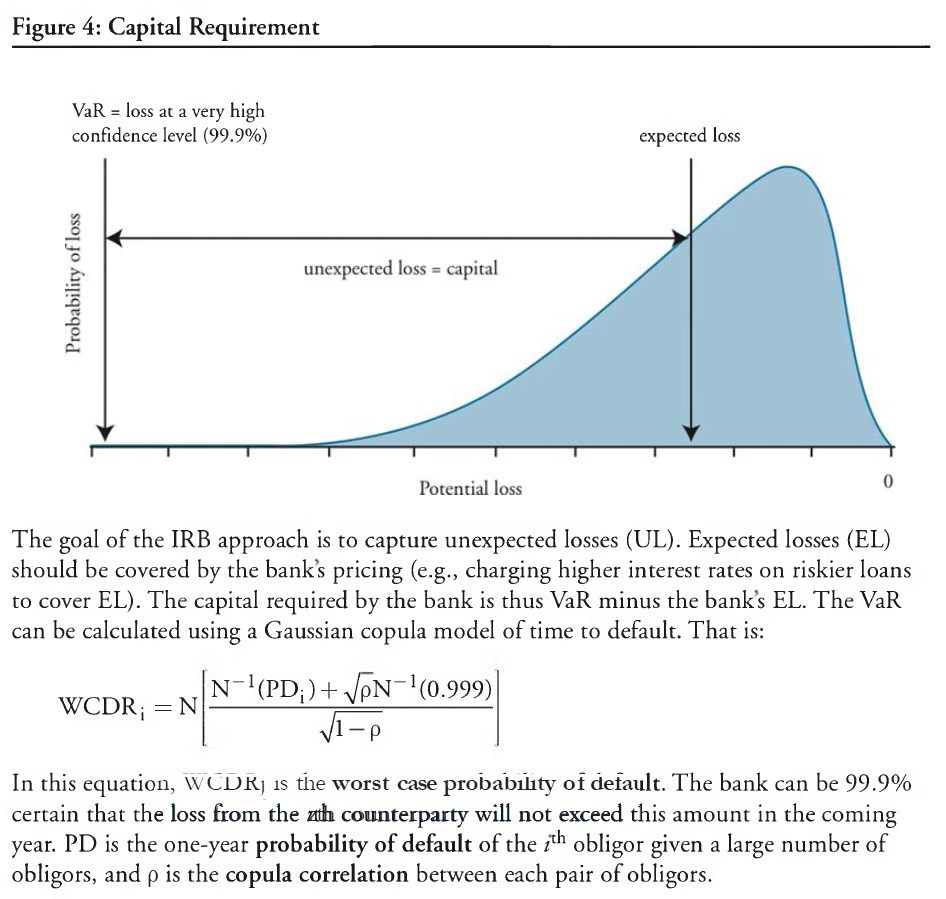
Assuming the bank has a large portfolio of instruments such as loans and derivatives with the same correlation, the one-year, 99.9% VaR is approximately:
VaR99,9%, 1-year ~ ΣiEADi x LGDi xWCDRi
The capital the bank is required to maintain is the excess of the worst-case loss over the bank’s expected loss defined as follows:
required capital = ΣiEADi x LGDi x (WCDRi — PDi)
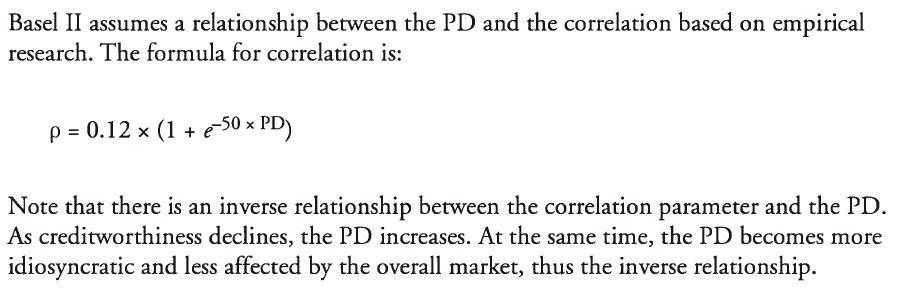
Relationship between the PD and the correlation based on empirical research
It is clear that WCDR increases as the correlation between each pair of obligors increases and as the probability of default increases. If the correlation is 0, then WCDR is equal to PD.
Maturity adjustment
From a counterparty’s perspective, the capital required for the counterparty incorporates a maturity adjustment as follows:
required capital = EAD x LGD x (WCDR — PD) x MA
where:
- MA = maturity adjustment = (1 + (M-2.5) x b)/(1 - 1.5 x b)
- M = maturity of the exposure
- b = [0.11852-0.05478 x In (PD)]2
The maturity adjustment, MA, allows for the possibility of declining creditworthiness and or the possible default of the counterparty for longer term exposures (i.e., longer than one year). If M = 1.0, then MA =1.0 and the maturity adjustment has no impact. The riskweighted assets are calculated as 12.5 times capital required:
RWA = 12.5 x [EAD x LGD x (WCDR - PD) x MA]
The capital required is 8% of RWA. The capital required should be sufficient to cover unexpected losses over a one-year period with 99.9% certainty (i.e., the bank is 99.9% certain the unexpected loss will not be exceeded). Expected losses should be covered by the bank’s product pricing. Theoretically, the WCDR is the probability of default that happens once every 1,000 years. If the Basel Committee finds the capital requirements too high or too low, it reserves the right to apply a scaling factor (e.g., 1.06 or 0.98) to increase or decrease the required capital.
On the exam, if you begin with RWA, multiply by 0.08 to get the capital requirement. If instead you begin with the capital requirement, multiply by 12.5 (or divide by 0.08) to get RWA. In other words, these percentages are simply reciprocals (i.e., 1/0.08 = 12.5)
Foundation IRB Approach vs. Advanced IRB Approach
- The foundation IRB approach and the advanced IRB approach are similar with the exception of who provides the estimates of LGD, EAD, and M. The key differences between the two approaches are outlined by the following.
Foundation IRB Approach
- The bank supplies the PD estimate. For bank and corporate exposures, there is a 0.03% floor set for PD.
- The LGD, EAD, and M are supervisory values set by the Basel Committee. The Basel Committee set LGD at 45% for senior claims and 75% for subordinated claims. If there is collateral, the LGD is reduced using the comprehensive approach.
- The EAD is calculated similar to the credit equivalent amount required under Basel I. It includes the impact of netting.
- M is usually set to 2.5.
Advanced IRB Approach
- Banks supply their own estimates of PD, LGD, EAD, and M.
- PD can be reduced by credit mitigants such as credit triggers subject to a floor of 0.03% for bank and corporate exposures.
- LGD is primarily influenced by the collateral and the seniority of the debt.
- With supervisory approval, banks can use their own estimates of credit conversion factors when calculating EAD.
Foundations IRB Approach and Advanced IRB Approach for Retail Exposures
- The two methods are merged for retail exposures. Banks provide their own estimates of PD, EAD, and LGD.
- There is no maturity adjustment (MA) for retail exposures.
- The capital requirement is EAD x LGD x (WCDR - PD).
- Risk-weighted assets are 12.5 x EAD x LGD x (WCDR — PD).
- Correlations are assumed to be much lower for retail exposures than for corporate exposures.
Describe and contrast the major elements of the three options available for the calculation of operational risk capital: basic indicator approach, standardized approach, and the Advanced Measurement Approach
- Basel II requires banks to maintain capital for operational risks.
- Under Basel II, there are three approaches banks may use to calculate capital for operational risk:
- Basic Indicator Approach (BIA). This is the simplest approach and is used by banks with less sophisticated risk management functions. The required capital for operational risk is equal to the bank’s average annual gross income (i.e., net interest income plus non-interest income) over the last three years multiplied by 0.15.
- The Standardized Approach (TSA). This method is similar to the basic indicator approach. The primary difference between the two approaches is that a different multiplier is applied to the bank’s gross income for different lines of business.
- Advanced Measurement Approach (AMA). Like the IRB approach discussed for credit risk, the capital requirement for operational risk under the advanced measurement approach is based on an operational risk loss (i.e., VaR) calculated over a one-year time horizon with a 99.9% confidence level. The approach has an advantage in that it allows banks to consider risk mitigating factors such as insurance contracts (e.g., fire insurance).
While Basel II generally lowered credit risk capital requirements for most banks, requiring banks to hold capital for operational risks had the effect of raising overall capital requirements back to (approximately) Basel I levels.
Describe the key elements of the three pillars of Basel II: minimum capital requirements, supervisory review, and market discipline
While Basel I improved the way capital requirements were determined for banks worldwide, it had some major limitations.
- First, all corporate loans were treated the same (i.e., a risk weight of 100%) regardless of the creditworthiness of the borrower. A firm with an AAA credit rating was treated the same as a borrower with a C rating.
- Basel I also ignored the benefits of diversification (i.e., there was no model of default correlation).
Basel II, proposed in June 1999 and after multiple revisions was published in 2004 and implemented in 2007, corrected a number of the deficiencies in Basel I. The rules applied to “internationally active” banks and thus many small regional banks in the United States were not subject to the requirements but fell under Basel IA, similar to Basel I, instead. All European banks are regulated under Basel II.
There are three pillars under Basel II:
- minimum capital requirements,
- supervisory review, and
- market discipline.

-
Topics 1-225
-
Topics 3-525
-
Topics 6-928
-
Topics 10-1217
-
Topics 13-1530
-
Topics 16-1823
-
Topics 19-2041
-
Topics 21-2334
-
Topics 24-2626
-
Topics 27-3038
-
Topics 31-3431
-
Topics 35-3621
-
Topics 37-3926
-
Topics 40-4223
-
Topics 43-4527
-
Topics 46-4823
-
Topics 49-5031
-
Topics 51-5434
-
Topics 55-5829
-
Topics 59-6116
-
Topics 62-6425
-
Topics 65-6832
-
Topics 69-7134
-
Topics 72-7939
-
Revision27



