Traction SubGroup
Proposed Biomechanical effects: *TEMPORARY*
6:
- Distraction/separation of VB’s
- Combo of distraction/gliding of facet joints
- tensing of ligamentous structures related to spinal segments
- Widening of IV Foramina
- Straightening of spinal curves
- Stretching of spinal musculature
Traction SubGroups
Indications
aka WHY???
- Disc herniation/protrusion
- DEC protrusion and DEC compression of nerve root
- component of a comprehensive therapy program
- DJD, hypOmobility of spinal jts
Traction SubGroups
CONTRAINDICATIONS
DO NOT USE
*REMEMBER THIS!!!
- Disease
- tumor
- infection
- Vascular compromise
- ANY CONDITION for which mvmt is contraindicated
- Fx
- Dislocation
- Pregnancy, osteoporosis, claustrophobia
- Cord Compression==> CE Syndrome
- Uncontrolled HTN
- Hiatal hernia
- Severe respiratory dis.
- Aortic aneurysm
- RA
- Worsening neurologic signs
According to studies….
Just an FYI…
Studies gen. unsuccessful in demo’ing efficacy of traction, thus traction is NOT RECOMMENDED for heterogenous groups of pts w/ LBP w/ or w/out sciatica
**IMPORTANT**
Delitto et. al 1995 proposed following criteria for classifying pts into this subgroup: Traction
Who WOULD benefit?
- Presence of LE symptoms
- Signs of Nerve root compression:
- reflexes
- myotomes
- dermatomes
- +SLR, +Cross SLR**
- +Slump Test **
- Absence of centralization w/ mvmt testing
- aka trying McKenzie method or NO directional preference
In a study looking @ traction + exercise together
Traction + extension oriented exercise
Traction + Ex. group BETTER
-less disability, less fear avoidance @ 2 wks
NO DIFF @ 6 wks compared to exercise alone….WHY?
Traction effects are short-term/temporary
The Traction Subgroup is characterized by
4 things:
- Presence of sciatica
- Signs of nerve root compression
- +slump
- +cross-SLR
- hypERreflexia
- myos/dermos
- Peripheralization w/ EXT mvmt
- +Cross SLR ***
Predictors of successful response to traction
ID of Subgroup
Defined:
Pts that exp peripheralization of sx’s w/ EXT mvmts AND have +Cross SLR test
==> BETTER likelihood of success w/ traction
Cai et al 2009: Development of CPR (clinical prediction rule) for Traction Subgroup
This is the actual CRITERIA for Tx
CPR for traction NOT YET definitive
BUT…start here…
IMPORTANT***
- FABQ-work subset-score <21
- NO neurological deficit
- Older than 30yo
- NON-manual job work status
***NOTE: If ALL 4 ABOVE PRESENT, INC likelihood of + response to traction from 20% to 69%
THACKERY ET AL. 2016
Basic jist?
Looked @ nerve root compression
2 groups
BOTH received EXT ex’s
1 ALSO mech. traction
NO sig. pain or disability diffs b/w groups
NO evidence traction is superior to EXT ex’s in nerve root compress
Is traction beneficial??
DEPENDS!!!!
Traction Parameters:
4:
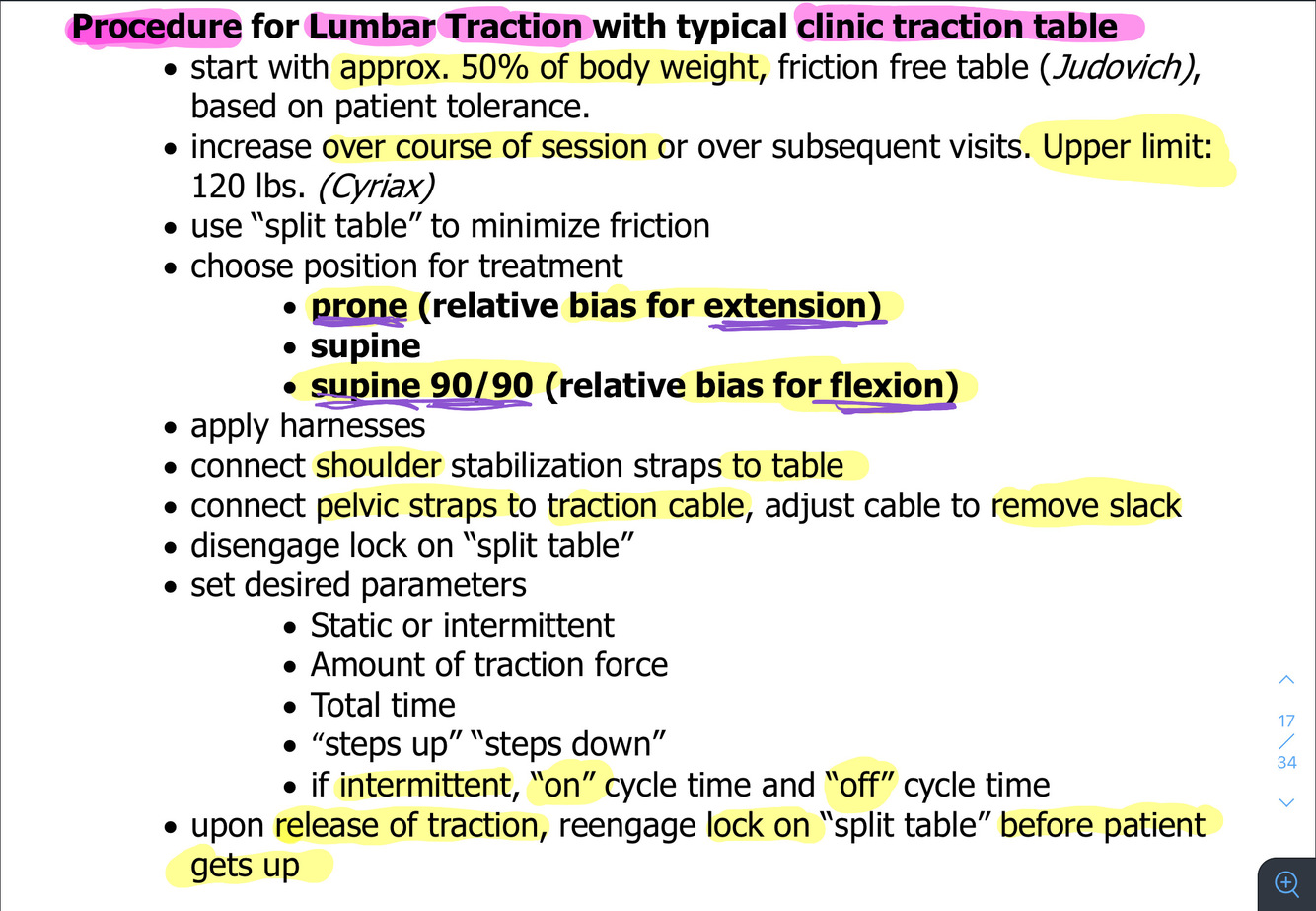
- Constant vs. Intermittent–pt. tolerance
- Amt of force
- *start @ 50% pts bw
- never >120lbs
- *start @ 50% pts bw
- Pt. positioning during tx
- Prone
- Supine w/ hip slight flexed
- Duration of tx
- typ 20mins
LS Traction Lab
Mech. LS Traction: TYPES
2:
- Clinic Systems
* traction table
* inversion traction
- Clinic Systems
- Home Units
* pneumatic systems
* inversion boots
- Home Units
Procedure for Lumbar Traction w/ typical Clinic Traction Table:
see pics
Stabilization Sub-group
*NOTE: shift in perspective from immobilization to stabilization ex’s
—–>
THIS subgroup historically tx’d w/ immobilization or sx stabilization
NOT ANYMORE
Research on stabilization and control of LBP—> inconsisten results
******
conflicting results suggest stabilization ex’s are effective for SOME but not ALL pts w/ LBP
Stabilization Subgroup:
CPR for stab. subgroup
Based on definition of 50% reduction of self-reported disability
4 Factors found to be predictive of improvement:
- Age <40
- Avg (of B/L LEs) SLR ROM >91degs
- Abberant mvmts during sag plane lumbar ROM**
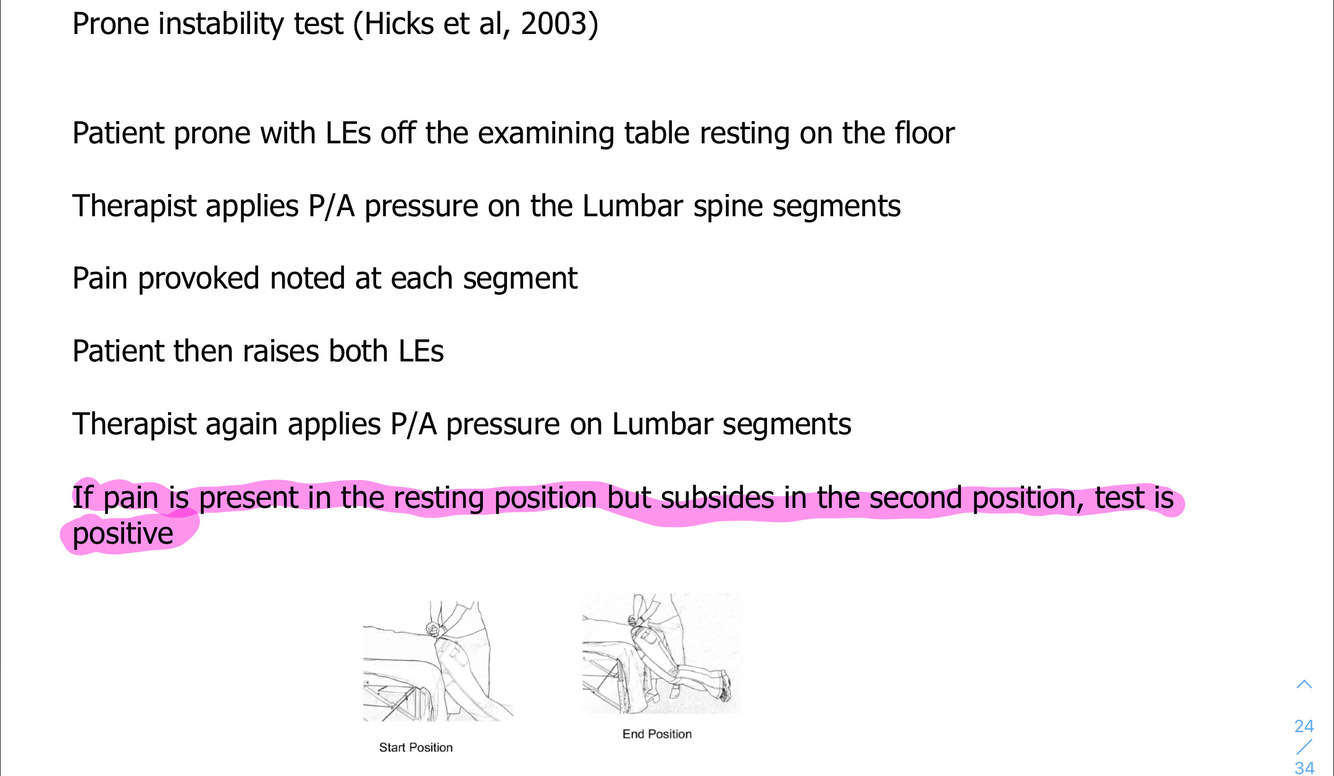
- Postivie prone instability test** (one w/ bent over table & lift legs—if pain disappears== + Test
**CPR defined as POSITIVE when 3 or more of above factors present
**+ LR 4.0
**INCs probability of successful outcome to 80%
Predicting those pts NOT LIKELY to respond to Stabilization Tx
4 Factors:
- NEGATIVE Prone Instability Test
- ABSENCE of Abberant mvmts during sag plane lumbar ROM
- ABSENCE of Lumbar HypERmobility assessed via P-A segmental lumbar spring test
- Score of 9 or HIGHER on FABQ phys activity subscale
**The presence of 3 or more of above HIGHLY PREDICTIVE of failure— 86% probability of failure to respond
Rabin et al.
more on stabilization ex’s
Prone Instability and Aberrant Mvmts may possess better predictive validity for those benefitting from Lumbar Stabilization***
Tx Considerations regarding Stabilization Subgroups
- Old School Focus
* focused on restricting motion deemed to be too excessive for the pts tolerance
- Old School Focus
- 2. Current Evidence
- shifted focus from avoiding to controlling movement
2 Basic Areas of Focus w/ Stabilization Group
- Deep Mm’s of the spine for stabilization
* TA
* Multifidus
* *NOTE: Stabilizers NOT endurance mm’s
- Deep Mm’s of the spine for stabilization
- Strength and Endurance of larger spinal mm’s
* Erector Spinae
* Obliques
* QL
- Strength and Endurance of larger spinal mm’s
Koumantakis et al.
Specific retraining group focus on multifidus and TA
vs.
Gen. strengthening focus on lg spinal mm’s—erectors, obliques
**No diff’s after 20wks
Specific strengthening protocols are superior to tx’s NOT including well-defined ex’s
Special Tests for Instability
Prone Instability Test
see pics


-
LS Anatomy, Exam, Subgrouping89
-
Traction and Stabilization Sub-Groups41
-
Lumbar Manipulation31
-
SI Joint Eval & Tx48
-
Neural Mobilization Exam + Intervention43
-
Chronic LBP23
-
Function and Disability w/ Self-Report Outcome Tools for Pts w/ Spinal Conditions18
-
TMJ Sx and Post-Sx Rehab7
-
TMJ Kinematics Review38
-
Examination & Interventions for Pts w/ TMJ Dysfunction71
-
Headaches17
-
1. Cervical Anatomy and Biomechanics47
-
2. C/S Examination47
-
3. Classification for Pts w/ Neck Pain46
-
5. WAD & Pathoanatomical Dx of the C/S65
-
TOS + Brachial Plexus Anatomy15
-
Thoracic Outlet Syndrome: UQ Neural Mob & Mgmt of Pt w/ Brachial Plexopathy100
-
Thoracic Spine-Kietrys38
-
T-Spine Manipulation- Cohen49
-
CRPS: Complex Regional Pain Syndrome20



