Training & Development
Training: Learning process that involves the acquisition of knowledge, skills and change of attitudes to enhance the performance of employees.
Development: the learning of knowledge, skills and attitude.
Training provides opportunity for learning, development is the process of learning.
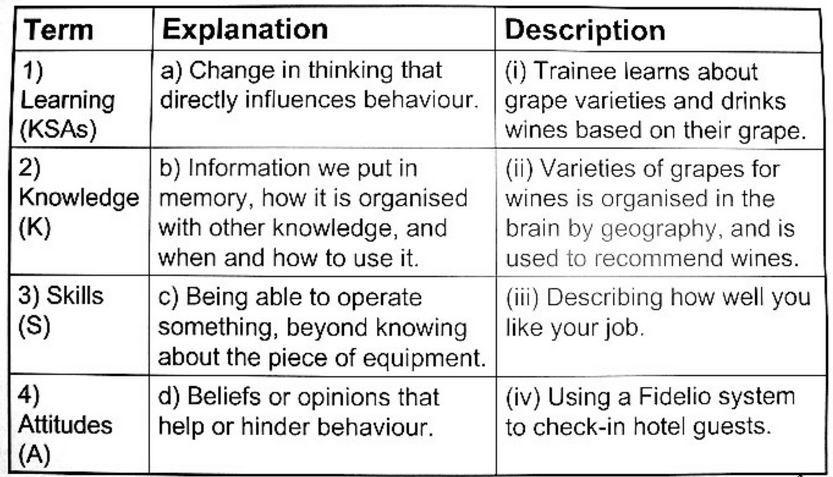
Learning, Knowledge, Skills and Attitudes.
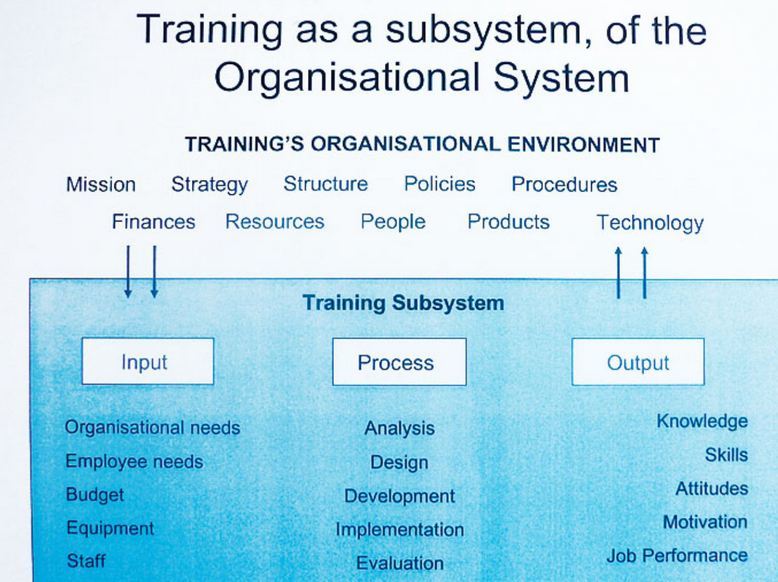
Training’s Organizational Environment (Input-Process-Output)
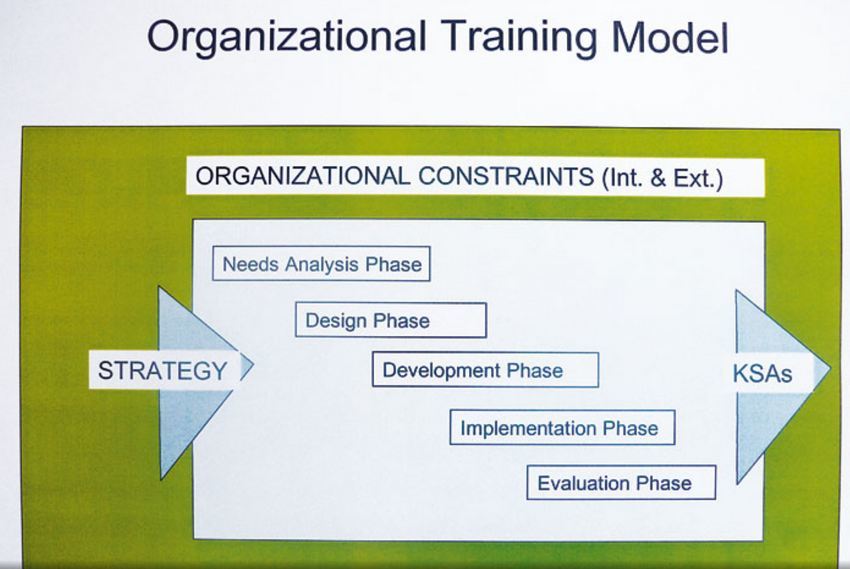
Organizational training model
How can training control the attrition rate?
- Combine individual with team activities.
- Share experiences.
- Provide the “how to“ and “why“.
- Perform a Needs Assesment.
- Evaluation.
Role of HR Department according to Training? (4)
- Active involvement in employee education.
- Rewards for improvement in performance.
- Rewards to be associated with self esteem and self worth.
- Providing pre-employment market oriented skill development education and post employment support for advanced education and training.
- Flexible access i.e. anytime, anywhere training.
Importance of Training and Development
- Optimum Utilization of Human Resources .
- Development of Human Resources .
- Development of skills of employees.
- Productivity.
- Team spirit.
- Organization Culture.
- Organization Climate.
- Quality .
- Healthy work environment .
- Health and Safety.
- Morale .
- Image.
- Profitability.
•
•Optimum Utilization of Human Resources .
Helps the employee to achieve the organizational goals as well as their individual goals.
•Development of Human Resources .
Development of human resources’ technical and behavioral skills in an organization.
Helps the employees in attaining personal growth.
•Development of skills of employees.
Increasing the job knowledge.
Helps to expand the horizons of human intellect and an overall personality of the employees.
•Productivity.
Helps in increasing the productivity of the employees that helps the organization further to achieve its long-term goal.
•Team spirit.
Understand the sense of team work, team spirit, and inter-team collaborations.
Enthusiasm to learn with the employees.
•Organization Culture.
To develop and improve the organizational health culture and effectiveness.
It helps in creating the learning culture within the organization.
•Organization Climate.
Helps building the positive perception and feeling about the organization.
The employees get these feelings from leaders, subordinates, and peers.
•Quality .
Helps in improving upon the quality of work and work-life.
•Healthy work environment .
Helps to build good employee relationship so that individual goals aligns with organizational goal.
•Health and Safety.
Preventing obsolescence
•Morale .
Helps in improving the morale of the work force.
•Image.
Helps in creating a better corporate image.
•Profitability.
Leads to improved profitability and more positive attitudes towards profit orientation.
Needs Assessment Definition
a systematic process for determining and addressing “gaps” between current conditions and desired
conditions to improve current performance or to correct a deficiency.
Person Analysis Definition
•Directed at identifying which individuals within an organization should receive training.
conduct a needs assessment (4 steps)
1) gap analysis: conditions, skills, knowledge, attitudes
2) priority/importance: urgency
3) problems
•Are people doing their jobs effectively?
•Do they know how to do their jobs?
4)possible solutions
techniques to conduct needs assesment
Observation: First hand observation and analysis in a setting in
which the observer is not interfering with normal productivity.
Used to gather first hand data about an employee’s strengths and
weaknesses.
Interviews: Using a series of predetermined questions to gauge
opinions and perceptions. This tool allows the employee to
comment on their performance, and allows the interviewer to ask
in depth questions about performance.
Questionnaires: Allows for a big picture of the environment by
asking respondents identical questions. Allows for more
BBA 3100- Training and Development- Needs Assessment
respondents than individual interviews, and takes less time. The
data collected can be analyzed in a more quantitative way than
with interviews.
Job Descriptions: Study of all responsibilities of a certain job to
define an employee’s expectations and responsibilities, allowing
for more thorough training and supervision.
The Difficulty Analysis: identification of an employee’s duties
that cause them the most difficulty, and allowing for more training
in those areas.
Problem Solving Conference: A conference setting that allows
employees and other staff to identify a plan for a new task or
technology and mold the training to it.
Appraisal Reviews: Within a performance review, questioning
the employee about their duties and training. Allows supervisor to
uncover reasons for poor performance.
Analysis of Organizational Policy: reviewing the organization’s
policy on training, and the amount and type of training offered to
employees.
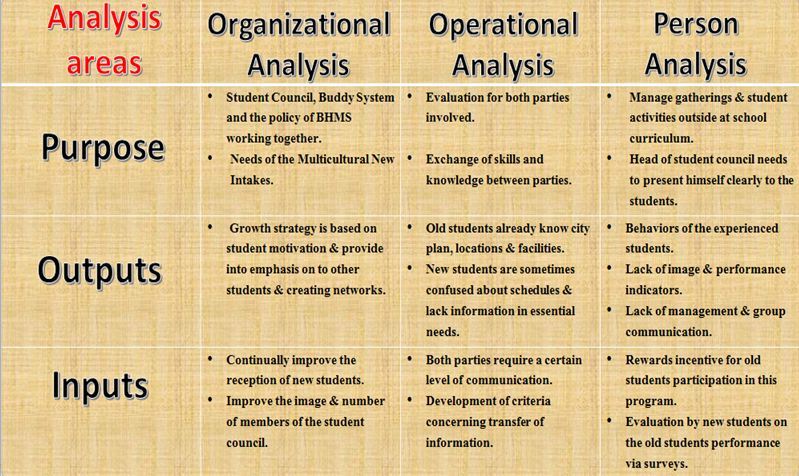
Needs Assessment Table (Input-Output and Purpose for the individual, for the operation and for the organization).
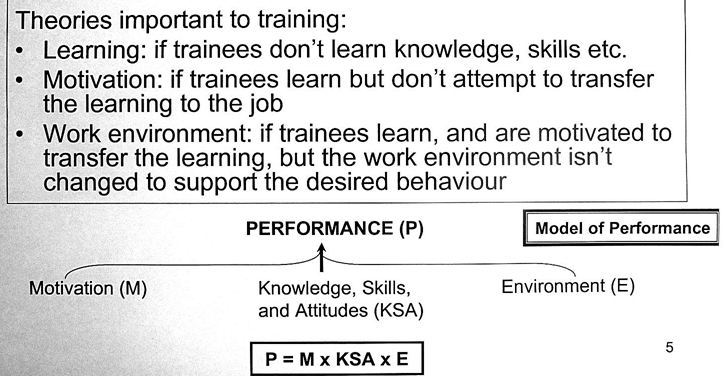
Explain the equation of performance
P = M x KSA x E
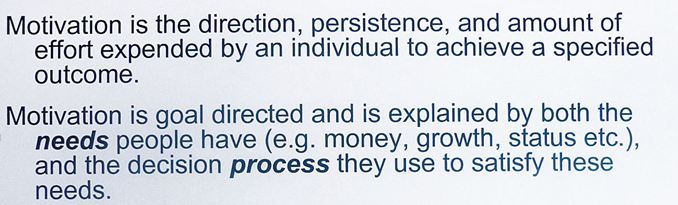
MOTIVATION: Is the direction, persistance, and amount of effort expended by an individual to achieve a specified outcome.
Learning: KNOWLEDGE, SKILLS, ATTITUDE
ENVIRONMENT
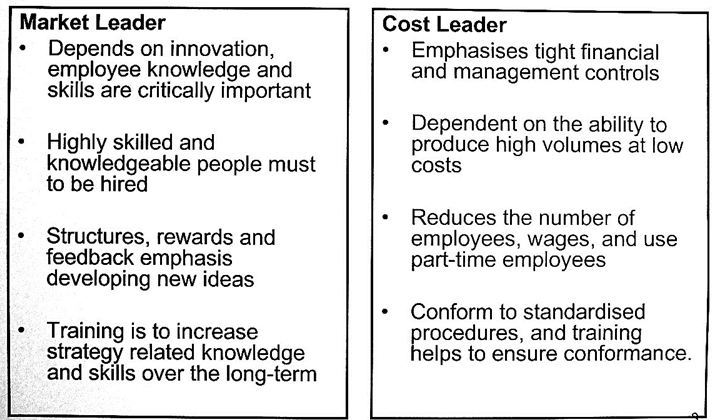
Market leader strategy vs Cost leader strategy
What is motivation?
cognitive learning
- Learning controls the learner, because trainers have some expectations, and strategies of how to learn.
- Is the result of listening, watching, touching or experiencing.
- Knowledge and attitude are developed.
- Lectures
- Demonstrations
- Discussions
- Computer based training
behavioral learning
- The trainer controls learning by controlling the stimuli and the response (either negative or positive)
- Skills are developed.
- Giving practical training to the trainees.
- Games and Simulations
a) Behavior modelling
b) Business games
c) Case studies
d) Equipment simulations
e) Role play - On the Job Training
- Off the Job Training
7 approaches to professional development
- Consultation: To assist an individual or group of individuals to clarify and address concerns by following a systematic problem-solving process.
- Coaching: To enhance a person’s competencies in a specific skill area by providing a process of observation, reflection, and action
- Communities of practice:
To improve professional practice by engaging in shared inquiry and learning with people who have a common goal
•Lesson study:
To solve practical dilemmas related to intervention or instruction through participation with other professionals in systematically examining practice
•Mentoring: To promote an individual’s awareness and refinement of his or her own professional development by providing and recommending structured opportunities for reflection and observation
- Reflective supervision: To support, develop and evaluate the performance of employees through a process of inquiry that encourages their understanding and articulation of the rationale for their own practices.
- Technical assistance:To assist individuals and their organization to improve by offering resources and information, supporting networking and change efforts.
3 learning styles
1.Visual Learners.
Puzzle building, reading, writing, charts and graphs, designing practical objects, interpreting visual images
2.Auditory Learners (through seeing))
Listening, speaking, writing, story telling, explaining, teaching, using humor, remembering information, convincing someone of their point of view.
3.Tactile/Kinesthetic Learners (through doing, touching and moving)
Problem solving, classifying and categorizing information, working with abstract concepts, geometric shapes..
How can training be evaluated?




