what types of RNA are involved in translation?
mRNA - messenger
tRNA - transfer
rRNA - ribosomal
what is the role of mRNA , tRNA and rRNA in translation?
- mRNA = template, encodes information to make the protein
- tRNA - carrier, each amino acid brought to mRNA by a specific tRNA
- rRNA - structural and functional roles in ribosomes
4.
what is the start codon on an mRNA?
AUG = methionine= typical 1st codon in protein
at what point on mRNA do we start translating codons?
just after the 5’UTR region - whenever it comes across a start codon
What is an open reading frame?
a set of codons that run continously bounded by an initiation codon and a termination codon = reading frame is determined by which base is chosen as the start of a codon
in protein synthesis usually only one open reading frame contains useful information
is the genetic code universal?
yes - it applies to all species conserved from early stage of evolution
what genetic change causes sickle cell anaemia?
it is due to a missense mutation in the beta globin gene - single nucleotide substitution (a to T) in the codon for amino acid 6 - converts a glutamic acid codon (GAG) to a valine codon (GTG) autosomal recessive
what is the ‘Wobble exception to base pairing’?
wobble = flexible pairings
the wobble base is last 3’ base in codon on mRNA which binds with the first 5’ based in anticodon on tRNA - it allows felxibility/efficiency in use of tRNA - a single tRNA species carrying an AA can recognize 2 codons
so this is why different codons can produce the same AA
what is the role of the ribosome?
they are the factories in which protein synthesis occurs - they are complexes of protein and rRNA - which is extensive secondary structuring stimilar to tRNA -
ribosome brings tRNA and mRNA together to translate nucleotide sequence of mRNA into amino acid of a protein
what are the 2 parts to tranlation initiation?
- assembly of components required for chain formation (tqo ribosomal subunits, mRNA, tRNA specified by the AUG codon, GTP, initiation factors to help ribosome recognise the sequence for the start of translation
- recognition of the start codon by a tRNA methionine molecule
*initiator tRNA is in P site
what are the 3 sites of the ribosome?
- A= aminoacyl site - accepts new tRNA
- P= peptidyl site - contains amino acid chain
- E= exit site - harbours deacylated tRNA on way out of ribosome
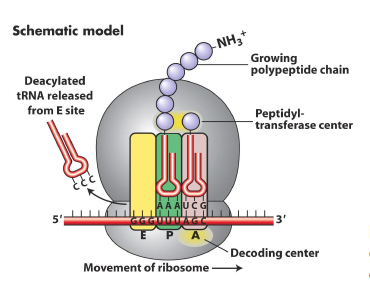
describe the process of ‘elongation ‘
elongation involves the addition of amino acids to the carboxyl end of the growing chain - peptide bonds are formed between adjacent amino acids
ribosome moves along mRNA being translated - in 5’ to 3’ direction
- tRNA delivered to A site
- peptide bonds formed
- growing amino acid chain now in A site
- after bond formed, the ribosome is translocated 3 nucleotides to the next codon
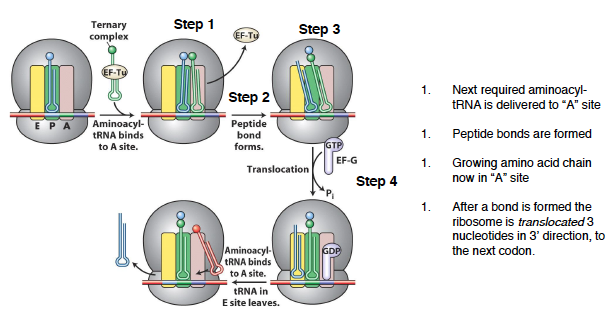
describe the process of termination in translation
occurs when one of three termination codons arrives in the A site
stop codon recognized by a release factor
release factor binds to A site which causes the newly synthesized protein to be released and dissasembly of the tRNA - ribosome- mRNA complex
how are polypeptide chains modified post translation?
- trimming - removal of part of the translated sequence
- chemical alterations - attachment of a chemical group
- degredation - marking a protein for destruction
what chemical alterations are made of post-tranlated peptide chains?
- phosphorylation - catalysed by protein kinases and protein phosphatases
- glycosylation - used to target proteins to plasma membrane lysosome
- hydroxylation - extensive in collagen
- palmitoylation - serves as an anchor in cell membrane
how are proteins degraded?
proteins are marked for destruction by ubiquitination - the attahcment of ubiquitin - which acts as a tag for proteosome

-
Colon Cancer: Molecular Pathogenesis and Precision Medicine22
-
pharmacogenetics13
-
Gene Therapeutics and Gene Therapy24
-
MM overview/tutorial3
-
First Class MM7
-
Cellular differentiation and Stem Cells17
-
Genome Structure16
-
Cell Division17
-
DNA replication18
-
Anti-cancer Agents 123
-
Anti-Cancer Agents 220
-
Cancer Cell Biology 2 - angiogenesis and metastasis24
-
Cancer cell biology 123
-
Life and Death of the cell25
-
Cytogenetics - human chromosomes and disorders21
-
MCQ 2016-17 MM29
-
Dynamic regulation of protein21
-
Aspects of Clinical Genetics8
-
Regulation of Gene expression22
-
Mendelian genetics 18
-
methods of molecular biology 29
-
Translation18
-
disease diagnosis molecular biology methods 38
-
Transcription11



