How does the cell translate an mRNA message into a protein?
With the help of tRNA
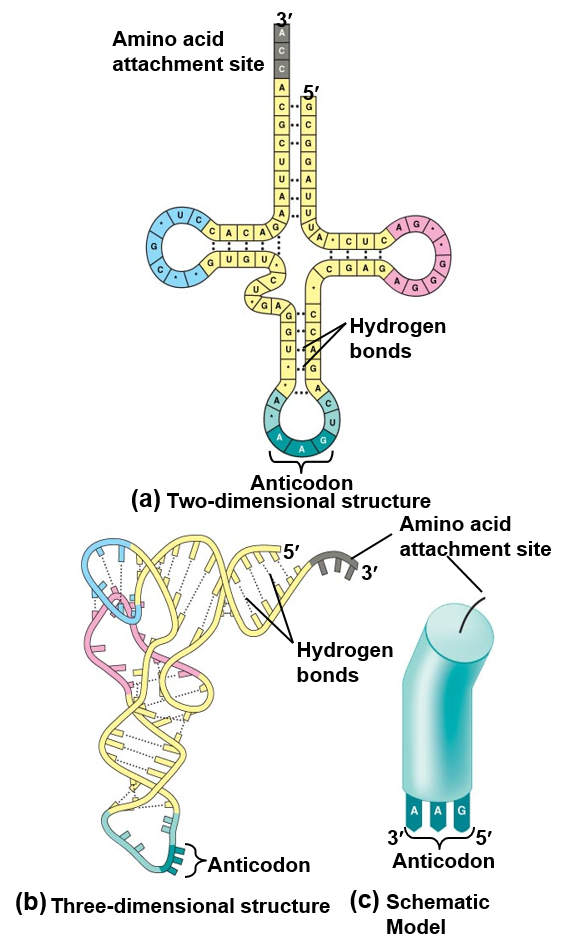
How many nucleotides does a tRNA consist of? Is it a single strand?
80
YES
What is attached at the 3’ end of a tRNA?
an amino acid
What is the anticodon of the tRNA? How long is it? What is it complementary to?
This is a 3 nucleotide sequence that is located on the other end relative to the amino acid
This pairs complementary with a codon on mRNA
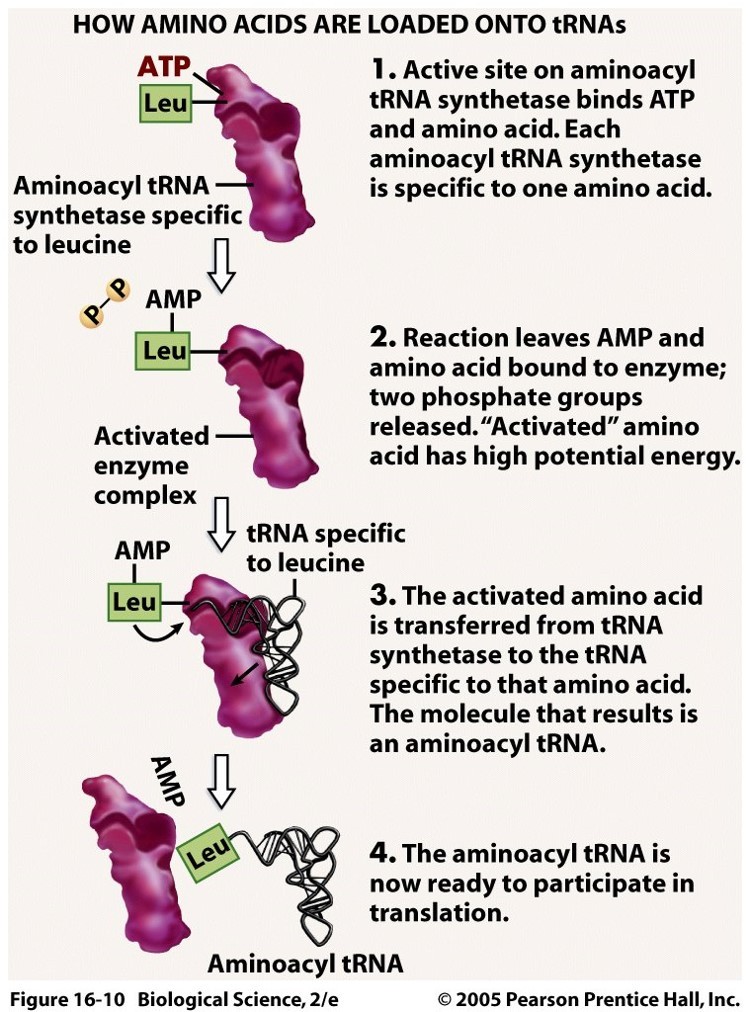
What is the function of aminoacyl-tRNA synthase?
This is an enzyme that matches and facilitates the binding of the amino acid to its appropriate tRNA molecule.
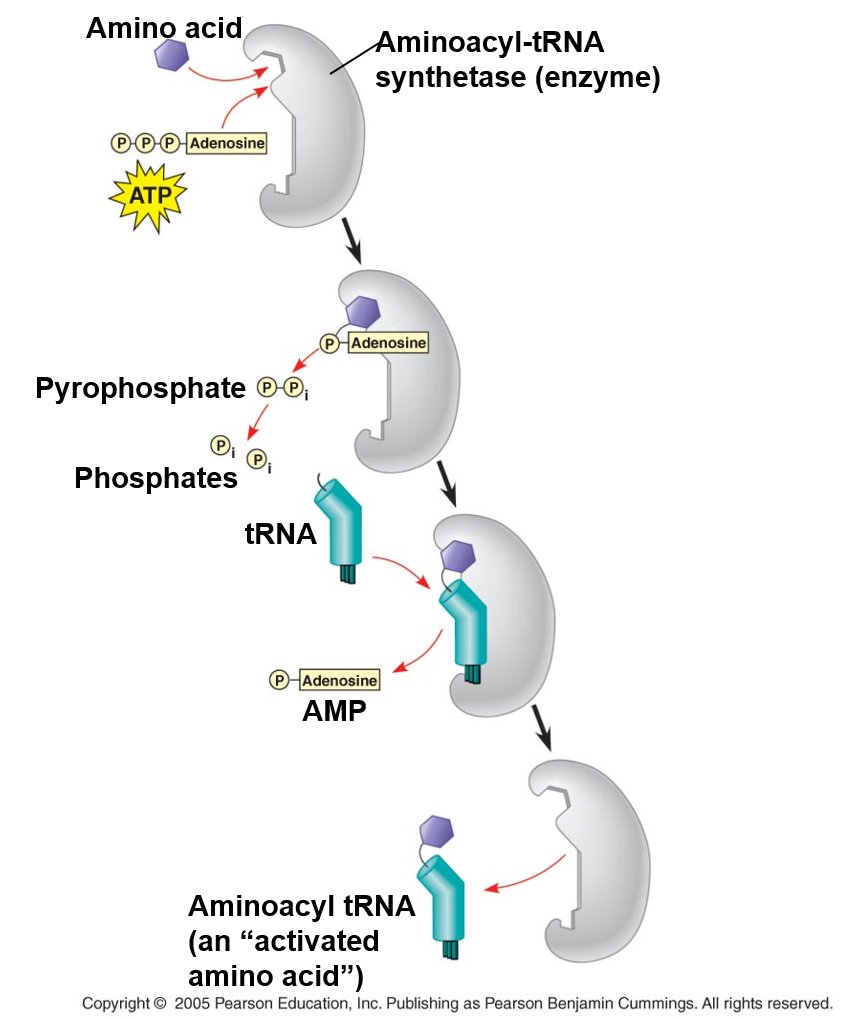
What are the two recognition steps that must occur in order for translation to be accurate?
- There must be a correct match between a tRNA and amino acid by the aminoacyl-tRNA synthase enzyme.
- There must be a correct match between the anticodon of the tRNA to the mRNA codon.
Look at this picture and have a basic understanding of how an amino acid is bound to tRNA.
Do it
How do ribosomes work with tRNA and mRNA in protein synthesis?
They facilitate the coupling of tRNA anticodons with their complementary mRNA codons.
What does a ribosome consist of?
Two ribosomal subunits: one large and one small
Ribosomal RNA (rRNA)
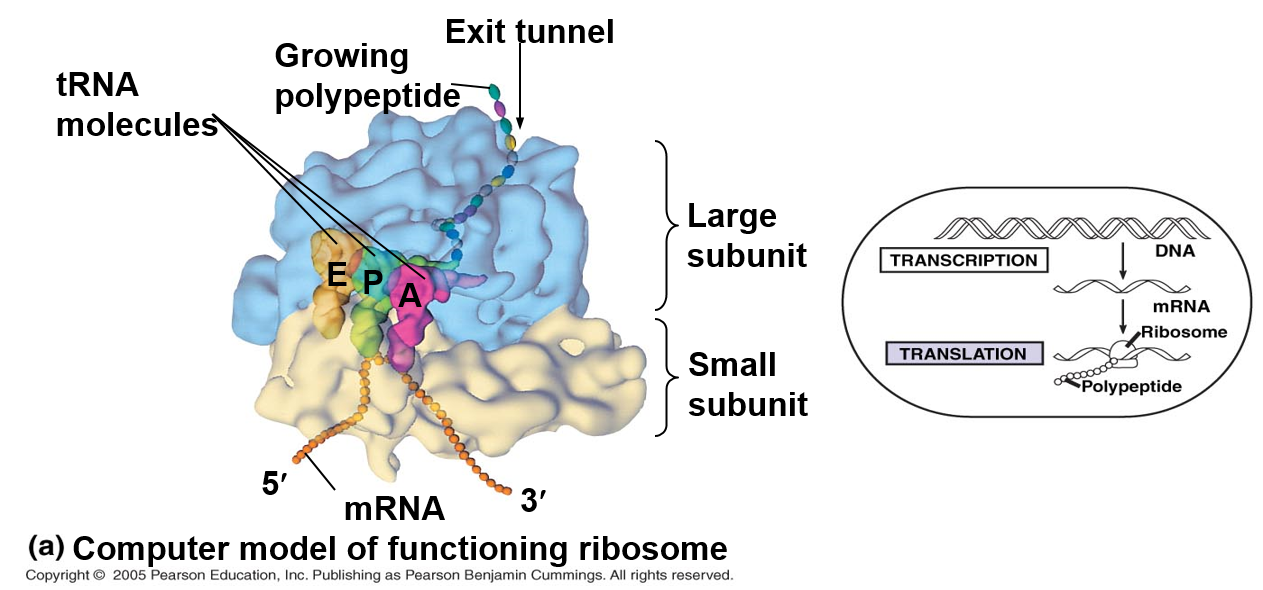
What are the three binding sites a robosome has for tRNA and their basic function?
P - holds the tRNA that carries the growing polypeptide chain
A - holds the tRNA that carries the next amino acid to be added to the chain
E - the exit site, tRNA leave the ribosome at this site.
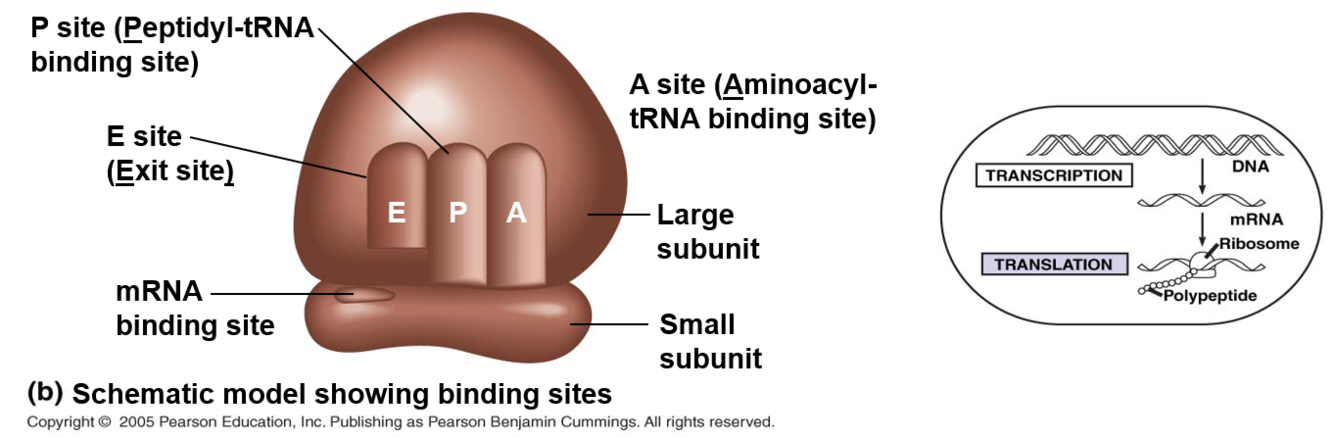
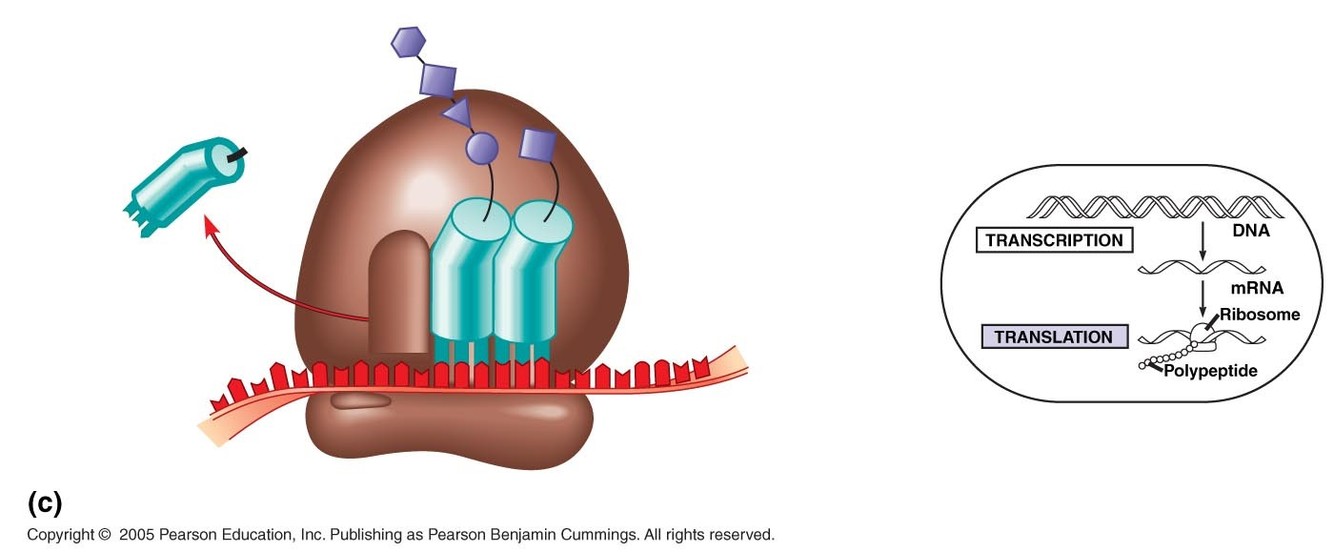
Have an understanding of this picture of a ribosome with tRNA and mRNA attached.
DO IT
What are the three stages of translation? Which two steps may require energy? What is used as the source of energy?
- initiation (may use energy in form of GTP)
- elongation (may use energy in form of GTP)
- termination (use energy in form of GTP to dissociate ribosomal assembly)
Do all three stages of translation require cofactors to aid in the process?
YES
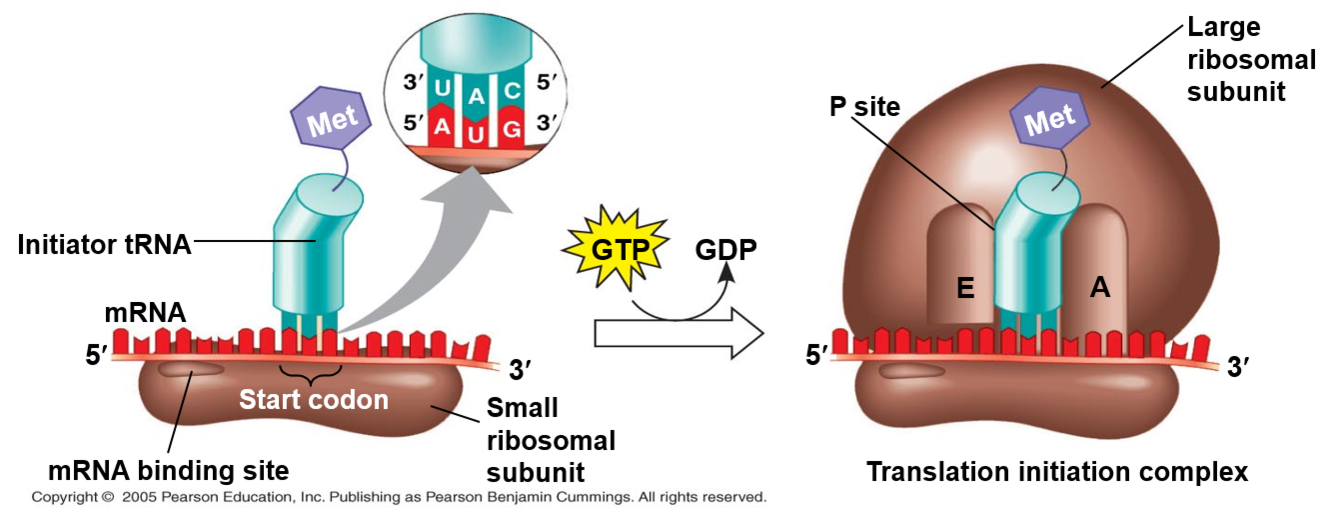
Describe the initiation stage of translation, this can be described in three steps.
- a small ribosomal subunit binds with mRNA and a special initiator tRNA (has methianine attached)
- the small subunit moves along the mRNA until it reached the start codon (AUG)
- Initiation factors (proteins) bring the large subunit and initiator tRNA takes up the P site of the large subunit.
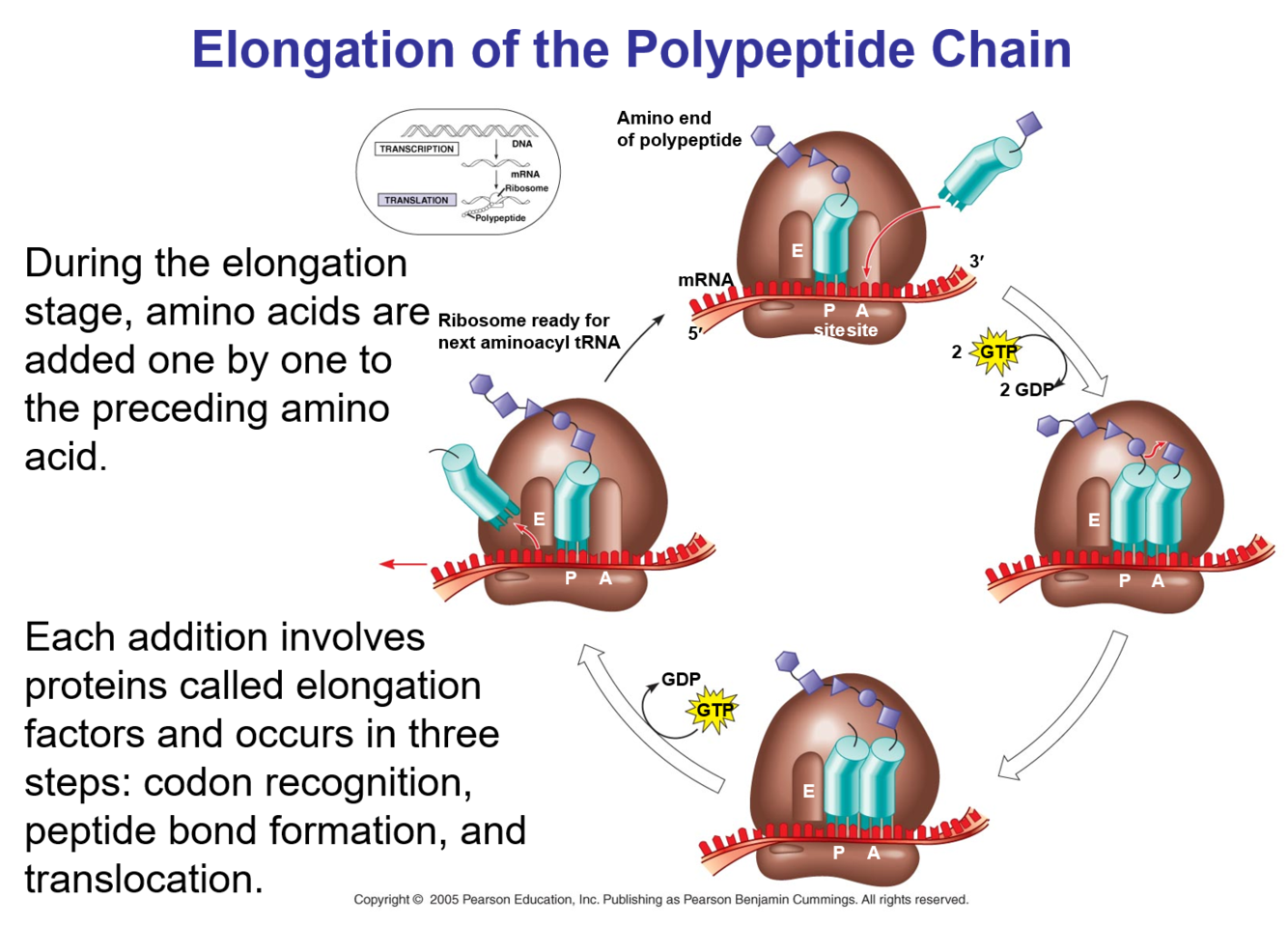
Describe the process of elongation in regards to translation. This is also described in a series of 3 steps.
- codon recognition - anticodon of incoming aminoacyl tRNA pairs with mRNA base sequence at the A site. (GTP hydrolysis makes this more efficient)
- Peptide bond formation - carboxyl end of elongated strand of amino acids in P site tRNA forms peptide bond with the amino group of new amino acid in A site on its tRNA. At this point the elongated strand is briefly at the A site.
- Translocation - robosome translocates the tRNA in the A site to the P site. At the same time the initial tRNA that was in the P site that is now empty of amino acids is moved to the E site where it is released. As the tRNAs are trnaslocated the mRNA moves alond with them because the tRNAs are bound to it. this exposes the next codon in the A site so the process can be repeated.
EACH ADDITION IS FACILITATED BY PROTEINS CALLED ELONGATION FACTORS.
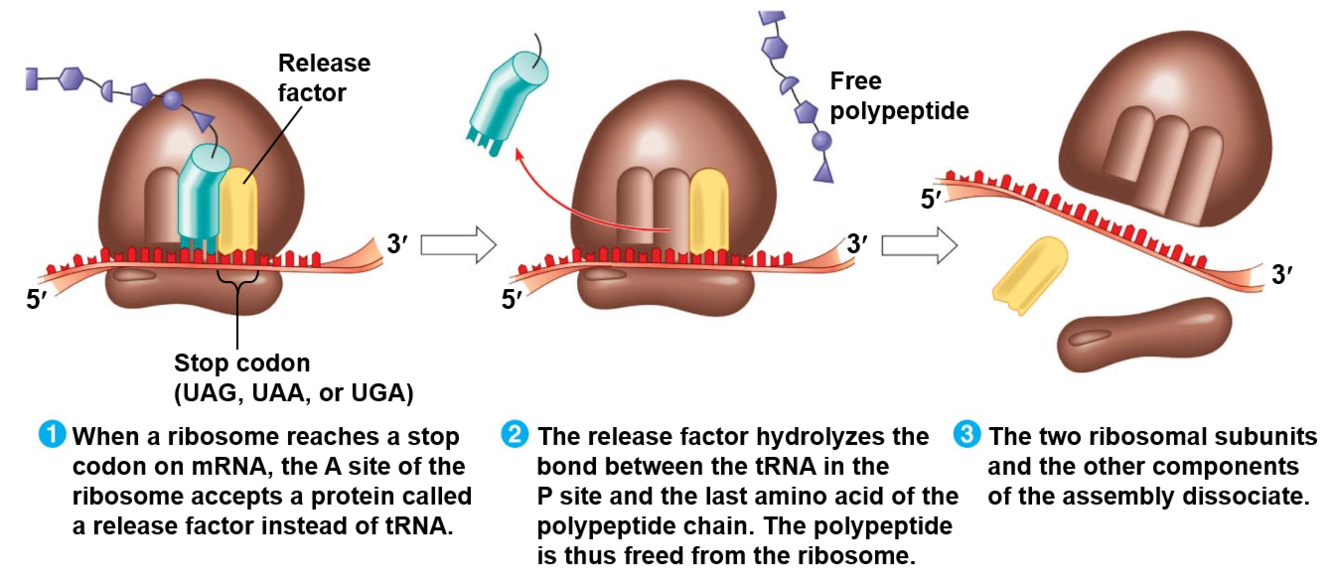
Describe the process of termination in translocation. This is also described in a 3 step sequence.
- Ribosome reached stop codon on mRNA. The A site then accepts a release factor instead of a tRNA at this point.
- The release factor hydrolyzes the bond between the P site tRNA and the last amino acid of its polypeptide chain. Freeing the polypeptide and tRNA from the ribosome.
- The two ribosomal subunits and other components dissociate with the help of GTP hydrolysis
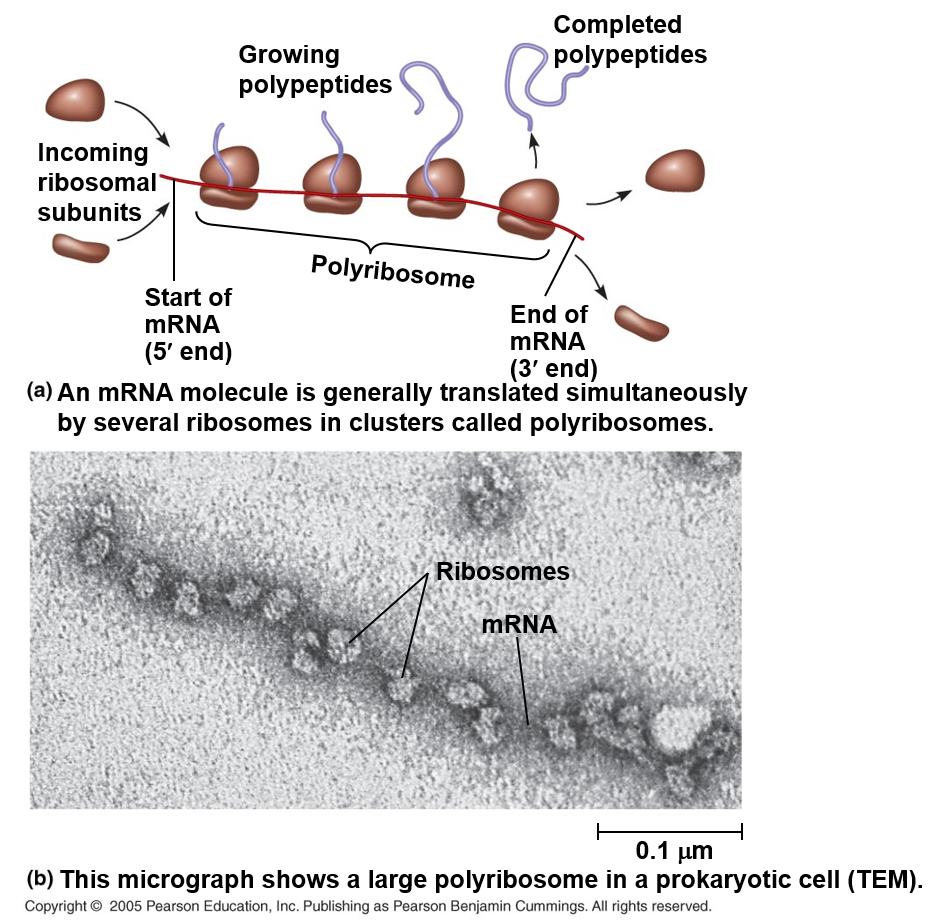
Can multiple ribosomes translate the same mRNA simultaneously? What does this form? Is there an advantage to this?
YES
This is called a polyribosome.
The advantage is many polypeptides can be made very quickly.
After translation, is a polypeptide chain ready to be considered a functional protein?
Most of the time, NO
They need to be modfied after translation
What happens after a polypeptide becomes a completed protein?
They are targeted to a specific site in the cell.
Does a polypeptide chain coil and fold into a 3D molecule with secondary and tertiary structure during and after its synthesis?
YES
What dictates the primary structure of the proteins (polypeptide chain)? What effect does this have on the conformation of the protein?
The gene
The determination of the primary structure indirectly determines the conformation of the polypeptide chain.
What are some examples of posttranslational modifications that may be required before proteins can do their job?
attachment of sugars, lipids, phosphate groups, etc..
What are the two types of ribosomes that may be found in a cells? What are they based on?
Based on their location:
Free ribosomes - found in cytosol and mainly produce proteins that function and stay in the cytosol
Bound ribosomes - Bound to the ER or nuclear envelope and produce proteins of the endomembrane system and proteins that are secreted from the cell (insulin, etc)
Can free and bound ribosomes switch roles? Does this mean they are identical?
YES and YES
free can become bound and bound can become free