- What is the Motor Carrier or DOT Type?
- What does this trailer mainly carry?
- What are some of the structural characteristics of this trailer?
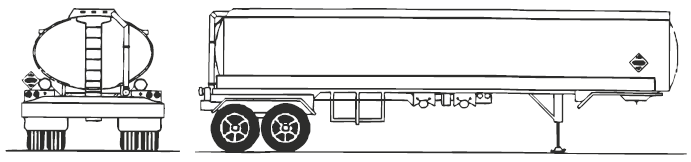
- MC306 or DOT406 Nonpressure Cargo Tank
- Flammable and combustible liquids as well as poison liquids.
- Characteristics
Usually oval shaped tank as seen from rear.
Nonpressure liquids. < 3 psig.
Over 90% are made from 3/16” Aluminum.
Can hold up to 9,000 gallons (8200 gal in NC).
Usually has several compartments separated by bulkheads capable of carrying different grades of product.
Discharge piping usually located along “belly” of tank.
May have a cabinet enclosing the control valves.
- What is the Motor Carrier or DOT Type?
- What does this trailer mainly carry?
- What are some of the structural characteristics of this trailer?
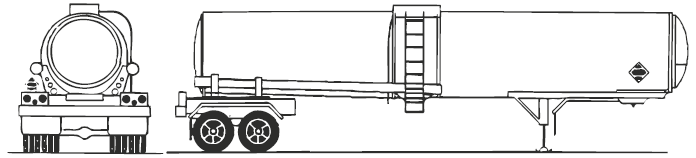
- MC307 or DOT407 - Low Pressure Cargo Tank
- Flammable and combustible liquids, mild corrosives, some Class B poisons, variety of other hazardous and non-hazardous liquids.
- Characteristics
Usually round or horseshoe shape from rear.
Minimum design pressure of not less than 25 psig and typically not more than 40 psig.
Most are made of stainless steel and are insulated to protect temperature sensitive commodities.
Usually has only one large compartment, but every compartment in excess of 2500 gal must have a manhole.
Discharge piping may be located at rear or bottom of the tank with tank bottom sloping towards the valve.
Some tanks may have external visible stiffening rings hidden by insulation and stainless steel jacketing.
- What is the Motor Carrier or DOT Type?
- What does this trailer mainly carry?
- What are some of the structural characteristics of this trailer?
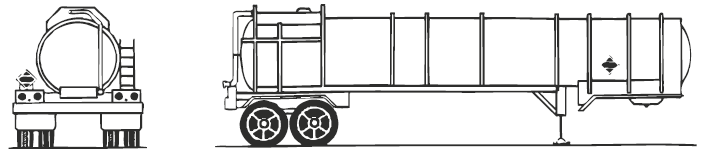
- MC312 or DOT412
- Corrosive Liquids
- Characteristics
Described as pencil or cigar tube in appearance with large external stiffening rings.
5 to 25 psig.
Most made out of mild steel but some may be made out of stainless steel or aluminum.
Can hold up to 6,000 gallons.
May have external insulation as well as internal lining of rubber, teflon, glass or other material.
Discharge piping traditionally located at top of tank but may also come from rear of tank.
Will have at least two valves to control flow.
- What is the Motor Carrier or DOT Type?
- What does this trailer mainly carry?
- What are some of the structural characteristics of this trailer?
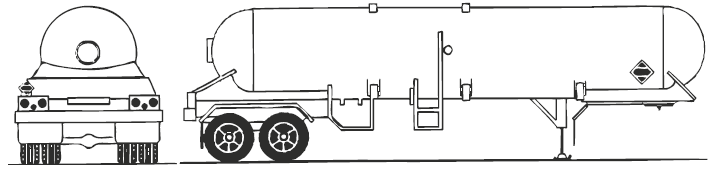
- MC331 Pressure Cargo Tank
- Gases liquefied by compression- Ex: Liquefied Petroleum Gas (LPG), anhydrous ammonia and others.
- Characteristics
Circular cross section seen from rear with rounded heads on front and rear.
High pressure liquefied gases. 100 to 500 psig. Usually normal design pressures of 265 psig.
Most are made from steel min. thickness of 3/16” to 3/8” with heads as thick as 1/4”.
Manholes are bolted shut.
Discharge piping and valves located at rear of tank.
Upper two thirds of tanks must be painted white or another reflective color or covered by a non-tarnishing jacket.
Will have safety relief valves located at different locations along tank.
- What is the Motor Carrier or DOT Type?
- What does this trailer mainly carry?
- What are some of the structural characteristics of this trailer?
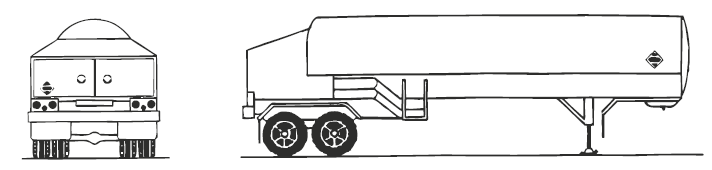
- MC338
- Cryogenic Liquids
- Characteristics
Tank within a tank usually made of steel with outer tank made out of aluminum.
Cryogenic liquids. >22 to 500 psig.
Cargo temperature usually -130°F or lower.
As cargo warms it builds up pressure that is released to atmosphere which in turn cools the cargo.
Should be handled like pressure cargo tanks.
Cabinet enclosing and protecting the control valves, piping and pumps located at rear.
- What is the Motor Carrier or DOT Type?
- What does this trailer mainly carry?
- What are some of the structural characteristics of this trailer?
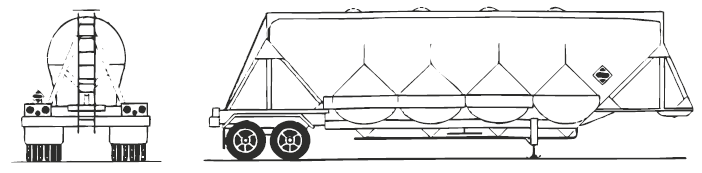
- Pneumatically Offloaded Hopper/Dry Bulk
- Dry solid granular materials. Fertilizer, oxidizers, plastics, cement, grain, flour.
- Characteristics
Various shaped tanks with characteristic hopper or funnel shapes on bottom.
May be very heavy and easily overturned.
Must be able to withstand overpressuring while offloading material pneumatically.
- What is the name of this trailer?
- What does this trailer carry?
- What are some of the structural characteristics of this trailer?
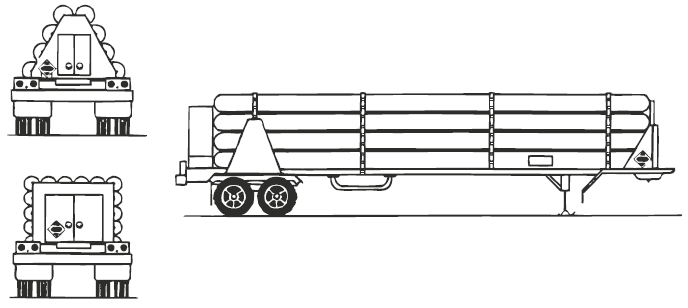
- Compressed Gas/Tube Trailer
- Various Bulk Compressed Gases
- Characteristics
Numerous “torpedo” like tubes within a supportive rack.
Pressures upwards of 3000 to 5000 psi.
Cabinet located at rear of trailer housing the connections and valves for tanks.
Designed to be left at end point of use connected for extended period of time.
- What is the name of this rail car?
- What does this rail car mainly carry?
- What are some of the structural characteristics of this rail car?
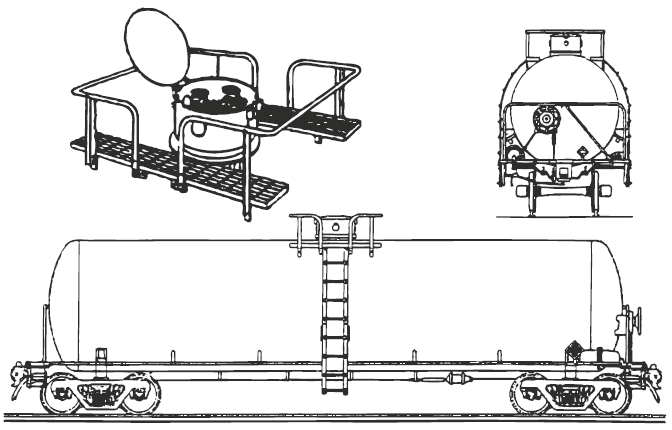
- Pressure Tank Car
- Flammable and nonflammable compressed gases or poisonous compressed gases. May also carry dangerous liquids such as LPG, Chlorine, Acrolein, Ethylene Oxide, Pyrophoric Liquids, etc.
- Characteristics
Cylindrical in shape with convex heads.
Fittings, gauges and valves located within an protective enclosed manway located at top of tank.
Top loading with pressures ranging from 100 to 600 psig.
May carry between 4,000 to 45,000 gallons.
Pressure tank cars may be equipped with insulation or jacketed thermal protection.
Pressure cars that do not have insulation or thermal protection will have at least the top two-thirds of the tank painted white.
Pressure cars carrying flammable gases and anhydrous ammonia may have shields on the lower portions of their heads protecting them from puncture.
- What is the name of this rail car?
- What does this rail car mainly carry?
- What are some of the structural characteristics of this rail car?
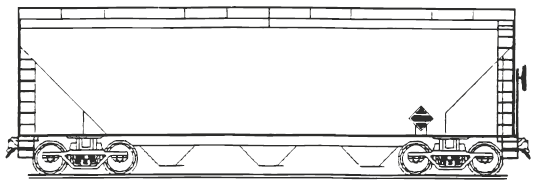
- Hopper Car/Pneumatically Unloaded Hopper Car
- Granulated material
- Characteristics
Various shaped tanks with characteristic hopper or funnel shapes on bottom.
Product is forced out by tipping the entire car, out the bottom using gravity or by pressurized air.
Pneumatically unloaded pressure cars are built to withstand pressures ranging from 20-80 psig.
May carry up to 100 tons of product.
- What is the name of this rail car?
- What does this rail car mainly carry?
- What are some of the structural characteristics of this rail car?
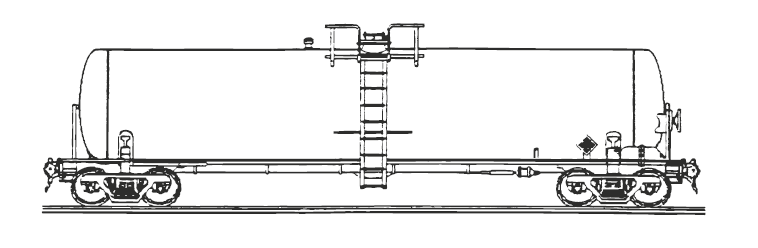
- Non-Pressure Tank Car
- Liquids and molten solids- Flammable, Combustible, Oxidizers, Organic Peroxides, Liquid Poisons, Corrosives, Non-Hazardous Liquids.
- Characteristics
Cylindrical in shape with convex heads.
Manway or expansion dome located on top will have exposed fittings NOT protected by enclosure.
Capacities ranging from 4,000 to 45,000 gallons.
Tank test pressures range from 35 to 100 psig.
Tanks may be separated into several compartments with each compartment having its own manway/expansion dome and fittings.
Cargo must have low vapor pressures (<25psig to 40psig at 105°F to 115°F)
May or may not be insulated.
- What is the name of this rail car?
- What does this rail car mainly carry?
- What are some of the structural characteristics of this rail car?
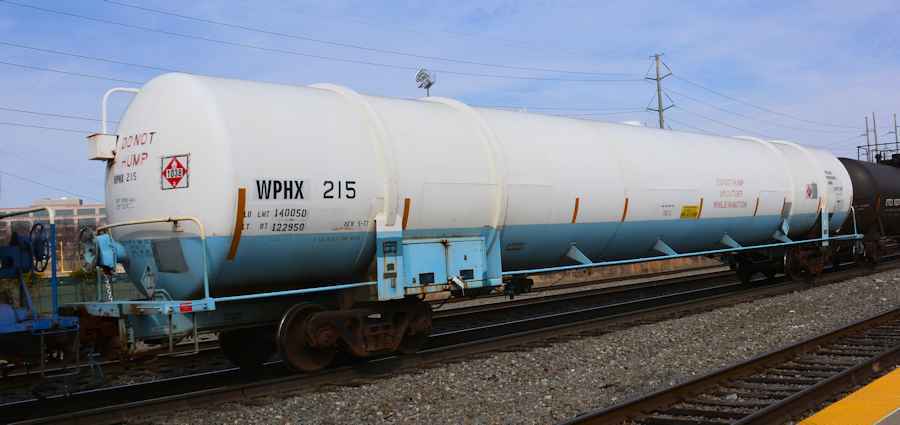
- Cryogenic Liquid Tank Car
- Liquefied gases: Argon, Hydrogen, Ethylene, Nitrogen, Oxygen.
- Characteristics
Identified from other tank cars by absence of exposed fittings and enclosed manway/expansion dome on top of tank.
Lower and longer in appearance compared to other tank rail cars.
Tank within a tank. Space in between is placed under a vacuum and filled with insulating material.
Designed to maintain refrigerated gases in liquefied state for up to 30 days.
Loading/unloading fittings in enclosures located at either end or at diagonal corners.
A few cryogenic liquid tank cars are secured in box car enclosures and are called XT boxed tanks. All valves and fittings are located inside the box car doors.
- What is the generic name for this type of container?
- Name the 5 DOT types for this style of container?
- Name the 5 International (IMO) types for this style of container?
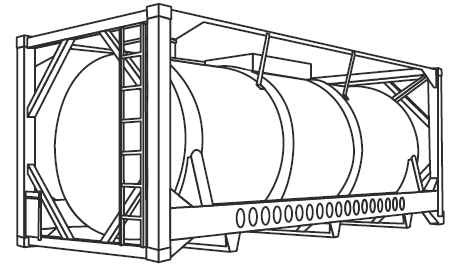
- Intermodal portable tank
- DOT: IM-101, IM-102, Spec 51, Spec 51L, Tube Module
- International: IMO type 1, IMO type 2, IMO type 5, IMO type 7, Tube Module
An IM-101 or IMO type 1 container is built to withstand pressures ranging from?
25.4 psig to 100 psig
An IM-102 or IMO type 2 container is built to withstand pressures ranging from?
14.5 psig to 25.4 psig
A DOT Spec 51 or IMO type 5 container is built to withstand pressures ranging from?
100 psig to 500 psig
A DOT Spec 51L or IMO type 7 container is built to carry which type of cargo?
Cryogenically liquefied gases such as argon, oxygen and helium.
A DOT IM 101 or IMO type 1 container is built to carry which type of cargo?
Non-hazardous and hazardous materials including toxic, corrosive and flammables with flashpoints below 32°F
A DOT IM 102 or IMO type 2 container is built to carry which type of cargo?
Foods and food grade commodities like juice and whiskey, industrial solvents and alcohols, some corrosives, pesticides, insecticides, resins, and flammables with flashpoints between 32°F and 140°F.
A DOT Spec 51 or IMO type 5 container is built to carry which type of cargo?
Gases liquefied under pressure. LPGas, anhydrous ammonia. Other liquids: motor fuel anti knock compound, aluminum alkyls.
A intermodal tube module can be expected to have pressures as high as?
5,000 psi
What is an intermodal tank container?
A tank or cylinder encased in an ISO engineered frame of steel that protects the tank and provides for the ability to stack, lift and secure the container.
Ordinarily what is the maximum capacity in gallons of an intermodal tank?
6,340 gallons (24,000 liters)
What are some of the design characteristics of the tanks in intermodal containers?
- 90% are built of stainless steel.
- Aluminum and magnesium alloy tanks are built but can not be used in water transport mode.
- For steel tanks the min. thickness for non-regulated commodities is 1/4” and regulated commodities is 3/8”
- For stainless steel tanks min. thickness for non-regulated commodities is slightly less than 1/8” and for regulated commodities is slightly less than 3/16”
There are two types of supporting frames that protect intermodals what are they and describe the differences.
BEAM- Frame structures located only at the ends or heads of the tank. Easily identified by two K’s back to back in framework. Backwards K on one head + Forward K on opposite head of tank.
BOX TYPE- Encloses the tank in a cage-like framework. Identified by upside down A’s in framework.




