Traumatic Brain Injury (TBI) classification
TBI an be classified by both severity and cause
Severity
- Mild
- GCS 13-15
- Also:
- LOC <30mins
- PTA <1 day
- Moderate
- GCS 9-12
- Also:
- PTA 1-7 days
- LOC 0.5-24 hours
- Severe
- GCS 3-8
- Also:
- PTA >7 days
- LOC >24 hours
Cause
- Primary
- fracture
- haemorrhage
- DAI
- Secondary
- hypoperfusion and hypoxia
Management of ICP
Needs to be below 20mmHg
nursing at 30 degrees
check collar (or remove)
EVD
Mannitol
Hyperventillation to PaCO2 of 30-35mmHg
Decompressive craniectomy
Anatomy of an underwater sealed drain
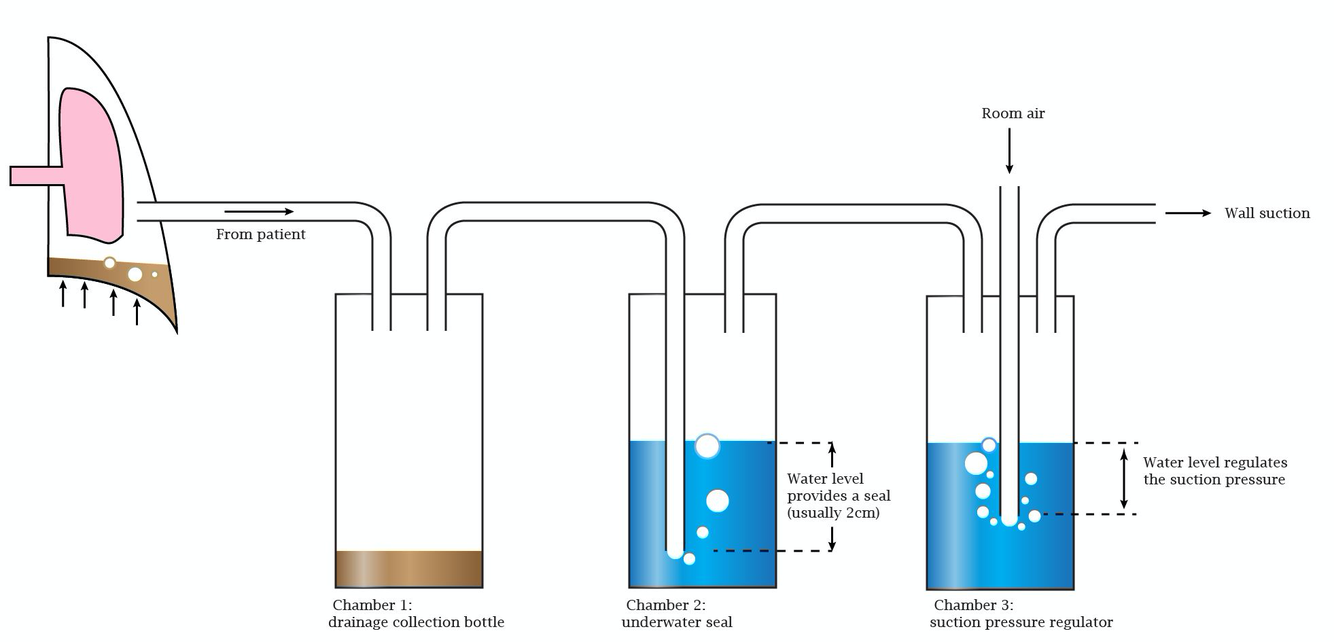
Considerations of extent of trauma in animal bites
May represent blunt and penetrating trauma
- Blunt
- Animals limbs
- Crushing with jaws
- Body weight
- Rotational distortion injuries
- Penetrating
- Amputation
- Penetration of body cavities
- Transmisable disease
- Bacterial
- Rabies (Rhabdovirus)
- Viral
Dog bite management
TRAUMA and EMST management, ABCDE approach
Tetanus
Antibiotics with Augmentin
- or cefoxitin
- consider pip-taz in severe infection
Wound care- the most important intervention for both bacterial and zoonotic infections e.g rabies
- clean
- debride
- healing by primary, delayed primary or secondary intention depending on wound and site
Fight bite
Human bite injury to the extensor surface of the metacarpophalangeal joint.
- due to striking closed fist against teeth
- high risk injuries
- NB: often appear minor
- tendon and joint are often involved
- secondary infection can be devastating to hand function.
Mammalian bite bacteriology
Pasteurella (most common esp canine and feline)
Staph species
Strep species
Humans: Eikenella corrodens
Name the key organism in human bite infections
Eikenella corrodens
Neck trauma zones
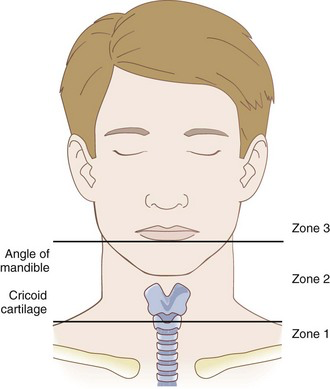
AAST liver injury grading:
Grade I
- Haematoma: subcapsular, <10% surface area
- Laceration: capsular tear, <1 cm parenchymal depth
AAST renal injury grading
Grade I
grade I
- subcapsular hematoma or contusion, without laceration
AAST renal injury grading
Grade II
grade II
- superficial laceration ≤1 cm depth not involving the collecting system (no evidence of urine extravasation)
- perirenal hematoma confined within the perirenal fascia
AAST renal injury grading
Grade III
grade III
- laceration >1 cm not involving the collecting system (no evidence of urine extravasation)
- vascular injury or active bleeding confined within the perirenal fascia
AAST renal injury grading
IV
grade IV
- laceration involving the collecting system with urinary extravasation
- laceration of the renal pelvis and/or complete ureteropelvic disruption
- vascular injury to segmental renal artery or vein
- segmental infarctions without associated active bleeding (i.e. due to vessel thrombosis)
- active bleeding extending beyond the perirenal fascia (i.e. into the retroperitoneum or peritoneum)
AAST renal injury grading
Grade V
grade V
- shattered kidney
- avulsion of renal hilum or laceration of the main renal artery or vein: devascularisation of a kidney due to hilar injury
- devascularised kidney with active bleeding
AAST splenic injury grading
All grades
grade I
- subcapsular hematoma <10% of surface area
- parenchymal laceration <1 cm depth
- capsular tear
grade II
- subcapsular hematoma 10-50% of surface area
- intraparenchymal hematoma <5 cm
- parenchymal laceration 1-3 cm in depth
grade III
- subcapsular hematoma >50% of surface area
- ruptured subcapsular or intraparenchymal hematoma ≥5 cm
- parenchymal laceration >3 cm in depth
grade IV
- any injury in the presence of a splenic vascular injury* or active bleeding confined within splenic capsule
- parenchymal laceration involving segmental or hilar vessels producing >25% devascularisation
grade V
- shattered spleen
- any injury in the presence of splenic vascular injury* with active bleeding extending beyond the spleen into the peritoneum
AAST splenic injury grading
Grade I
grade I
- subcapsular haematoma <10% of surface area
- parenchymal laceration <1 cm depth
- capsular tear
AAST splenic injury grading
Grade II
Grade II
- subcapsular haematoma 10-50% of surface area
- intraparenchymal haematoma <5 cm
- parenchymal laceration 1-3 cm in depth
AAST splenic injury grading
Grade III
Grade III
- subcapsular haematoma >50% of surface area
- ruptured subcapsular or intraparenchymal haematoma ≥5 cm
- parenchymal laceration >3 cm in depth
AAST splenic injury grading
Grade IV
Grade IV
- any injury in the presence of a splenic vascular injury or active bleeding confined within splenic capsule
- parenchymal laceration involving segmental or hilar vessels producing >25% devascularisation
AAST splenic injury grading
Grade V
Grade V
- shattered spleen
- any injury in the presence of splenic vascular injury with active bleeding extending beyond the spleen into the peritoneum
AAST pancreatic injury grading
grade 1:
- haematoma with minor contusion/laceration but without duct injury
grade 2:
- major contusion/laceration but without duct injury
grade 3:
- distal laceration or parenchymal injury with duct injury
grade 4:
- proximal (i.e. to the right of the superior mesenteric vein) laceration or parenchymal injury with an injury to bile duct/ampulla
grade 5:
- massive disruption of the pancreatic head
Injury Severity Score (ISS) score
Score is intended primarily for research but does correlate with LOS, ICU days so may have wider uses esp in ICU for prognostication
Score 0-75 points
Calculated mathematically from simple parameters
- 6 body regions
- Head and Neck
- Facial
- Chest
- Abdomen
- Extremity
- External
- Graded:
- No injury
- Minor
- Moderate
- Serious
- Severe
- Critical
- Unsurvivable
How can blast injuries be classified?
Primary
- Wounding of air filled viscera as a result of blast wave
Secondary
- Penetrating trauma from bomb fragments and other projectiles
Tertiary
- Casualties propelled by blast- usual blunt injury mechanisms
Quaternary
- Crush from structural collapse
- Burns
- Other mechanisms not classed as primary, secondary, tertiary

-
Small Intestine59
-
Appendix to Anus142
-
Oesophagogastric108
-
Skin and hernia81
-
Hepatopancreaticobiliary166
-
Breast, endocrine, head and neck211
-
Imaging of import and archetypic anatomy137
-
Pathophysiology pearls55
-
Trauma39
-
Pharmacology, devices, perioperative care and nutrition68
-
Genitourinary and vascular18
-
Soft tissue tumours and the periphery13
-
Ethics, statistics and professionalism8



