What is special about the way the trochlear nerve (CNIV) emerges from the CNS?
only somatic efferent nerve to emerge from the posterior aspect of the central nerve system
Why is the course of the trochlear nerve in the brainstem unusual?
decussates before leaving the brainstem
What 1 muscle is supplied by the trohlear nerve?
superior oblique
Where is the trochlear nerve nucleus located?
anterior part of the periaqueductal grey matter at the level fo the inferior colliculus (caudal to III nerve nucleus) in line with the other oculomotor nuclei
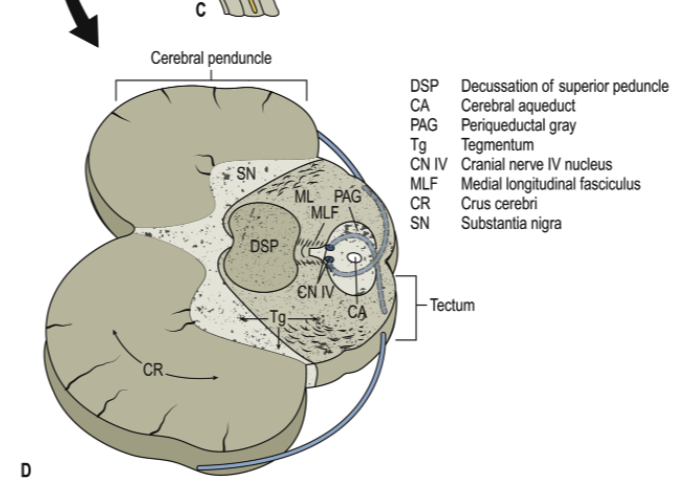
What are 5 steps to the course of CNIV from its origin between the intracranial portion emerges from the brainstem?
- fibres pass from nucleus anterior and laterally towards tegmentum
- turn and pass posteriorly around periaqueductal grey matter
- pass into superior medullary velum (part of roof of fourth ventricle)
- decussate in SMV
- emerge from posterior surface of brainstem in posterior cranial fossa
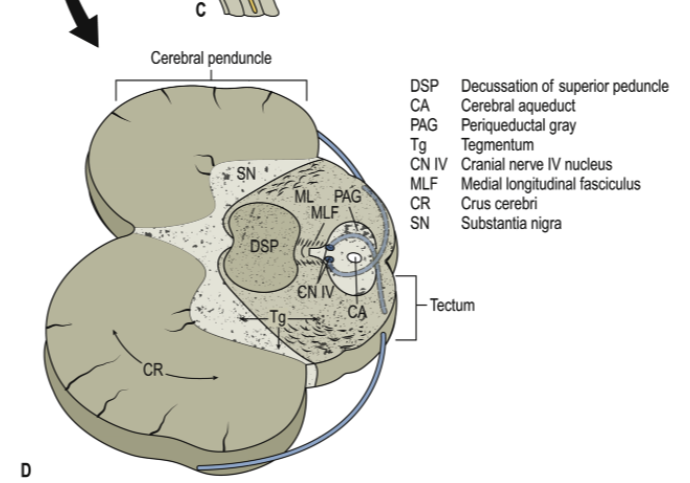
How many cranial nerves decussate completely and which are they?
CNIV is the only one
Where on the posterior surface of the brainstem do CNIV slender nerves emerge?
caudal to the inferior colliculi on dorsal surface of the brainstem
What are 4 stages of the course of CNIV from emerging on the posterior aspect of the brainstem to entering the cavernous sinus?
- emerge below inferior colliculi
- each nerve winds around crura of the midbrain (cerebral peduncles), above superior cerebellar artery and pons, and below posterior cerebral artery
- continue anteriorly immediately under free edge of tentorium cerebelli
- pierces this dura and enters lateral wall of cavernous sinus, beneath oculomotor nerve
What 3 structures do the trochlear nerves run between after emerging on the posterior aspect of the brainstem?
above superior cerebellar artery and pons
below posterior cerebral artery
How do the trochlear nerves enter the cavernous sinus?
after piercing dura of tentorium cerebelli, enters lateral wall of cavernous sinus beneath CNIII
What is the course of the CNIV inside the cavernous sinus to reach the orbit?
- enters lateral wall of cavernous sinus under CNIII
- passes upwards, coming to lie above oculomotor nerve
- enters orbit outside tendinous ring in lateral part of superior orbital fissure
How does CNIV enter the orbit?
from cavernous sinus, enters orbit outside the tendinous ring in the lateral part of the superior orbital fissure
What is the intraorbital course of CNIV?
passes forwards above origin of levator palpebrae superioris close to the bone, to enter upper free edge of superior oblique
How frequently is the trochlear nerve paralysed alone?
rarely
At what 2 points is the trochlear nerve particularly vulnerable?
- at posterior exit from brainstem
- as it winds round midbrain
Lesions in which 2 regions causing compression may affect the trochlear nerve?
- undersurface of the tentorium
- cavernous sinus
What are 3 key symptoms of superior oblique paralysis due to trochlear nerve lesions?
- diplopia when looking down
- difficulty looking down when eye is adducted, because superior oblique is only depressor in the adducted state
- patients carry head tilted to non-affected side with chin lowered
Why do trochlear nerve lesions cause difficulty looking down in the adducted state?
in the adducted state, superior oblique is the only depressor
Why do patients characteristically carry the head tilted to non-affected side, chin down in CNIV lesions?
to compensate for overaction of inferior oblique producing unopposed torsion on eye
In which structure in the brainstem is the trochlear nucleus found?
midbrain (level of inferior nucleus)



