Kidney function
- Tubular function
- Curriculum Feedback
- Production of urine
- Selective reabsorption of contents to be retained
How much water daily:
How much water 2L 70 kg man ( a lot of fluid comes from food)
Sometimes over drinking water can lead to urinary tract infection
Loose fluid in
- Sweat
- Exhalation
- urine
Osmolarity
“a measure of the osmotic pressure exerted by a solution across a perfect semi-permeable membrane”
Dependent on the number of particles in a solution and NOT the nature of the particles
- If we have a 1mmol/L of Na2HPO4 , this is the equivalent of 3 mosmoles/L
- This is made up from 1 mosmol/L HPO42- and 2 mosmol/L of Na+
- We add all the concentrations together and each ions is counted separately
- Osmolarity = All the concentrations of the different solutes (measured in mmol/l) added together. Each ion is “counted” separately
- Osmolarity = All the concentrations of the different solutes (measured in mmol/l) added together. Each ion is “counted” separately
Normal plasma osmolarity = 285-295 mosmol/l
Urine osmolarity = 50 – 1200 mosmol/l
Renal tubular wall
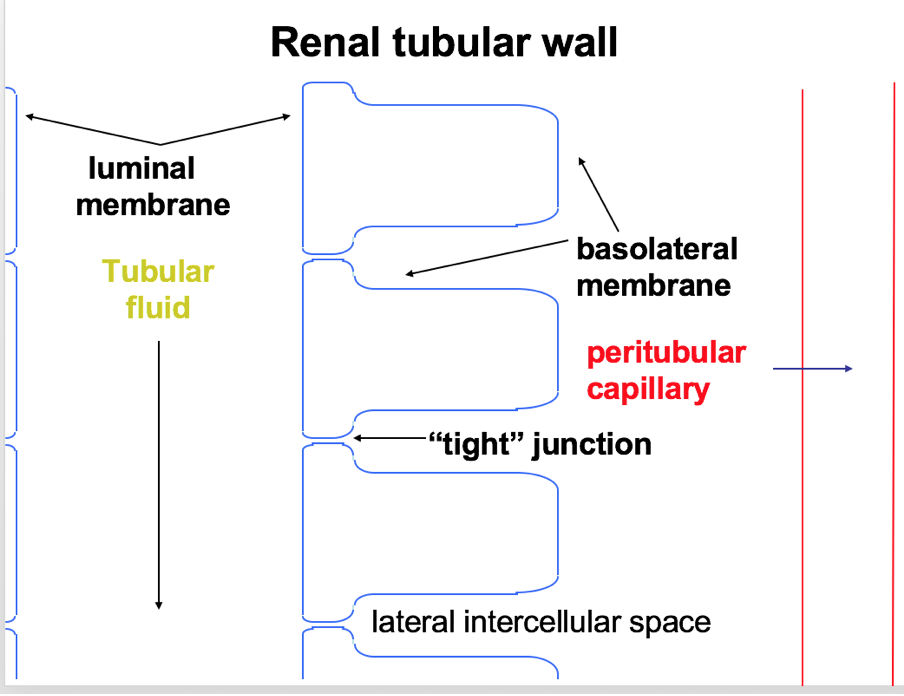
The nephron is covered with epithelial cells:
- across tubular wall
- tight junctions
- basolateral membrane facing outwards towards peritubular capillary
- luminal membrane facing the lumen where the tubular fluid is
- reabsorption occurs from capillaries to lumen
- secretion occurs from lumen to capillaries
- reabsorption and secretion occur either in a transcellular (through cells) or a paracellular pathway (between the cells) -> depends on how tight the junctions are
Types of transport in the tubules:
- Active transport: limited by protein transporters (hydrophilic compounds)
- Passive transport: moved through membranes just dependent on solute concentrations (unlimited)
- Counter-transport (limited)
- Co-transport (limited)
Transport maxima
- There is always a maximum rate of transport eg.
– we’ve hit our maximum and we cannot reabsorb any more glucose and hence we excrete it – DIABETES MELLITUS
(also happens in high vitamin B)
Regulation of a passive uptake system
- store channels inside the cell when we don’t want lots of transport
- move them to the membrane when we do
Water transport:
- H2O will move through tight junctions if junctions are not too tight
- it will go through aquaporins
- Water gets reabsorbed passively by osmosis in response to build up of Na in intercellular spaces
Transporters are located in different parts of the nephron. Most of the Na transporters are located in the proximal tubule, while fewer are spread out through other segments.
Filtration as a mechanism of urine production
Filtration
- Blood passing through glomerulus is filtered (under high pressureà hyperfiltration )
- Filtrate consists of all components that have a molecular weight <~50 000 molecular weight (this is because our organism doesn’t want to lose the cells that took a lot of energy to produce)
- Key processes to keeping key molecules in the organism
Renal artery comes of the aorta -> short distance, high pressure structure.
Arterioles, therefore, experience high pressure and in case of an individual that has high blood pressure these arterioles become damaged
Therefore, if the filtering processes is damaged and we start to get proteins in our urine
Afferent is a big structure while the efferent arteriole is very small resulting in a pressure gradient where the fluid is squeezed out the filtration system.
Components to the filter of the glomerulus
- high surface area -> lots of the capillaries
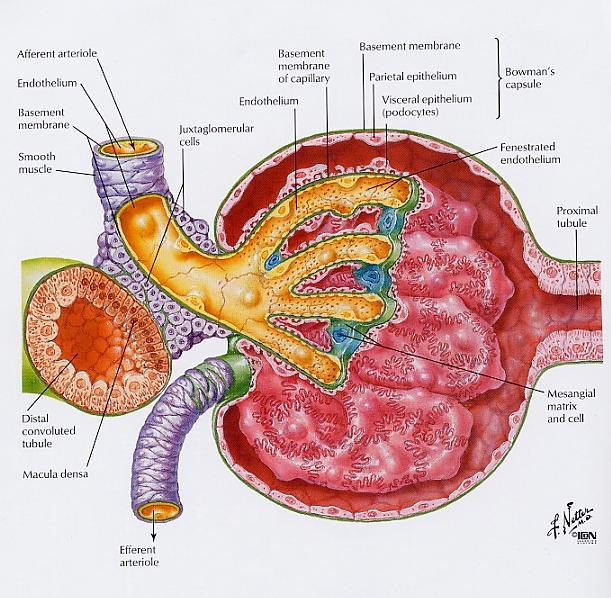
- the inner surface of the capillary is fenestrated epithelium (lots of dot in the endothelium since we can’t fluid to pass through it)
- Modified basal membrane allows things to filter through
- Outside the capillaries we have the Podocytes that provide the filter
The fluid which comes out the filtration in the glomerulus will be Isotonic (exactly the same concentration as the blood) and it will go to the proximal tubule
Renal corpuscle
Components
- Bowman’s capsule collects the fluid
- glomerulus consists of capillaries
- podocytes associated with glomerulus
Blood supply
at vascular pole of corpuscle
blood entering from the afferent arteriole, exit from the efferent arteriole(under high pressure)
Filtration barrier consists of
- Fenestrated epithelium in the capillary that has specialised basal lamina
- the filtration slits between foot processes of podocytes(allows passage of ions and molecules <~50 000)
Reabsorption and secretion as mechanisms of urine production
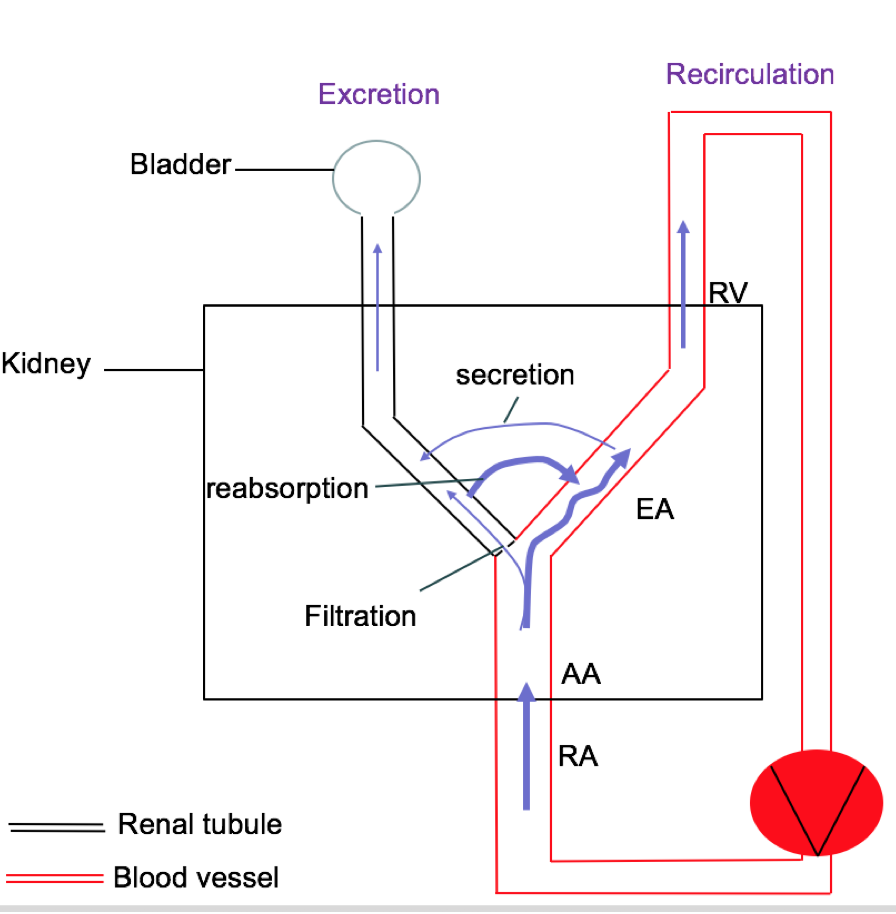
We produce urine by passive filtration, through a molecular sieve (glomerular filtration)
BUT
Can’t afford to lose all of the water and small molecules that pass through the filter
We filtrate them through a sieve and then reabsorb nutrients
- Renal artery brings blood to tubular system within the kidney
- Blood goes either to the right or left (image)
- 120ml/ minute go to the left
- A large portion of it is reabsorbed (99% of the ultra filtrate)
- Unwanted substances -> secreted (movement of solutes and water from the circulation to the nephron)
- Fluid (on the left) is excreted
- Fluid (on the right) enters renal vein and recirculates
- Need to maintain solute balance, plasma concentration, and pH
Specialize different parts of the nephron to perform specific tasks
Secretion
- Moves substances from peritubular capillaries into tubular lumen
- Like filtration, this constitutes a pathway into the tubule
- Can occur by diffusion or by transcellular mediated transport
- The most important substances secreted are H+ and K+
- Choline, creatinine, penicillin & other drugs also secreted
- Active secretion from blood side into tubular cell (via basolateral membrane) and from cell into lumen (via luminal membrane)
Proximal convoluted tubule
Proximal convoluted tubule:
a section of the renal tubule located in the kidney’s cortex that is responsible for the reabsorption of the majority of the ultrafiltrate
reabsorbs: water, urea (passively) sodium, chloride, calcium, potassium, phosphate, bicarbonate, glucose, amino acids, vitamin C (actively)
Reabsorption
If the fluid is not reabsorbed then you’ll be dead in 10 min
What we shouldn’t see in urine
- Glucose (should be completely absorbed)
- Proteins (should be re-absorbed by the proximal convoluted tubule)
- A lot of water
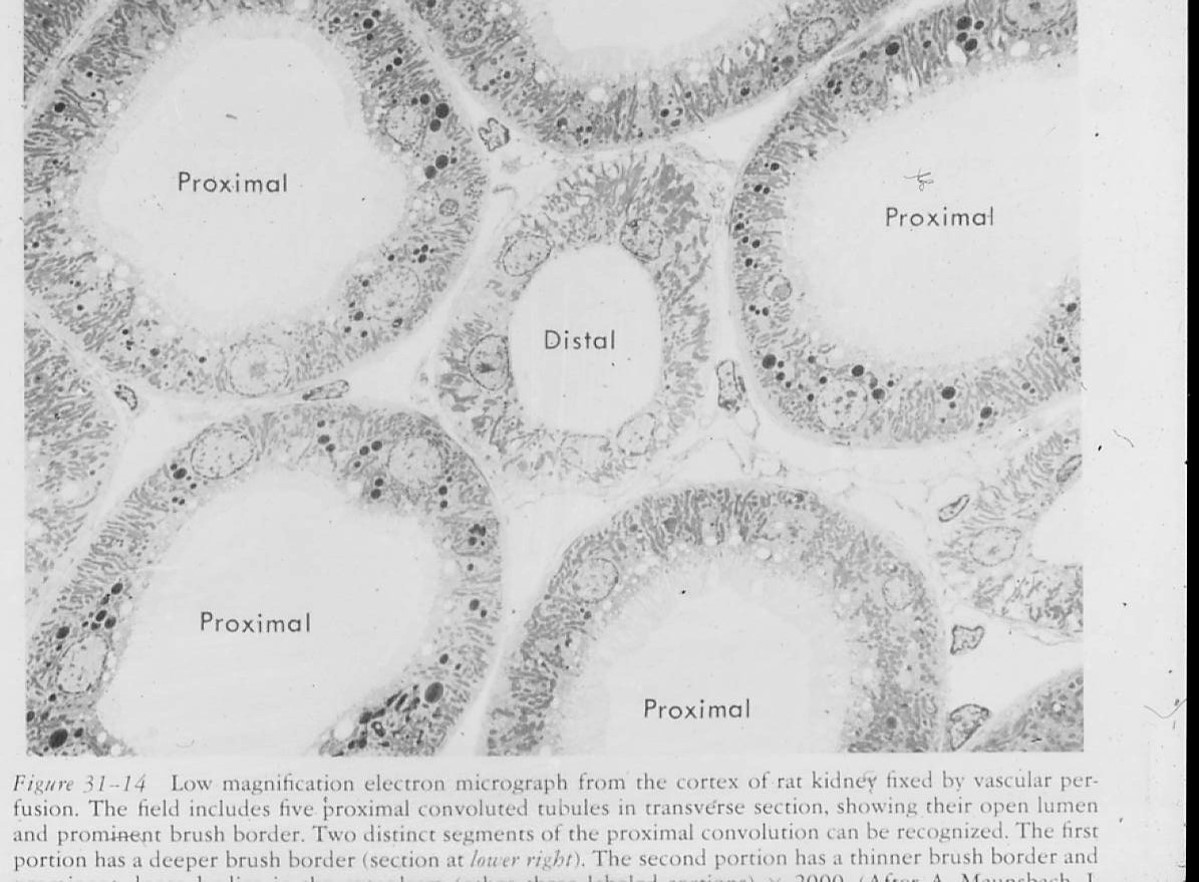
Proximal convoluted tubule
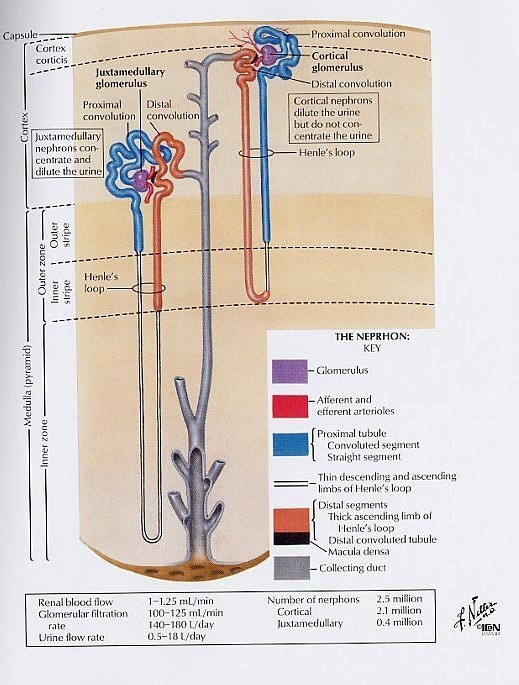
- Found in the cortex
- Lots of blood supply
- Lots of vesicles
- Brush border with a high surface area ( a lot of water to be reabsorbed)
- Loads of mitochondrial
Functions
What gets reabsorbed
- 70% of glomerular filtrate
- 60-70% of all solute
- 100% glucose
- 65% Na
- 90% bicarb
- Water and anions follow Na+ (osmolarity is maintained)
How?
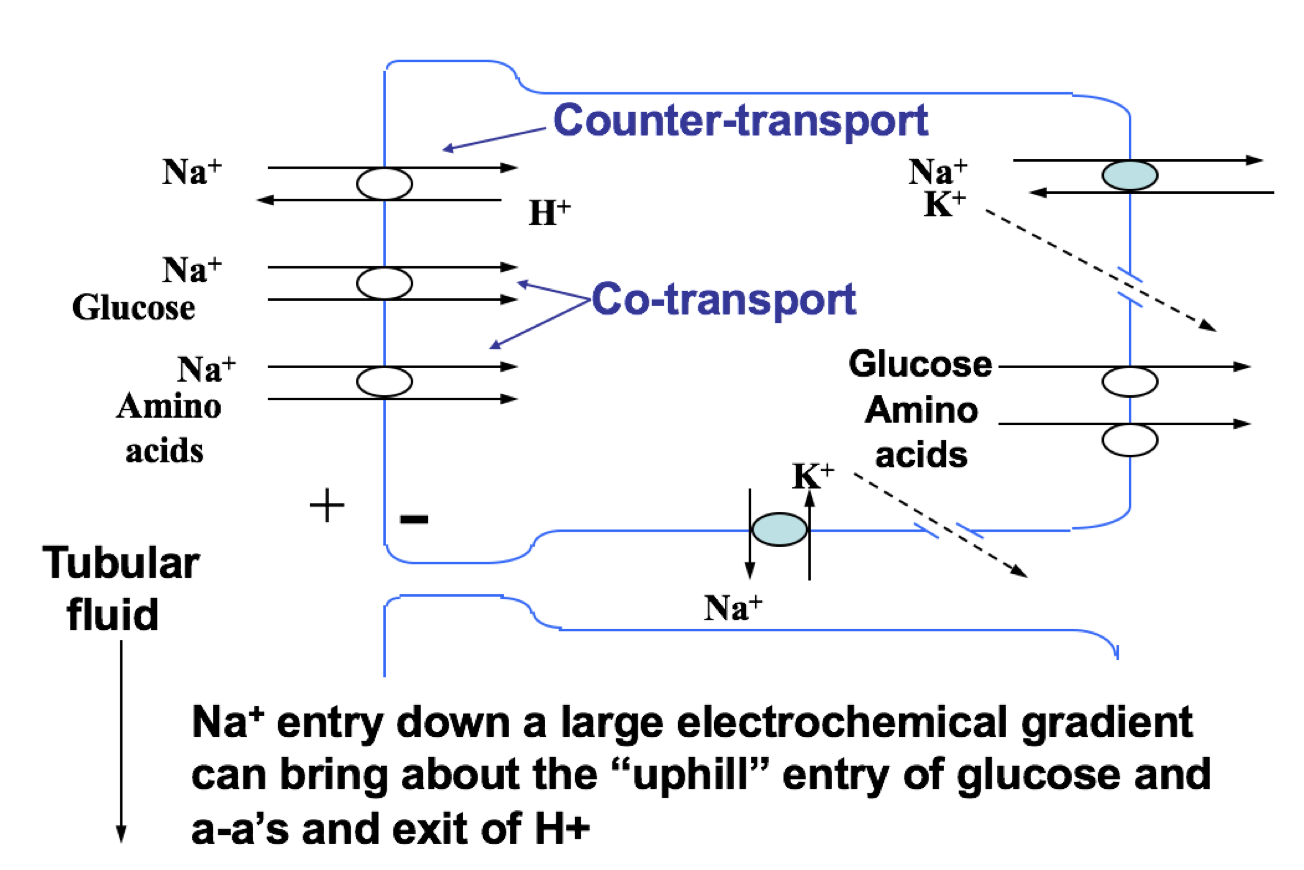
- Reabsorption of sodium Na+ by basolateral Na+ pump
- Pumping of K+ outside the cell (Na/K ATPase)
- Na+ concentration is low inside the lumen: key energy component of the system
- Water and other anions (such as Chloride ions) follow Na+ outside to peritubular capillary
- Low Na concentration inside the cell leads to Na+ cotransporters (Na+/glucose co-transporter, Na+/amino acid) and counter transporter to pump Na+ from lumen to surface cell
- Once this happens, Na+ concentration comes higher inside the cell than in capillaries so
- Glucose, amino acids uptake by capillaries by passive transport
Bicarbonate: indirectly coupled to Na+
- Na+ transported to the cell via co-transporter with H+
- H+ passes to lumen where it associates with HCO3- to make H2CO3
- Carbonic anhydrase breaks H2CO3 to H2O and CO2
- CO2 and H2O enter the cell where the same process happens to make HCO3- which exits to capillaries
Structural features
Sealed with (water-permeable) tight junctions but due to the iso-osmolar fluid we don’t really need very tight junctions because we are not going to see a big influx or efflux of fluids
A lot of mitochondria and there a dense brush border because energy is generated
Large surface area with aquaporins which allow transcellular water diffusion
Loop of Henle
Creation of hyper-osmotic extracellular fluid
Still some ions left in the fluid
And still 30% of the filtrate passing through
In order to finish up the re-absorption the following happen in the loop of Henle and vasa recta (blood vesselsà capillaries) via the Countercurrent mechanism
Loop of Henle becomes thin and there are different layers of this loops and this is because inside the medulla there are different concentration of ions ( can have many different concentrations)
Descending limb is thin and doesn’t have that many mitochondria (quite passive) passively allows ions to pass the membrane
Ascending has more mitochondria does all the work to produce all the solution
Loop of Henle - the countercurrent mechanism (around 15% will be absorbed)
Descending
- Thin tubule
- Passively allows ions and fluid to cross its membrane (aquaporins present)
- Simple squamous epithelium
- the quietest part of the system– not many mitochondria and very tight junctions to reabsorb water
- water passively exits because of high interstitial concentrations
* Ascending* - thick limb-Cuboidal epithelium, few microvilli
- Cl- is actively reabsorbed and and Na+ follows
- Very water-impermeable tight junctions ( the fluid inside the tubule becomes concentrated and you don’t want water to go back into the tubule
- Membranes lack aquaporins - low permeability to water stops the diffusion of fluids
Results in hypo-osmotic tubular fluid and in a hyper-osmotic extracellular fluid
- High energy is required in the ascending limp- prominent mitochondria
- In the descending limb water will leave tubule ( due to the hyper-osmotic environment produced by the ascending),
- Then the Vasa recta allow the fluid to be taken away from the area
By now 85% water and 90% sodium and potassium have been reabsorbed.
Transporter driven by Na/K ATPase
Loop diuretics block the Na/K/Cl co-transporter.
Fluid leaving the loop of Henle is hypo-osmolar with respect to plasma -> water has been reabsorbed
Distal convoluted tubule/Cortical collecting duct
Mechanism of urine production in kidney
- In the distal convoluted tubules there will be an adjustment of ion content of urine
- Principally a function of distal convoluted tubule
- Controls levels of Na+, K+, H+, NH4+SS
Distal convoluted tubule/Cortical collecting duct
- They don’t have brush border but funny-little invagination in their surface
- Small number of mitochondria
- Seems like there are more proximal than distal convoluted tubules but in reality they are shorter in length since they don’t have that much to do.
- Under the control of antidiuretic hormone Change the amount of fluid in the tubule
- Site of osmotic re-equilibration (control by vasopressin)
- Adjustment of Na+/K+/H+/NH4+ controlled by aldosterone (adrenal glands)
- There is a dug which is anti-hypertensive and reduced blood pressure by causing the excretion of more sodium ions and control their blood pressure
- Cuboidal epithelium, few microvilli and lots of invaginations containing the sodium pumps
- interdigitations with Na+ pumps
- Na+ and Cl- co-transporter linked to Ca2+ reabsorption
- Na+ and chloride are reabsorbed by a channel sensitive to thiazides. (Thiazides cause a rise in plasma Ca2+)
- Specialisation at macula densa, part of juxtaglomerular apparatus – detects changes in [Na+] of filtrate
Collecting duct
Variable absorption regulated by aldosterone and vasopressin
Distal part of nephron is impermeable to water without ADH.
Absence of ADH – tubule impermeable to water
Cell types
Principal Cell: important in sodium, potassium and water balance (mediated via Na/K ATP pump) aldosterone
Intercalated Cell: important in acid-base balance (mediate via H-ATP pump)
Medullary collecting duct
Concentration of urine
- Concentration of urine occurs at collecting tubule
- The medulla has very hyperosmotic extracellular fluid
- Movement of water down osmotic gradient into extracellular fluid
- Controlled by vasopressin (=ADH, antidiuretic hormone produces thirst)
- Tight gap junctions; we are dealing with dense concentrated fluid and we don’t want it to be absorbed.
Medullary collecting duct
- Passes through medulla with its hyper-osmotic extracellular fluid
- Water moves down osmotic gradient to concentrate urine
- Anti-diuretic hormone acts on the cell and allows fluid to be reabsorbed and produce very concentrated urine
- Rate of water movement is controlled by aquaporin-2 in apical membrane ( apex, inner surface of the cells)
- Once the water is in the fluid is in the cell it rapidly gets re absorbed by the base
- Whether we produce concentrated urea has to do with the antidiuretic hormone acting at the surface of the collecting duct
- No mitochondria cause it is not an active process
- content varied by exo-/endocytosis mechanism
- under control from the pituitary hormone vasopressin
- Duct has simple cuboidal epithelium
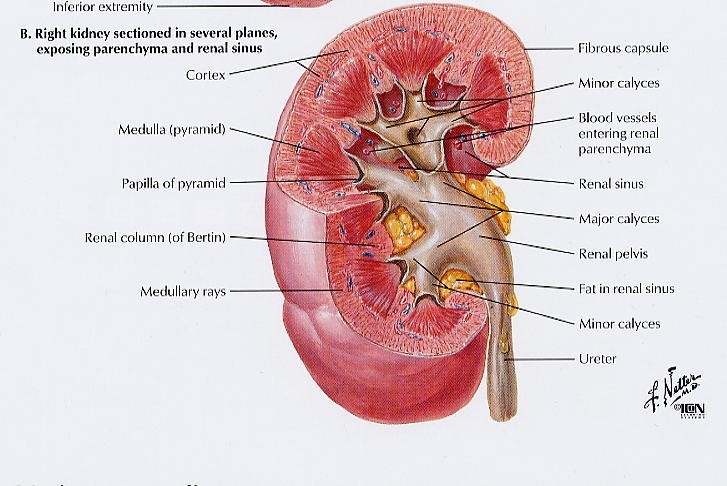
- Drains into minor calyx at papilla of medullary pyramid
- Minor and major calyces and pelvis have urinary epithelium
Juxtaglomerular apparatus
Juxtaglomerular apparatus
- High pressure system
- Very close to the aorta
- Barrier receptors are in the parotids which are close to the heart and can help to measure the blood pressure
- I f I want to produce a hormone to control blood pressure in the body a really good place would be the kidney because there are million units all sensing blood pressure àgreat place that’s what the Juxtaglomerular apparatus is.
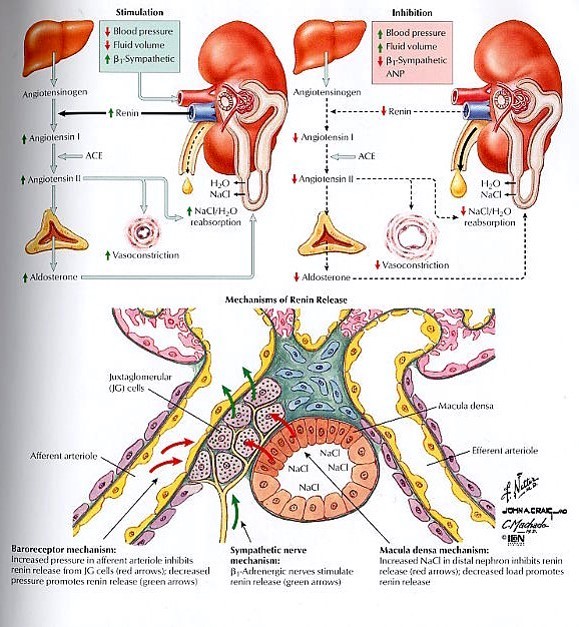
- Right next to the afferent arteriole where high blood peruse blood goes into the glomerulus it has cells that can sense the blood pressure and there are the macula densa which are endocrine function cells.
What happens
- If you have a lot of sodium in the distal convoluted tubule it will stop the production of Renin ( this is why diet with high sodium levels are not preferred for people with high blood pressure)
- Resulting in a decrease in Angiotensin 1 and then a decrease in Angiotensin 2 resulting in the vasodilation of vessels and pass more urine
- Increase in renin causes production of angiotensin 1 (where in an organ with high surface area such as the lungs Angiotensin 1 will be turned into angiotensin 2) resulting in more aldosterone production and therefore retain fluid and causing vasoconstriction to increase blood pressure
- Key medication for high blood pressureà those that are ACE inhibitors and stop the production of angiotensin 2 (blood vessels open up, people get rid of their fluid, blood pressure goes down) acts on the kidney.
Cells are packed with pro-renin and can release it if they are told by the macula densa
Cellular components are
- macula densa of distal convoluted tubule
- juxtaglomerular cells of afferent arteriole
Single gene defects that affect tubular function
- Renal tubule acidosis
- Bartter syndrome
- Fanconi syndrome
- (Dent’s disease)
Renal tubular acidosis
- hyperchloremic metabolic acidosis – in the blood
- leads to impaired growth
- leads to hypokalemia
Mechanisms underlying the main types of defects in distal renal tubular acidosis:
- failure of system pumping protons out to lumen
- leads to metabolic acidosis in the blood
- not acidic urine
- problems with carbonic anhydrase (flashcard 7)
- difunctional carbonic anhydrase leads to failure of pumping protons out –> metabolic acidosis
Bartter syndrome
Bartter syndrome: Excessive electrolyte secretion
One specific form: Antenatal Bartter syndrome
- Lots more water in the amniotic system
- You are getting read of salts so water is following the salts
- Premature birth, polyhydramnios
- severe salt loss
- moderate metabolic alkalosis
- hypokalemia
- renin and aldosterone hypersecretion
Ascending loop of henle: loss of sodium
Fanconi syndrome
Fanconi Syndrome
- Excretion of low molecular proteins
- Increased excretion of uric acid, glucose, phosphate, bicarbonate
- Increased excretion of low Molecular Weight protein
- Disease of the proximal tubules associated with Renal tubular acidosis (type 1)
- Dent’s disease: because you cannot separate the protein from the protein carrier because you cannot acidify the endosome
Dent’s disease
- a mutation is going on endosomal compartment
- mutation of chloride transporter
To acidify endosome we have to pump protons in :
- ph goes down
- positive charge inside the membrane goes up –> it gets harder to pump protons in when the ph is low
- transporter which lets some of the protons out at the expense of bringing two Cl- in
- the net production in charge of three 1 H+ out 2 CL-in
- if that is mutation the endosome never gets to the ph that will allow the detachment
Reabsorption of protein
Reabsorption of protein:
- Protein receptor on membrane
- Low specificity but high capacity of binding protein
- protein gets endocytosed
- Dissociate protein from the receptor protein -> pH drops for them to dissociate
- Protein dissociates and is reabsorbed while receptors recirculate back to the membrane
Balance sodium excretion according to dietary intake
Sodium: most prevalent, and important, solute in the ECF
- Increased dietary sodium -> Increased osmolarity (but the body can’t let this happen) -> will retain water -> Increased Extra Cellular Fluid Volume -> Increased blood volume and pressure
Positive balance, increase the amount of water in the body, gain weight - Decreased dietary sodium -> lose water -> Decreased osmolarity (but the body can’t let this happen) -> Decreased ECF volume -> Decreased blood volume and pressure
Na+ is reabsorbed:
- PCT: 65% - major site of reabsorption (& everything else, glucose & amino acids)
- Ascending Loop: 25%
- DCT: 8%
- Collecting Duct: 2%
When there is increased Glomerular Filtration Rate (GFR) there is more absorption of Na+ (since more is presented)
When there is decreased GFR -> less Na+ passes on to kidneys (less is presented)
Easiest way to modify amount of Na excreted is to modify amount of Na entered in the system
Regulating sodium excretion in times of low sodium and high Na levels
- Easiest way to modify amount of Na excreted is to modify amount of Na entered in the system
To reduce Na excretion (aka to increase reabsorption)-> reduction to the amount of Na entering the glomerulus
To increase Na secretion -> increase of amount presented
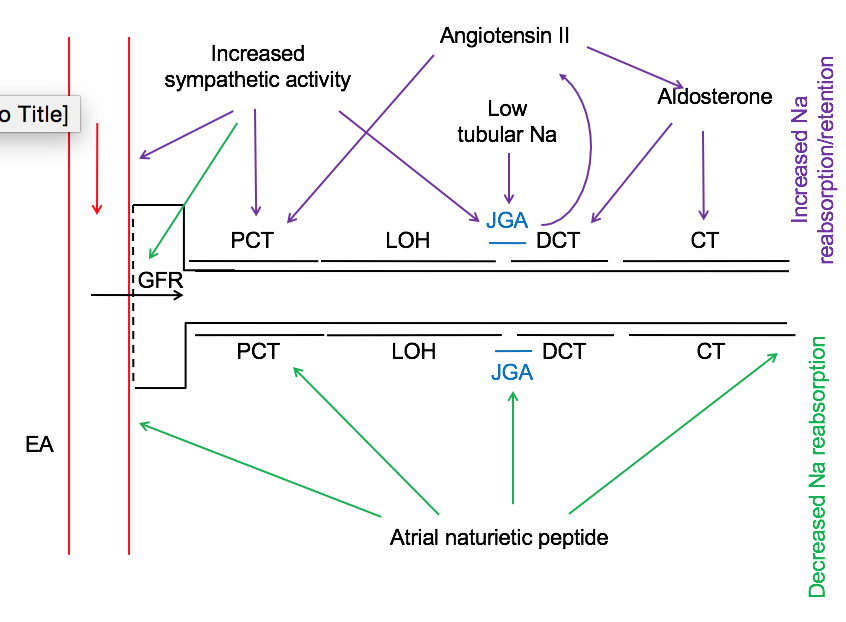
Factors contributing to Na retention (triggered in low blood pressure:
- Sympathetic activity –>
- decrease in GFR
- convoluted tubules reabsorb more sodium
- stimulate cells of juxtaglomerular apparatus (JXA) to secrete renin (low tubular Na also stimulates that) –> angiotensin II production
- Angiotensin II –>
- increase blood pressure (vasoconstriction)
- stimulate Na uptake in proximal convoluted tubule
- cause aldosterone to be released
- Aldosterone
- Stimulate Na uptake in collecting tubules and distal convoluted tubules
Factors contributing to Na excretion (triggered in high blood pressure:
- Atrial natriuretic peptide:
- Increase in GFR
- Decrease uptake in PCT, CT
- Suppresses renin secretion by JXA
Secretion of renin by Juxtaglomerular Apparatus
- By the activity of NA+, K+, Cl- channel in JGA
- If not lots of salt in the environment, the amount that comes inside the tubular cell decreases
- Steps:
- These cells are hypoosmolar compared to the outside environment
- they lose water to the outside environment
- they shrink
- produce PGE2 and NO
- stimulate granular cells to produce renin
- Renin secretion also stimulated by local hormones & sympathetic nervous system
JGA from the kidney -> Renin
Liver -> angiotensinogen
Angiotensinogen + renin -> angiotensin I ->(ACE) angiotensin II –> aldosterone
Angiotensin II
- directly affects proximal convoluted tubule ->increase sodium uptake -> increase reabsorption of water -> increase in ECF -> increase in BP
- direct effects to vascular system to cause vasocontriction -> increase BP
- triggers the secretion of aldosterone
*
Aldosterone: normal functions and abdormalities
Aldosterone
- Steroid hormone
- Synthesized and released from the adrenal cortex
Released in response to Angiotensin ll,
- decrease in blood pressure (via baroreceptors)
- decreased osmolarity of ultrafiltrate
Stimulates:
- Increased Sodium reabsorption (controls reabsorption of 35g Na/day)
- Increased Potassium secretion
Functions: (like a steroid hormone)
- steroid hormone receptor outside the cell which is bound to inactivated protein
- aldosterone binds and inactivated protein detaches
- steroid hormone receptor + bounded aldosterone enter cell
- causes changes in the transcription set of genes
- net effect: increases the amount of Na+ K+ ATPase
- Increases amount of Na+ ions on the apical side of the membrane + amount of regulatory protein responsible for activating that channel
Aldosterone excess:
- leads to hypokalaemic alkalosis
Diseases of Aldosterone secretion
Hypoaldosteronism
- Reabsorption of sodium in the distal nephron is reduced
- Increased urinary loss of sodium
- ECF volume falls
- Increased renin, Ang II and ADH
- (get rid of too much sodium) : Dizziness, low BP, palpitations, salt craving
Hyperaldosteronism
- Reabsorption of sodium in the distal nephron is increased
- Reduced urinary loss of sodium
- ECF volume increases (hypertension)
- reduced renin, Ang II and ADH
- Increased ANP and BNP
- High blood pressure: Muscle weakness, Polyuria, thirst
Liddle’s Syndrome
An inherited disease of high blood pressure.
- mutation in the aldosterone activated sodium channel
- the channel is always ‘on - always reabsorb too much Na
- Results in sodium retention, leading to hypertension
Relationship between increased/ decreased Extracellular Fluid and Blood Pressure
Increased ECF -> Increased BP
Decreased ECF -> Decrease BP
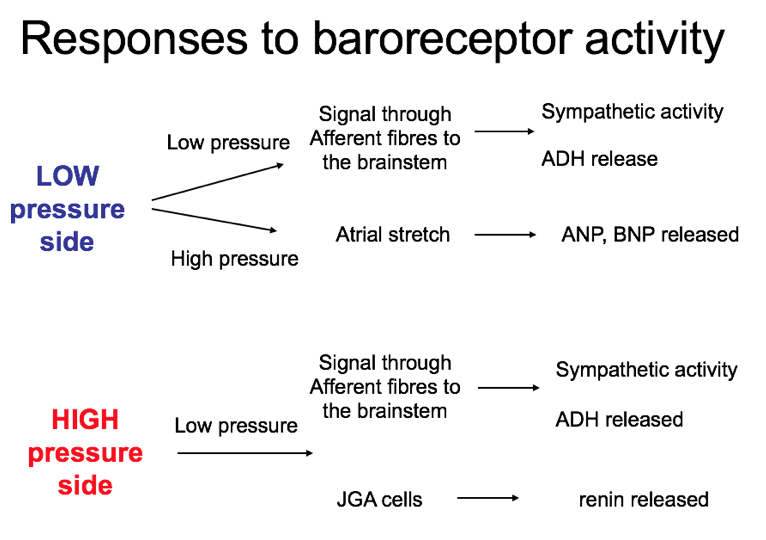
Baroreceptors on Heart & Vascular system
Low-pressure receptors:
- atria (heart)
- left ventricle (heart)
- pulmonary vasculature (vasculature)
High-pressure receptors: (only vascular system)
- Carotid Sinus
- Aortic arch
- Juxtaglomerular apparatus
Low-pressure side can both react to Low and High pressure
High-pressure side can only react to high pressure (see image)
Arial Natriuretic Peptide (ANP)
Small peptide made in the atria (also make BNP)
Released in response to atrial stretch (i.e. high blood pressure)
Actions:
- Vasodilatation of renal (and other systemic) blood vessels
- Inhibition of Sodium reabsorption in proximal tubule and in the collecting ducts
- Inhibits release of renin and aldosterone
- Reduces blood pressure
Diuretics
Regulation of water and salt balance are inter-related
- Na+ levels determine the ECF volume
- Reducing ECF volume reduces BP
- Reducing Na+ reabsorption reduces total Na+ levels, ECF volume and BP
Renin Angiotensin System
ACE Inhibitors: ACE inhibitors (lower blood pressure)
Effects of the consequent reduction in Angiotensin II and aldosterone levels are not confined to the kidney –> reduce BP
Diuretic drugs
- Osmotic Diuretics: glucose (as in diabetes mellitus) also mannitol
- Carbonic anhydrase inhibitors
- Loop Diuretics: furosemide (blocks triple co-transporter)
- Thiazides: block Na/Cl co-transport
- K+ sparing diuretics:
- amiloride - block Na channels
- spironolactone – aldosterone antagonist
Carbonic anhydrase
- Inhibit carbonic anhydrase- inhibit the production of protons in tubular cells –> fewer protons to be pumped –> less sodium to come in –> more sodium excreted
- Carbonic anhydrase activity leads to Na+ re-absorption and increased urinary acidity
Potent Diuretics: furosemide:
- Block transporter Na-Cl-K in ascending loop of Henle
- Increase Na in interstitial fluid
- natriuresis (5-10% of filtered blood)
Thiazides:
- Block Na-Cl symporter of distal convoluted tubule
- Small natriuresis (2-5% of filtered blood)
K sparing diuretics
- work in the distal part of the tubular system
- Inhibits Na channel on lumen surface - less Na comes in - less Na can pass out to blood through Na-K ATPase - less K enters the cell and goes to a lumen
- Small natriuresis (2-5% of filtered blood)
- Aldosterone also stimulates these 2 channels (Na channels and Na K ATPase)




