Summary 1
Summary 2
Final Summary 3
First Analysis
Second Analysis
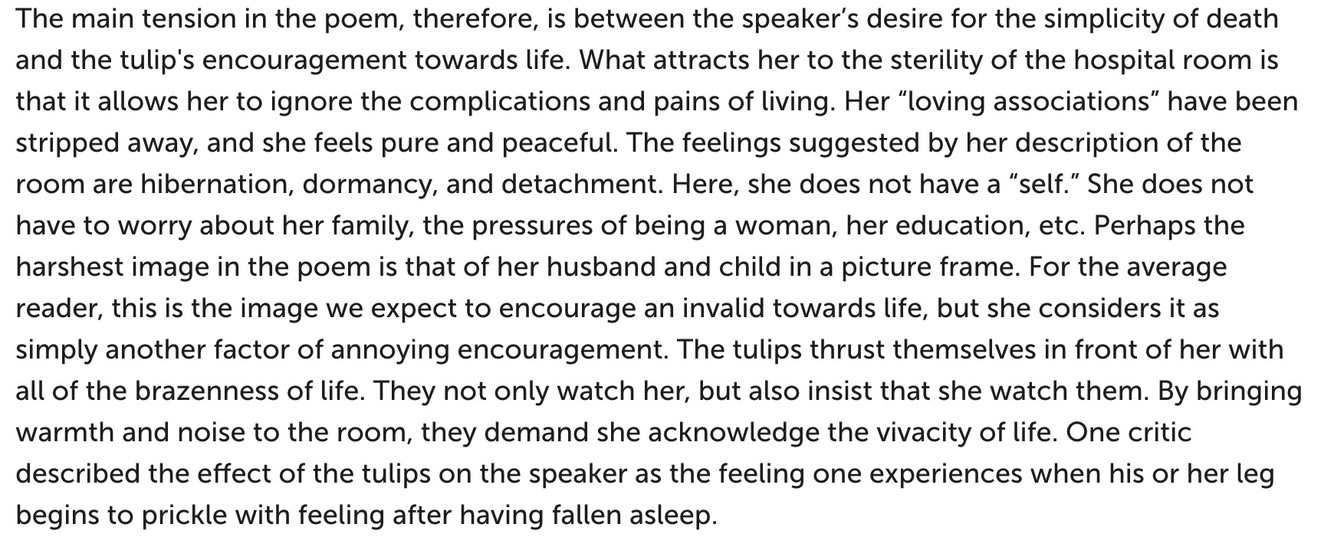
Third Analysis
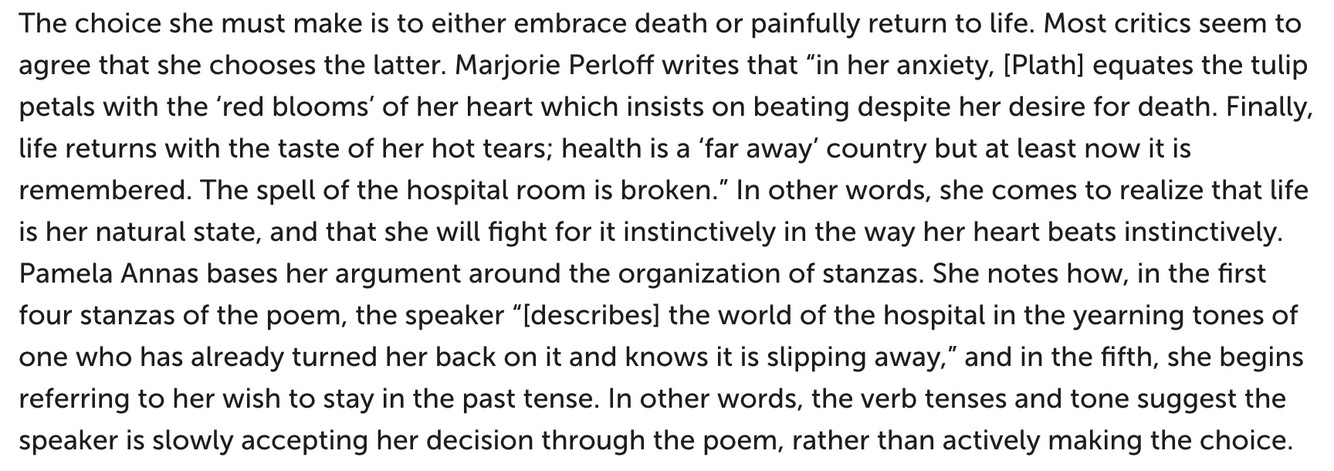
Final Analysis
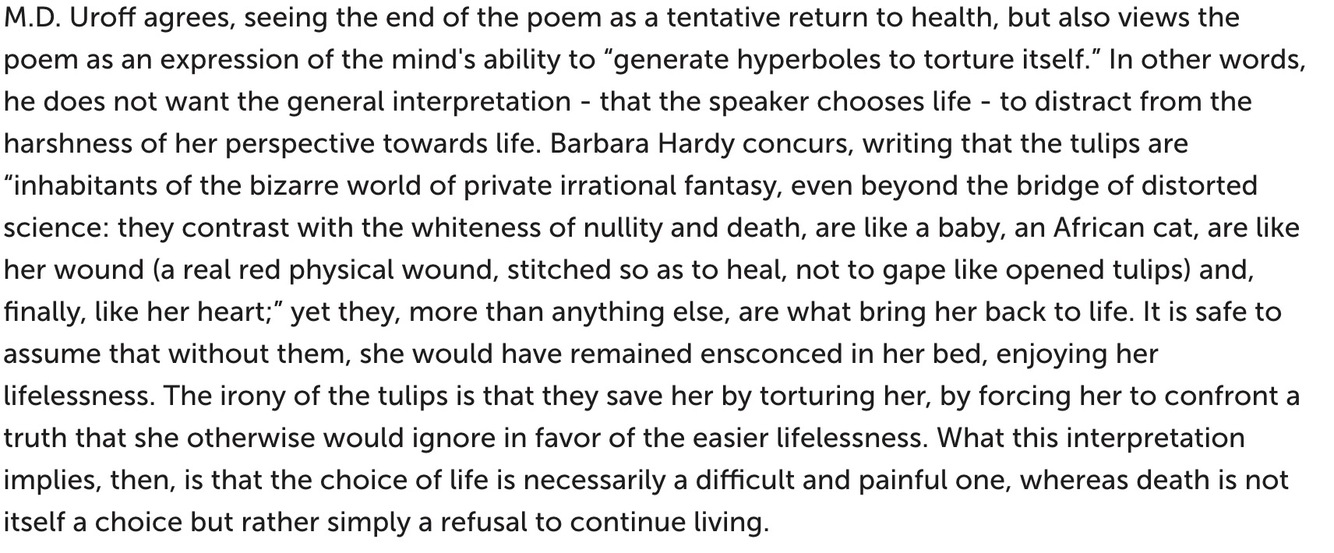
Line
The tulips are too excitable, it is winter here.
Look how white everything is, how quiet, how snowed-in.
- # Plath is not happy about these tulips.
- Tulips are oftentimes the first sign of spring, which is an apt explanation concerning why they don’t belong here.
- Flowers, what are you doing, it’s winter, die already.
- It might not be necessarily winter. “Winter,” “white” and “snowed-in” might only be metaphors for the white, confined hospital setting. This is relevant, because the tulips might be appropriate to the setting but not to the speaker.
- Winter here – white everything – quiet – snowed in.
Plath is layering on the imagery of whites and associating the color with a meaning very deliberately.
White battles Red in Tulips.
Line
I am learning peacefulness, lying by myself quietly
As the light lies on these white walls, this bed, these hands.
- You normally are ‘peaceful’ with your whole body and jump into it. This represents the two fighting forces of red (excitement) and white (purity).
She is learning to control the side of her which is innately full of violent thoughts and consumed with the ‘explosions’ of ideas. She wishes to get away from her mind through learning how to be peaceful. - Rather than the light shining on the walls, the light is lying, just the way she is. Plath may feel as though the light is heavy, and perhaps she is even melting in to it.
She is also expressing a detached behavior: THESE hands, THIS bed; rather than my hands and my bed. Perhaps because she is nobody, as she explains in the next line.
Upvote
Line
I am nobody; I have nothing to do with explosions.
I have given my name and my day-clothes up to the nurses
- And she is calmer thinking she is nobody. She doesn’t want the pressure of trying to be a great writer. She doesn’t want to write anything now. But the tulips are the kind of object that might inspire a poem – they are a reminder of her ambitions.
- Random, beautiful, and perhaps (probably) a comment on Plath’s own perception of her poetry, as well as critical reception.
Plath’s journals and letters reveal she was very self-conscious about the dangers of making her poems too melodramatic or too confined to structure; unlike most people, she was aware of her flaws as an artist and struggled to correct them.
Plath is usually a very loud poet – meaning she is very clear about her topics or vivid with extreme imagery. In “Tulips,” the style is very calm and NOT excited or rapid-fire.
She has nothing to do with explosions here.
Here’s a rare sexy picture of Plath, to contrast with the normal pictures:
- It has been suggested that embracing “peacefulness” and rejecting “explosions” are positive sentiments. They supposedly represent a calming of her psyche, or maybe an effort to write more well balanced poetry. This line, however, and the lines that follow, begin a trend that counters those ideas. She gives up her “name” and “day-clothes,” suggesting that she is losing her individuality and her way of life. “Anesthetists” and “surgeons” take away her “history” and “body,” suggesting a loss of the past that has molded and formed her identity.
Line
And my history to the anesthetist and my body to surgeons.
- Anesthesia offers another image of whiteness, if a bit obliquely – anesthesia has frequently been the result of substances called milk –
Milk of the poppy – opium to modern day Propofol, which is what Michael Jackson overdosed on.
*
Line
They have propped my head between the pillow and the sheet-cuff
Like an eye between two white lids that will not shut.
Stupid pupil, it has to take everything in.
- This suggests extreme passiveness, as if her head is unable to support itself. It is done to her, she seems unable to lift her own head.
- The “two white lids” are, figuratively, the pillow and the sheet-cuff; a powerful metaphor of a helpless, constricted passivity.
Two other prominent possibilities are present: some have suggested this is a reference to Anthony Burgess’s grotesque “Ludovico Technique” in A Clockwork Orange, where the eyes are held open in order to force social conditioning. However, A Clockwork Orange was published in 1962, and “Tulips” – the first poem to feature Plath’s Ariel-voice – was written in 1961, making the reference implausible unless it was a late revision. (Furthermore, while Ariel was released in 1965, it was finished by February 1963, when Plath committed suicide).
Some have also pointed to Plath’s two children, but there isn’t any clear indication that this is the case.
- Pupil as in the obvious reference to her eye, but take it out of context and the line is:
“Stupid pupil, it has to take everything in.”
A person so stupid that “it” (apparently doesn’t deserve a gender pronoun) and must learn everything to begin to function in society.
Plath went through electroshock therapy after her suicide attempt at about 20.
Electroshock therapy generally had the effect of wiping the brain clear of most of its memories temporarily, with everything slowly coming back. This poem may be referencing her experience with electroshock therapy, although it is set later, since she references Ted Hughes and one of her children, presumably Nicholas, the elder of her childern.
Line
The nurses pass and pass, they are no trouble,
They pass the way gulls pass inland in their white caps,
Doing things with their hands, one just the same as another,
So it is impossible to tell how many there are.
- The description of the nurses gives possible clues to what is happening to the speaker. She describes them in this way, “they are no trouble,” and later, “one just the same as another.” Like the cold, white atmosphere of the hospital, they don their “white caps,” which is similar to the later description of herself as a nun. She desires the peace and comfort of being like them, or rather, just like everyone else. She seems to willingly conform to their expectations, which could figuratively represent societal expectations. She freely gives in to the coercion of those around her, while she fights against her urges to embrace the “explosions” and “too red” convictions and passions of her true identity.
- More originality. Sylvia Plath and the Metaphysical poets have a lot in common, in terms of their inventive and unexpected imagery (known as ‘conceits’). The busy-ness of birds, constantly looking for food, constantly pecking, is apt; rather a delightful comparison.
There is a disturbing aspect of this metaphor though (or is it a simile, with ‘the way’ as a comparison?), in that she projects her negativity, sees the world as undifferentiated. Often in hospital the minor comings and goings become very significant as the outside world shrinks. People often say things like ‘I look forward to nurse x coming on duty’, or ‘nurse y works so hard’ or ‘nurse z makes me laugh’. Sylvia Plath hasn’t gone through this process; the individuality of the people caring for her is lost.
Line
My body is a pebble to them, they tend it as water
Tends to the pebbles it must run over, smoothing them gently.
They bring me numbness in their bright needles, theybring me sleep.
- If said aloud these lines have a rhythmic, lapping effect, rather like the water they are describing.
- Again, the speaker is erasing her own humanity by comparing herself to an inanimate object. Though these few lines give us creepy images, Plath is showing us that there is also something peaceful about it.
Line
Now I have lost myself I am sick of baggage——
My patent leather overnight case like a black pillbox,
My husband and child smiling out of the family photo;
Their smiles catch onto my skin, little smiling hooks.
- Both the physical overnight bag in the line below and the emotional baggage of family and connections weigh her down. Lost to herself, the weight of owning things and belonging to others is nauseating.
- Pillboxes aren’t typically black.
Therefore, the description of a black pillbox is ironic. (To further put this irony into perspective, try Googling black pill box in one tab and white pill box in another tab. A search for white pill box will return proportionally more little white containers for pills instead of the hats than a search for black pill box would for little black containers for pills instead of the hat. Even Google concedes the irony in this line.) This will be talked about momentarily.
In the previous line, the speaker says she’s sick of baggage. Two em dashes follow, and this means she intends to explain what her baggage is. This line is part of her explaining.
The baggage described in this line is a patent leather overnight case. The speaker might be tired of lugging it around from or to wherever she and the anesthetists, nurses, and surgeons are, but it probably has some figurative baggage to it. It might make her feel annoyed or disgusted because of whatever she associates with it.
The speaker says the overnight case is like a black pillbox. Because a black pillbox is ironic, perhaps it’s implied that the pills aren’t effective or aren’t medicinal. The overnight case is talked about as if it’s not necessarily conducive to the speaker’s health. Maybe it’s detrimental.
Black is traditionally a color worn at funerary events. Imagery like a black pillbox–along with all the imagery of winter–might be foreshadowing the speaker’s forthcoming death. Additionally, black is commonly associated with bereavement. In the next two lines, the speaker’s attention turns to her family. They might be deceased, or they might be profoundly absent from her life, but they’re baggage nonetheless. She could be bereaving the distance between them or the permanent loss of them. Consequently, she might despise this burden. (She is sick of baggage after all.)
- Here she is describing what she saw when she was put to sleep by the nurses for her surgery. Plath had two children (Nicholas and Frieda) and a husband, but smiling is in contrast to the reality of this family: after Plath committed suicide, her son Nicholas did the same about 20 years later because of depression – the same reason his mother committed suicide.
- Plath makes the smiles hooks because they draw her back to the real world and she just wants to be numb and unnoticed: pure.
Line
I have let things slip, a thirty-year-old cargo boat
stubbornly hanging on to my name and address.
They have swabbed me clear of my loving associations.
- Plath compares herself to an empty cargo vessel. She imagines herself as a hull devoid of content.
- Her name and her address are all that is left–like the empty hull of the cargo boat. Her insides, her emotions, are gone along with her loving associations.
- To prepare the patient’s body before surgery, a nurse literally swabs it clean with disinfectant. Again, the hospital is dehumanizing her. Naturally, we tend to think about family, especially children, when undergoing surgery, to hold on to identity. Sylvia Plath has lost even the sense of the people she loves.
This could also be a morbid pun, referencing swabbing a ship’s deck as she just compared herself to a cargo boat.
*
Line
Scared and bare on the green plastic-pillowed trolley
I watched my teaset, my bureaus of linen, my books
Sink out of sight, and the water went over my head.
I am a nun now, I have never been so pure.
- Perhaps a description of the trip to the operating theatre prior to surgery for an appendectomy in combination with associations with her recent miscarriage.
Ted Hughes says she wrote ‘Tulips’ after being hospitalized for an appendectomy in March of 1961. She had miscarried just a short time before this operation; probably the second hospital confinement triggered associations with death and birth.
- Jeanine Dobbs in “Viciousness in the Kitchen: Sylvia Plath’s Domestic Poetry.” Modern Language Studies 7.2 (1977)
- She has renounced all emotional attachment to her possessions. As she sinks into the oblivion of anesthesia, she loses or lets go of her connection to the things that once meant something to her. She is letting go of the material world.
- Her husband and child, like hooks, remind her of her past and her identity before she was stripped and numbed. That is followed by this stanza, which feels like one contradiction after another. She disparagingly calls her past a “thirty-year-old cargo boat / stubbornly hanging on…” Yet she then seems mournful that they have taken away her “loving associations,” leaving her “Scared and bare.” Then, being “Scared and bare” she suddenly feels a seemingly calming and peaceful sensation as “the water went over my head” and she feels she has “never been so pure.” There appears to be a tug of war inside her, unsure whether she wants to cling to her past and identity, which has brought her pain and sorrow, or change in some way (possibly conforming to social expectations), which rejects her past and identity but will bring her peace and purity.
Line
I didn’t want any flowers, I only wanted
To lie with my hands turned up and be utterly empty.
How free it is, you have no idea how free——
The peacefulness is so big it dazes you,
And it asks nothing, a name tag, a few trinkets.
- The flowers may depict that there are loved ones i.e. friends and family that care about the narrator. However her not wanting these suggests that she is done with them all and wants to be forgotten as the dead truly are.
- Plath’s hands being ‘turned up’ is a sign of defeat. She has given up on life and wants out. Her wanting to be ‘utterly empty’ is a further sign that she wants the oblivion that she hopes death can bring.
On the other hand, while the dead are mentioned in this stanza, there is no clear evidence that the speaker wants to die in this poem. In fact, in the next two stanzas, she is upset that the tulips threaten her life. They are “red lead sinkers round my neck” and they “eat my oxygen.” She desires something else, something white and pure, which rejects the vivid tulips, suggesting that her desire “to efface myself” is something other than death.
- She seeks detachment, oblivion, and finds it is what she values.
- The peacefulness is personified. It becomes the friend she wants, having rejected the humans around her. Note the long dashes, the pause while she relishes this peace. And the long vowels and slow pace of ‘so big it dazes you.’
- She has acquired a morbid imagination.
- This is another extraordinary comparison. And gruesome! The idea of the dead taking holy communion is disturbing.
*
Line
The tulips are too red in the first place, they hurt me.
Even through the gift paper I could hear them breathe
Lightly, through their white swaddlings, like an awful baby.
Their redness talks to my wound, it corresponds.
They are subtle : they seem to float, though they weigh me down,
Upsetting me with their sudden tongues and their color,
A dozen red lead sinkers round my neck.
- This poem, as well as a great deal of other poetry by Plath, plays with an opposition of colors that isn’t always easy to catch. Here, we have red and white, which make frequent appearances in Sylvia Plath’s work (at least, in the Ariel poems).
Red in this poem is about annoyance, violence, irritation, explosions, and more. Red has also much to do with vitality—and this partly derives from the matter-of-fact that red is a vital color.
White is all about quietness, peace, and an almost living death or form of invisibility.
- She compares the reappearing theme of red and tulips to what red could also refer to – violence and danger. Before this poem she had experienced electroshock therapy to prevent her from any suicidal attempts. Her experiences with electroshock therapy influenced her poetry throughout her adult life.
The red reminds her of painful experiences and she wishes to remain in the white peace she has found. - This is a truly bizarre and barely credible simile. The tulips have acquired a gothic horror existence. It suggests a sinister subversion of the maternal instinct, bearing in mind Sylvia Plath had two natural children. Could this be interpreted as a disturbance of the balance of her mind?
- The ‘wound’ could refer to her surgical wound from appendicectomy, or her inner emotional wound Both interpretations apply.
- This is a contrary to the first few stanzas, where Plath explaining how the tulips stand out among the sea of whiteness. Perhaps because they are mysterious–after all, they do float and weigh her down.
Line
Nobody watched me before, now I am watched.
The tulips turn to me, and the window behind me
Where once a day the light slowly widens and slowly thins,
And I see myself, flat, ridiculous, a cut-paper shadow
Between the eye of the sun and the eyes of the tulips,
And I have no face, I have wanted to efface myself.
The vivid tulips eat my oxygen.
- This suggests their mutual identification; she and the tulips are closely associated, almost to begin to merge.
- Plath is reduced to a ‘cut-paper’ shadow – a double negative as paper is thin and insubstantial in the first place, and she is the shadow of it.
- This is a clever, if sinister, play on words.
- It’s as if the tulips, by the process of photorespiration, are consuming her air and murdering her.
Line
Before they came the air was calm enough,
Coming and going, breath by breath, without any fuss.
Then the tulips filled it up like a loud noise.
Now the air snags and eddies round them the way a river
Snags and eddies round a sunken rust-red engine.
They concentrate my attention, that was happy
Playing and resting without committing itself.
- This line has a gentle, rocking rhythm, appropriate to the meaning. Plath achieves this with her phrasing — coming and going, breath by breath’ — which creates a unified line.
- The tulips add life and vibrancy to the droll life that Plath had become accustomed to living in the hospital. The mention of the “loud noise” that the tulips make adds to Plath’s view that the tulips are disrupting her perfectly comfortable life. Whilst wishing to die, the tulips will not stop reminding her of life.
The description of the air as ‘snagg[ing] and eddy[ing]’ around the tulips – repeated twice – suggests that the flowers attract and disrupt the flow of air, just as her calm is also disrupted.
- The idea of the ‘sunken rust-red engine’ is odd. The rich tulip-red blooms have become something rusty and abandoned. All things positive are inverted and distorted by Plath’s mind.
Plath uses a similar idea in her poem Sheep in Fog, where she compares a train to
Oh slow
Horse the colour of rust
Trains are sometimes referred to as ‘iron horses’. Both of these suggest decay and dragging, impeding movement that disrupts the poet’s calm.
- ‘Playing and resting’ is child-like, as if her adult intellect and physical athleticism have disappeared, to be replaced by an essentially simple existence.
Line
The walls, also, seem to be warming themselves.
The tulips should be behind bars like dangerous animals;
They are opening like the mouth of some great African cat,
And I am aware of my heart: it opens and closes
Its bowl of red blooms out of sheer love of me.
The water I taste is warm and salt, like the sea,
And comes from a country far away as health.
- I have always perceived in this couplet a reference to one of Ted Hughes’ animal poems, which expresses his admiration for the caged wild energy of a defiant captive jaguar. If I am correct and Plath’s allusion is a conscious one, it makes more ironic the tulips’ metonymy of her husband as the giver of the otherwise conventional get-well bouquet.
- This actually has two different meanings. Opening and closing her heart refers to being outspoken or the exact opposite – she is aware of this fact.
In a more literal way, a heart (the valves) also opens and closes. - The line above indicates that her heart keeps on beating, despite her wishes. It is something that the body naturally does; it is entirely out of her control (thus her “awareness” of the heartbeat). Her heart and the tulips both symbolize life.
For the first time the poet feels something positive- the blooms now appear to possess a love for her, rather than a certain contempt; they don’t try to destroy her. The poem is full of contradictions like this, perhaps indicating something about Plath’s mindset.
- The water seems to symbolize her tears, as she is caught in the conflict between living and dying.
- Plath acknowledges her sickness. The idea of a ‘country’ far away mirrors the opening sentence of Hartley’s 1953 novel ‘The Go-Between’. ‘The past is a foreign country: they do things differently there.’ It is likely that Plath would have known the line and its relevance to her situation.

-
Epigraph - Love in the time of cholera8
-
Kitchen -surface [characters]12
-
Kitchen- notes0
-
Kitchen- quotes8
-
About Sylvia Plath30
-
Cut-Sylvia Plath29
-
Mirror- Sylvia Plath24
-
Lady Lazarus- Sylvia Plath43
-
Two Sisters of Persephone- Sylvia Plath19
-
Two Views of the Cadaver Room8
-
The Other19
-
Tulips23
-
StillBorn16



