Phases of the Unified Process are?
InECT
- Inception
- Elaboration
- Construction
- Transition
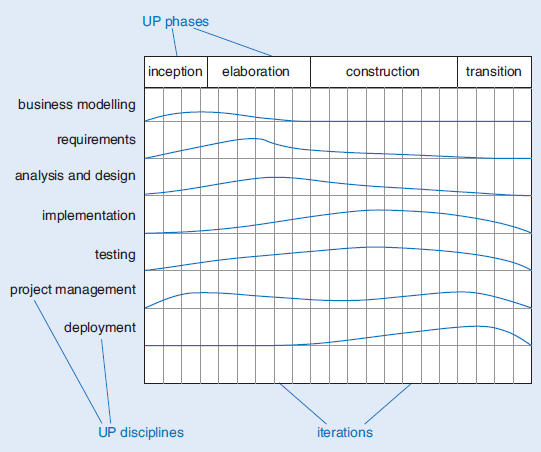
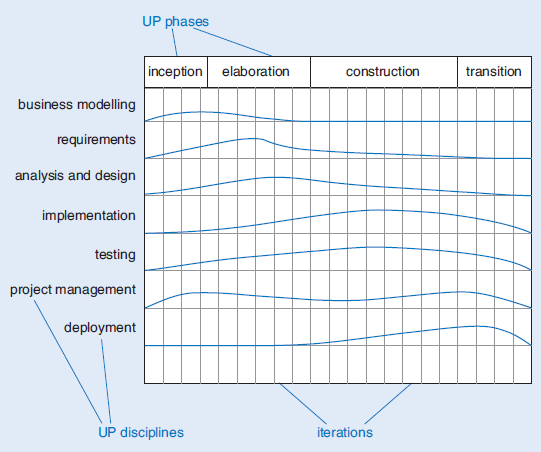
Disciplines contained in the Unified Process?
- Business Modelling
- Requirements
- Analysis and Design
- Implementation
- Testing
- Project Panagement
- Deployment
UP Inception Phase
The following are typical goals for the Inception phase.
- Establish a justification or business case for the project
- Establish the project scope and boundary conditions
- Outline the use cases and key requirements that will drive the design tradeoffs
- Outline one or more candidate architectures
- Identify risks
- Prepare a preliminary project schedule and cost estimate
UP Elaboration Phase
During the Elaboration phase the project team is expected to capture a healthy majority of the system requirements. However, the primary goals of Elaboration are to address known risk factors and to establish and validate the system architecture.
UP Construction Phase
Construction is the largest phase in the project. In this phase the remainder of the system is built on the foundation laid in Elaboration. System features are implemented in a series of short, timeboxed iterations. Each iteration results in an executable release of the software.
UP Transition Phase
The final project phase is Transition. In this phase the system is deployed to the target users. Feedback received from an initial release (or initial releases) may result in further refinements to be incorporated over the course of several Transition phase iterations. The Transition phase also includes system conversions and user training.
Summary - 1
A model is an abstract representation of a concept, a specification, a design or a system from a particular point of view of either the user or the developer. In general, it is a simplification that is used to understand an aspect of the system in question.
Summary - 2
A standard modelling language helps those involved in software development projects to communicate effectively. If the standard is widely used, it will reduce the time taken for developers to become familiar with a new project.
Summary - 3
The Unified Modeling Language (UML) is a useful standard because it is easy to use, sufficiently expressive, unambiguous and widely used. There are also a variety of tools that support UML.
**Summary - 4 **
During software development, there may be many models made from a variety of viewpoints. They must not contradict each other, that is, they must be consistent.




