Explain the iodine test.
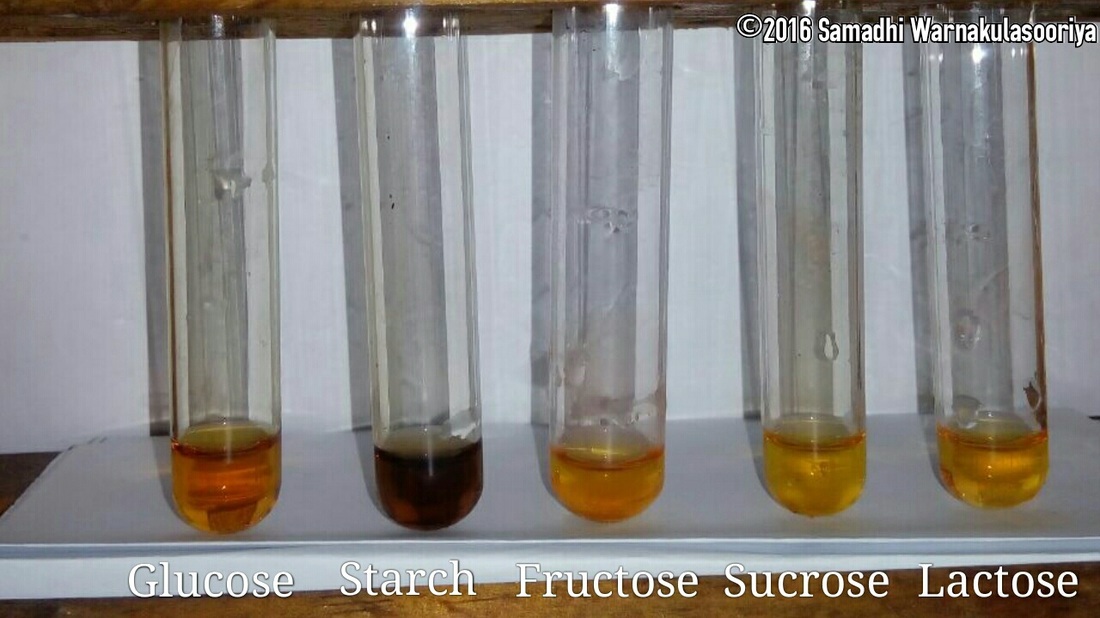
- Tests for the presence of starch
- Add iodine dissolved in potassium iodide solution to test sample
- If starch is present the colour will change from brown/orange to dark blue/black
- If no starch is present, the colour stays brown/orange
Explain the Biuret test.
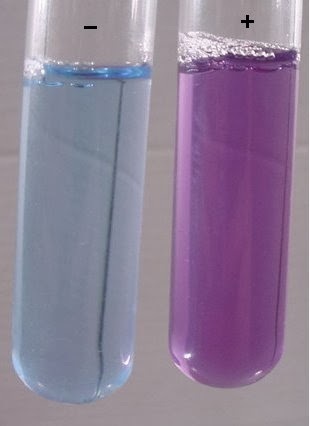
- Test for the presence of protein
- The test solution needs to be alkaline so first step is to add few drops of sodium hydroxide solution
- Next add the copper (ii) sulphate solution
- If protein is present (positive result) the solution turns pale purple
- If no protein is present (negative result) then the solution stays pale blue
What is used to test for starch?
Iodine
Why does iodine turn starch blue?
When dissolved in potassium iodide the iodine forms a tri-iodide ion, which slips into the middle of the amylose helix.
What does the biuret test really discover?
Peptide bonds in proteins
How is the colour formed in the biuret test?
Colour is formed by a complex between the nitrogen atoms in a peptide chain and Cu2+ ions
Explain the Emulsion test.
- Tests for the presence of lipids
- Shake test sample with ethanol for about 1 minute then pour solution into water
- If lipid is present, solution turns milky
- The more lipid present, the more noticeable the milky colour
- If there is no lipid present the solution stays clear
What is used to test for reducing sugars?
Benedict’s solution
Explain the steps in the Benedict’s test.
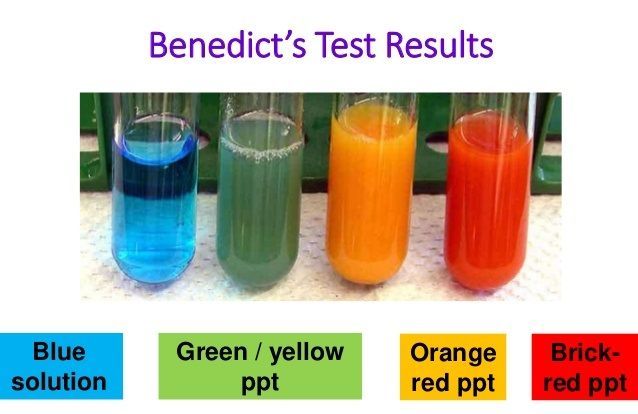
- Add Benedicts reagent (blue) to sample
- Heat it in water bath that’s been brought to boil
- Watch for colour change
- Colour of precipitate changes from: blue - green - yellow - orange - brick red
- If positive result, forms coloured precipitate
- The higher the concentration of reducing sugar, further the colour change goes (used to compare amount of reducing sugars in different solutions)
Define reducing sugar
- A sugar which can give electrons (reduce) to other molecules
- Reducing sugars include all monosaccharides and some disaccharides
What causes the change in colour of the Benedict’s solution?
The Cu2+ in benidict solution reduces into Cu+ making copper oxide giving that orange colour
What else can test for reducing sugars?
Commercially manufactured test strips
Glucose strips like for testing for diabetes etc
What are biosensors?
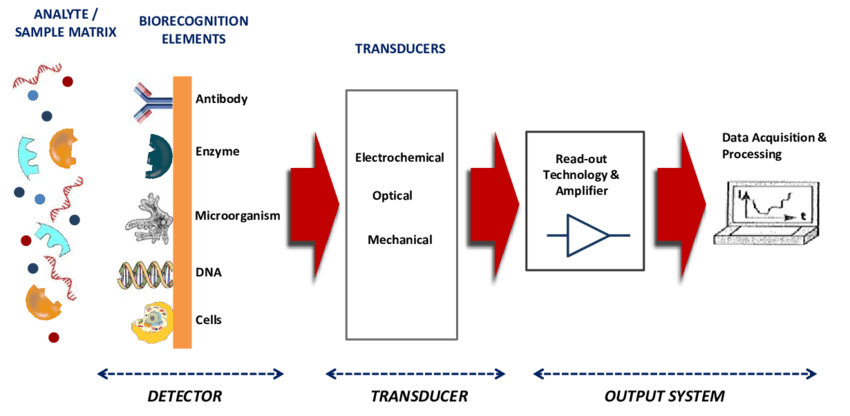
- Biosensors use biological components to determine the presence and concentration of molecules
- Glucose blood strips are an example
- Blood is the alayte which is placed onto the test strip,
- Molecular recognition uses glucose oxidase immobilised upon the surface of the strip
- Glucose in the blood reacts with a glucose oxidase producing gluconic acid causing a change in the tranducer (a change in the current between the terminals of a glucose monitor)
- Data is processed by the glucose monitor to give a reading dependent upon the current
Why are glucose test strips useful and how do glucose test strips work?
- Useful to test a person’s urine for reducing sugars which could indicate if person has diabete
- Also can help a diabetic person to manage their bloods
- Glucose tested using test strips coated in reagent (Benedict’s solution)
- Strips dipped in test solution and change colour if glucose (reducing sugar) is present
- Colour change is compared to chart to give indication of the concentration of glucose present
N.B this test only shows presence of a reducing sugar, which could be glucose, this is why a blood test is then done to determine if this is glucose
What is a more accurate method than the Benedict’s test to compare the amount of reducing sugars in different solutions?
Filter the solution and weigh the precipitate
What is the test for non-reducing sugars?
Benedict’s test
What must first happen to the sugar solution before it can tested for non-reducing sugars?
Boiled with hydrochloric acid to hydrolyse the bonds and free up the reducing sugar group e.g. Sucrose split into glucose and fructose
After adding hydrochloric acid to free up the reducing sugar group, what must be added to the testing solution to neutralise the acid?
Sodium hydrogen carbonate
What are the non-reducing sugars Benedict’s test results?
- Positive result, forms coloured precipitate.
- Colour changes:
- Blue - Green - Yellow - Orange - Red
- Negative result, stays blue so no sugar present
How can colorimetry be used to calculate the concentraction of reducing sugar present?
- A colorimeter is a piece of equipement that quantitatively measures the absorbance, or transmission, of light be a coloured solution.
- The more concentrated a solution is the more light it will absorb and the less light it will transmit.

-
Unit 2: Microscopy20
-
Unit 2 - Cells and Organelles20
-
Unit 2 - Cells and Organelles 220
-
Unit 2 - Biological Elements & Water20
-
Unit 2 - Carbohydrates20
-
Unit 2 - Testing for biological molecules20
-
Unit 2 - Lipids33
-
Unit 2 - Proteins73
-
Unit 2 - Nucleic acids & DNA replication73
-
Unit 2 - Enzymes35
-
Unit 2 - Plasma membranes34
-
Unit 2 - Diffusion/osmosis/active transport66
-
Unit 2 - The cell cycle, mitosis, meiosis86
-
Unit 2 - Cell organisation and stem cells29
-
Unit 3 - Mammalian gas exchange and ventilation24
-
Unit 3 - Gas exchange and ventilation in bony fish and insects10
-
Unit 3 - Circulatory systems27
-
Unit 3 - Blood and blood vessels46
-
Unit 3 - Tissue fluid17
-
Unit 3 - Structure and anatomy of the heart23
-
Unit 3 - The cardiac cycle, heart action coordination, and ECGs38
-
Unit 3 - Transport of oxygen and carbon dioxide41
-
Unit 3 - Transport in plants94
-
Unit 4 - Classification35
-
Unit 4 - Variation and Evolution69
-
Unit 4 - Biodiversity124
-
Unit 4 - Communicable disease, disease prevention and the immune system161
-
Unit 4 - Pathogens that cause disease in plants and animals28
-
Unit 4 - Specific immune response27
-
Unit 5 - Neuronal Communication62
-
Unit 5 - Hormonal Communication55
-
Unit 5 - Communication and Homeostasis45
-
Unit 5 - Excretion, homeostasis and the liver86
-
Unit 5 - Plant & Animal Responses142
-
Unit 5 - Photosynthesis60
-
Unit 5 - Respiration48
-
Unit 6 - Genetics of living systems81
-
Unit 6 - Patterns of Inheritance85
-
Unit 6 - Manipulating genomes85
-
Unit 6 - Cloning and biotechnology91
-
Unit 6 - Ecosystems90
-
Unit 6 - Population and Sustainability54



