gross primary productivity (GPP).
(rate at which) energy {incorporated intobiomass by { plants
Using the information in the table, describe and explain the effects of temperature and precipitation on GPP.
- GPP {depends / eq} on photosynthesis ; 2. higher the temperature the higher the GPP / eq ; 3. enzymes in (photosynthesis / chemical reaction ) {can work faster / more kinetic energy / eq } ; 4. higher the {precipitation / eq} the higher the GPP / eq ; 5. idea that water is needed for the light-dependent reaction ;
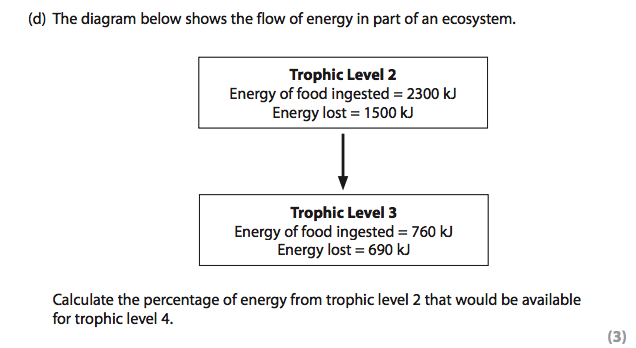
- (trophic level 2) 2300 - 1500 / 800 (kJ) ;
- (trophic level 3) 760 - 690 / 70 (kJ) ;
- ((70 ÷ 800) x 100) = 8.8 / 8.75 (%)
) Using the information in the table, explain the effects of temperatures above 40 °C on the activity of RUBISCO.
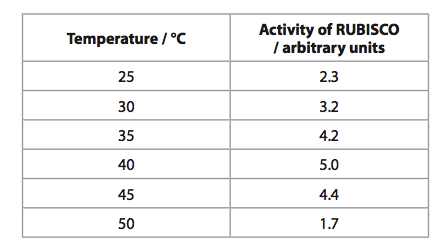
- idea that enzyme activity decreases ;
- credit calculated reduction e.g. 0.6, 2.7 , 3.3 ;
- idea that an increase in temperature results in increase in kinetic energy ;
- causing changes in bonds (in the enzyme) / eq ;
- idea that enzyme is denaturing (above 40 ºC) ;
- idea that carbon fixation is reduced ;
Name the two substrates that would have been used in this experiment.
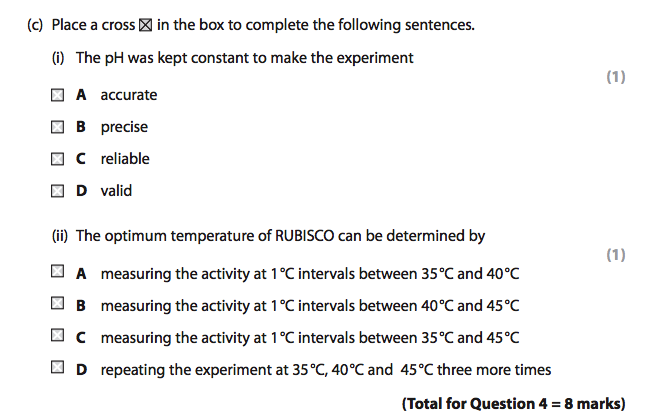
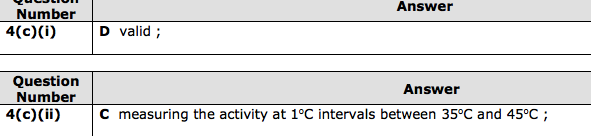
{RuBP / ribulose bisphosphate} AND {carbon dioxide / CO2} ;
Using the information in the graph, describe the changes in the pollen count in the layers of peat from a depth of 12.5 m to a depth of 13.5 m.
- idea that cellulose is a {polymer / polysaccharide} of β glucose ;
- reference to 1-4 glycosidic {bonds / eq} ;
- idea that every other glucose is inverted ;
- idea of cellulose molecules arranged {parallel /as microfibrils} ;
- joined by hydrogen bonds / eq ;
b) Suggest why there is no data for some of the depths
- idea of {lack of / very slow} decomposition ;
- due to lack of {microorganisms / bacteria / fungi / named decomposer} (involved in decomposition) / eq ;
- as a result there are fewer enzymes / eq ;
- low pH {reduces enzyme activity / kills microorganisms /eq} ;
Suggest why temperature changes affect sea level.
in double fertilisationone (haploid) male {gamete fuses with (haploid) {egg cell /
to produce a {diploid zygote one (haploid) male nucleus} fuses with { polar nuclei to produce a {triploid / 3n} endosperm (nucleus) ;
It is claimed that the volcanic eruption of Toba caused a change in world climate. (i) Using the information in both graphs, describe the evidence that supports this claim
- decrease in pollen count (in peat) after eruption / eq ;
- decrease in sea level after eruption
(ii) Using the information in both graphs, suggest why this claim may not be true. (3)
data only comes from one peat bog ;
dea of {fluctuations (in the data)
(i) Using the information in the graph, describe the changes in abundance of spruce, ash and elm trees over the last 14 000 years. (
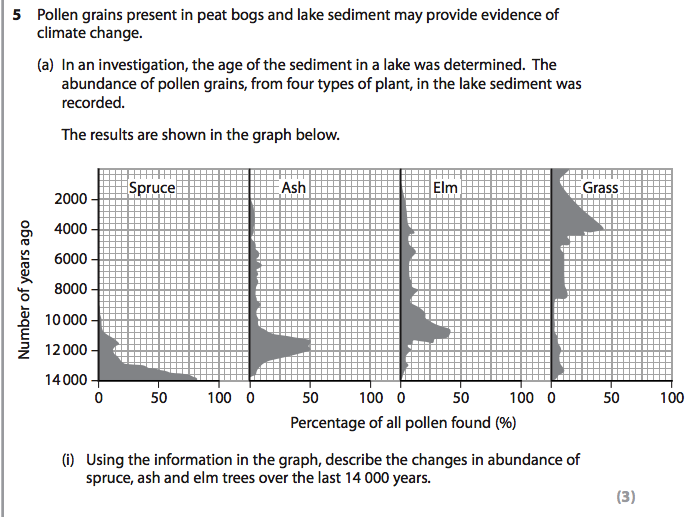
- idea that spruce present 14 000 years ago but disappeared about 10 000 years ago ; 2. idea that ash was very high around 12 000 years ago and then remained (in low numbers) until about 2 000 years ago ;
- idea that elm was very high around 11 000 years ago and then remained (in low numbers) until about 2 000 years ago
(ii) Ash and elm trees grow in wet, poorly-drained soils. Grass grows in drier conditions. Using the information in the graph, describe the changes in climate at this lake over the last 14 000 years.
- idea that conditions were (fairly) dry 14 000 years ago ;
- idea that conditions got wetter ;
- and then got gradually drier about 5000 years ago ;
(iii) Explain how the information in the graph indicates that other types of plant were present around this lake.
idea that the {abundance / types} of plant is reflected by the percentage of pollen grains present ;
- idea that pollen from all species are low ;
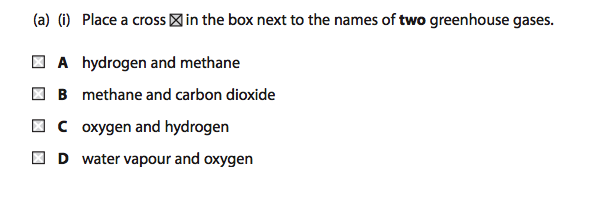
B methane and carbon dioxide ;
(b) Explain how dendrochronology may also be used to provide evidence for climate change.
- dendrochronology is the study of tree rings / eq ;
- idea that each year a (new) tree ring is formed ;
- idea that the size of the ring reflects the growth of the tree (that year) ;
- idea that {size of ring / growth} is affected by {climate / named factor} ;
- idea that photosynthesis is affected by {climate / named factor} ;
- idea that the number of rings can be used to work out the timescale;
(ii) Describe how an increase in greenhouse gases could cause the loss of sea ice.
- idea that {UV / shorter wavelengths of / eq} light can pass through the greenhouse gases ;
- {heat (energy) / IR / longer wavelengths of light / eq} cannot pass back out (through greenhouse gases) / eq ;
- increasing the temperature of the earth’s {atmosphere / surface} / eq ;
- idea that higher temperatures melt more of the ice ;
- idea that less ice will {refreeze / form / eq} ;
Suggest why the loss of sea ice could result in a decrease in the number of polar bears.
. idea of less {habitat / hunting ground / eq} ;
- idea that there will be less (seals) to feed on ;
- idea that the bears are not building up sufficient food reserves ;
- idea that the polar bears have to swim further {for food / to reach their dens};
- idea that there are fewer dens ;
Distinguish between the terms environment and habitat.
- idea that an environment includes the biotic and abiotic factors (of a habitat) ;
- idea that a habitat is an area where organisms {live / interact / eq} ;
Explain why microorganisms are added to the soil in the biosphere.
- for decomposition / eq (of plants / animals / excrement);
- to improve the {quality / mineral content / depth / structure / eq } of the soil ;
- idea of releasing carbon dioxide (back into atmosphere) ;
- idea that carbon dioxide is used in photosynthesis
; 5. to recycle the {nitrogen / elements} ;
- (microbes) provide food for other (soil) organisms
Explain the meaning of the term species richness.
/ abundance} of (different) species ; 2. in an {area
Suggest why a decrease in species richness would decrease the use of light energy in the biosphere.
fewer {types of plant / (plant) species} ;
absorbing different {amounts / wavelengths} of light ;
- different species have different structures (related to absorbing light) eq ;
) Explain why the uptake of carbon dioxide and plant productivity both decrease as species richness decreased.
- idea that if there is less light (energy) being used there will be less photosynthesis ;
- idea that if light-dependent reaction is reduced there will be less {ATP / reduced NADP / eq} ;
- idea that {carbon fixation / Calvin cycle / light-independent reaction } will be less ;
- idea that as a result less GALP will be made ;
- so less {hexose / glucose} made ;
- so less {biomass
Describe the structure of a cellulose molecule.
cellulose is {polymer / polysaccharide} of β glucose ;
- reference to 1-4 glycosidic {bonds / eq} ;
- idea that every other glucose is {inverted / rotated by 180°C} ;






