Food is the main stimulant for acid production. What are the 3 pahses of food-stimulated acid production? Which phase results in the most acid secretion?
- Cephalic, Gastric, Intestinal
- Gastric phase results in the most acid secretion
- G cells –> gastrin –> ECL cells (histamine –> H2 receptor on parietal cell) + parietal cells
- D cells –> somatostatin –> inhibits gastrin release
What are the 3 stimulatory receptors on the basolateral surface of parietal cell? Which is the most important? What does stimulation of these receptors lead to?
- M3 Muscarinic Receptor
- CCK-B gastrin receptor
- H2 receptor ** most important
Stimulation leads to activation of the proton pump (secretes H, neighboring Cl pump = HCl secretion)
Channels involved for successful secretion of HCl in the parietal cell
- H+K+ ATPase (antiporter)
- Cl channel
- K channel
What are the four major components of Gastric Mucosal Defense?
What are they all regulated by?
- Mucus secretion
- Bicarbonate secretion (buffer)
- Mucosal blood flow
- Cell restitution/turn over
Mucosal prostaglandins regulate
General key cause for inflammatory disorders of upper GI tract
imbalance between aggressive and **defensive mucosal forces **
Primary regions of gastric acid-related diseases, and primary findings (3)
Lower esophagus: Acid Reflux
- esophagitis
- strictures
- Barret’s esophaguse
- esophageal adenocarcinoma
Stomach:
- gastritis
- gastric ulcer
Duodenum
- duodenitis
- duodenal ulcer (more common than gastric)
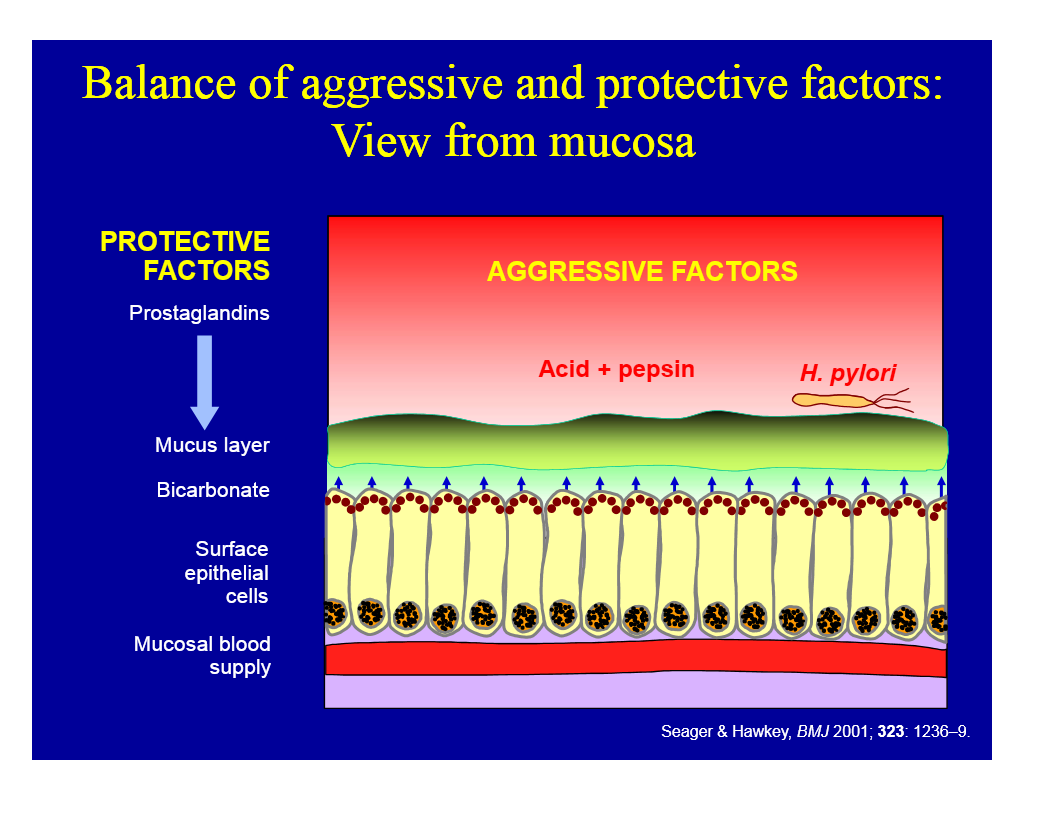
Balance of aggressive factors (3) and protective factors (5): View from mucosa
Aggressive factors: Acid + pepsin, H. Pylori
Protective Factors (top/lumen to bottom):
- prostaglandins
- mucus layer
- bicarbonate
- surface epithelial cells
- mucosal blood supply
In terms of a balance beam between healthy mucosa and peptic ulcer formation, list the hostile factors (4) and protective factors (4)
Hostile factors:
- H. Pylori
- Gastric Acid
- Pepsin
- NSAIDs
Aggressive factors
- Bicarbonate
- Prostaglandins
- mucus production
- blood flow to mucosa
What are the 3 main causes of Peptic Ulcer Disease?
- Helicobacter pylori infection
- NSAID and ASA
- Zollinger-Ellison Syndrome
What does H. pylori produce thats potent and why ?
What layer does H. Pylori reside in?
Urease: converts urea to ammonia and carbon dioxide
Resides in the mucus layer overlying the gastric epithelium (mucus layer is adjacent to the lumen). Has flagella to swim through it
What factors may contribute to colonization of gastric mucosa by H. pylori? 3 mains ones with subsets.
- Urease activity
* may neutralize acid in local environment - Motility
- spiral, corscrew shape (gram negative bacteria)
- flagellae
- proteases (local mucus layer digestion)
- Adherence
- attachment pedestals
- bacterial adhesins specific for gastric-type epithelium
- epithelial cell receptors
H. Pylori is present only in the following types of mucosa
- Human gastric mucosa
- Ectopic or metaplastic gastric-type mucosa elsewhere in GI tract
- Esophagus
- Duodenum
- Meckel’s diverticlum
- (true diverticulum, persistence of the vitelline duct: may contain ectopic acid-secreting gastric mucosa and/or pancreatic tissue)
- Rectum
Mechanisms responsible for H. pylori-induced GI injury are not clearly defined. What are 3 proposed mechanisms?
- production of toxic products –> local tissue injury
- induces local mucosal immune responses
- causes increased gastrin and may increase acid secretion
Explain the proposed mechanism by which H. Pylori possible increases acid secretion
H. pylori infection —> decreased number of D-cells —> decreased somatostain release —> decreased G cell inhibition –> increased Gastrin secretion –> incresed number of parietal cells –> increased gastric acid secretion
Study done about H. Pylori and D-cell density
eradiation of H. pylori:
- increases antral D-cell density and somatostain
- decreases antral gastrin
What are peptic ulcers strongly associated with? (and which etiologic factor for the peptic ulcers in specific)
Peptic ulcers are strongly associated with antral gastritis, and there was a much stronger correlation between non-NSAID associated ulcers (H. pylori) than NSAID associated ones.
**histological antral gastritis is usually due to H. pylori)
What is likelihood of developing an ulcer with H. pylori infection?
10-15% (and 10% ulcer gastritis)
True or false: eradiation of H. pylori dramatically reduces ulcer recurrence
True. Slightly more effective at getting rid of duodenal ulcers than gastric.
Antral gastritis associated with:
Pan (entire stomach) gastritis associated with: (2)
Antral gastritis: PUD
Pan gastritis: gastric cancer and MALT lymphoma
H. pylori therapy
What type of mechansim is used
Success rate
Dual mechanism therapy
- Acid suppression (Bismuth or PPI)
- Antibiotics: Macrolides, Penicillins, Tetracyclincs, Metronidazole, Floxins all used
Success rate is about 75-90%, not ideal
Definition of dyspepsia
Which type of ulcers have increased dyspepsia while eating and which type has decreased dyspepsia while eating?
Which type of ulcers have no pain or dyspepsia?
Dyspepsia: Epigastric burning
**Note: Dyspepsia does NOT equal PUD
- Gastric ulcer: increased dyspepsia with eating (more acid production in stomach to digest the incoming food)
- Duodenal ulcer: decreased dyspepsia with eating (duodenum secretes protective factors to prepare for acidic gastric contents)
- NSAID ulcers often have no pain or dyspepsia
Complications of PUD and their associated symptom (3)
- obstruction —> vomiting
- melena (black tarry feces) or hematemesis —> bleeding
- perforation —> pain, distention, sepsis
Which type of ulcer is more frequent
Duodenal ulcers occur 4x more than gastric ulcers.
H. pylori prevalance
Colombia, Narino

-
Molecular Basis of Cancer29
-
Invasion and Metastasis Pathology24
-
Inflammation and Cancer5
-
Cancer Chemo Principles55
-
Myeloid Neoplasms66
-
Lung Cancer Path and Phys30
-
Lymphoid Neoplasms78
-
Pancreatic Cancer Pathology18
-
Adipose Tissue as Endocrine Organ17
-
Diabetes Complications -Grimm22
-
Anti Thyroid Drugs12
-
Diabetes Complications -Malchoff33
-
Diabetes Management56
-
Thyroid Disorders and Cancers35
-
Principles of GI Inflammation Disorders12
-
Upper GI Inflammatory Disorders36
-
PUD pharmacology19
-
Nausea and Vomiting Pharmacology19
-
Intestinal Motility Drugs Pharmacology18



