Differentiate btw afferents and efferents of the PNS.
- afferents = sensation, 1 neuron, perikaryon in ganglion (spinal ganglion)
- efferents = motor innervation, 1 neuron, perikaryon in ventral horn, pseudounipolar
Which cranial nerve has bipolar neurons?
n. facialis
Define segmental innervation.
Where can it be seen most prominently?
peripheral nerve of 1 segment innervates area (esp. dermatomes) of same segment
→ trunk, nn. intercostales
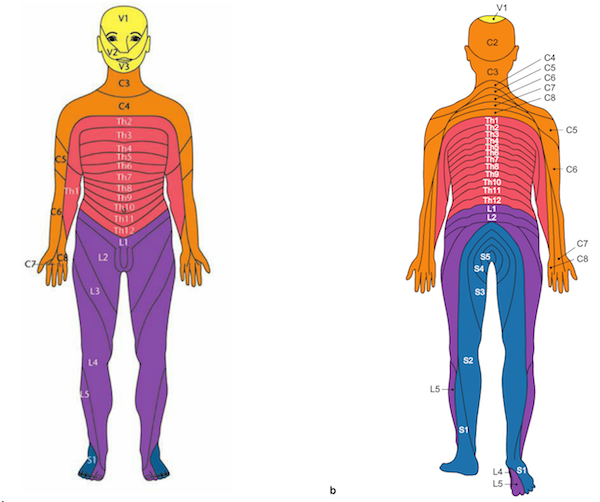
What are dermatomes?
Briefly describe the innervation of the different segments.
area of skin that is mainly supplied by a single spinal nerve
BUT: C1 doesn’t have a dermatome
<u>NOTE:</u> V1 - 3 refer to skin innervation by division of <strong>n. V</strong>
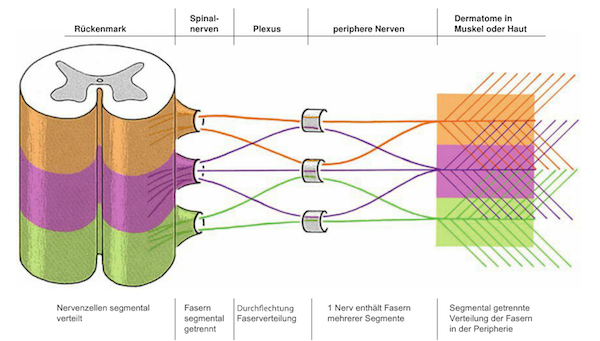
Explain generally how a plexus is formed.
spinal nerves enter plexus segmentally seperated, exchange fibers, leave as mixed-segmental peripheral nerves
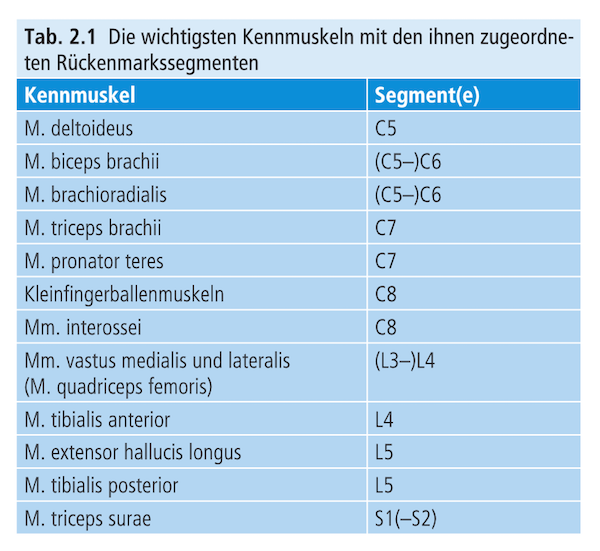
What is a segment-indicating muscle?
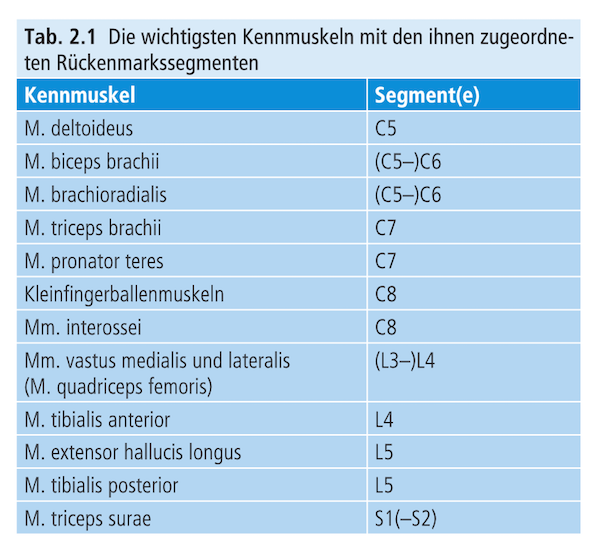
List for C5 - C7.
mainly innervated by one distinct spinal nerve
→ can indicate lesion in that very segment
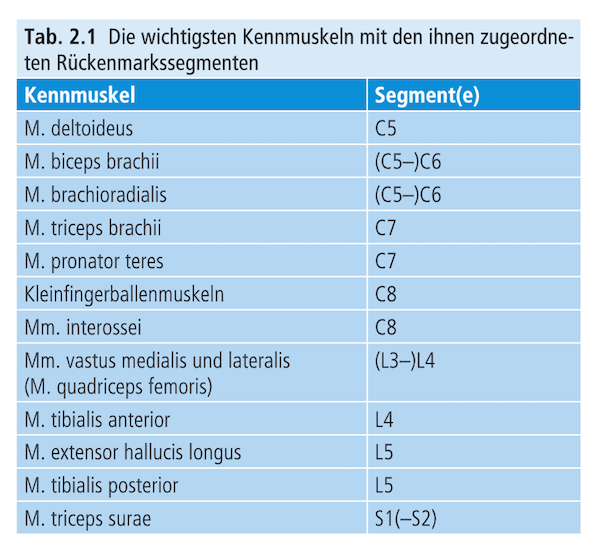
What is a segment-indicating muscle?
List for C8, L3-4.
mainly innervated by one distinct spinal nerve
→ can indicate lesion in that very segment
What is a segment-indicating muscle?
List for L5 - S2.
mainly innervated by one distinct spinal nerve
→ can indicate lesion in that very segment
Explain the general pathway of spinal nerves.
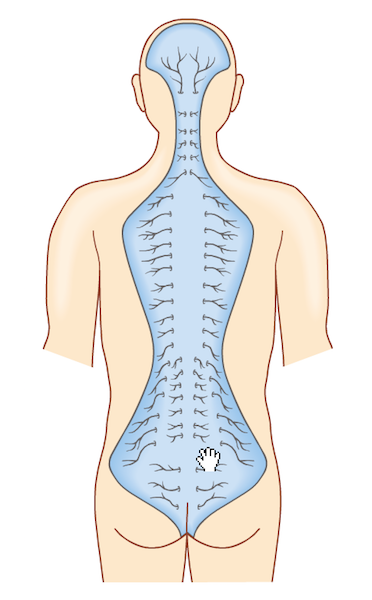
- ventral motor + dorsal sensory root unite
→ spinal nerve in canalis vertebralis - give off r. meningeus: enters canalis vertebralis again → supplies periostium, meningi + intervertebral disks
- spinal nerves bifurcate into r. anterior + r. posterior
Explain the function of rr. posteriores of the cervical spinal nerves.
all sensory except C1
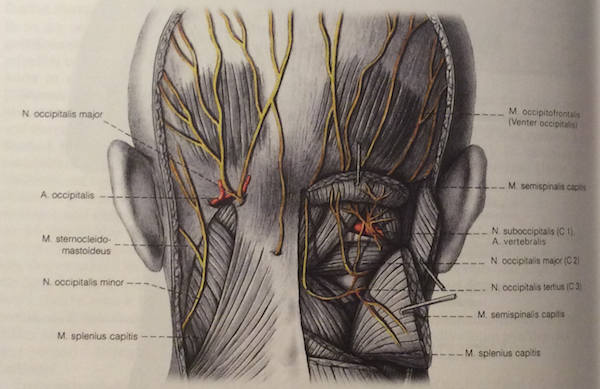
- C1 = n. suboccipitalis: motor inn. of deep short nuchal mm. + m. semispinalis capitis
- C2 = n. occipitalis major: skin inn. - vertex
- C3 = n. occipitalis tertius: skin inn. caudal + medial to C2
- C4 - 8 = skin inn. of nuchal region caudally
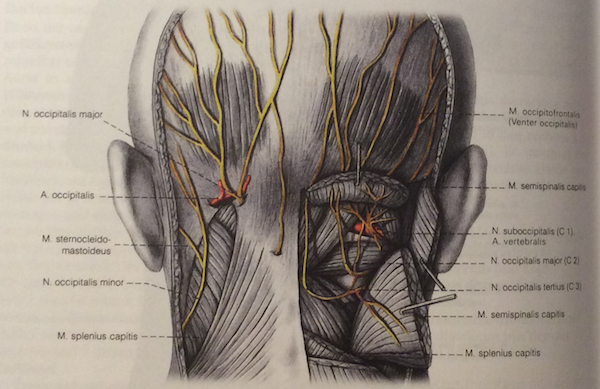
Which structure can be frequently seen next to n. occipitalis major?
a. occipitalis
Explain the function of rr. posteriores of the thoracic - sacral spinal nerves.
- T1-12 = skin + motor inn. of autochthonal back mm.
- L1 - S5 = nn. clunium superiores + medii: skin inn. of pelvis, gluteal region
skin innervation of the back
Explain the pathway of rr. anteriores of the thoracic region.
only rr. anteriores that do NOT participate in formation of plexus
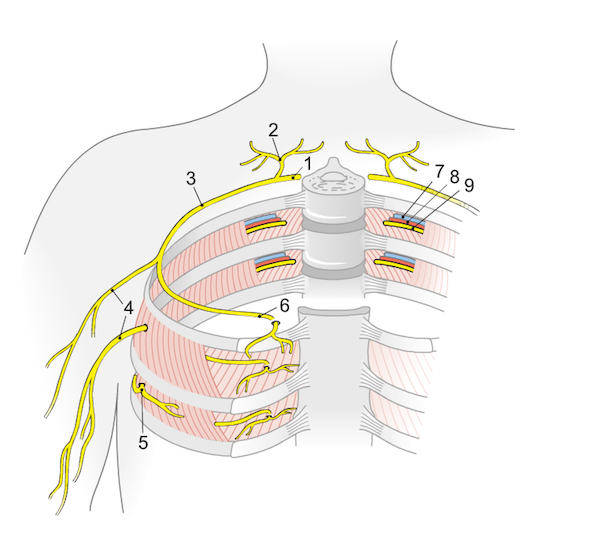
→ form nn. intercostales on inner wall of thorax, run at superior border of rib
- Th1 - 6: end at sternum
- Th7 - 12: after sternum downwards to linea alba
→ r. cutaneus lateralis + r. cutaneus ant. innervate pleura + peritoneum
3 = r. ant., 5 = r. cutaneus lat., 6 = r. cutaneus ant.
Differentiate btw the general function of nn. intercostales.
innervate intercostal mm. + resp. dermatomes
Th1 - 6: end at sternum
- ALSO: mm. serrati post. sup. + inf.
Th7 - 12: after sternum downwards to linea alba
- ALSO: abdominal mm.
→ give off r. cutaneus lateralis + r. cutaneus ant. innervate pleura + peritoneum
3 = r. ant., 5 = r. cutaneus lat., 6 = r. cutaneus ant.
Which nn. intercostales have a special role?
- 1st: participates in plexus brachialis
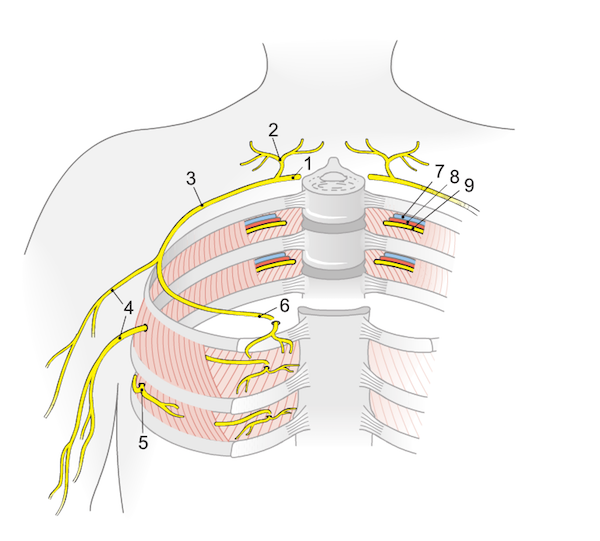
- 2nd (+3rd): sensory collateral to upper limb, hence n. intercostobrachialis → anastomoses w/ n. cutaneus brachii medialis
- 12th: under last rib, hence n. subcostalis
3 = r. ant, 4 = n. intercostobrachialis
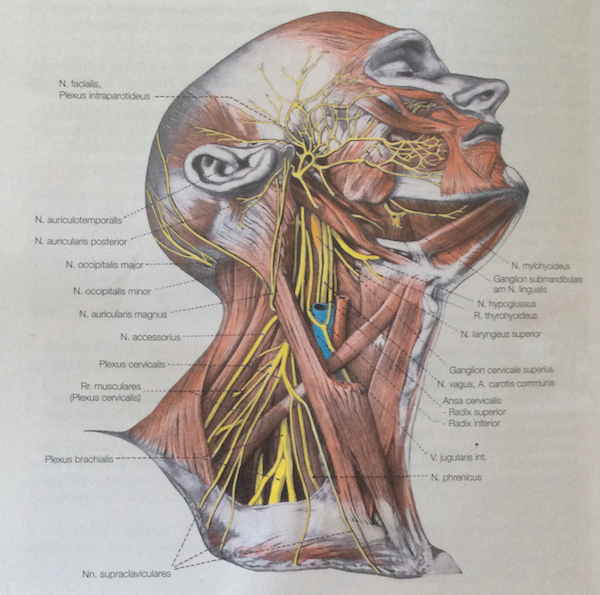
Which nerves form plexus cervicalis?
Where is it located?
General functions.
rr. anteriores of C1 - 4
form plexus cervicalis deep to m. sternocleidomastoideus btw mm. scaleni and m. levator scapulae in trigonum colli laterale
→ infrahyoid mm. + sensory innervation of cervical region
<u>NOTE:</u> prominent <strong>ansa cervicalis profunda</strong>
Which muscular branches are given off by plexus cervicalis?
- branches to
- mm. scaleni
- deep nuchal mm.
- m. sternocleidomastoideus
- m. trapeziuse
- ansa cervicalis (profunda)
- n. phrenicus
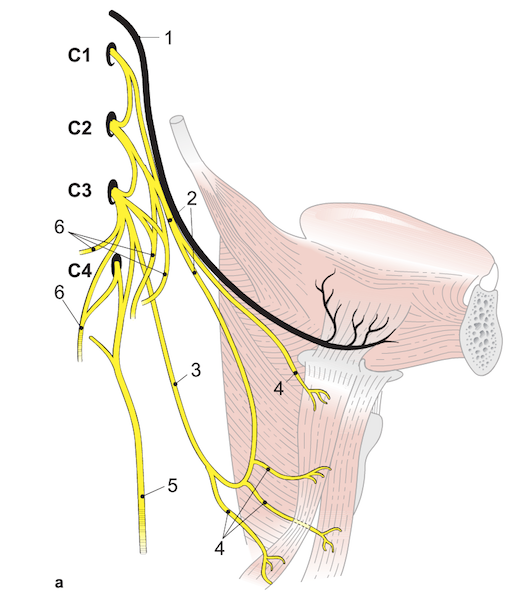
What is ansa cervicalis profunda?
Spinal origin?
Pathway + function.
loop formed by plexus cervicalis
radix superior (C1, 2) runs parallel to n. XII, then anastomoses w/ radix inferior (C3, 4) ventrally to v. jugularis/a. carotis communis
→ m. geniohyoideus + infrahyoid mm.
1 = n. XII, 2 = radix sup., 3 = radix inf., 4 = branches to infrahyoids
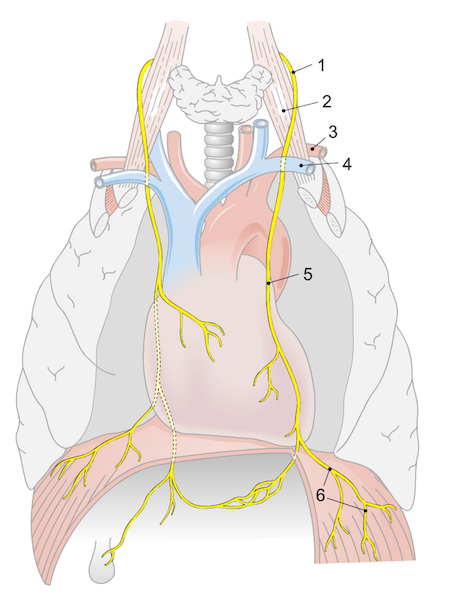
Describe the pathway of n. phrenicus
branch of plexus cervicalis (C3 - 5)
- runs on m. scalenus ant. downwards
- enters thorax btw a. + v. subclavia
- then btw pleura + pericardium in ant. mediastinum
- leaves thorax at apex of heart (left)/ foramen venae cavae (right) to diaphragm
1 = n. phrenicus, 2 = m. scal. ant., 3 = a. subcl., 4 = v. subcl.
Which branches are given off by n. phrenicus?
Function?
- rr. perciadiaci → pericardium, pleura
- rr. phrenicoabdominales → peritoneum
⇒ motor/sensory innervation of diaphragm
(3, 4 and 5 keep diaphragm alive)
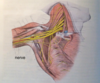
Which sensory branches are formed by plexus cervicalis?
Spinal origin.
4 branches
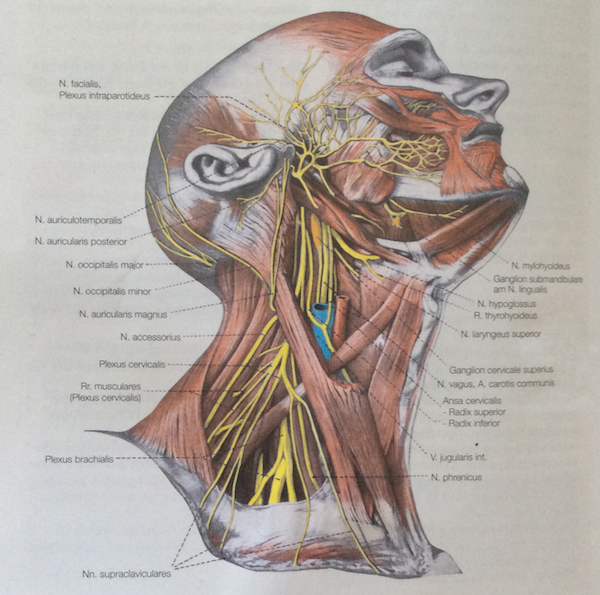
- n. occipitalis minor (C2): dorsally to m. sternoc.
- n. auricularis magnus (C2, 3): crosses m. sternoc. superiorly
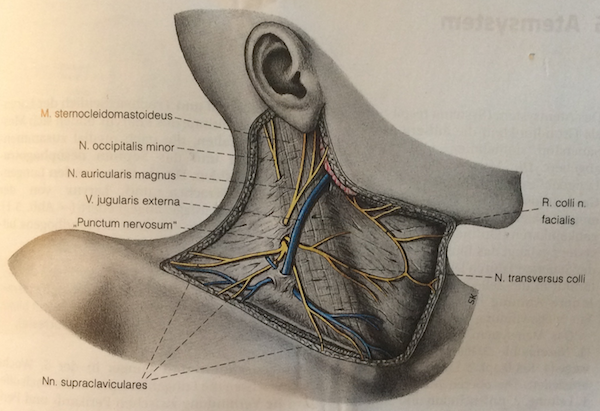
- n. transversus colli (C2, 3): crosses m. sternoc. inferiorly, forms ansa cervicals superficialis
- nn. supraclaviculares (C3, 4): to clavicle, upper chest, shoulder
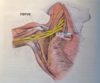
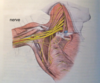
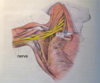
cf. picture
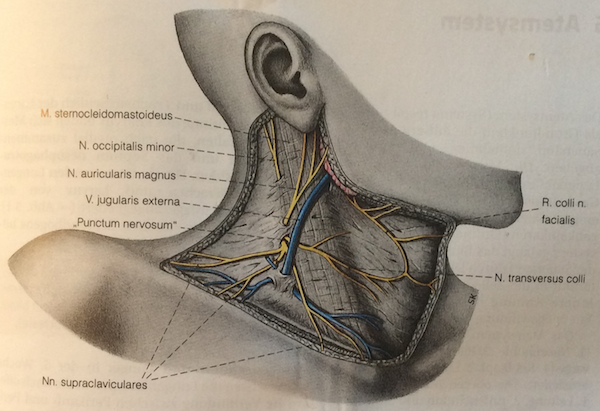
What is a common feature of all sensory branches of plexus cervicalis?
exit all together at post border of m. sternocleidomastoideus
= punctum nervosum/Erb’s point
What is ansa cervicalis superficialis?
neural anastomosis of n. transversus colli from plexus cervicalis and r. colli n. facialis
→ superficial loop
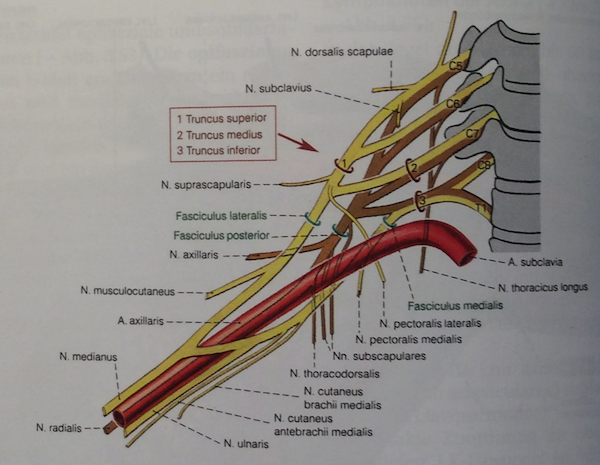
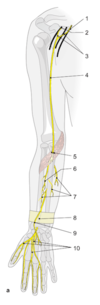
Where does plexus brachialis originate from?
Explain its general pathway.
(mainly) C5 - T1
- originates in trigonum colli laterale
- runs together with a. subclavia through hiatus scalenus to form 3 trunci
- rearrangement to 3 fasciculi dorsally to clavicle, accompanying a. axillaris












-
Meninges + ventricles + liquor49
-
Cranial nerves26
-
Blood supply & drainage45
-
Gross anatomy - brainstem, diencephalon, cerebellum73
-
Gross anatomy - telencephalon51
-
Embryo - Brain, add. to Ben's basics11
-
Cranial nn. ncll. + medulla, pons43
-
Upper plexuses62
-
Upper dorsal regions54
-
Lower plexuses39
-
Lower dorsal regions64
-
Cranial nn. I - VI details49
-
Cranial nn. VII - XII details50



