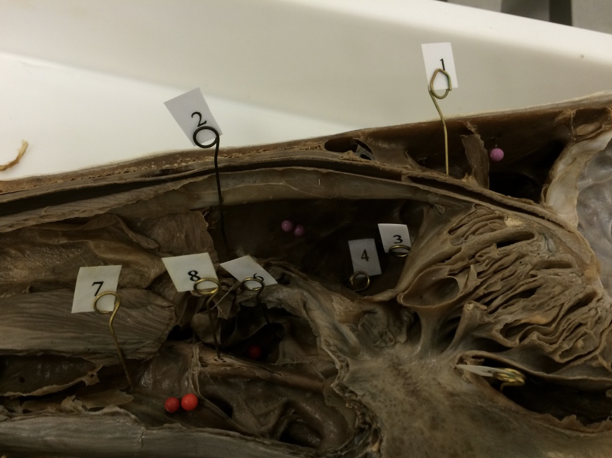
The sinuses have been impregnated with silver to highlight their extent and boundaries. Note the extent of the frontal and maxillary sinuses and their relationship to each other. The boney septum which divides the maxillary sinus into a rostral and caudal compartment is also highlighted. Identify 1-4.
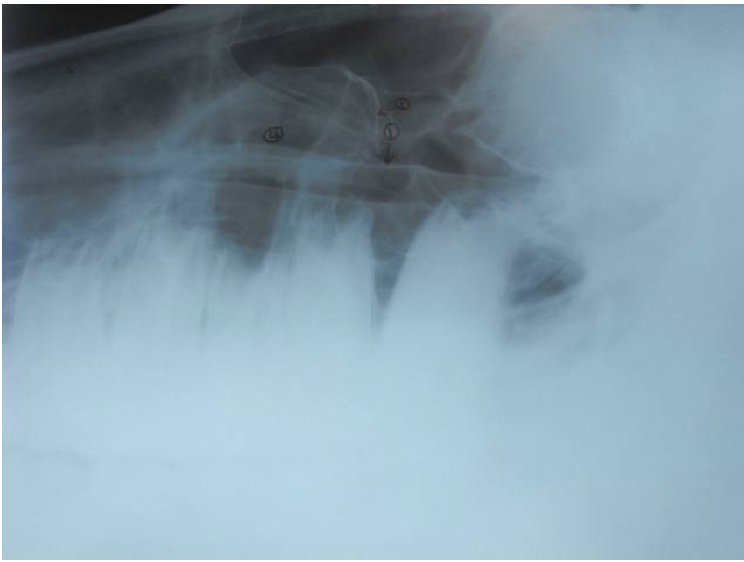
1 =infraorbital canal
2 = frontal sinus
3= septum separating caudal maxillary sinus from rostral compartment
4= rostral maxillary sinus
Which cheek teeth lie within the rostral maxillary sinus and which lie within the caudal maxillary sinus?
¾ and 5/6
The rostral and caudal maxillary sinuses increase in size with age as the reserve crowns of the cheek teeth move down as the teeth wear.
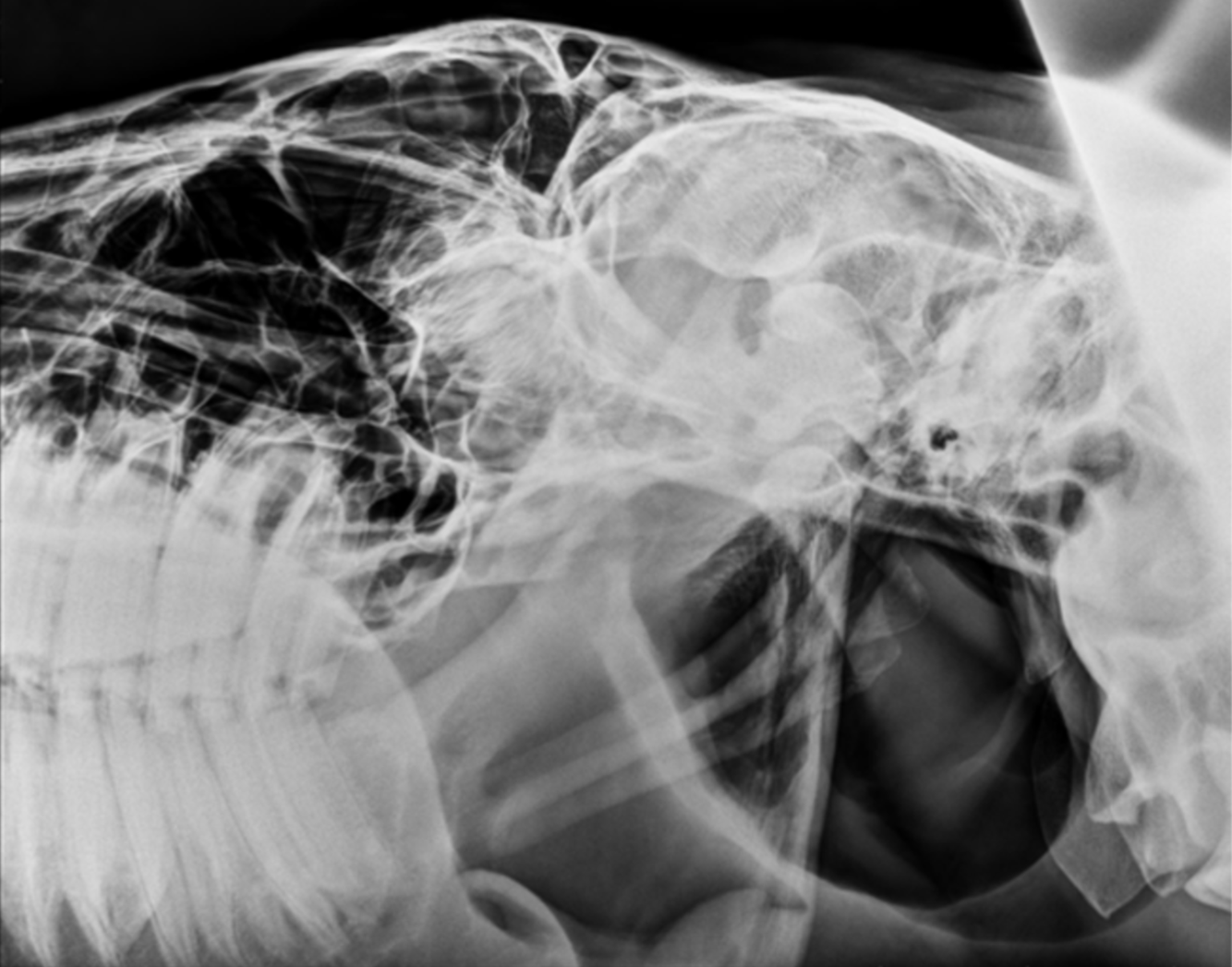
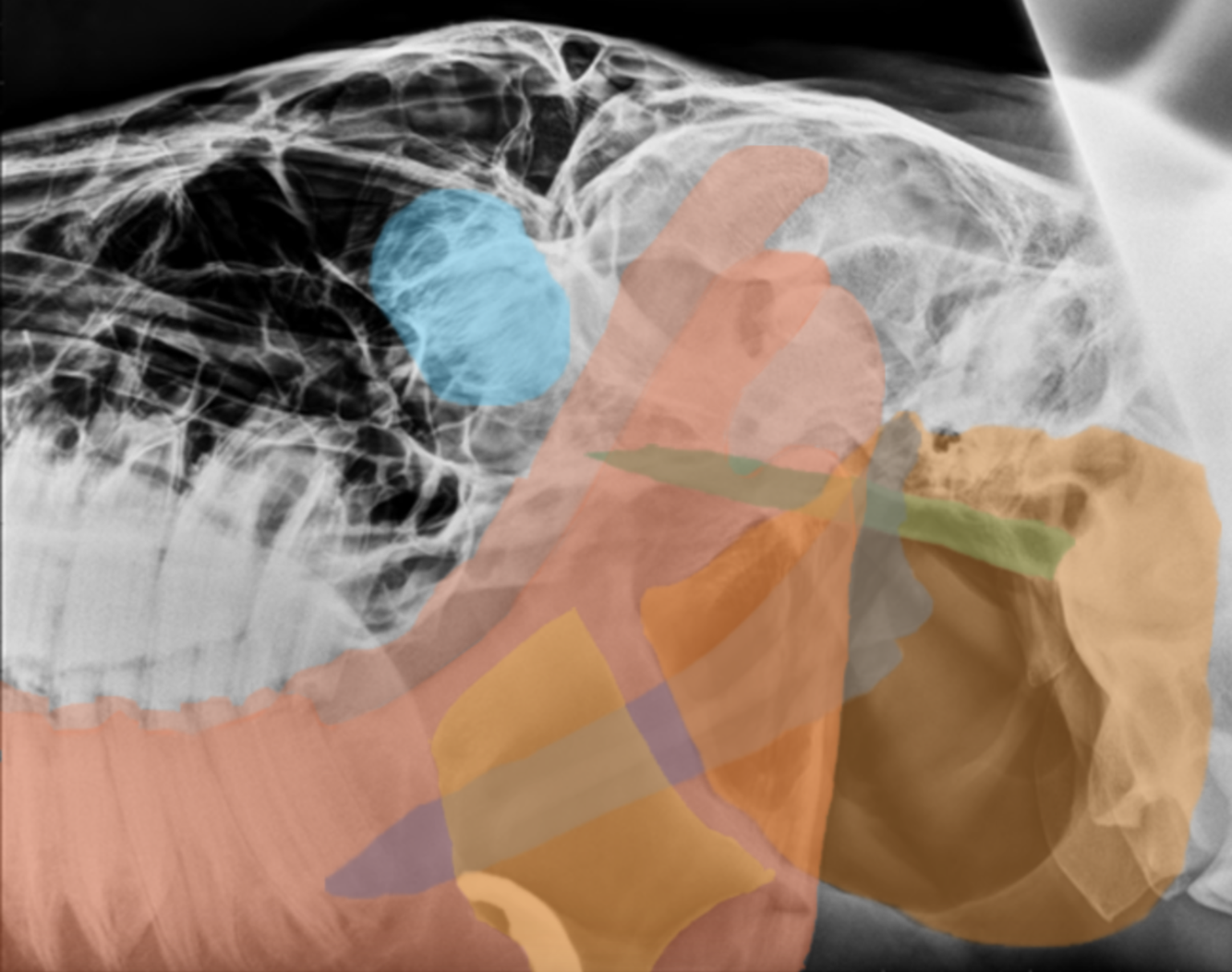
left lateral equine skull
orange: gutteral pouches (left and right)
yellow: pharynx
blue: ethmotrubinates
red: mandibles (left and right)
white: epiglottis
dark blue: styelohyoid bones (left and right)
green: basiphenoid
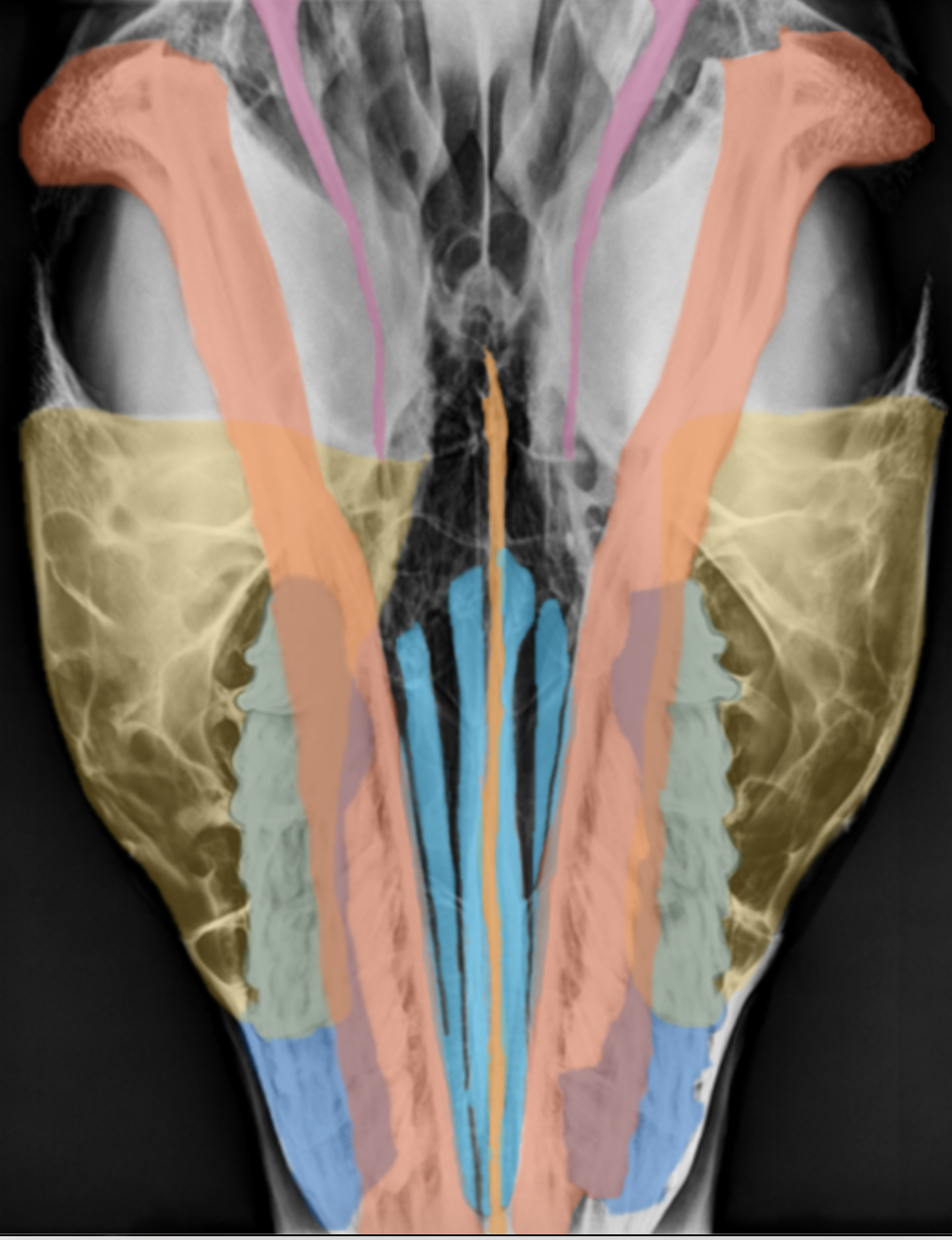
dorsoventral equine skull
https://vetmed.illinois.edu/imaging_anatomy/equine/skull/ex01/skull01-eq%20.html
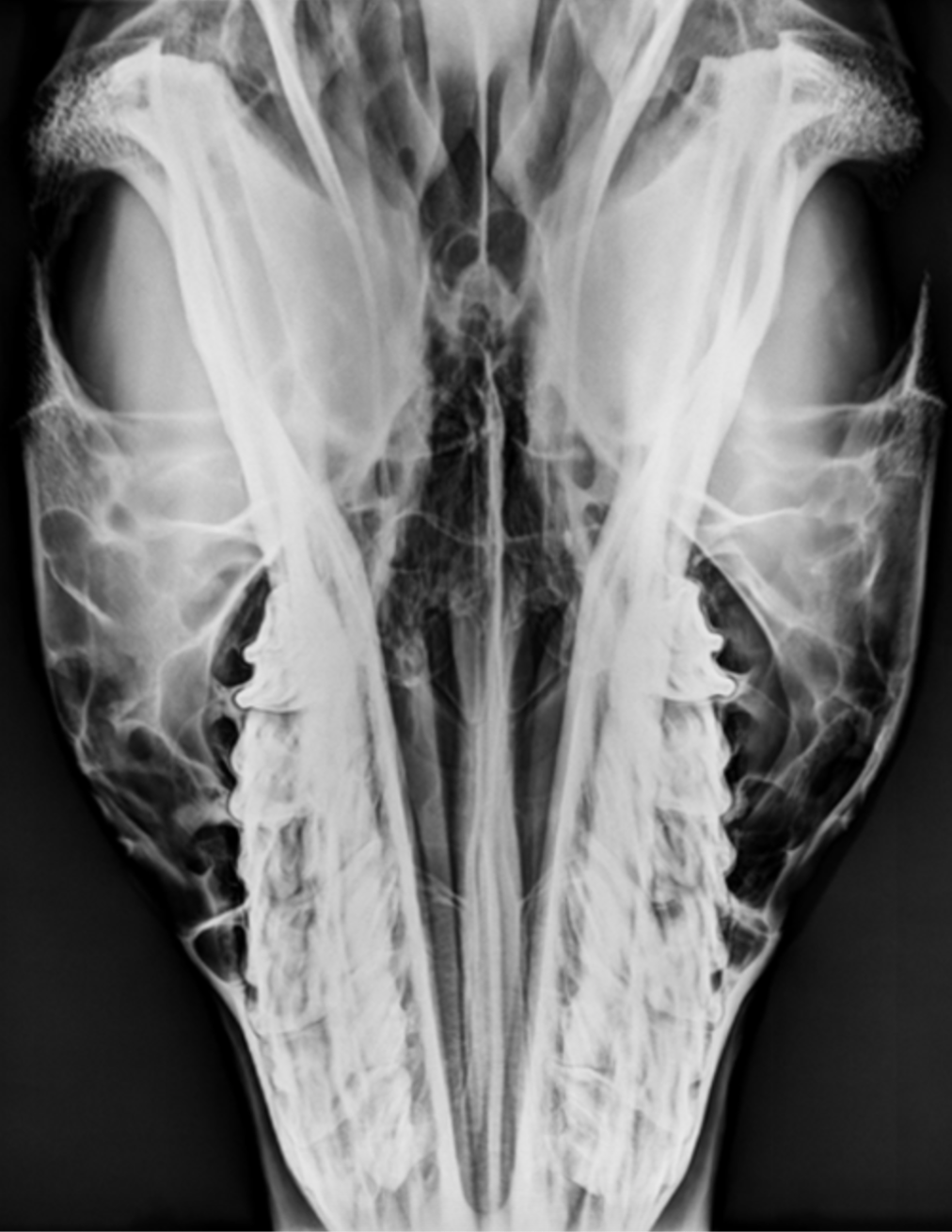
red: mandibles
blue: nasal turbinates (conchi)
orange: vomer
yellow: maxillary sinus
pink: styelohyoid bones
dark blue: maxillary teeth
left-right oblique view equine skull
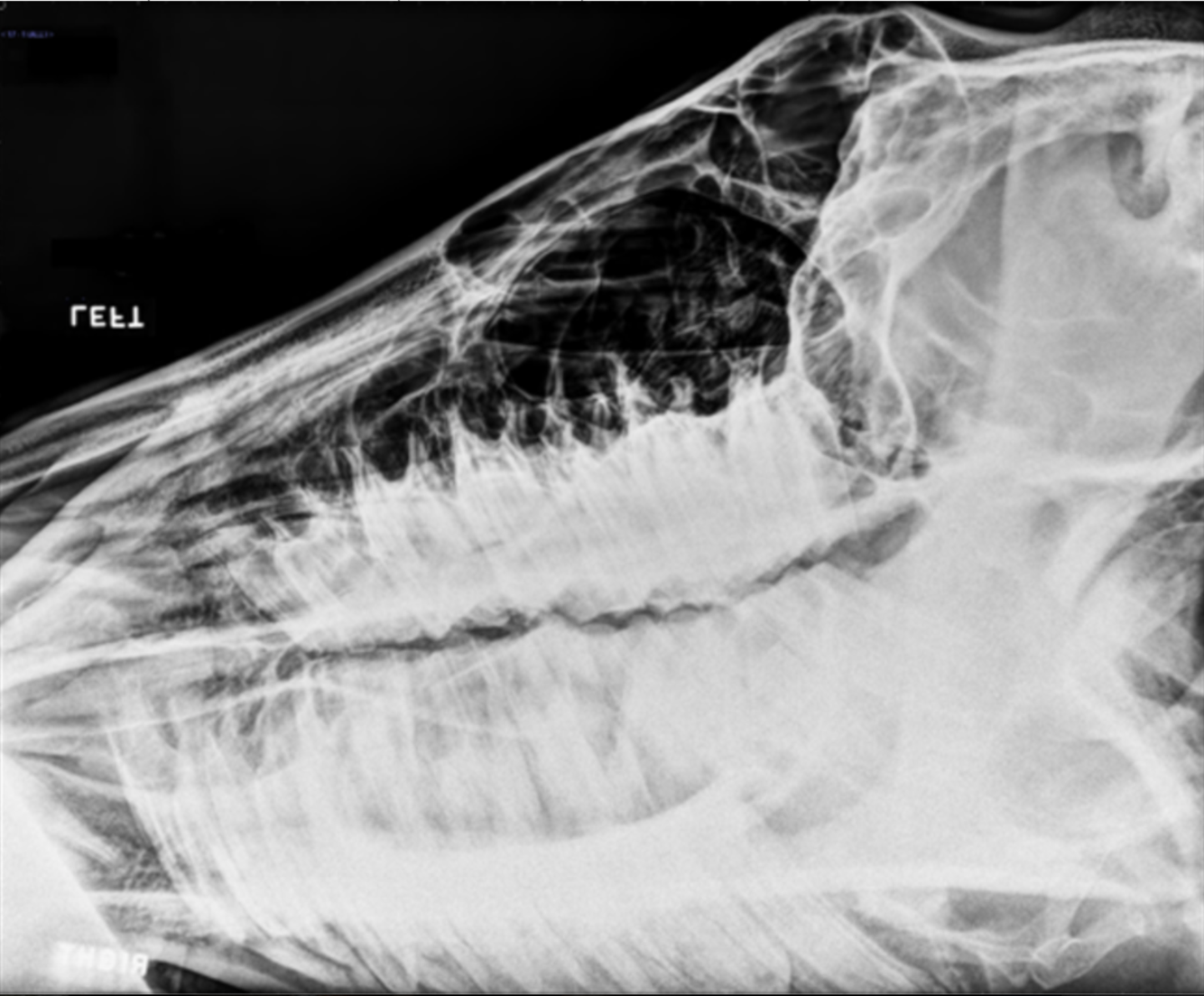
red: right mandible
orange: left zygomatic arch
grey: hyoid bones
yellow: left mandible and teeth
green: left frontal sinus
blue: left maxilla and teeth
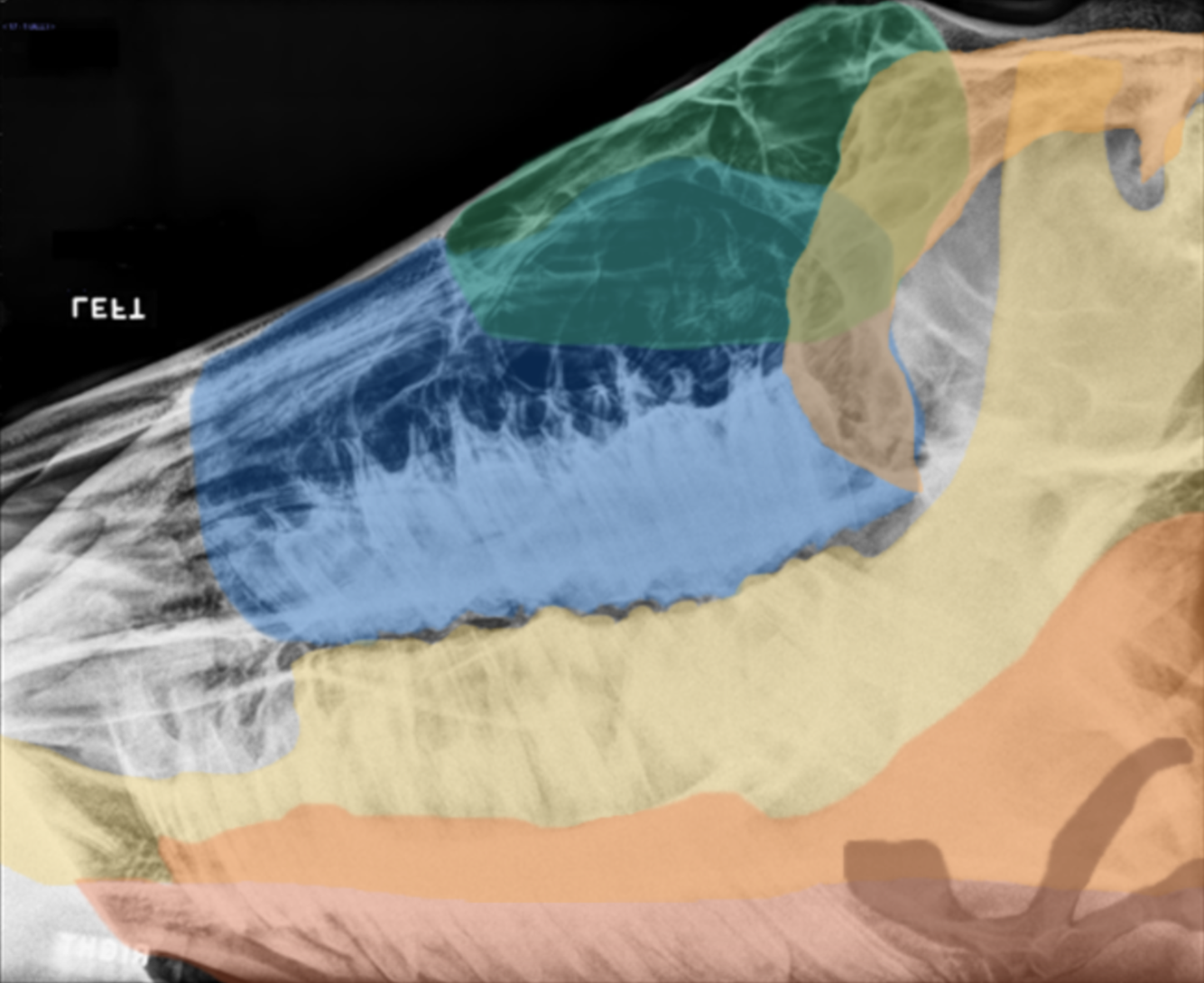
identify the paranasal sinuses
why doesn’t the nasal vestibule directly lead to the nasal cavity in this species
A blind pouch extends dorsal and caudally as far as the naso-incisive notch (false nostril). The entrance to the nasal cavity lies ventral and medial to this.
List two ways the horse can very the amount of oxygen entering the lower respiratory passageways during exercise.
By reducing blood supply to nasal mucosa and abducting the glottis
Identify the labelled structures using the specimens and keys provided
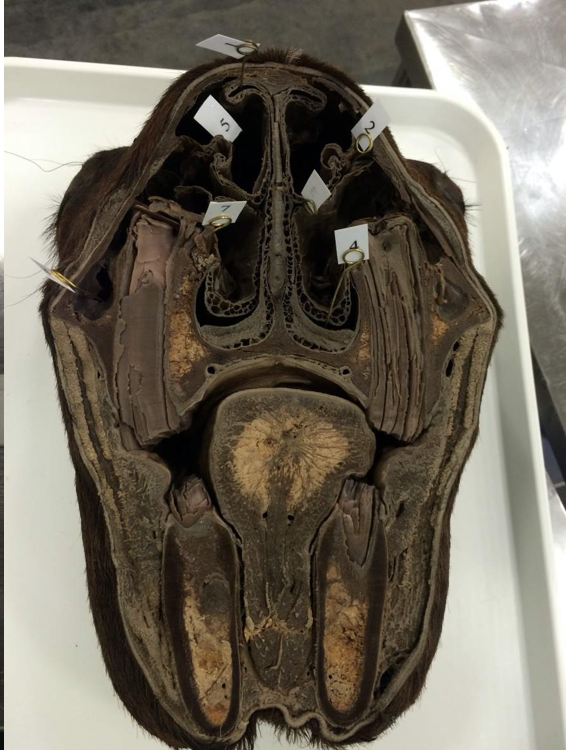
- dorsal meatus
- middle meatus
- common meatus
- ventral meatus
- frontal sinus
- rostral maxillary sinus
- infraorbital canal and nerve
The dorsal conchae form a sinus caudally in this species. This is in direct communication with the frontal sinus. How do these sinuses communicate with the nasal cavity?
Indirectly the frontomaxillary opening communicates with caudal maxillary sinus which communicates with the nasal cavity via the nasomaxillary opening.
what is the features of the ethmoidal conchae in the equine and where are they
small
confined to the caudal part of nasal cavity
The ventral conchae also form a sinus caudally. This communicates with the rostral maxillary sinus. Do the rostral and caudal maxillary sinuses communicate with each other?
No separated by a septum
How do the a) rostral and b) caudal maxillary sinuses communicate with the nasal cavity?
Both communicate with the nasal cavity via the nasomaxillary opening which straddles the septum.
Precisely where would you locate the nasomaxillary opening?
Middle meatus of the nasal cavity
The infraorbital canal carrying the infraorbital nerve travels through the maxillary sinus. What name is given to the foramen in the skull through which this nerve becomes superficial?
Infraorbital foramen
sagittal sections of horse head nasal septum intact
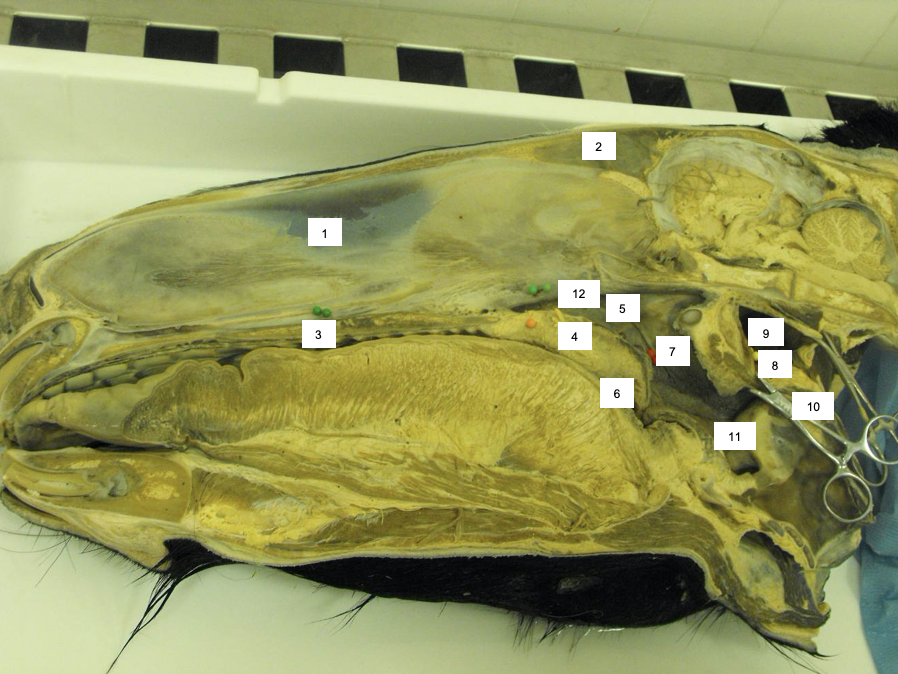
- Nasal septum
- Frontal sinus
- Hard palate
- Soft palate
- Nasopharynx
- Oropharynx
- Opening of auditory tube (large cartilage support)
- Guttural pouch- the midline septum has been reflected to reveal the medial and lateral compartments of the right pouch
- The stylohyoid bone cans be seen to divide the pouch into medial and alteral compartments.
- The oesophagus
- Larynx
- The vomer
Sagittal sections horse head nasal septum removed to reveal conchae in nasal cavity
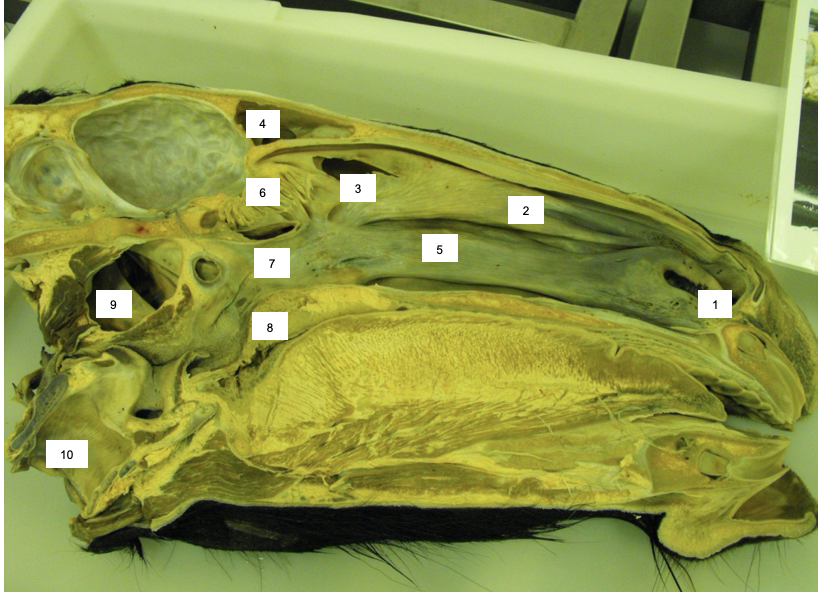
- Leading to nasal vestibule
- Dorsal concha (scrolled)
- Dorsal concha (sinus)
- Frontal sinus – continuous with 3
- Ventral concha
- Ethmoidal conchae
- Opening of auditory tube (large cartilage support)
- Long soft palate- surrounds aditus of larynx
- Stylohyoid bone in guttural pouch.
- Trachea
Sagittal section showing the extent of the Paranasal sinuses
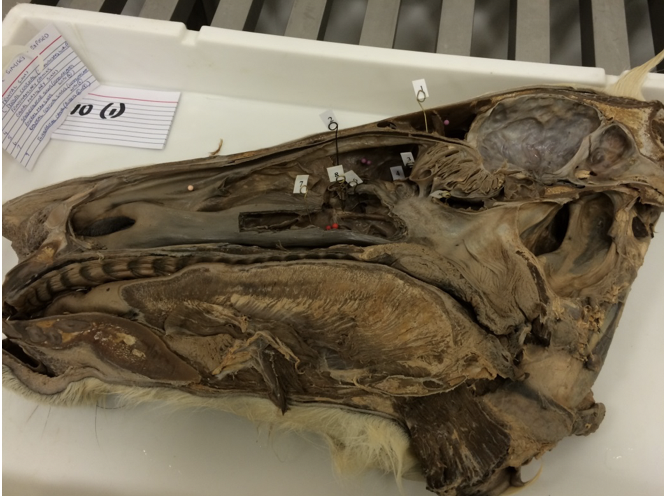
- Frontal sinus
- Dorsal conchal sinus (communicates with [1]
- Frontomaxillary opening
- Caudal maxillary sinus
- Sphenopalatine sinus (communicates with [4]
- Rostral maxillary sinus
- Ventral conchal sinus (communicates with [6]
- Infraoribital canal and nerve (travels through [6] &[7]
Sagittal section showing the extent of the Paranasal sinuses
- Frontal sinus
- Dorsal conchal sinus (communicates with [1]
- Frontomaxillary opening
- Caudal maxillary sinus
- Sphenopalatine sinus (communicates with [4]
- Rostral maxillary sinus
- Ventral conchal sinus (communicates with [6]
- Infraoribital canal and nerve (travels through [6] &[7]
Guttural pouch transverse section through donkey head (caudal section)
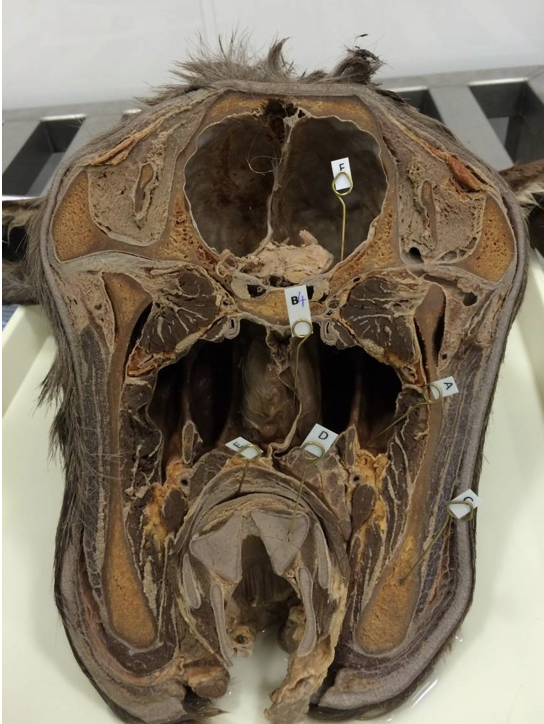
- Lateral compartment of guttural pouch
- Septum dividing each guttural pouch
- Rami of mandible
- Arytenoid cartilages
- Oesophagus
- Cranial cavity
name the structures
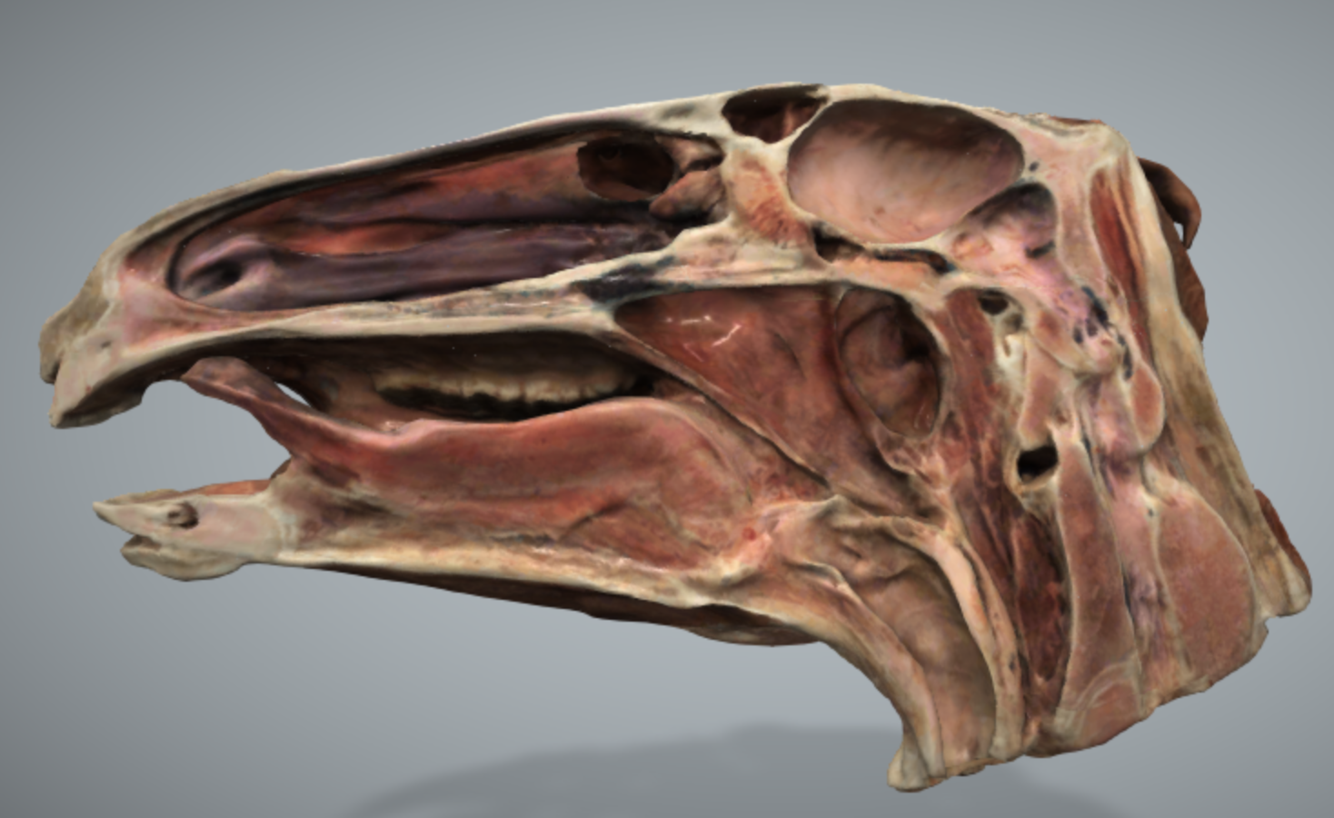
name the sinuses
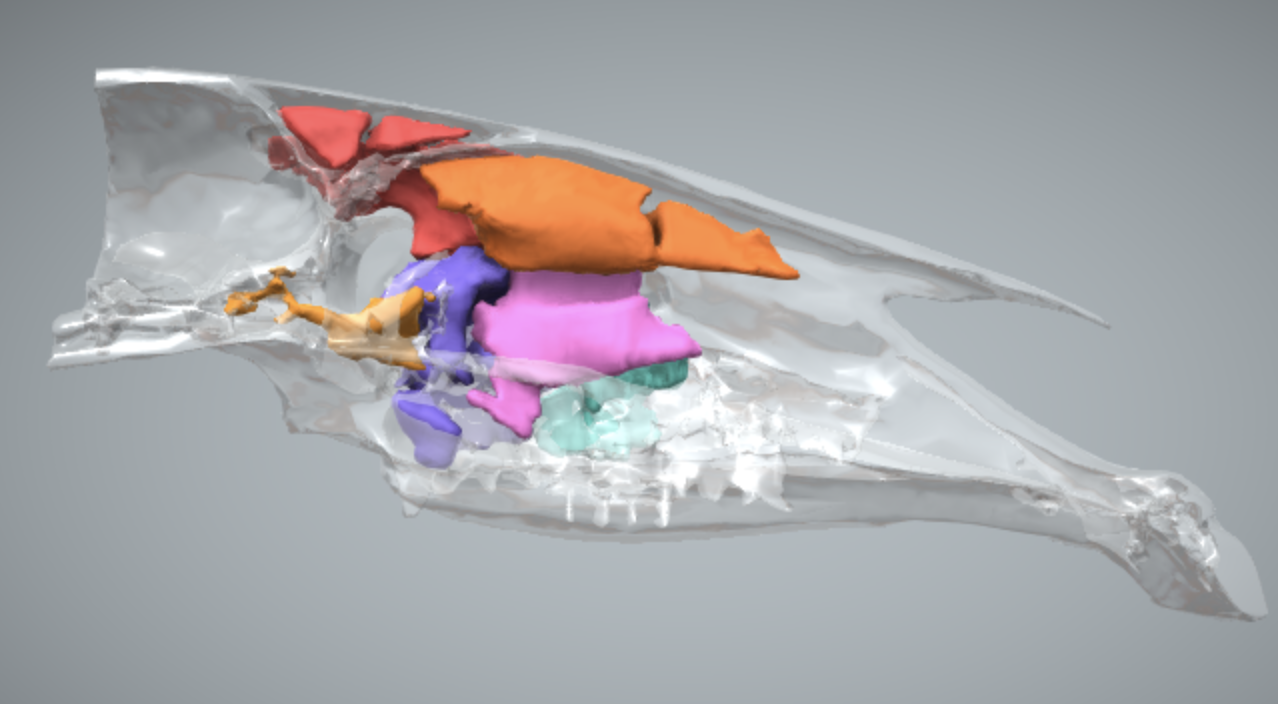
pink: ventral conchal sinus
yellow: sphenopalatine sinus
light blue: rostral maxillary sinus (left)
purple: caudal maxillary sinus
red: frontal sinus
orange: dorsal conchal sinus
name the sinuses
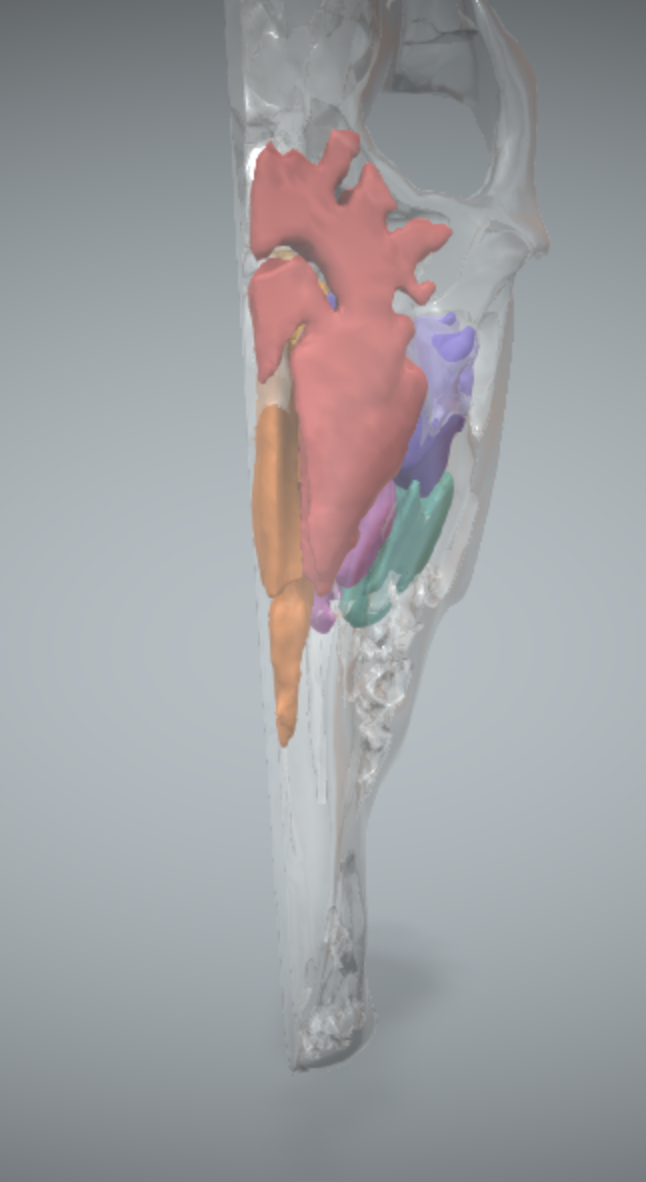
pink: ventral conchal sinus
yellow: sphenopalatine sinus
light blue: rostral maxillary sinus (left)
purple: caudal maxillary sinus
red: frontal sinus
orange: dorsal conchal sinus
name the sinuses
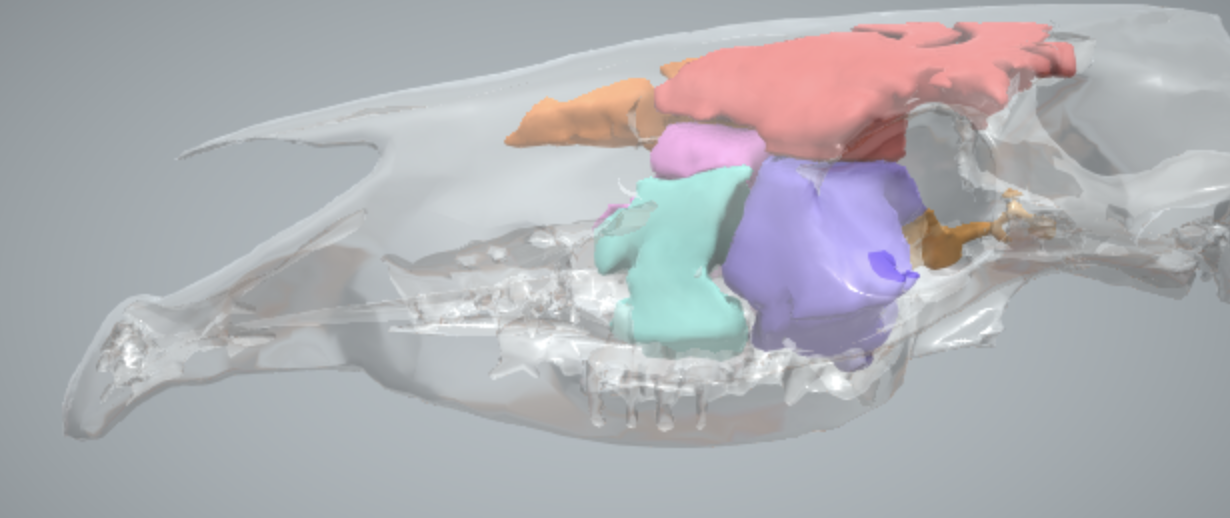
pink: ventral conchal sinus
yellow: sphenopalatine sinus
light blue: rostral maxillary sinus (left)
purple: caudal maxillary sinus
red: frontal sinus
orange: dorsal conchal sinus



-
Upper Resp. Passageways- Nose, Nasal Cavity and Nasopharynx59
-
Upper Resp. Passageways- Paranasal sinuses, Anatomy of Nasopharynx (Equine)51
-
Housing, Environment, Animal Health22
-
Upper Resp. Passageways- Comparative Anatomy + Structure + Functional Characteristics27
-
Larynx Structure & Function35
-
Larynx- Controlling Airways & Noise48
-
Comparative Housing8
-
Influenza Virus + Genetic Change30
-
Topographical Anatomy of Ventral Neck + Thoracic Cavity31
-
Respiratory Anatomy Practical65
-
PCR As Diagnostic Tool17
-
Emerging & Zoonotic Viral Disease1
-
Pleural Membranes, Reflections & Recesses & Mediastinum32
-
Calf Pneumonia59
-
Lungs- General Anatomy, Structure & Function39
-
Comparative Lung Features + Diaphragm41
-
Breathing & Airways62
-
Anaerobic & Aerobic Respiration35
-
Gas Exchange + Transport: O229
-
Gas Exchange + Transport: CO217
-
Thoracic Wall54
-
Intubation in Cat & Dog6
-
Larynx, Trachea, Lungs - Comparative Anatomy Practical88
-
Patterns of Disease in Lung: Inflammation51
-
Control of Ventilation35
-
Patterns of Disease in Lung: Neoplasia23
-
Respiratory Acid-Base Balance28
-
Lungworms in Large Animals46
-
Resp. Pharmacology and Lungs as Route Of Drug Delivery33
-
General Anaesthetics35
-
Antimicrobial use in Lung Infection 146
-
Antimicrobial use in Lung Infection 235
-
Upper Resp. Tract Noise In Companion Animals71
-
Corticosteroid & Respiratory Systems28
-
Upper Resp. Passageway Equine Practical47
-
Radiography & Ultrasound of Normal Thorax15
-
Thoracic Wall & Topographical Features Practical79
-
Respiratory Pathology38
-
Feline Resp. Case SDL16
-
Resp. Physiology SDL21
-
Resp. Histopathology16
-
Assessment of Resp. Function in Clinical Patients19
-
Anatomy & Histology5



