What are the types of analysis?
Types of Analysis
- Macroscopic Examination
- Chemical Analysis (Urine Dipstick)
- Microscopic Examination
- Culture (not covered in this lecture)
Components of macroscopic examination
Macroscopic Examination
- Odor/Smell
- Color
If odor is ammonia-like what does that potentially indicate?
Ammonia-like: (Urea-splitting bacteria)
If odor is foul, offensive what does that potentially indicate?
Foul, offensive: Old specimen, pus or inflammation
If odor is sweet what does that potentially indicate?
Sweet: Glucose
If odor is fruity what does that potentially indicate?
Fruity= Ketones
If odor is sulfur what does that potentially indicate?
Sulfer= Asparagus
If color is colorless what does potentially that indicate?
Colorless= Diluted urine
If color is deep yellow what does potentially that indicate?
Deep Yellow= Concentrated Urine
If color is yellow-green what does that potentially indicate?
Yellow-Green= Bilirubin / Biliverdin
If color is red what does that potentially indicate?
Red= Blood / Hemoglobin
What does a chemical analysis consist of?
Urine Dipstick
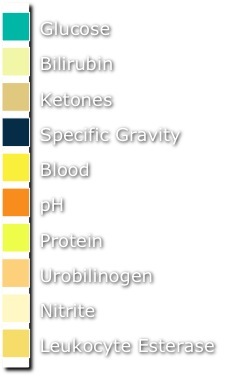
What is the range for normal specific gavity?
Normal range of specific gravity: 1.001-1.030
What is the cause of low specfic gravity (< 1.001)?
Diabetes insipidus (low SG)
What is the cause of high specific gravity (> 1.030)?
Dehydration (high SG)
What are some limitations of the urine dipstick?
Limitations of Urine Dipstick Specific Gravity
- Interference: alkaline urine
- Does not measure non-ionized solutes (e.g. glucose)
What is the normal pH for urine?
Normal pH 6
What causes urine to be acidic?
Acidic (less than 4.5):
- metabolic acidosis
- high-protein diet
What would cause urine to be basic?
Alkaline (greater than 8.0)
- renal tubular acidosis (>5.5)
What are the limitations of the urine dipstick for pH?
Limitations
- Interference: bacterial overgrowth (alkaline or acidic)
- “run over effect” effect of protein pad on pH indicator pad
- Buffers from the protein area of the strip (pH 3.0) spill over to the pH area of the strip and make the pH of the sample appear more acidic than it really is.
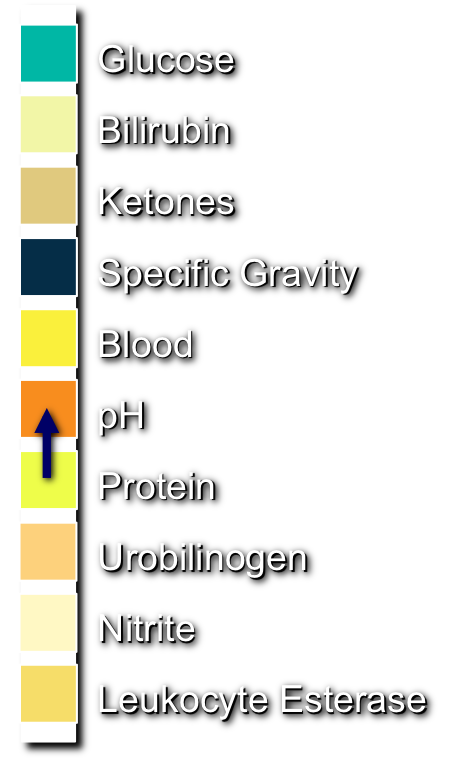
What are some pathological reasons for protein in the urine?
Pathological Reasons for Protein in Urine
- Glomerulonephritis
- Renal tumor
What are some causes of glucose in the urine?
Glucose
- Diabetes mellitus
- Renal glycosuria
What are some limitations of testing glucose on a urine dipstick?
Limitations
- Only measures glucose and not other sugars.
- Renal threshold must be passed in order for glucose to spill into the urine.
What are the non-pathological reasons why protein would be in urine?
Non-Pathological Reasons for Protein in Urine
- Severe muscular exertion
- Pregnancy







-
Respiratory System63
-
Biotechnology and Molecular Biology61
-
Bacterial and Viral Genetics55
-
Growth, Nutrition, and Ecology61
-
Respiratory System Physiology24
-
Microbial Metabolism49
-
Anatomy of the Digestive System118
-
Lecture Digestion1
-
Anatomy of the Male Reproductive System41
-
Anatomy of the Female Reproductive System26
-
Physiology of Reproduction: Gametogenesis and Female Cycles40
-
Urinalysis50
-
Survey of Embryonic Development47



