What are the diseases discussed that fall under the UTI category?
- urethritis
- cystitis: MOST common
- pyelonephritis
- vaginitis
- prostititis
- bacteruria
Which two diseases are pregnant women at an increased risk for?
- pyelonephritis
- bateruria
What are the major virulence factors that common UTI bacteria have?
ADHESINS: pili and fimbrae
- type 1 FimH (MS): binds to mannose; bladder + lower tract epithelial cells
- PAP-P fimbrae: binds to P blood group antigens
What are other virulence factors that UTI bacteria have?
- Biofilm formation: may become difficult to target with abx and cause reoccurence
- Motility
- Fe scavengers: sideorphores
- serum resistance
- hemolysins: cause pores in endothelium = easier to invade
- urease +: increase acidic environment (?)
Which route of infection is most common for UTI?
Ascending: urethra > bladder> ureter > kidney
Differentiate between a complicated and uncomplicated UTI
- uncomplicated: no underlying cause for symptoms
- dysuria
- increased freq & urgency
- pyuria
- bacteruria
2. complicated: UTI due to: catheter or anatomical abnormality
- pyuria + pathogen
- fever
- other symptoms above
Name the main risk factors for developping UTIs
- sexual intercourse + spermicide use {on condoms}: causes changes in the microflora and insertion increase bacterial presence
- nonsecretors of ABO antigens: since the Pap P fimbrae bind to ABO antigens, some people will secrete antigens into GU tract for elimination with a decreased risk of UTI; some people are non secretors and have increased risk
- vesicoureteral reflux: abnormality in the valve that connect the ureters to the bladder; this allows reflux from the bladder back up into ureters and kidney = increase chance for ascension of bateria
- obstruction: prostate or tumor/stones
Describe: vesicoureteral reflux
- patho: abnormality in the valve that connect the ureters to the bladder; this allows reflux from the bladder back up into ureters and kidney = increase chance for ascension of bateria
- epi: most common in children
- symptoms: recurrent UTI
- treat: surgery
What are the main bacteria that causes UTIs?
Uncomplicated:
- E. coli [most common]
- S. sapro (RARE)
Complicated: more variety
- E. coli
- proteus
- pseudomonas {urease +}
- providentia {urease +}
Describe the etiology of UTIs
Common; esp in women
25% recurrence rate in 6 months
Prevalence varies by age and gender
How does prevalence vary by age and gender?
neonates: M>F; gentic defects
children: M < F
adults: M < F; sexual intercourse
elderly: M=W; prostate hypertrophy & vaginal prolapse
**risk increases with age! 1% {neonates} and 30-40% {elderly}
If a patient has dysuria, which three infections should be on your differential?
- cystitis
- urethritis
- vaginitis
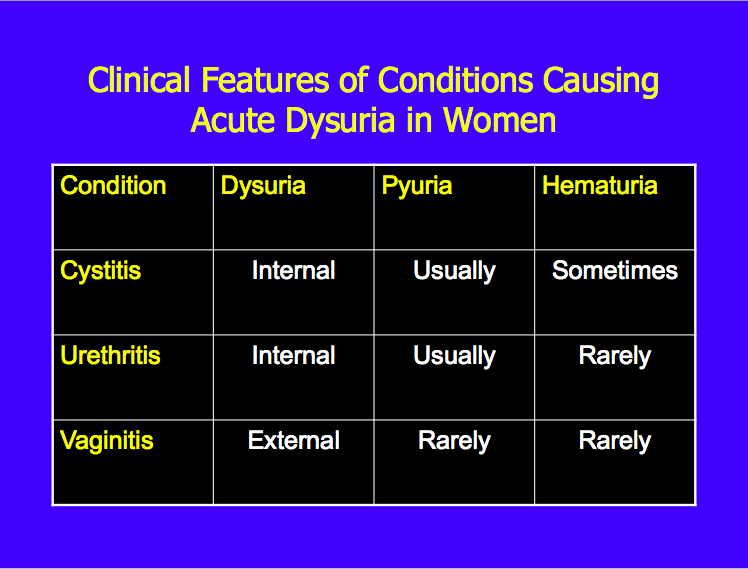
DEPCT: cystitis
- d: infection of the bladder
- e: sexually active women
- p: ascending bateria from GI tract into bladder
- c: common UTI symptons + suprapubic pain
- t: no urinalysis or culture needed for diagnosis; Bactrim (Trimethoprim + sulfamethoxazole) or nitrofuratoin; no FQ
DEPCT: pyelonephritis
d: histo—WBC casts
d: inflammation caused by ascending infection
e: pregnant women
c: flank pain, fever, costovertebral tenderness, bacteremia and septic shock {if bacteria into venous system from kidney}
t: FQ ( less risk of resistance to FQ than cystitis); ceftriaxone
DEPCT: prostatis
RARE!
d: positive urine culture**
d: inflammation of prostate
e: men; non bacterial form is most common
c: acute–same as UTI; chronic—asymp OR perineal pain
t:
What are three ways to analyze a urine sample?
- chemical analysis: dipstick
- leukocyte esterase: presence of pyruia
- nitrite: bacteria with nitrate reductase
- microscopic urinalysis:
- WBC casts: pyelonephritis
- urine culture: mcconkey agar
- ensure that sample is uniform and not contaminated
How would we treat a first time uncomplicated UTI?
cephalosporin: ceftriaxone or ciprofloxacin
How would we treat a recurrent complicated UTI?
- Give broad coverage: piperacillin, ticarcillin, tobramycin
- Once urine culture returns: narrow coverage
- use pt history to determine bacteria previously indicated in UTI and treat those
What are some things to keep in mind when treating an STI?
- urine concentrations must reach the MIC in order for organism to be targeted
- person with renal failure, may not be possible to get drugs into the urine
- you can use bacteriostatic or bactericidal abx




