What are the functions of the vertebral column?
- support
- weight bearing
- posture
- protection of spinal cord
- attachment site of muscles and ligaments
How many vertebrae are there in each section?
- 33 in total
- cervical: 7
- thoracic: 12
- lumbar: 5
- sacral: 5 fused
- coccyx: 5 fused
What are the curvatures in each section?
- cervical: concave posteriorly, high mobility
- thoracic: convex posteriorly, low mobility
- lumbar: concave posteriorly, high mobility
- coccyx: convex posteriorly, low mobility
Why are some spinal sections more mobile than others?
Thoracic must have little movement as it protects vital organs. Cervical has high mobility to allow head and neck to move.
Define lordosis and kyphosis
- lordosis: inward curving
- kyphosis: outward curving
Label the diagram below.
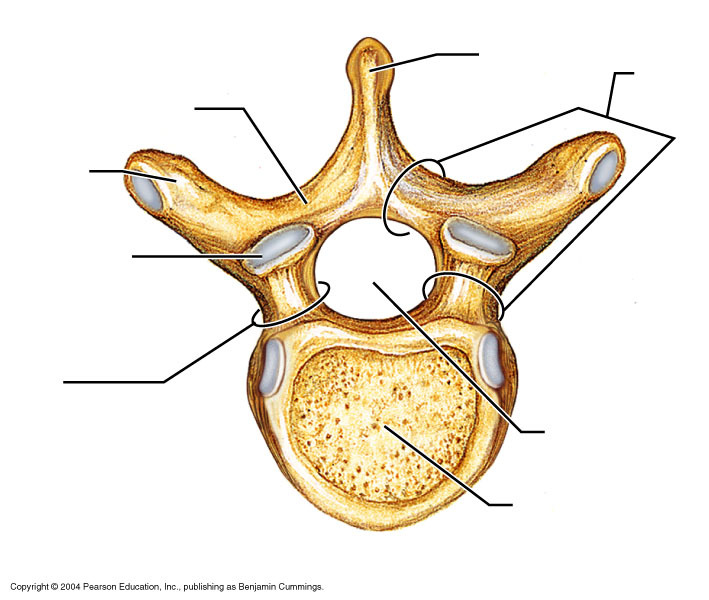
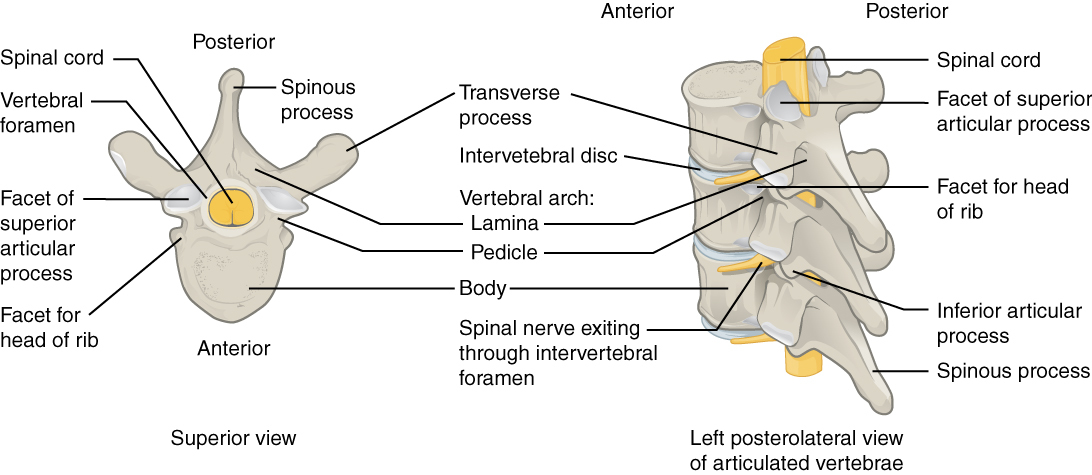
What is the function and location of spinous and transverse processes?
Location: posterior (SP) and to the side (TP)
Function: attachment for muscles and ligaments
Which vertebrae have transverse processes with facets for articulation, what do they articulate with?
Thoracic vertebrae
Articulate with rib bones
What is the function of the body of the vertebrae? How does it change throughout the spinal regions?
Protects the vertebral arch
As more weight is put on it (i.e. distal spinal regions) the body gets larger and thicker to accommodate for this
What is the lamina of the vertebrae and what is its function?
positioned poterolaterally, forming an arch with the pedicle. Protects the spinal cord
What is the vertebral canal formed from and what is its function?
Intervertebral foramen make up the vertebral canal to allow passage of spinal nerves and the spinal cord. Formed by superior and inferior vertebral notches
What is the typical vertebrae of each spinal region?
C3. C4, T6, L3 & L2
What determines the ROM in the vertebral column?
-Angular spinous processes
Thoracic has angular SPs as it must limit movement in order to protect organs, the luumbar region has straight SPs and thus allows lots of movement
What are some characteristics of the cervical vertebrae?
- Bifid spinal process for more muscle attachment with more specificity
- SPs are short and horizontally directed
- thinner body due to less weight demand
- vertebral arh as it contains all descending and ascending nerve tracts
- TPs have holes as it has arteries passing through that supply the brain
Describe the atlas and axis vertebrae
atlas and axis are the first two vertebrae that form a pivot joint. Atlas pivots around dens of atlas allowing us to turn our heads.
What are some characteristics of thoracic vertebrae?
- vertebral canal is smaller as it has less nerves (upper limb tracts already exited)
- body is heart shaped and larger
- facets of TPs for rib articulation
- SPs are oblique and sit flat on top of one another to limit movement
- SPs are long for muscle attachment
What are some characteristics of the lumbar vertebrae?
- large vertbral foramen due to large amount of innervation to lower limb (lumbar enlargement)
- kidney shaped body
- larger body (weight bearing)
- longer TPs for muscle attachment
- SPs horizontally directed, wider and thicker for movement and muscle attachment
What are some characteristics of sacral vertebrae?
- vertebrae are fused together as well as the TPs and SPs to accommodate for weight bearing
- links with hips to form the pelvis
- sacral foramina for spinal nerve passage
Where are the intervertebral joints located?
between vertebrae
Describe intervertebral discs.
Cartilaginous and soft for motion (symphysis, firbocartilaginous).
Annulus fibrosis is the outer most layer which has a more fibrous material to give structural integrity and anchors the to bodies together.
Nucleus pulposis is a gelatinous hydrophilic substance for shock absorption
Where does the thickness in the intervertebral discs differ?
where a lot of movement is required the discs are thicker i.e. cervical and lumbar regions
What are the ligaments supporting the vertebral column? What are their functions?
- anterior longitudinal ligament: runs along front of the vertebral column to limit extension and keeps the intervertebral disc in the joint
- posterior longitudinal ligament: runs inside the vertebral column to limit posterior movement of the discs
What are the movements of the vertebral column? What planes do they occur in?
Flexion and extension (sagittal plane)
lateral flexion (coronal plane)
rotation (transverse plane)
To cause
1) extension
2) flexion
3) lateral flexion
4) rotation
Where would muscles lie on the vertebral column?
1) posterior
2) anterior
3) medial/laterally
4) oblique/horizontally directed muscles




